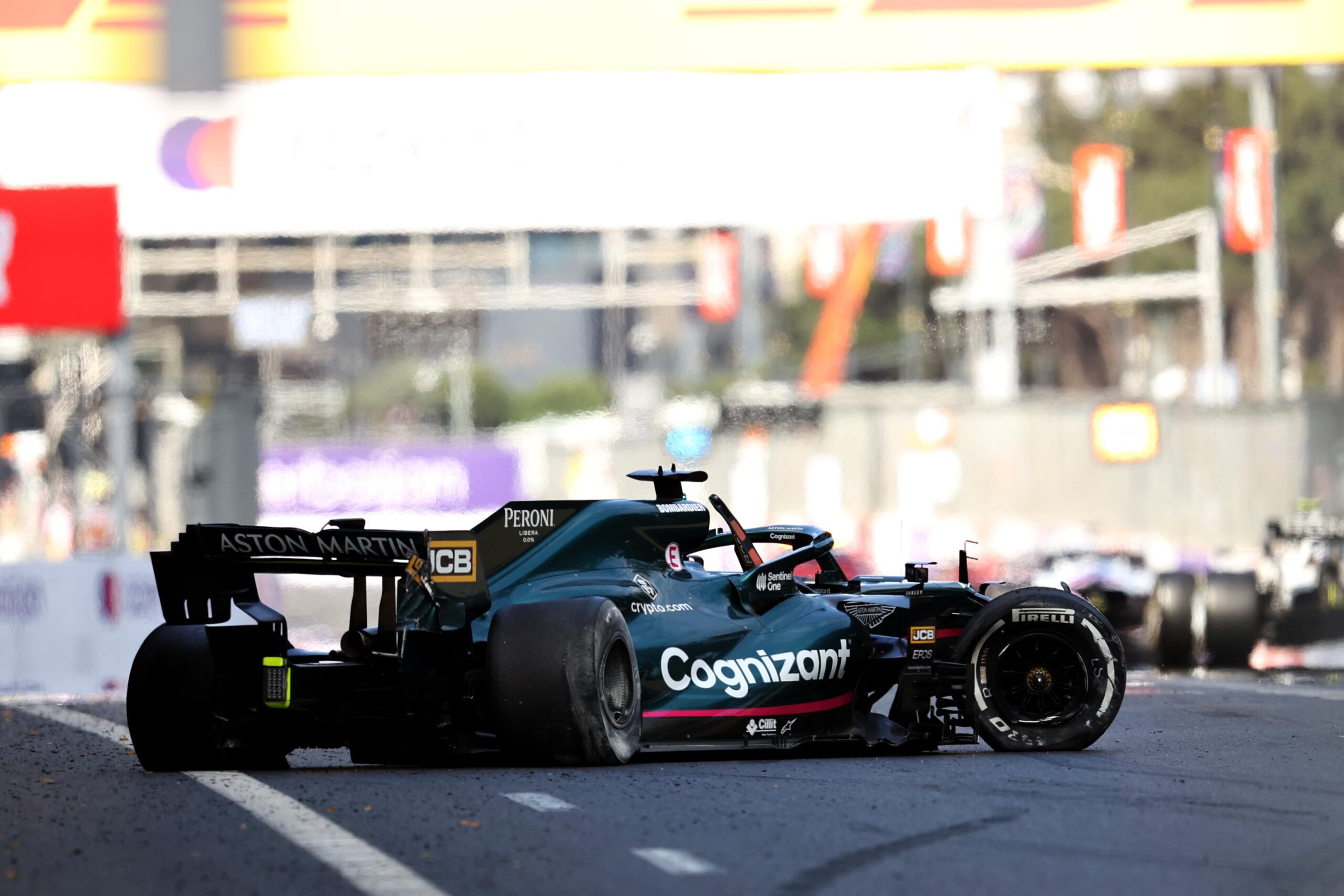
2021 Russian GP report | Hamilton claims 100th win after Norris heartbreak

Hamilton 1st, Verstappen 2nd…sounds like a pretty regular race then, no?
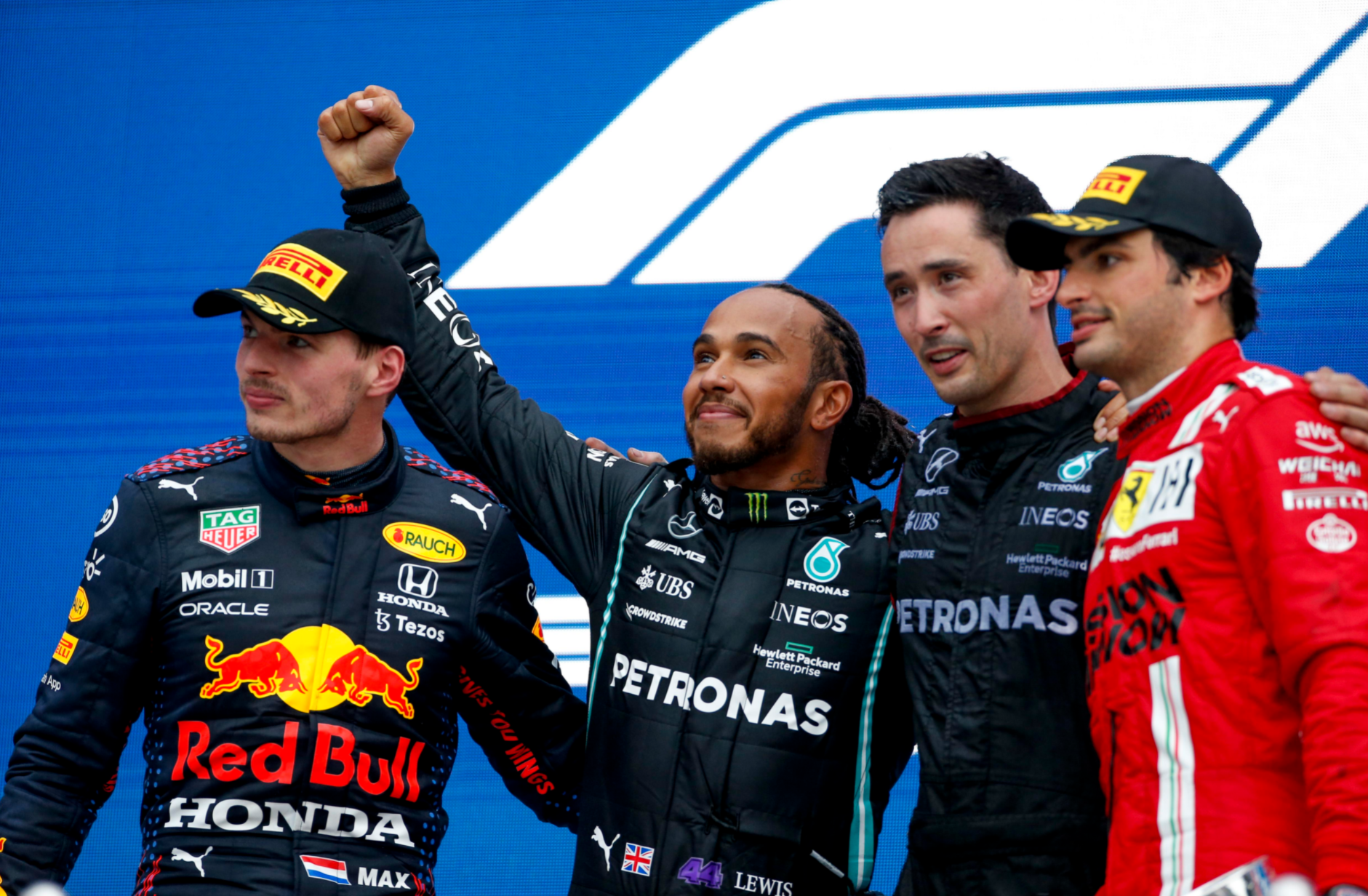
The podium at the Russian Grand Prix.
Image credit: Daimler AG

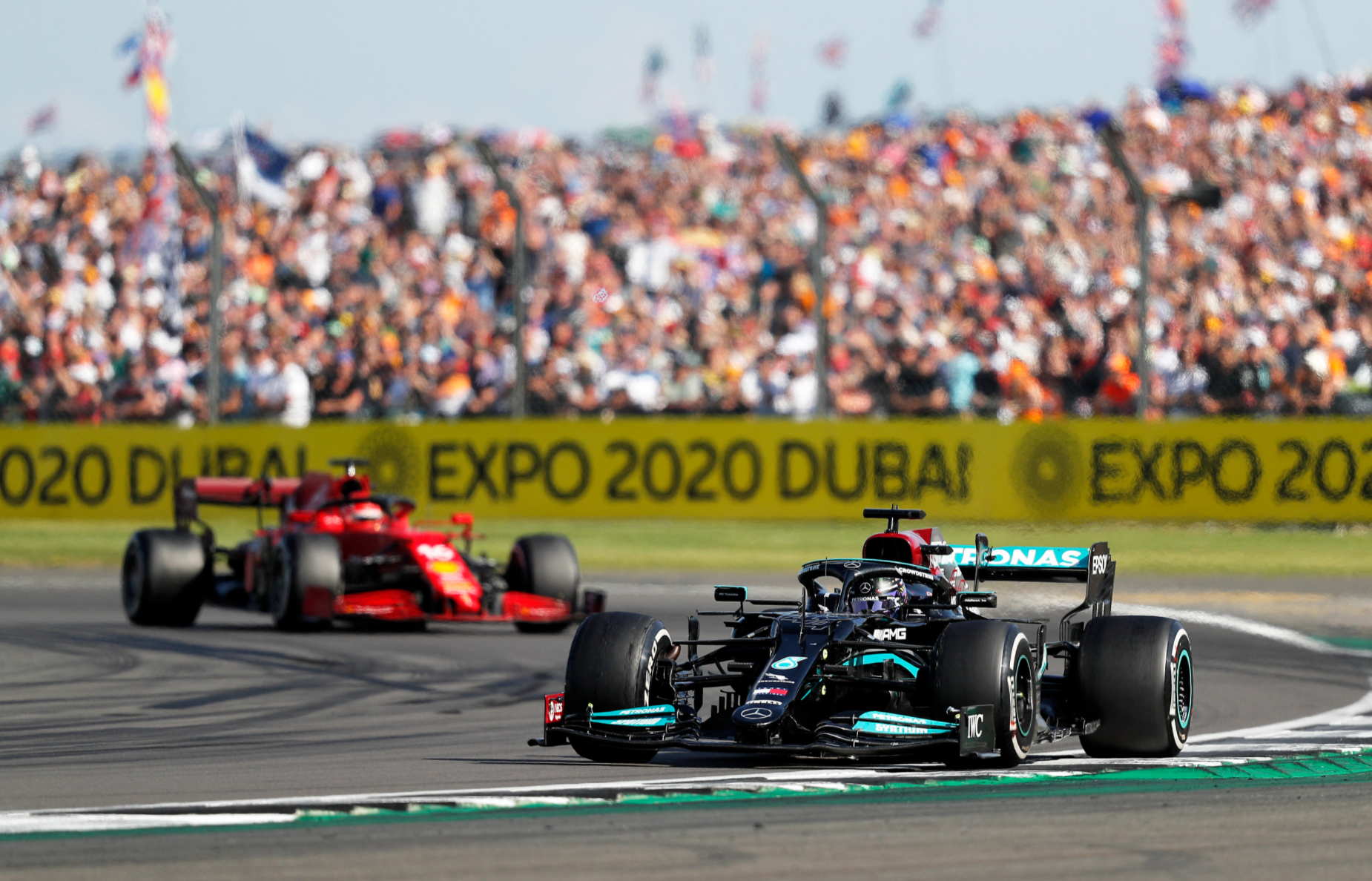
Lewis Hamilton finally completed his extraordinary century of Formula 1 victories, after taking the lead with three laps remaining of a thrilling Russian Grand Prix.

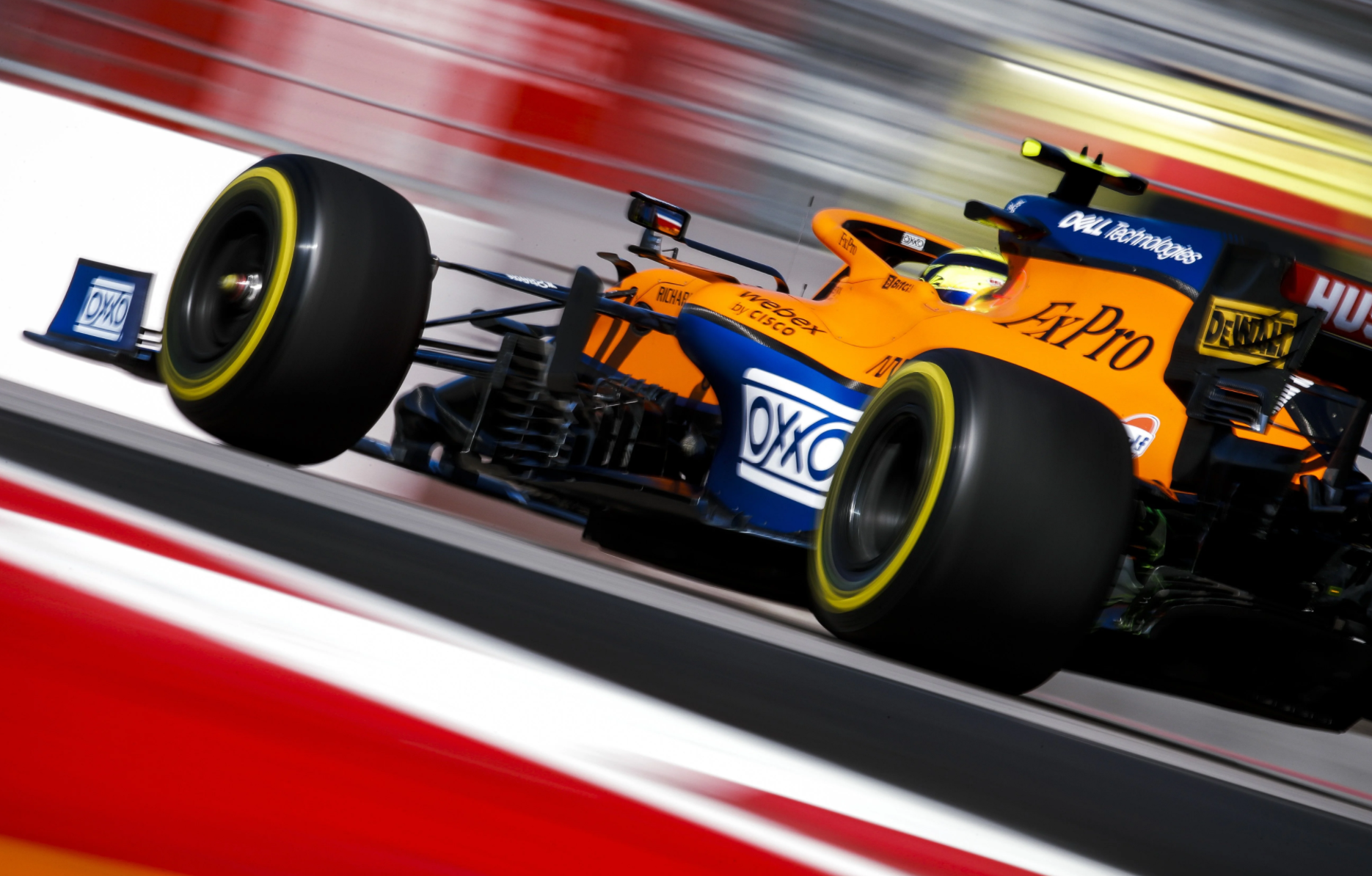
Most of the race was led by Lando Norris. The 21-year-old McLaren driver took an impressive maiden pole position on Saturday in changeable conditions but lost the lead to his good friend Carlos Sainz on the long run to the first real corner of Turn 2.

Norris stalked the Ferrari for 12 laps before reclaiming the lead and then showed maturity far beyond his years, showing no signs of stress as he led a grand prix for the first time.

Meanwhile, in the title battle, Hamilton – who had qualified fourth – had been boxed in at the start and found himself in sixth, behind the leading pair, future teammate George Russell, Lance Stroll and Daniel Ricciardo.
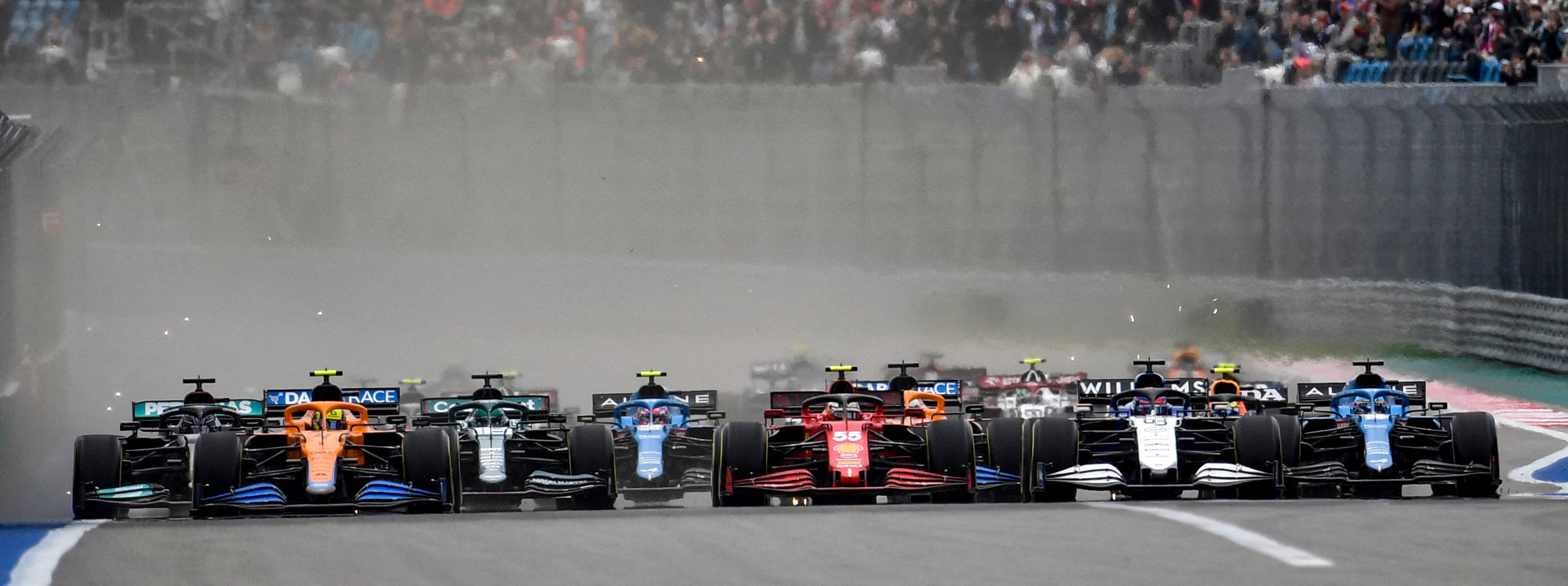
The pack head six-wide into the first corner.
Image credit: Getty Images

The group formed a DRS train and would remain in the same order for the first stint of the race.

Hamilton’s title rival Max Verstappen had started from the back after taking an engine penalty – a decision that was already on the cards but was cemented by the Dutchman’s three-place grid penalty for his clash with Hamilton at the previous race.

The Red Bull scythed through the field in the opening laps – disappointingly for Mercedes, even making short work of Valtteri Bottas – and found himself just three positions and two seconds behind his rival approaching the halfway point.

Of the drivers at the front, Sainz, Russell and Stroll pitted early on, with the rest extending and the title rivals pitting together on lap 26.

Having been released, Hamilton had finally been able to demonstrate his pace and succeeded in jumping all the former passengers of the DRS train except Stroll, who he swiftly dispatched two laps later.

It was not long until he had also caught and passed Sainz, leaving an eight-second gap to Norris with a little over 20 laps remaining.
Lando Norris at the Russian Grand Prix.
Image credit: Motorsport Images

Things were not going so well for Verstappen, who – having started on the hard tyre and then pitted unusually early – was struggling on the mediums and had fallen behind Fernando Alonso into seventh place.

The gap at the front reduced rapidly, but once the Mercedes had moved within two seconds of the McLaren, it once again demonstrated its distaste for dirty air. That, twinned with the papaya car’s prodigious top speed, meant that Hamilton was unable to get close enough to make a move with the laps counting down.

But then the rain began to fall.

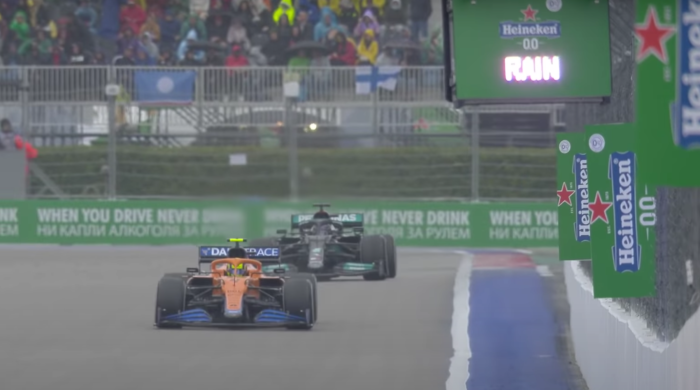
By lap 47 of 53, the parts of the track closest to the Black Sea were significantly wet. Norris had a moment of oversteer and ran wide, but a cautious Hamilton – with one eye on the championship battle – remained narrowly behind.

It was now all about whether to risk the change to intermediate tyres, with parts of the track becoming increasingly treacherous but other areas still dry.
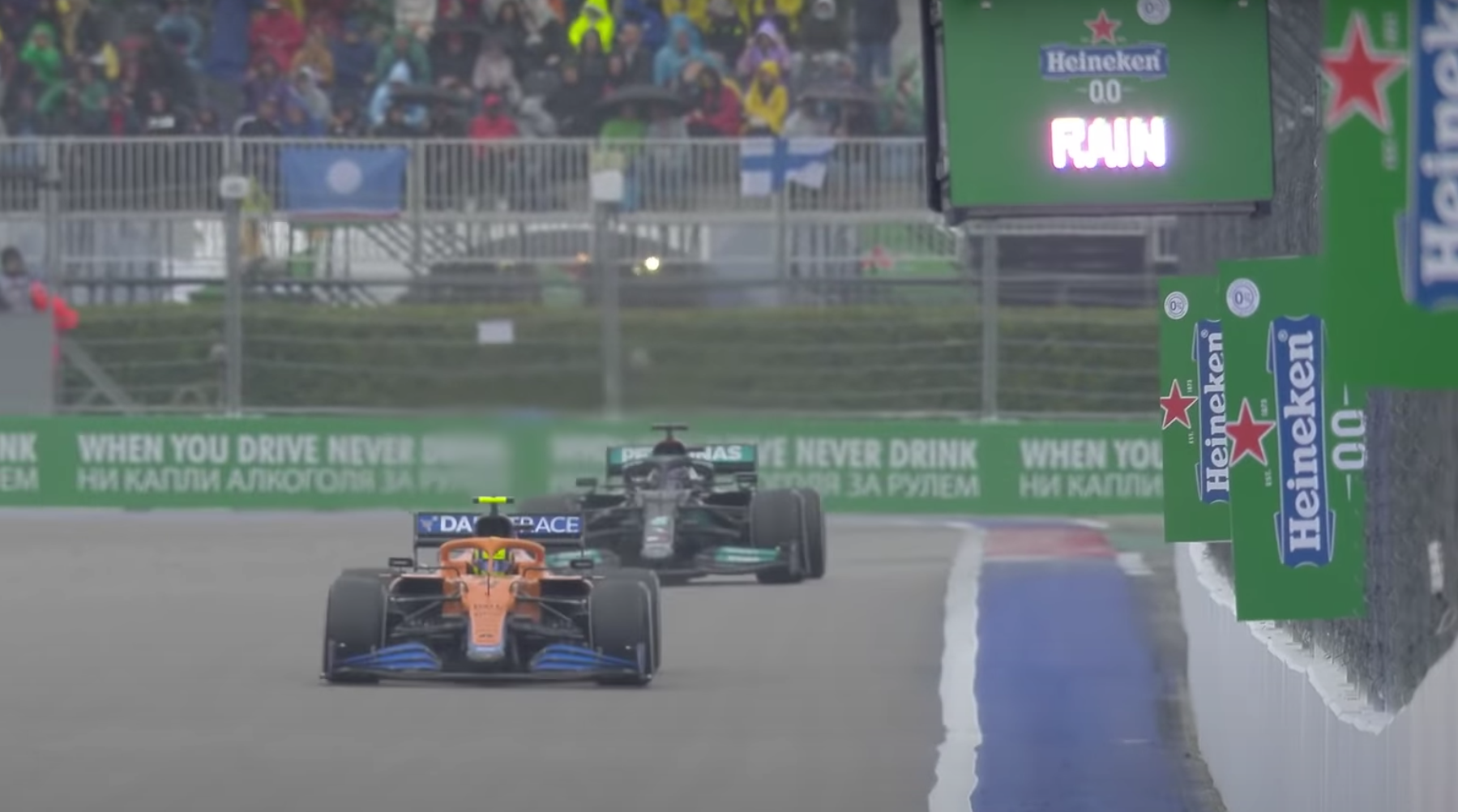
Lewis Hamilton closes on Lando Norris as the rain begins to fall at the Russian Grand Prix.

Norris was not interested in giving up the lead and stayed out. Hamilton ignored his team’s first call to come in, but a second call saying that the rain was going to increase convinced him to come in with four laps remaining.

The rain did increase. Norris committed to his decision but the downpour became torrential and as the McLaren slithered off the road two laps later, Hamilton sailed past and he accepted that he had to pit.

The running order turned on its head as those who had stayed out lost not seconds but minutes to the drivers on intermediate tyres.

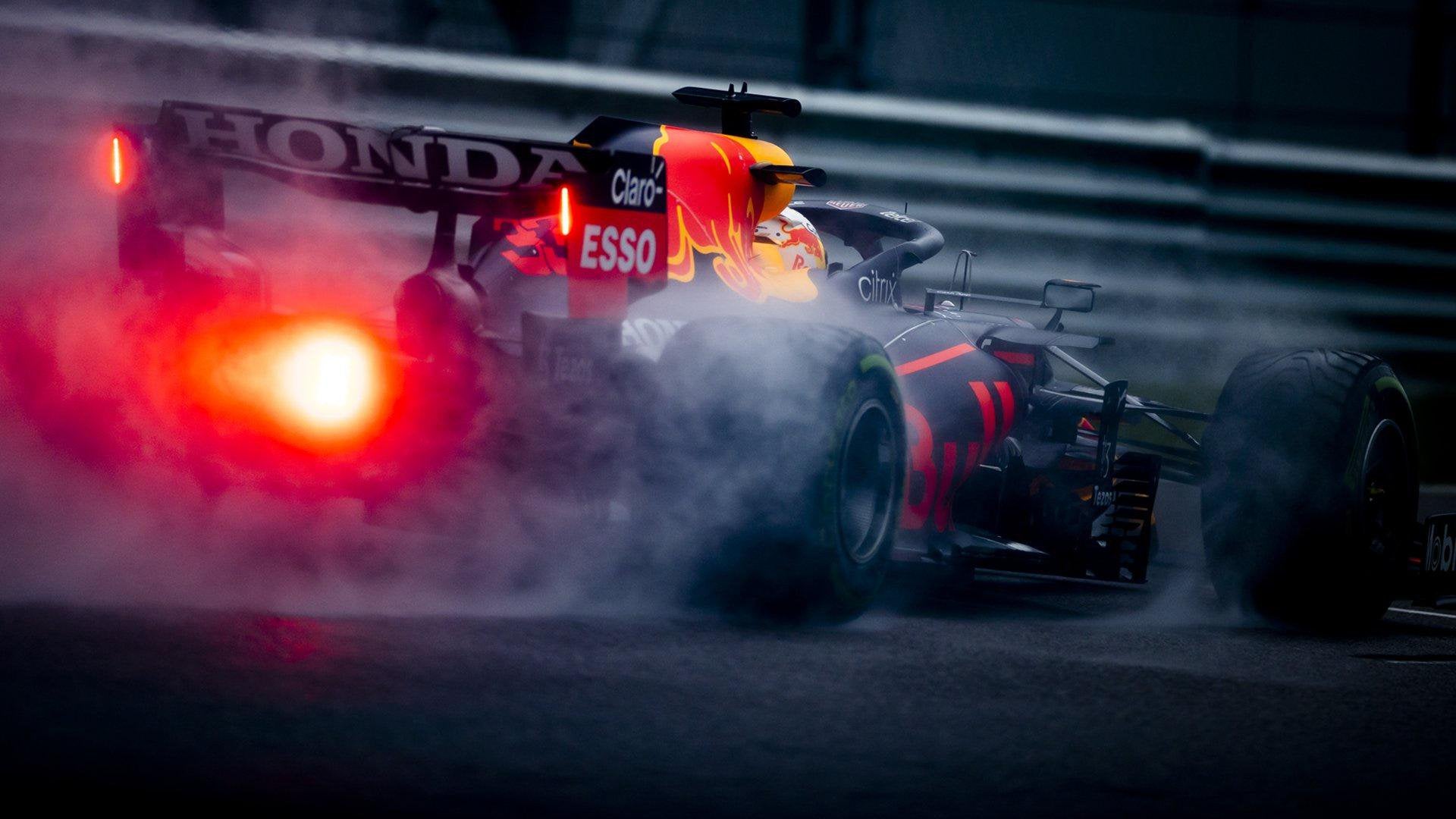
Verstappen – who had pitted early – jumped from seventh to second, Bottas from 14th to fifth and Kimi Räikkönen from 13th to eighth, whilst Sergio Pérez fell from fourth to ninth and Charles Leclerc from eighth to 15th.
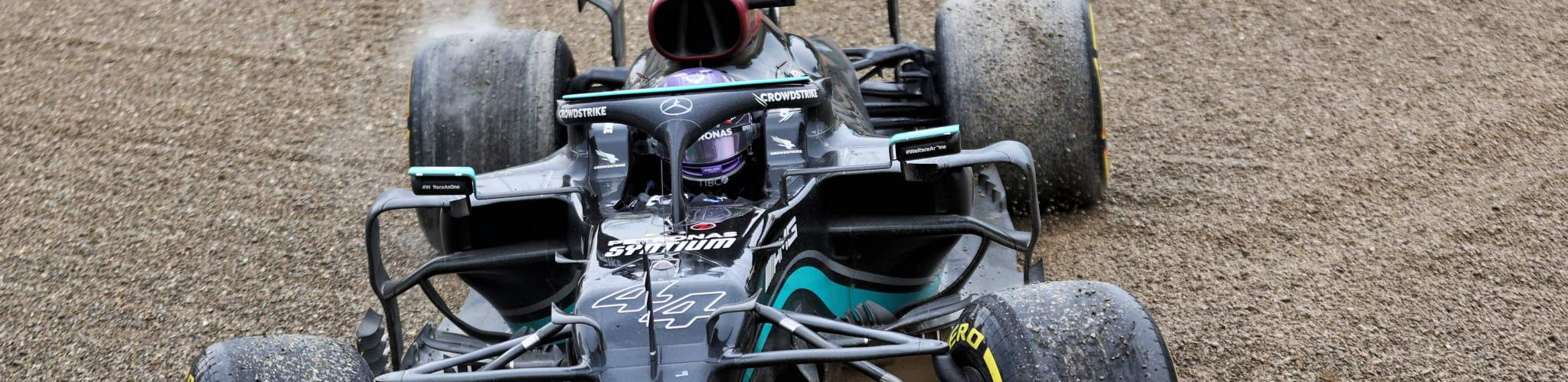
Sainz hung onto third, to claim his fifth podium, with Ricciardo three seconds down the road in fourth. Norris was, at least, able to recover to seventh and a bonus point for the fastest lap, but was understandably heartbroken, having come so close to what would have been a thoroughly deserved maiden victory.

The young Briton demonstrated his immense talent, however – as he has for much of this season – and can be sure that his time will come.

Hamilton may be at the other end of his career now, but showed he is far from past it as he became the first ever Formula 1 centurion. A mind-boggling achievement.

The next big milestone would be the record-breaking eighth world title, but he will have to work even harder for that after Verstappen’s surprise second place.

The Impact on the Championship
Max Verstappen in the wet at the Russian Grand Prix.
Image credit: Red Bull Racing Honda

Whilst the day belonged to Hamilton and his momentous achievement, Red Bull perhaps leave Russia the happier of the two title-contending teams.

Team Principal Christian Horner had said they would be content if Verstappen could work his way up to fifth from the back of the grid and keep the points swing to Hamilton to around 15.

So, leaving Sochi with just seven fewer points than the new championship leader is a huge win for the Austrian team.

Their main man should now be fine for power units through to the end of the season, whilst the expectation is that Hamilton will have to take a penalty for a fourth engine at some point between now and Abu Dhabi.
After two races where Red Bull expected to see a Mercedes 1-2 and Hamilton build a considerable lead in the standings, Verstappen sits just two points behind.

As for the remainder of the season, it very much depends on how many of the scheduled races take place as planned. Mexico and Brazil have historically been Red Bull circuits, but the jury remains out on whether the F1 circus will be able to travel to either considering the current Covid restrictions.

There are some unknowns – such as the new track in Saudi Arabia and a race likely to take place in Qatar – and the remaining tracks are too close to call.

Basically, the situation remains as it has been for most of the year: this title could go either way.

The Russian Grand Prix in 60 Seconds

Answering the Burning Questions

Will Verstappen take an engine penalty and start from the back? Yep.

With rain due on Saturday, when will qualifying actually take place and will it spring any surprises? Despite torrential rain on Saturday morning, it went ahead at the scheduled time and sprung plenty of surprises.

Is Ricciardo now going to be back to his best with the added confidence from Monza win? Fourth place was a good result, but Norris was back to being comfortably on top throughout the weekend.
2021 Italian GP report | Ricciardo’s redemption as Hamilton and Verstappen clash again

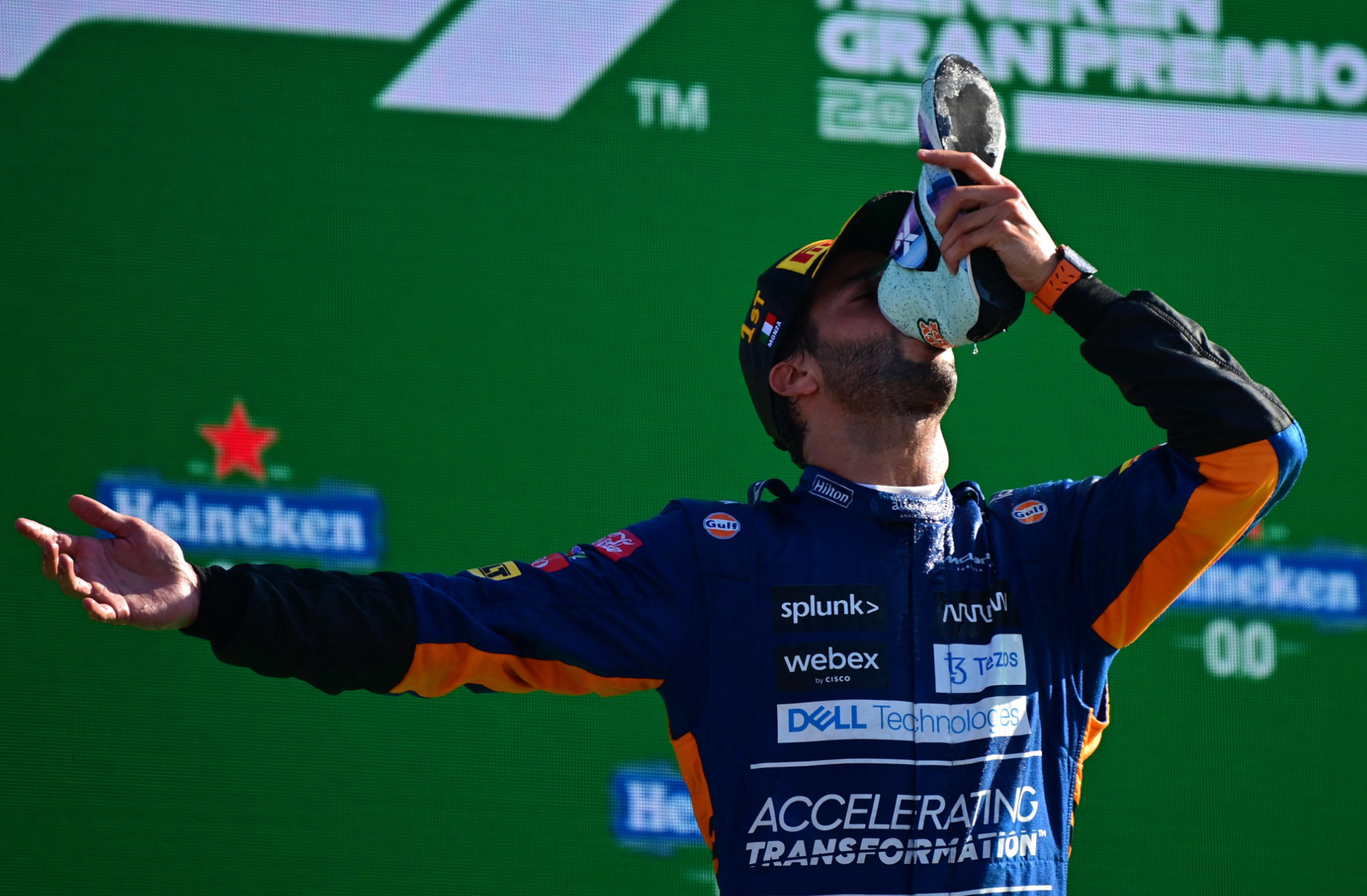
It’s shoeys all round…except for the title rivals.
Daniel Ricciardo celebrates winning the Italian Grand Prix with a trademark 'shoey'.
Image credit: Getty Images

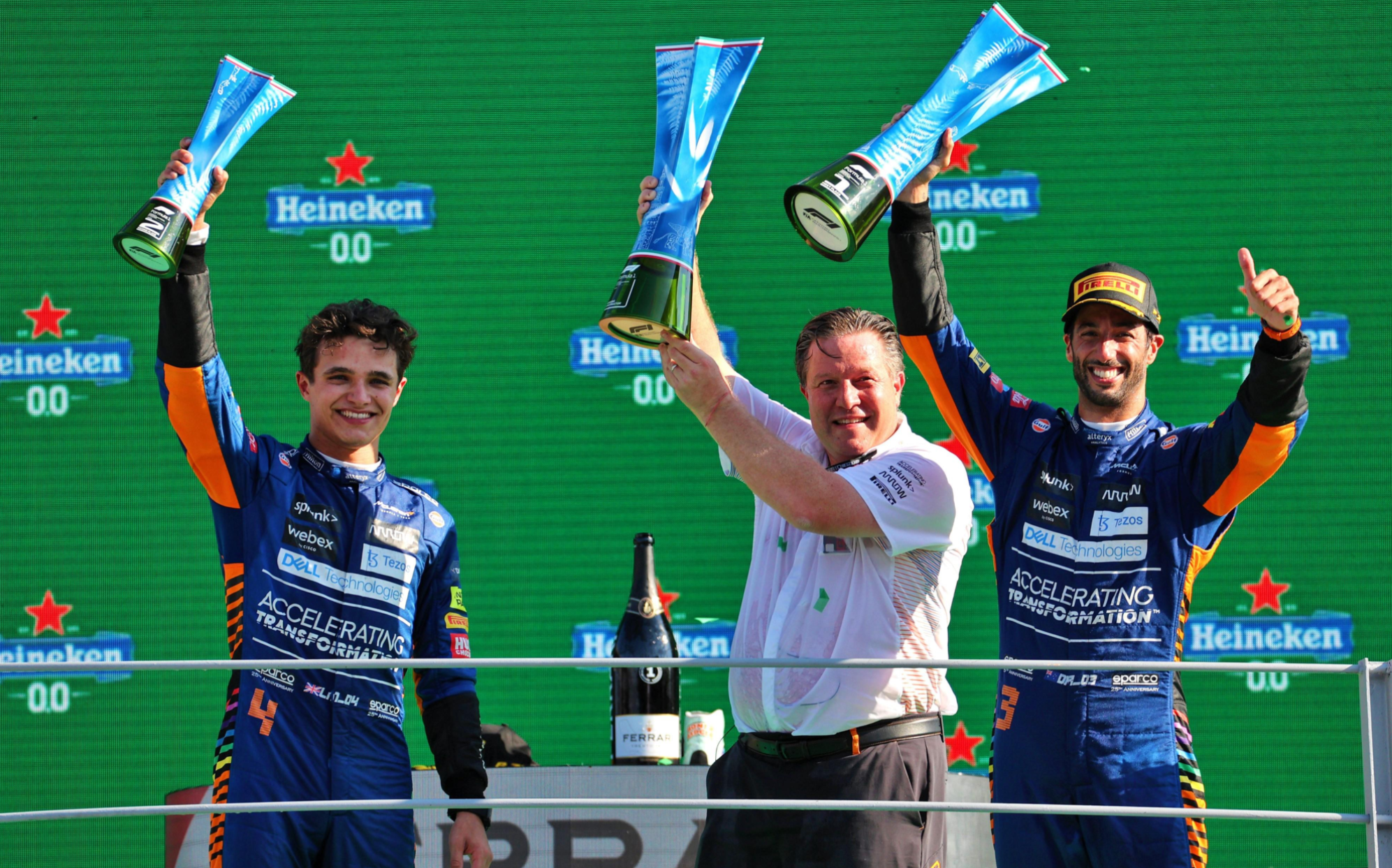
Daniel Ricciardo won his first race since leaving Red Bull in 2018 on an extraordinary Italian Grand Prix weekend.
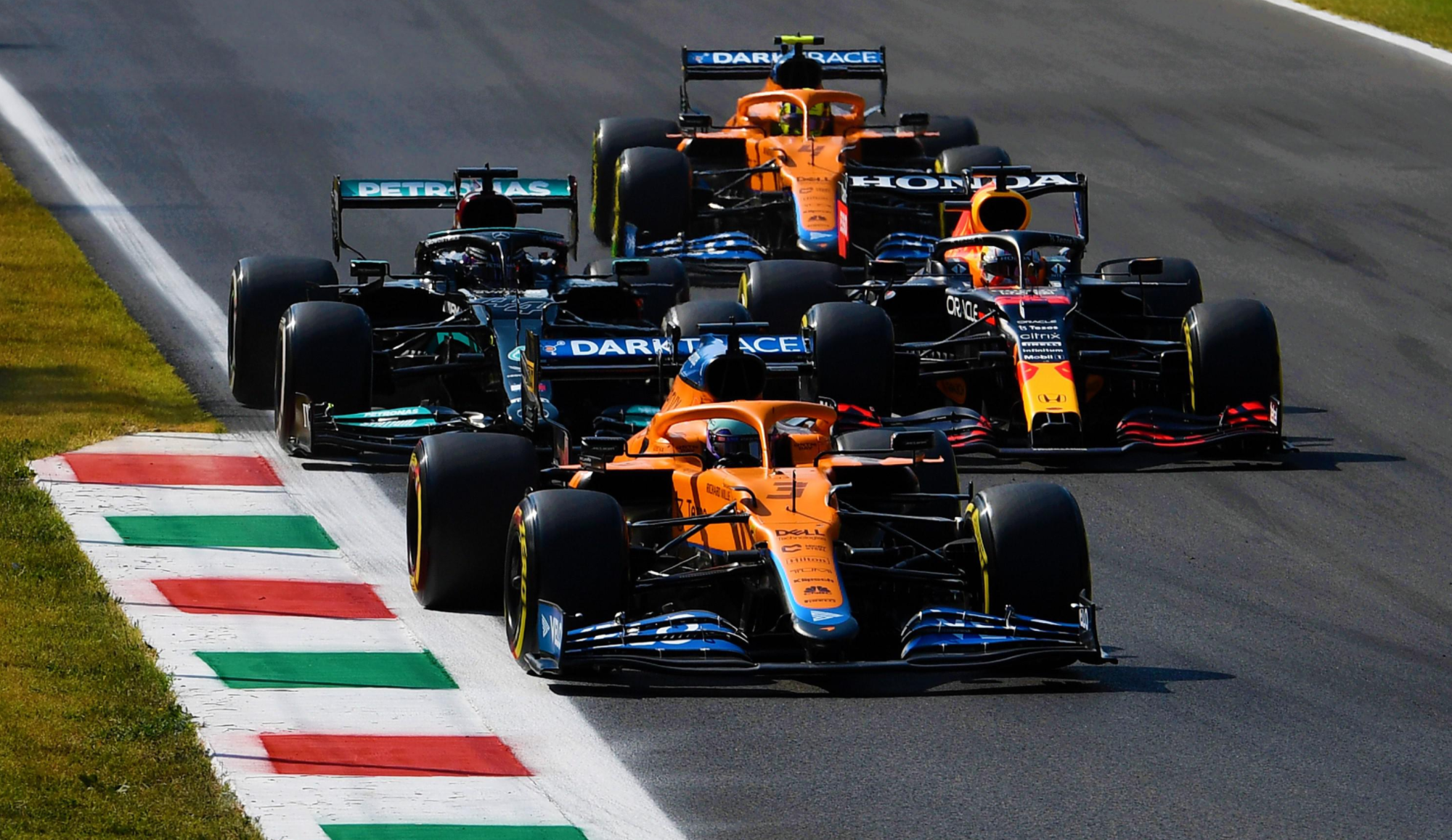
McLaren were legitimate challengers in Monza and took advantage of the leading teams’ messy weekends to claim a first victory since 2012, with Lando Norris making it a 1-2 for the papaya team.

After a poor start in the sprint race, Lewis Hamilton found himself fourth on the grid and, with teammate Valtteri Bottas starting at the back after taking a new engine, it was Max Verstappen and Ricciardo who lined up on the front row.

The Honey Badger nailed his getaway and comfortably beat the Red Bull to the first corner. From there, he never looked back.

Hamilton also got a good start, passing Norris for third and then challenging Verstappen into the second chicane of Variante della Roggia. The reigning champion got himself alongside the Red Bull but – not for the first time this season – was run out of road on the outside and rejoined the track behind Norris.

The two McLarens and the two title rivals battle.
Image credit: Getty Images

It would not be the rivals’ final meeting on track.

The first stint of the race was a tale of the two title contenders failing to pass the McLaren in front of them, largely thanks to their excellent straight-line speed and strong traction out of the final corner.

Ricciardo triggered the sole round of pit stops when he came in on lap 23, but the series of events leading to the biggest moment of the weekend began when Verstappen responded one lap later.

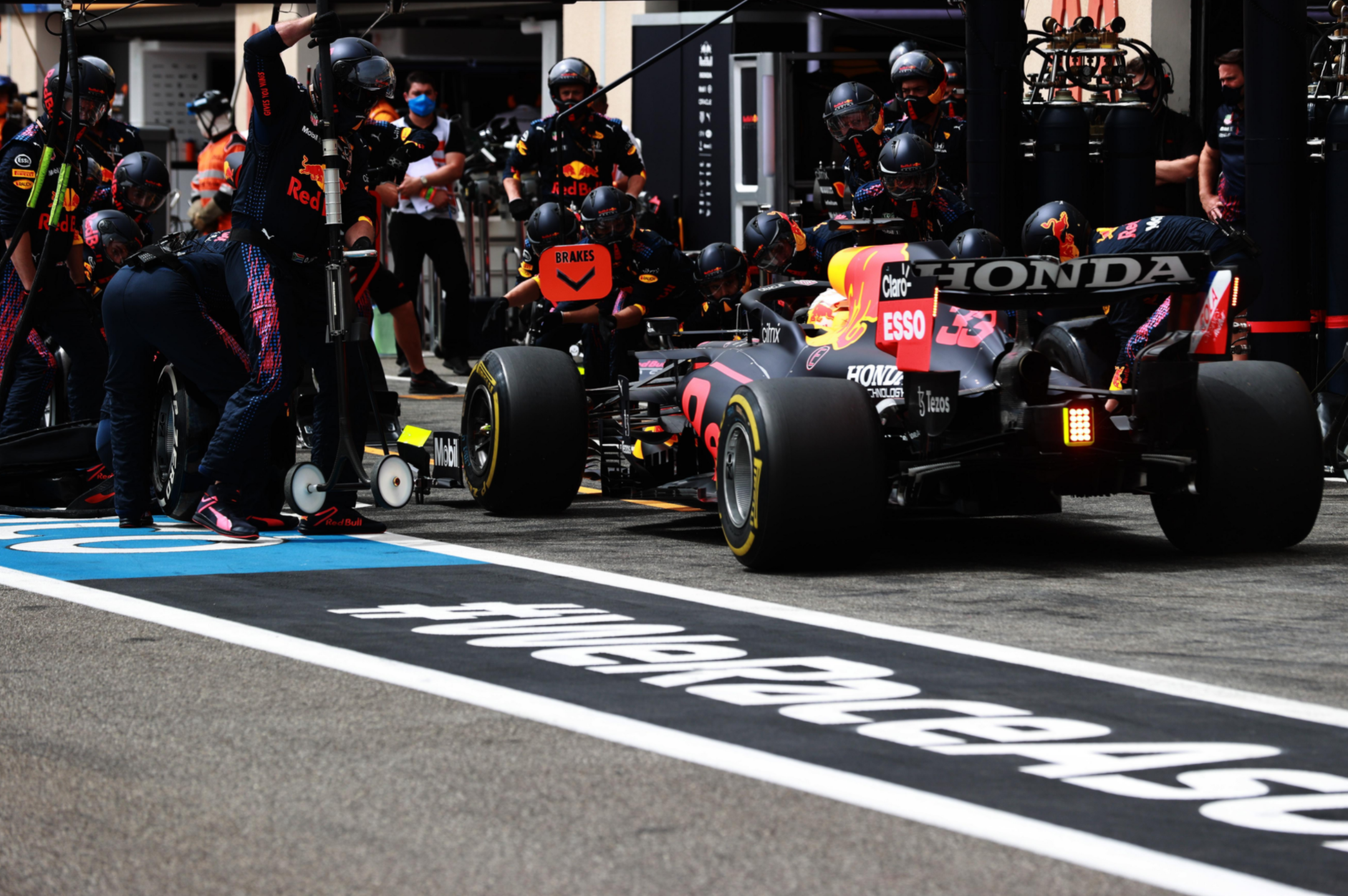
The usually flawless Red Bull pit crew suffered a sensor issue which led to a painful, 11-second stop for the championship leader and saw him fall behind Norris.

Mercedes – despite Hamilton having started on the harder tyre compound – knew this was their chance to jump Verstappen and brought car number 44 in two laps later. It was another poor stop, however – at a little over four seconds – and saw Hamilton rejoin right between Norris and Verstappen.

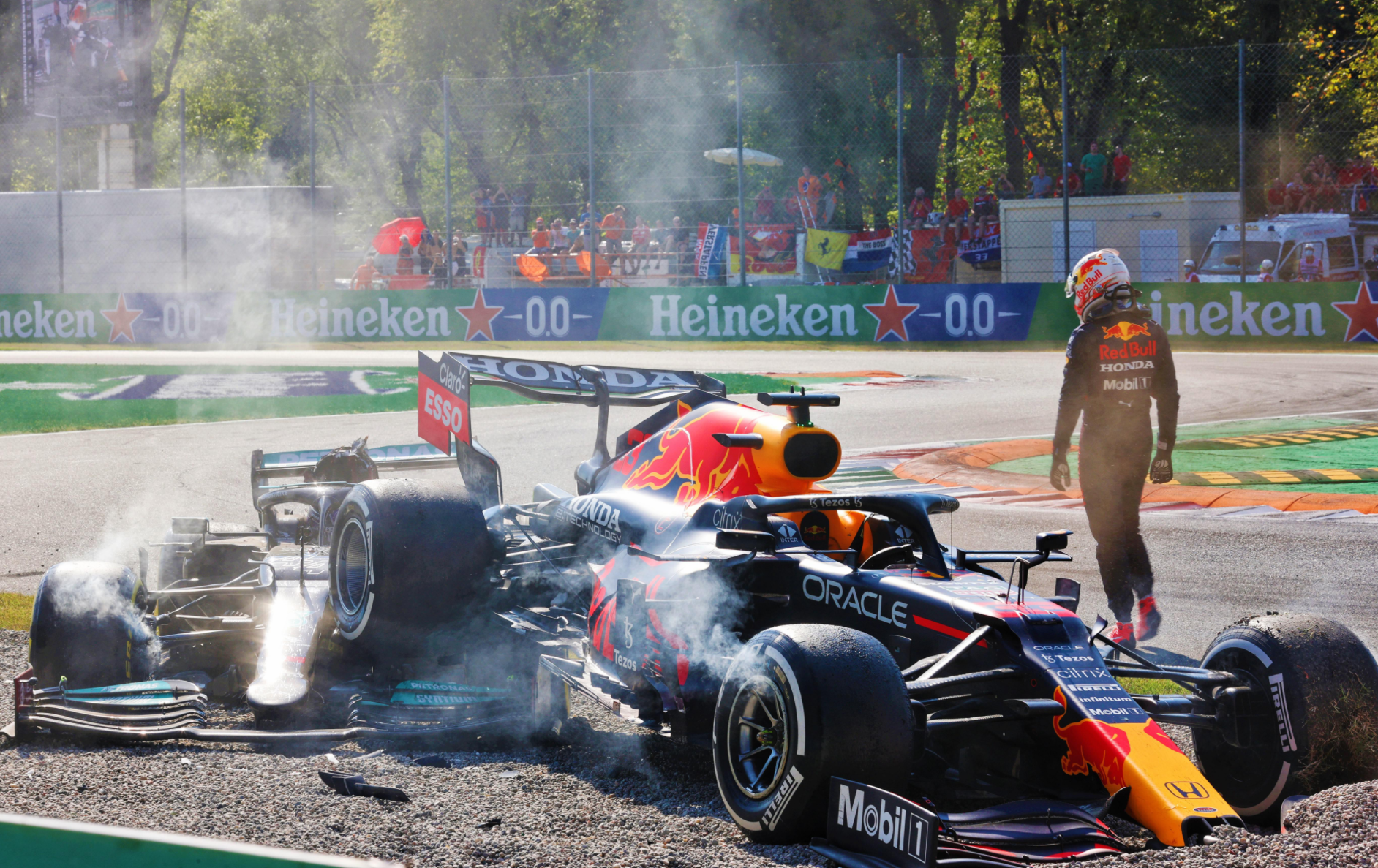
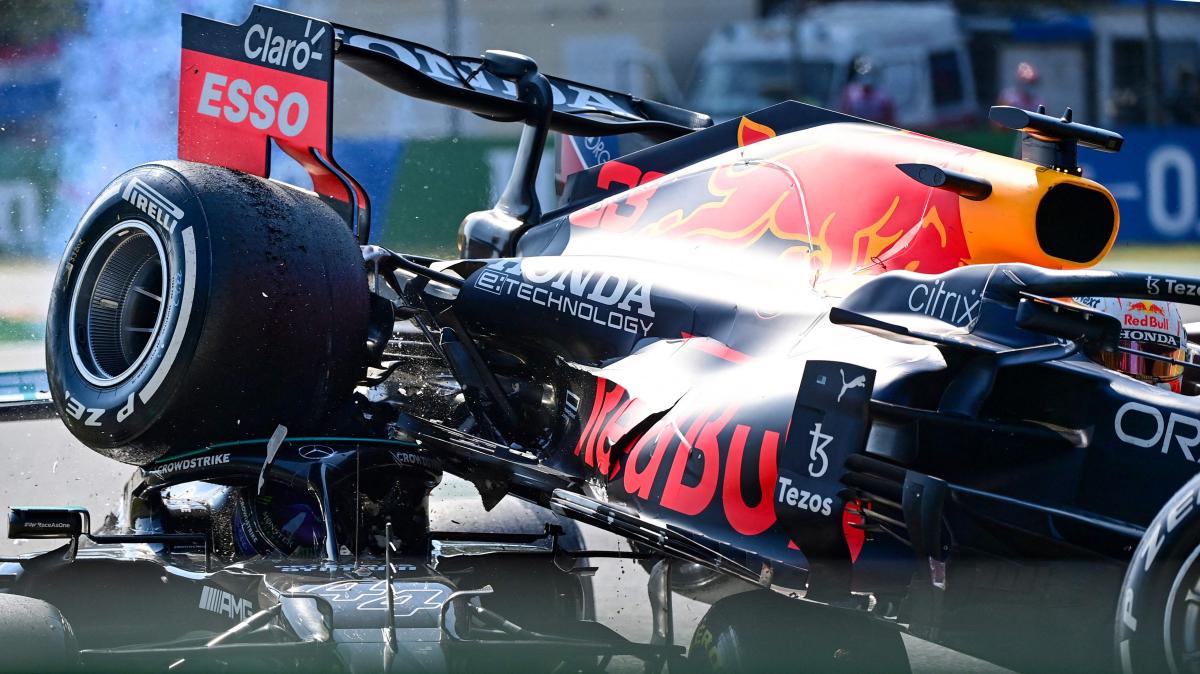
The Dutchman tried to stick it out around the outside of Turn One but ran out of road and bounced over the sausage kerbs. That sent him straight on into Hamilton and, as his right rear rode over the left rear of the Mercedes, he suddenly found himself sitting on top of his rival’s car.

The aftermath of the clash between Lewis Hamilton and Max Verstappen.
Image credit: GPblog NL

Despite Hamilton’s efforts to reverse out from underneath the Bull which had so rudely mounted him, both were out of the race and the Safety Car was called.

The race restarted on lap 30 with Charles Leclerc delighting the Tifosi by having moved up into second with a cheap pit stop during the Safety Car period.

Not for long, though, as Norris bravely kept his foot in at almost 200 mph with two tyres on the grass through Curva Grande to retake the position from the Ferrari.

After a brief challenge on his teammate for the lead, McLaren decided to call the race off and focus on securing a scarcely believable 1-2.

Behind them, Bottas continued his inspired charge through the field. The Finn had topped qualifying on Friday and won the Sprint on Saturday but started at the back for the main event after taking on a new engine.

He fought his way up to fourth on the road, which became a podium once Sergio Pérez was hit with a five-second time penalty for overtaking off the track. The Mexican also recovered well from a disappointing qualifying but would ultimately claim fifth – splitting the two Ferraris – once the penalty was applied.

Out front, though, it was all about the McLarens, who completed another wave of of orange celebrations – after Verstappen’s win at home seven days before – as they crossed the line in first and second.

What a tale of redemption for the team and their Aussie driver, who had struggled so badly to adapt to his new car in the first part of the season.

McLaren celebrate on the Italian Grand Prix podium.
Image credit: AFP

He appears to have succeeded in mentally resetting over the summer break and his eighth F1 victory will perhaps be the most satisfying of his career to date.

Now we wait to see what the Woking team can do with the regulations reset for next season. If they continue on their current trajectory, they could well be fighting for victories on a far more regular basis.

Breaking Down the Latest Hamilton-Verstappen Incident

Just as the battle at the front was becoming more amicable once again – with Hamilton appearing genuinely please for his rival’s home success – we get another flashpoint.

There was much debate over the culpability in their dramatic clash at Silverstone, and that will likely be the case again over the next fortnight.

Predictably, the drivers blamed each other. But the stance of Christian Horner – and even the ever-outspoken Helmut Marko – that it was a racing incident shows an effective admission of guilt on this one.

It usually takes just the slightest hint of accountability from Hamilton for them to go on the media warpath, encouraging their followers to raise their pitchforks to the sky.

There was an element or irony in elements of the Red Bull camp’s reaction in Italy. Firstly, Verstappen’s protestations that Hamilton should have left him more space are somewhat hypocritical, considering his approach to a very similar situation with the roles reversed on lap 1.

And, in hindsight, after having made such ridiculous accusations to the extremes of Hamilton having practically committed attempted murder in Silverstone, playing off an incident where their driver’s car struck Hamilton’s helmet as no big deal also seems a little incongruous.

Max Verstappen's wheel strikes Lewis Hamilton's helmet.
Image credit: AFP

The stewards decided Verstappen was predominantly to blame and have handed him a three-place grid penalty for the next event. Not that it will matter considering the likelihood of Red Bull taking an engine penalty in Sochi.

From this writer’s point of view, the penalty feels about right. The Dutchman entered the chicane behind Hamilton but his overspeed meant that he was probably justified in sticking his car on the outside initially.

However, despite Hamilton leaving just about enough space to do so, it was clear that the trajectory and speed at which Verstappen entered was only going to result in one outcome, unless Hamilton basically parked his Mercedes on the outside of the second corner and waved him through.

That is the point at which most drivers on the grid – including Hamilton himself earlier in the race – would bail out of the move and take to the escape road. But Verstappen is not most drivers.

His sheer bloody-mindedness means that he will almost never back out of a confrontation. Since joining the sport – even as a 17-year-old – he has epitomised the Ayrton Senna ‘back out or we crash’ mantra.

Personally, I would much rather see a hard battle over the course of a series of corners or laps, with two racers battling it out right on the edge.

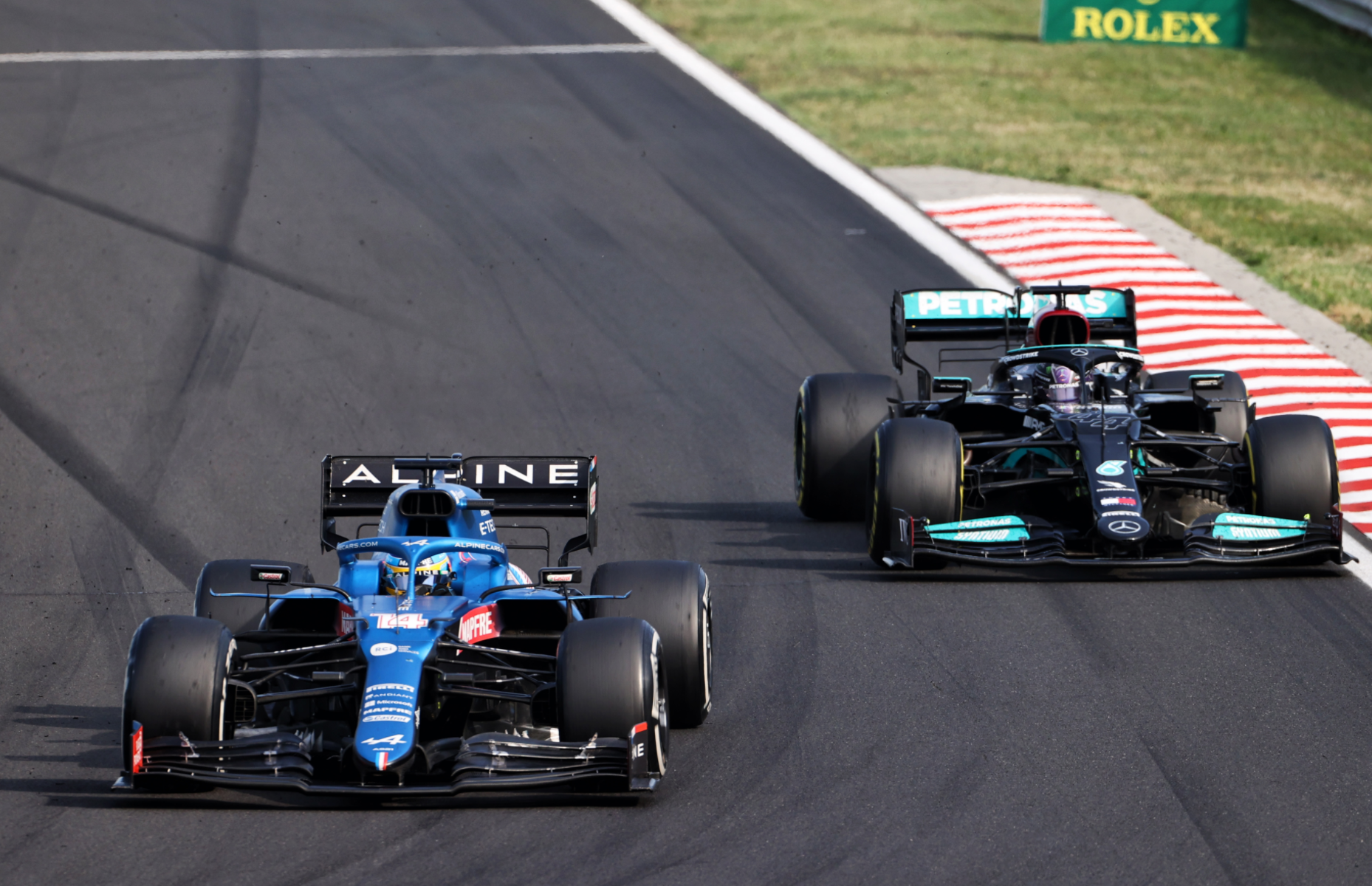
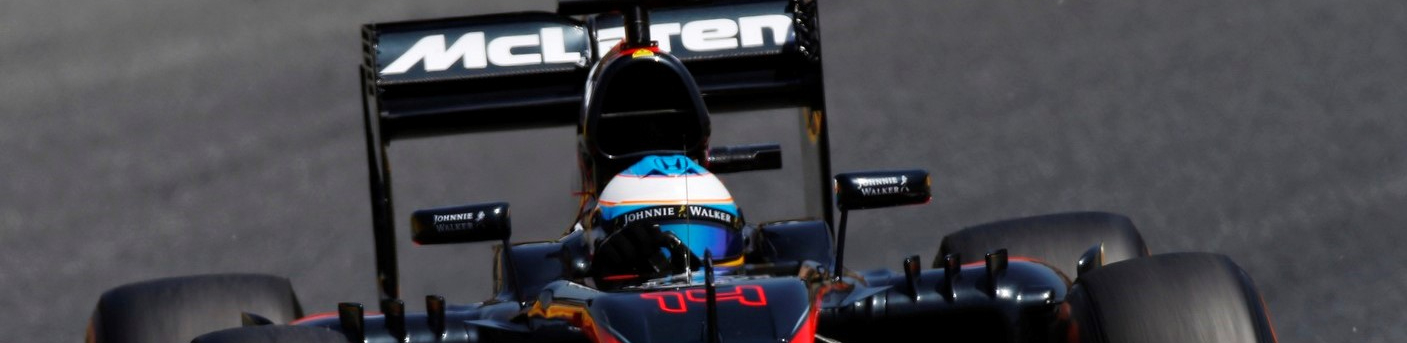
Fernando Alonso and Lewis Hamilton battle at the Hungarian Grand Prix.
Image credit: XPB Images

Hamilton and Fernando Alonso demonstrated that in Hungary this year – and many times before – as have plenty of other drivers.

That is surely what we want to see. Whilst these monumental crashes are great for the drama, and will be spoken about for years, it is a shame that the most referenced points of this incredible season will be the leaders ending up in the gravel, rather than battles for the ages like Alonso and Michael Schumacher at Imola in 2005.

It almost brings a question to Verstappen’s wheel-to-wheel ability. The 23-year-old is clearly spectacularly fast, but at what point do we consider him to be poor in wheel-to-wheel combat? The instances of him forcing drivers off the road outnumbers his on-the-edge battles at an increasing rate.

He surely has the ability and spatial awareness required, but whether he chooses to do so is the bigger issue.

There is a very fine line between hard driving and poor driving.

The Italian Grand Prix in 60 Seconds

Answering the Burning Questions

How will the Sprint Qualifying format play out this time around? Once again, we had a crazy weekend – but whether the format was instrumental in that is up for debate.

Will Mercedes dominate on a power-sensitive track? In terms of outright pace, probably. In terms of the race, it was actually a McLaren domination.

Will we get the usual Monza shenanigans in the regular qualifying session on Friday? Yep, as predicted it was all a bit cringeworthy at points.

2021 Dutch GP report | Verstappen sends the Orange Army wild

The Dutch sure know how to throw a party.
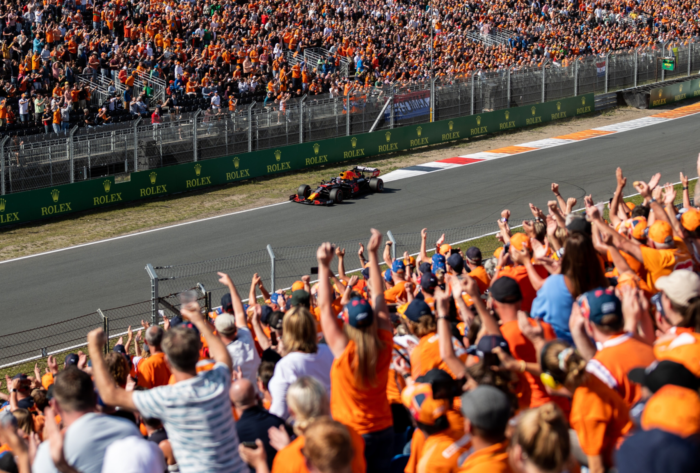
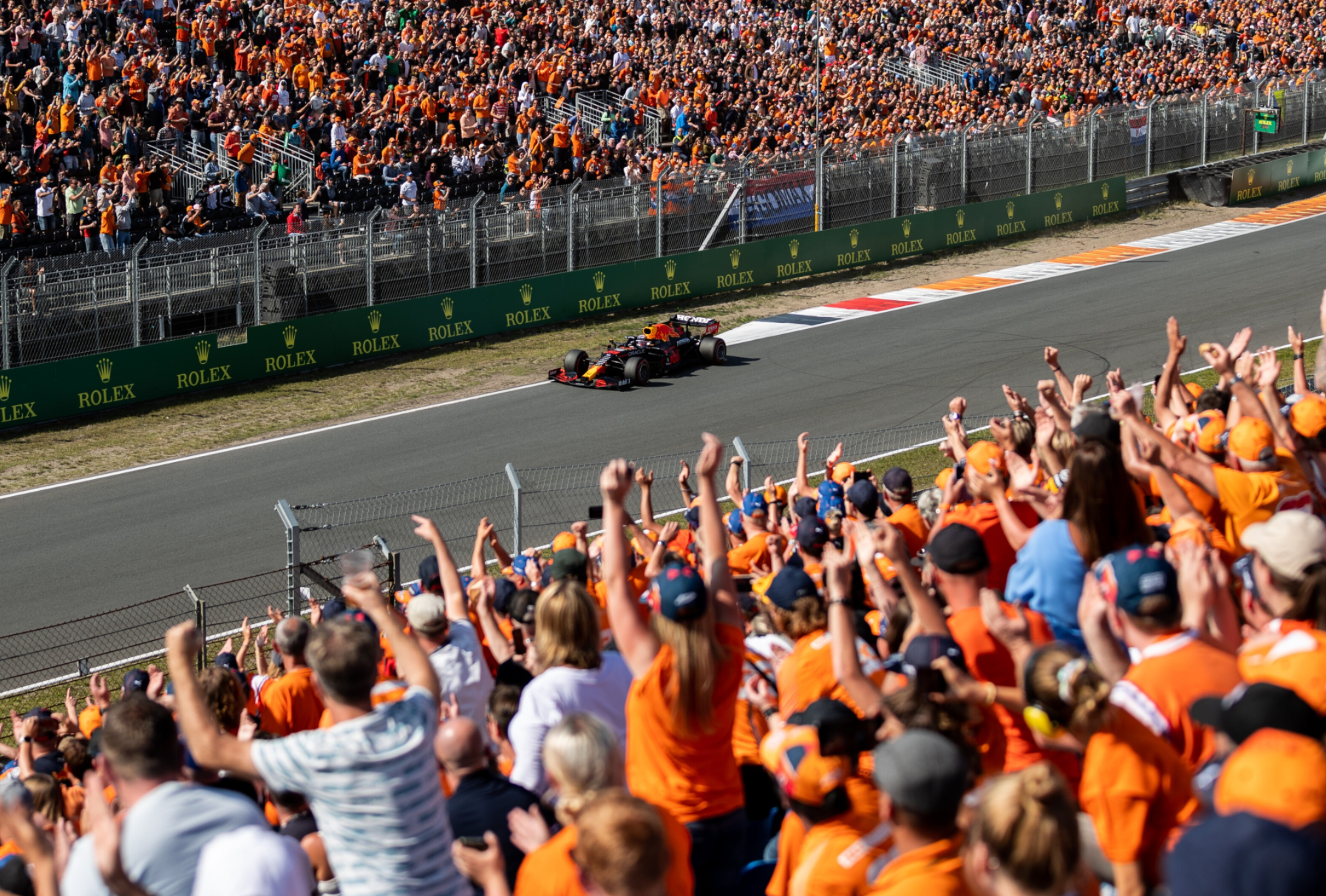
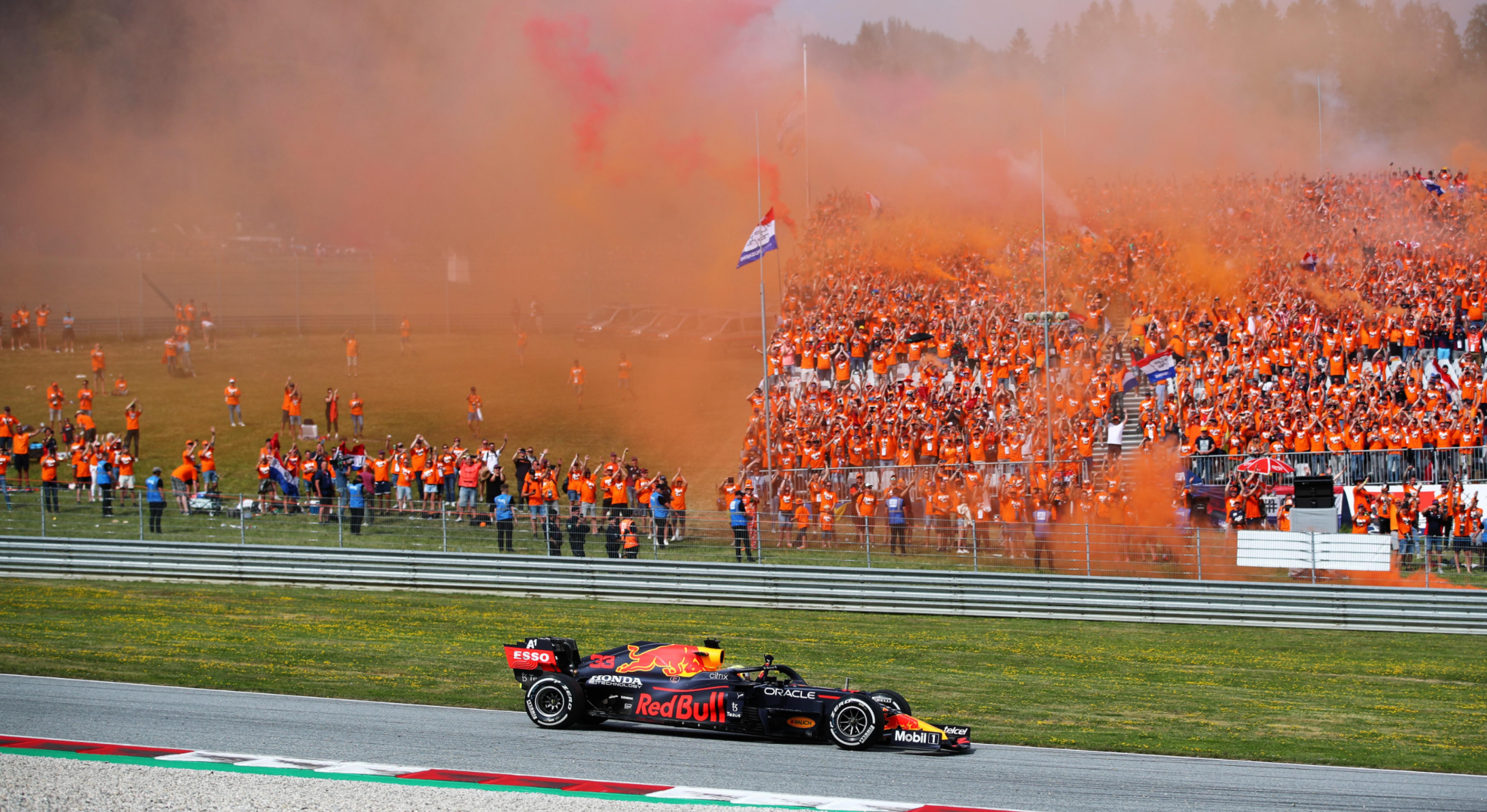
The Orange Army goes wild at the Dutch Grand Prix.
Image credit: Getty Images

Max Verstappen withstood everything Mercedes threw at him to win the Dutch Grand Prix – his home race – at the first attempt, much to the delight of a sea of orange.

The Red Bull looked the slightly better car over the course of the weekend – at least in the hands of Verstappen – and it was the 23-year-old who narrowly secured pole position on Saturday.

Lewis Hamilton impressively closed to within 0.038 seconds of his title rival, after a tricky weekend where he missed almost all of Practice 2 with an engine issue, but the margin should have been larger with Verstappen’s DRS failing to open after he had also missed fifth gear earlier in the lap.

On Sunday, as soon as the flying Dutchman had successfully navigated the run to the first corner, it was to be a tale of strategy.

Sergio Pérez in the other Red Bull had been caught out in Q1 and would be starting from the back, which left Mercedes able to utilise two-versus-one tactics.

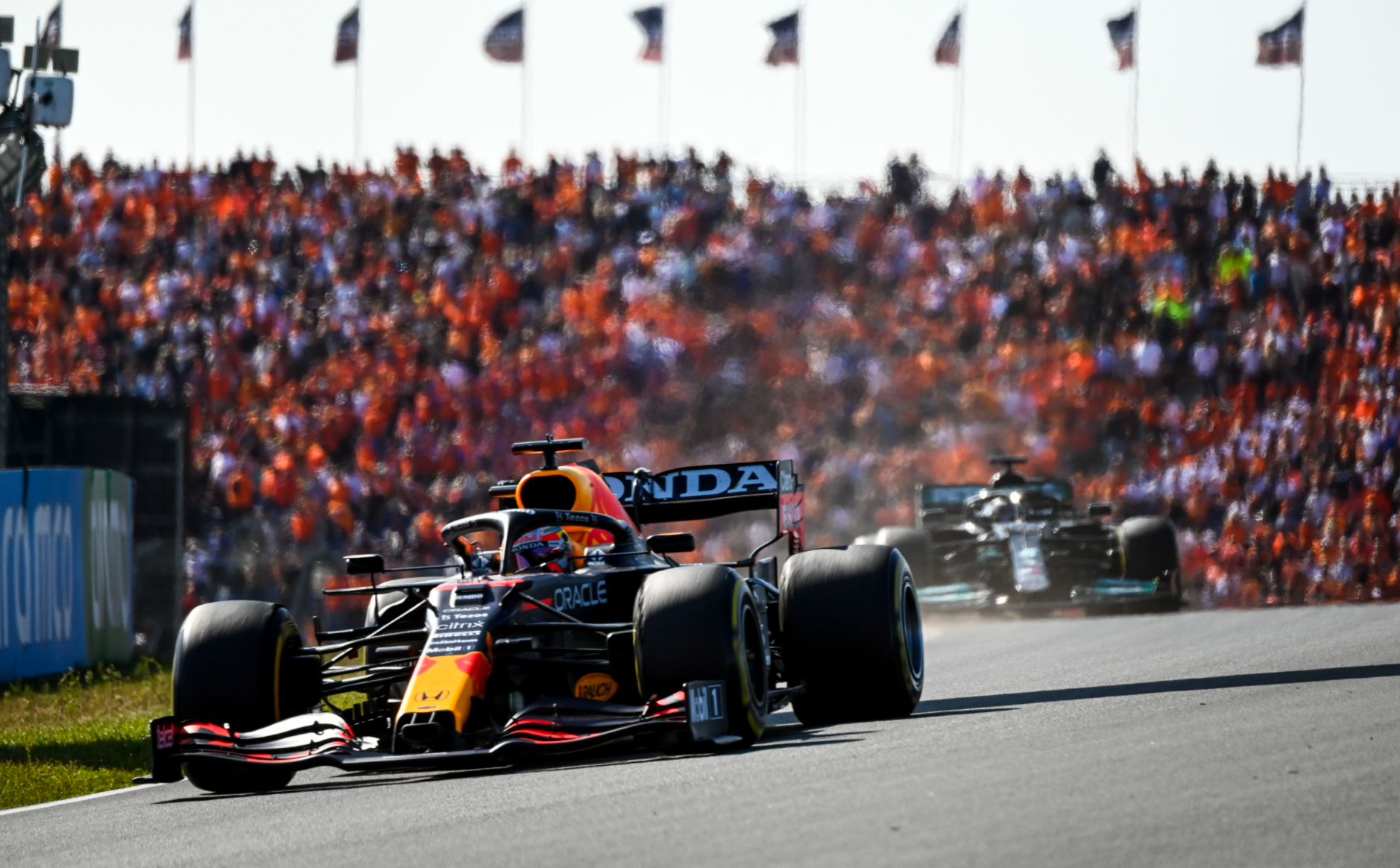
Lewis Hamilton chases Max Verstappen.
Image credit: Sutton Images

They attempted to take advantage, bringing Hamilton in for an attempted undercut, whilst teammate Valtteri Bottas ran long on a one-stop. The Finn made his Mercedes as wide as possible when Verstappen caught him, but was unable to stop him sailing past after one lap, despite the Zandvoort circuit proving predictably difficult to pass on.

Once again, Mercedes attempted the undercut with Hamilton, pulling the trigger unexpectedly early on lap 39. It was poorly executed, though, with the reigning champion emerging into traffic and Verstappen was easily able to cover him.

From there, it was plain sailing for the home favourite and car number 44 eventually gave up the chase to pit and secure the fastest lap.

A six-point swing in the title battle leaves Verstappen three points ahead in the standings heading to the season’s second sprint-qualifying weekend at Monza. On paper, it is a track that should favour the Silver Arrows. But how often have things followed the script this season?

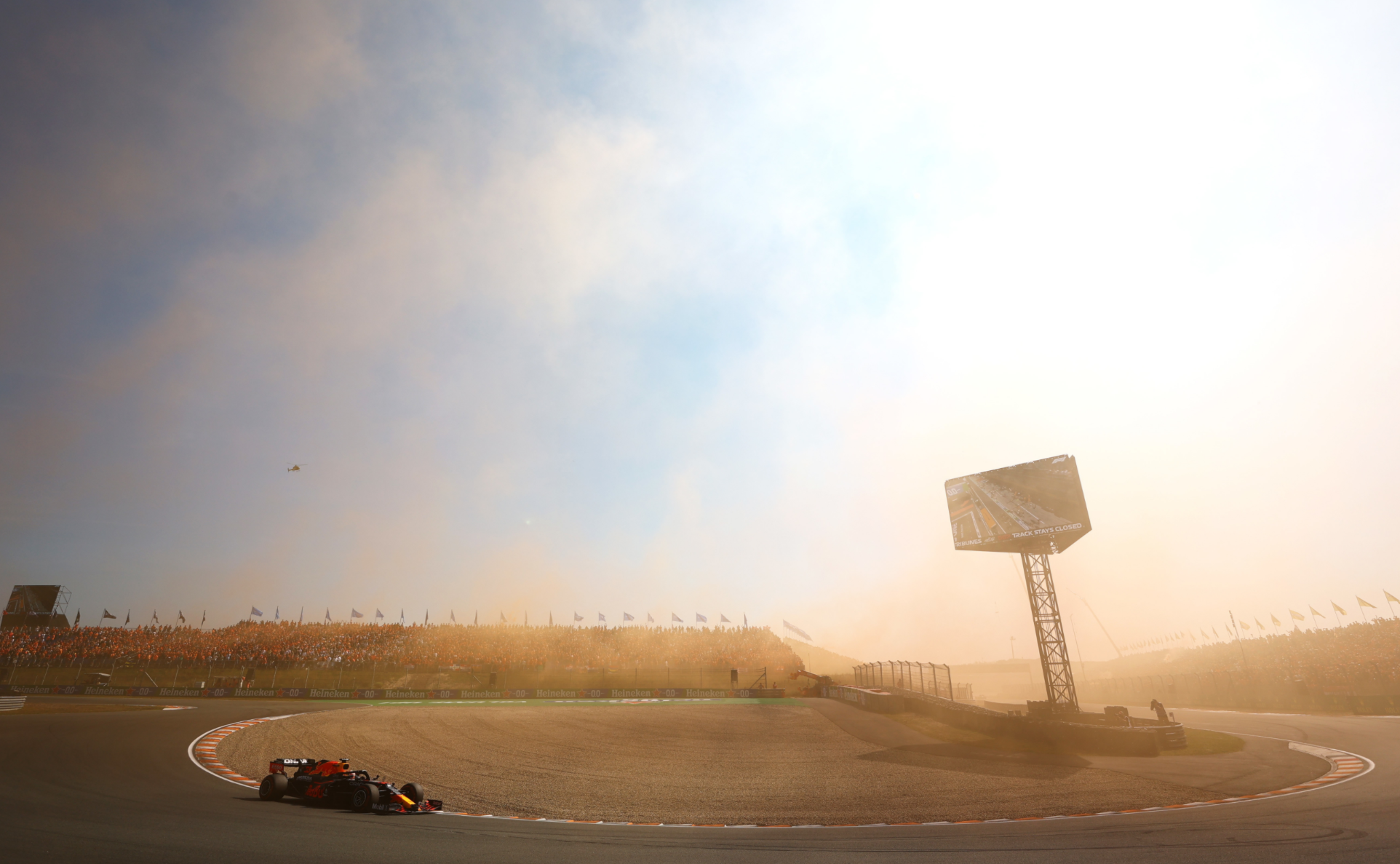
An orange haze from the Dutch fans' flares.
Image credit: Getty Images

A Tough Weekend for McLaren

Behind the most common podium trio of all time, Pierre Gasly once again excelled in the AlphaTauri, backing up his excellent fourth in qualifying with a lonely but flawless race.

Behind him, the Ferraris finished fifth and seventh – split by Fernando Alonso, who judged his tyre life to perfection to pass Carlos Sainz on the last lap – which sees them open out an 11.5-point gap to McLaren in the Constructors’ Championship.

The crowd may have been wall-to-wall orange, but things did not go the way of the papaya team in the Netherlands.

Unusually, Lando Norris struggled for pace throughout the weekend, and was then caught out by the pair of Williams crashes in Q2, leaving him 13th on the grid. Teammate Daniel Ricciardo did make it through to Q3 but could only manage 10th and, after nearly not starting the race at all, struggled for pace during it.

Norris extended his first stint well and caught the Honey Badger towards the end of the race. Team orders allowed him past but, after a tough battle with the recovering Pérez, Norris would only finish one place in front of a mildly disgruntled Ricciardo to claim the final point.

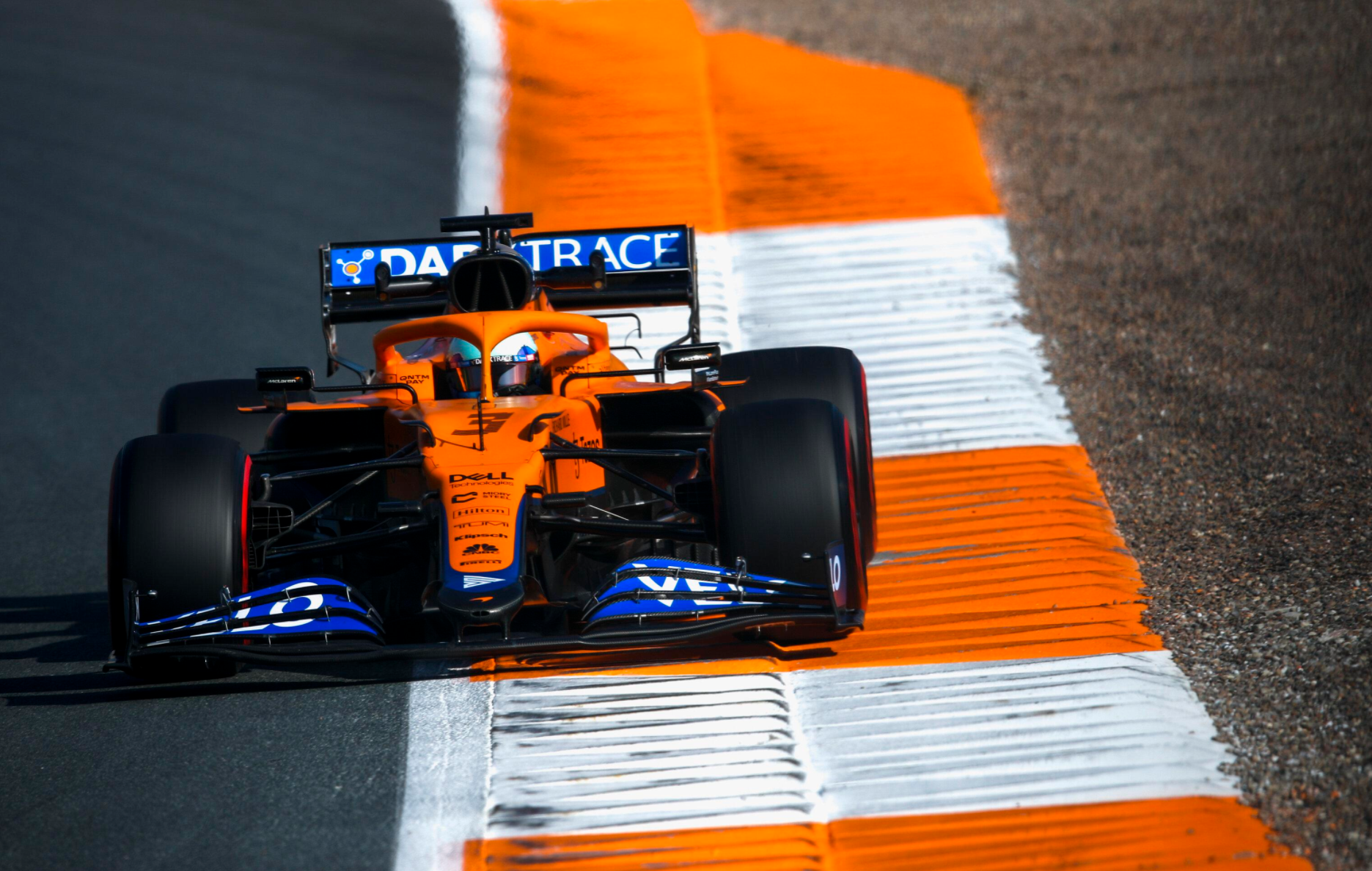
Daniel Ricciardo at the Dutch Grand Prix.
Image credit: Motorsport Images

Monza will give them an excellent chance to bounce back immediately, however. They are renowned for their straight-line prowess this season and could even find themselves mixing it with the big boys next weekend at the Temple of Speed.

The Dutch Grand Prix in 60 Seconds

Answering the Burning Questions

Will Red Bull or Mercedes come out on top at a track that is somewhere between the Red Bull Ring and the Hungaroring? It was pretty tight, but Red Bull appeared to have a slight edge.

How will the drivers cope with a very unique circuit? They all seemed to love it. Along the lines of Mugello last year – a thrilling rollercoaster but not designed for modern F1 cars to overtake.

Will there be any overtaking? See above. Although Pérez produced some inventive moves to make his way back through the field.

The safety car leads Max Verstappen at the Belgian Grand Prix

2021 Belgian GP report | Verstappen wins… ‘Belgian Grand Prix’

The race that never was.
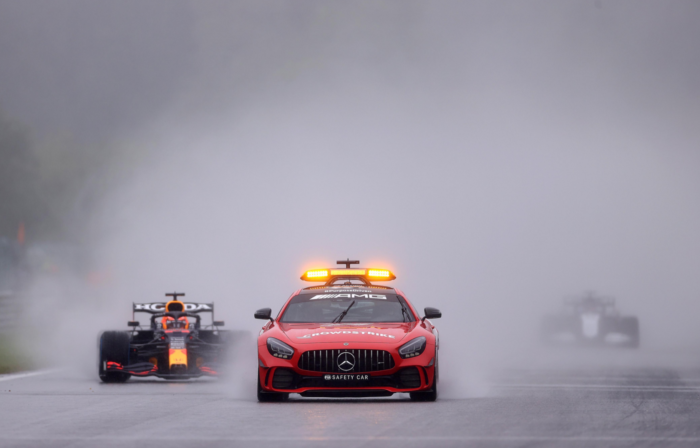
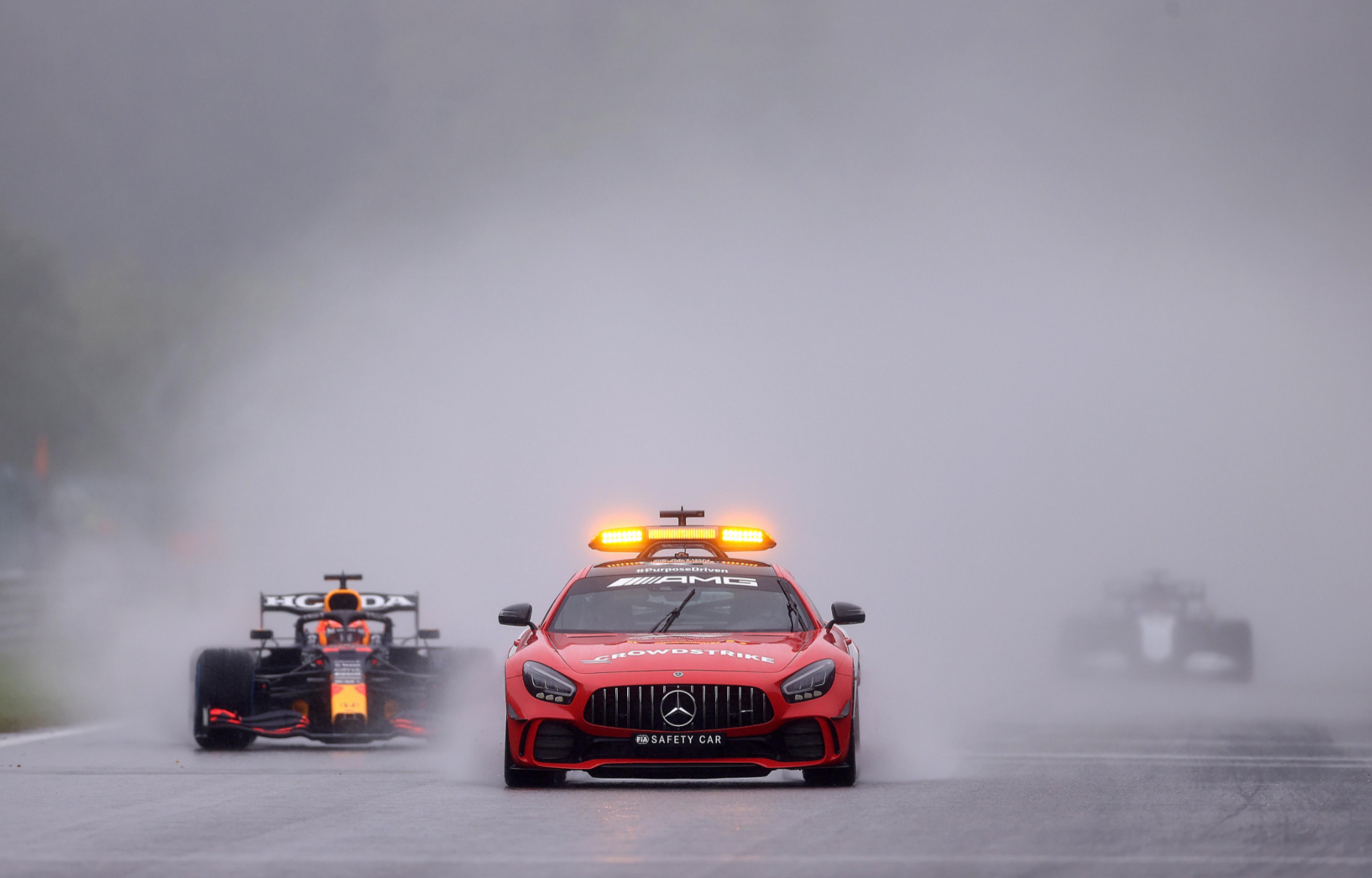
The safety car leads Max Verstappen at the Belgian Grand Prix.
Image credit: Getty Images

Max Verstappen was declared the winner of the Belgian Grand Prix after the requisite two laps amidst a never-ending downpour at Spa.

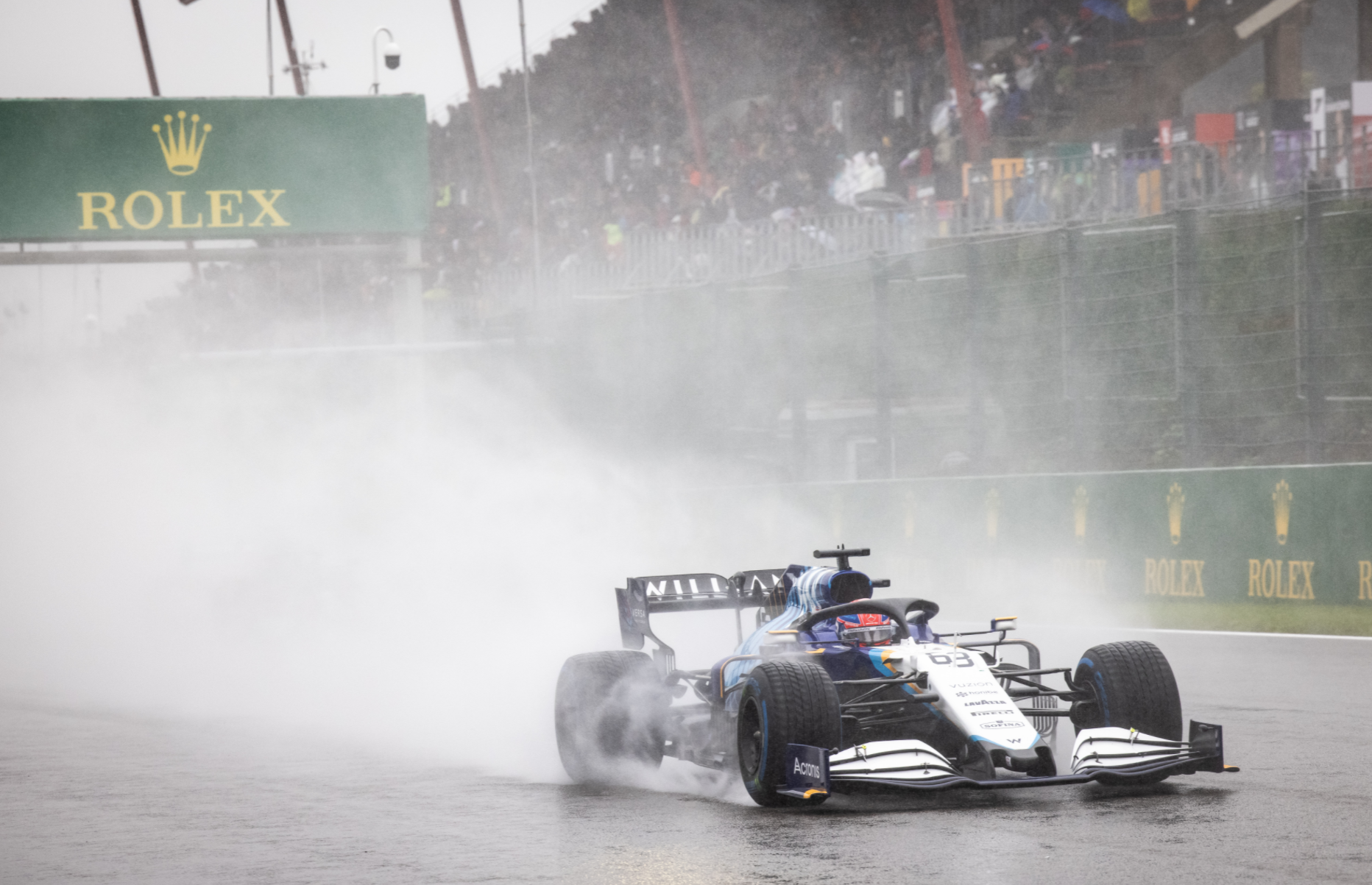
After a spectacular qualifying session on Saturday, which saw George Russell very nearly snatch the unlikeliest of pole positions, fans waited for hours as the race was continuously delayed.

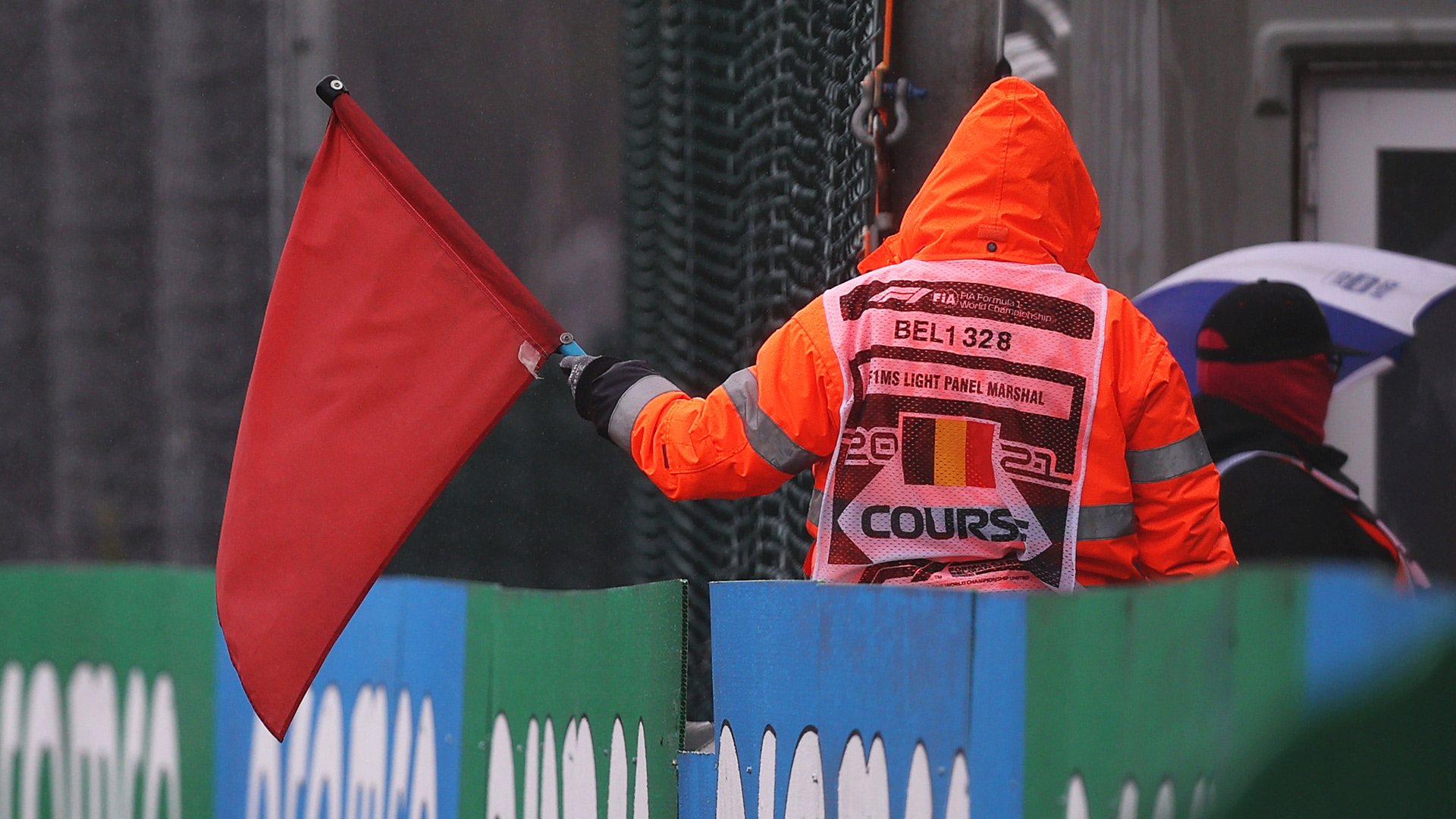
Eventually, with light fading fast and the rain showing no sign of dissipating, the drivers went out behind the safety car on what were – officially at least – reconnaissance laps, only for the race to be red flagged once again.

Around three and a half hours after the lights should have gone out, it was confirmed that the race would not restart and Verstappen was announced as the winner. That also meant a first ever podium for Russell in second and a 174th podium for Lewis Hamilton in third, with the field awarded half points.

A Bad Day for Formula 1

The red flag is waved as the Belgian Grand Prix comes to a halt after two laps.
Image credit: Getty Images

Either side of the summer break, we went from one of the best races in years, to one of the worst ever.

If you can even call it a race.

The situation was clearly a very challenging one for all involved, but the way in which those in charge dealt with it left a lot to be desired. This is not simply a case of having the benefit of hindsight – it was clear to see at the time that many of the procedures were farcical.

Team strategists radioed Michael Masi, clueless of the situation, and received conflicting answers; the commentators did their best to inform the viewers but repeatedly found out that they were wrong.

This writer was just as confused as Martin Brundle upon discovering that the race had been shortened by one lap for each ‘delayed start’. Race start times have been changed in the past without it being classed as such. And then there was the debacle of the various clocks that may or may not have started, and were ultimately paused by the stewards anyway.

George Russell at the soaking wet Belgian Grand Prix.
Image credit: XPB Images

It felt as though the rules were often being applied far too literally and that all common sense had been washed away by the biblical rain.

And finally came the laps that were classed as ‘the race’. As Hamilton stated in his post-race interview, they were sent out for “one reason and one reason only”: to ensure that there was an official result at the end of the day.

It is a result, however, that leaves a bitter taste in the mouth. For most of the teams and drivers, for those watching at home, and particularly for those in the grandstands. It is particularly painful to read first-hand accounts such as this one of fans who had paid hundreds of pounds or euros to sit in the rain for hours and then, in theory, not receive a refund as – they officially at least – witnessed an ‘event’.

We can only hope that F1 will do something to reimburse them. And that it will learn from this shambles for the future.

The ‘Belgian Grand Prix’ in 30 Seconds

Answering the Burning Questions

What madness happens on the first lap this time? Nothing. Absolutely nothing.

Will Red Bull decide to get an almost inevitable engine penalty out of the way here? Nope.

Are we set for a typical wet and wild race in Spa with showers forecast all weekend? It was too wet and wild…to the point that there was no race.

2021 Hungarian GP report | Ocon wins extraordinary race

A race that almost made Monza 2020 look dull.
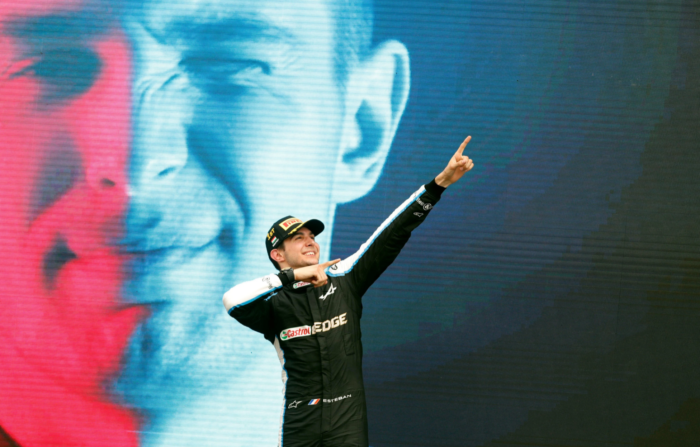
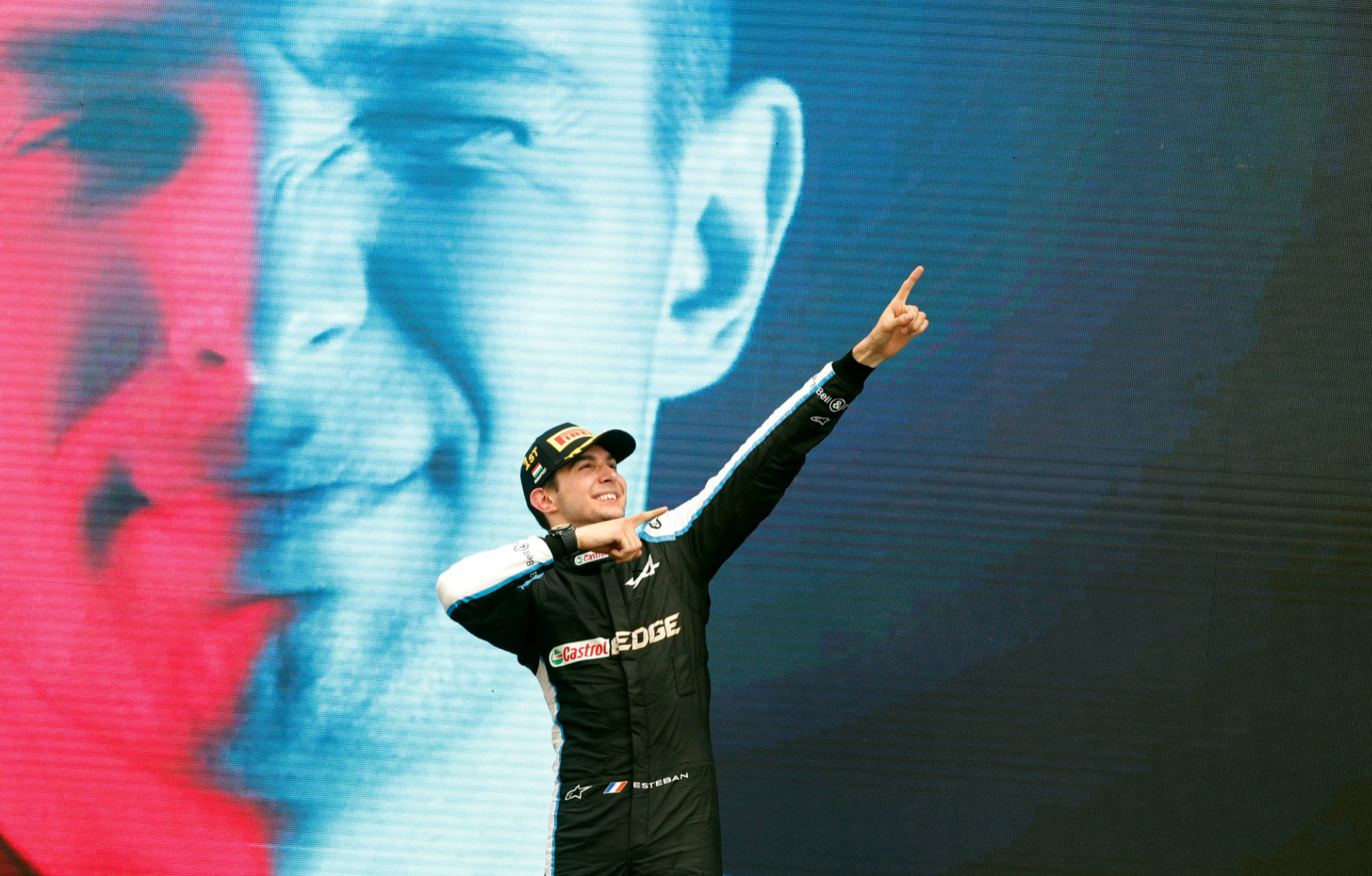
Esteban Ocon celebrates his shock win at the Hungarian Grand Prix.
Image credit: Reuters

Esteban Ocon took his maiden Formula 1 victory in a chaotic Hungarian Grand Prix after a first corner pile-up.

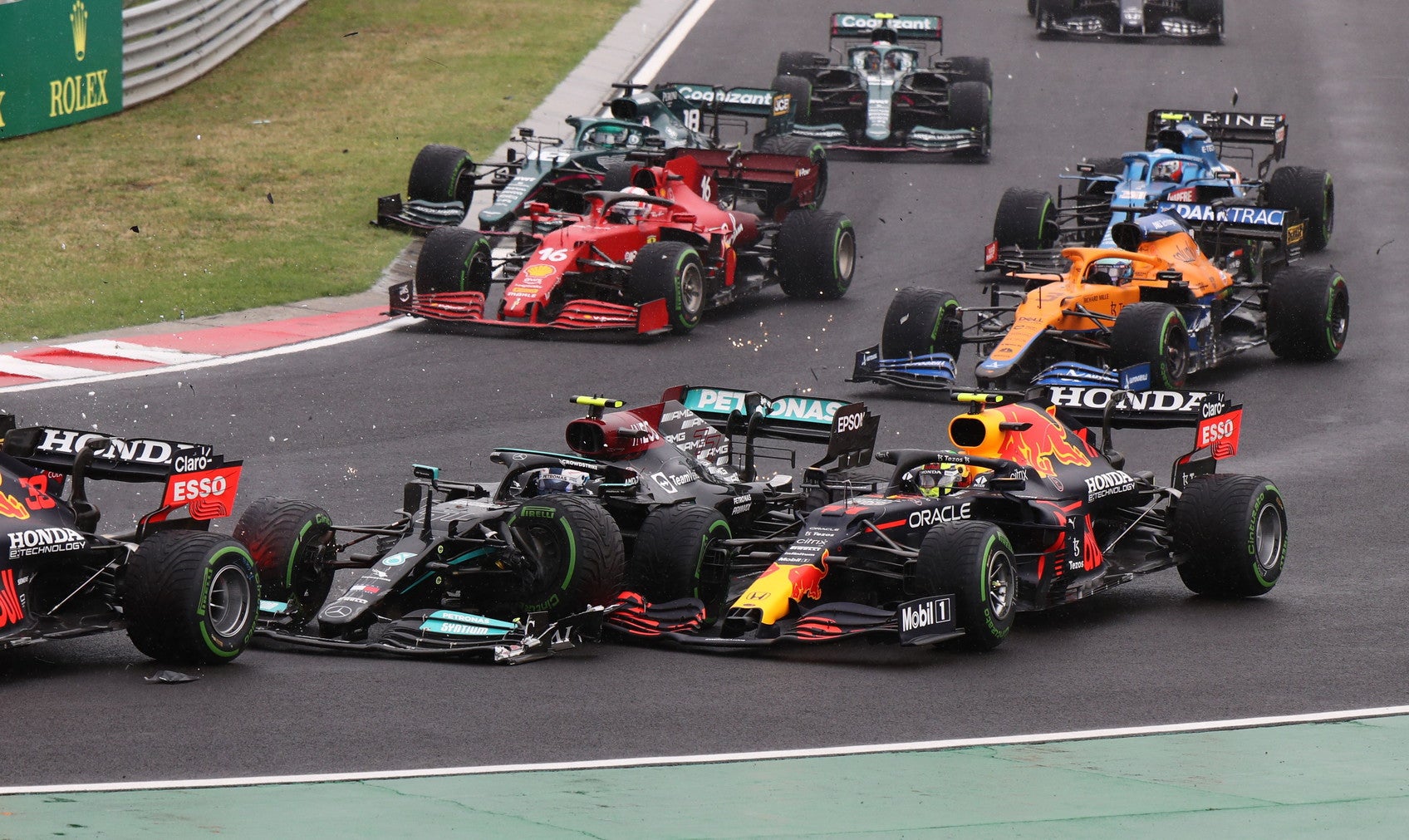
Rain started to fall half an hour before the lights went out and caused chaos at Turn One. Valtteri Bottas, after a poor getaway, braked too late and ploughed into the back of Lando Norris, in turn punting the young Briton into Max Verstappen. Bottas himself then slid into the other Red Bull of Sergio Pérez.

That had left Charles Leclerc looking at second place, only for Lance Stroll to crash into him after also missing his braking point. This time, rather than being the projectile, a McLaren was on the receiving end, Daniel Ricciardo being spun round by the helpless Ferrari.

Bottas and Pérez retired immediately with Norris joining them during the ensuing red flag. Verstappen and Ricciardo were able to continue but with significant damage, despite the best efforts of the Red Bull mechanics during the stoppage.

The drama was far from over, however.

As the drivers followed the safety car round for a standing restart, still on intermediate tyres, it became apparent that the sun had dried the track out incredibly quickly. Lewis Hamilton lined up once again in his pole spot…but nobody followed him…

Every other driver had come in to fit dry tyres. Mayhem in the pits ended with all the drivers lining up at the end of the pit lane, and George Russell unsuccessfully trying to pull off a sneaky mass overtake.

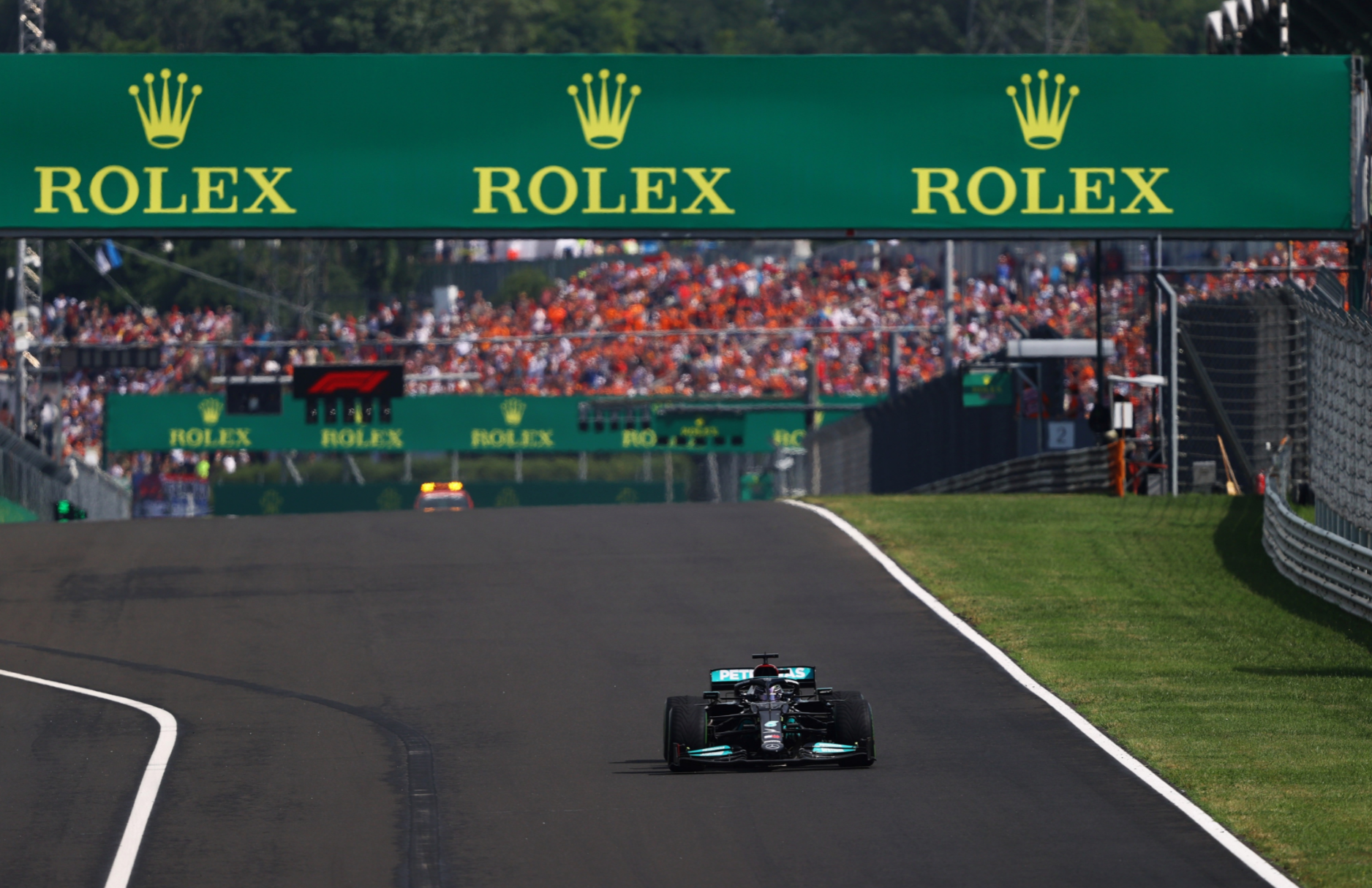
Lewis Hamilton all alone at the second start.
Image credit: Getty Images

So, it was lights out and away just Hamilton went, but knowing that he would have to stop at the end of the lap. Having done so, he rejoined in last place.

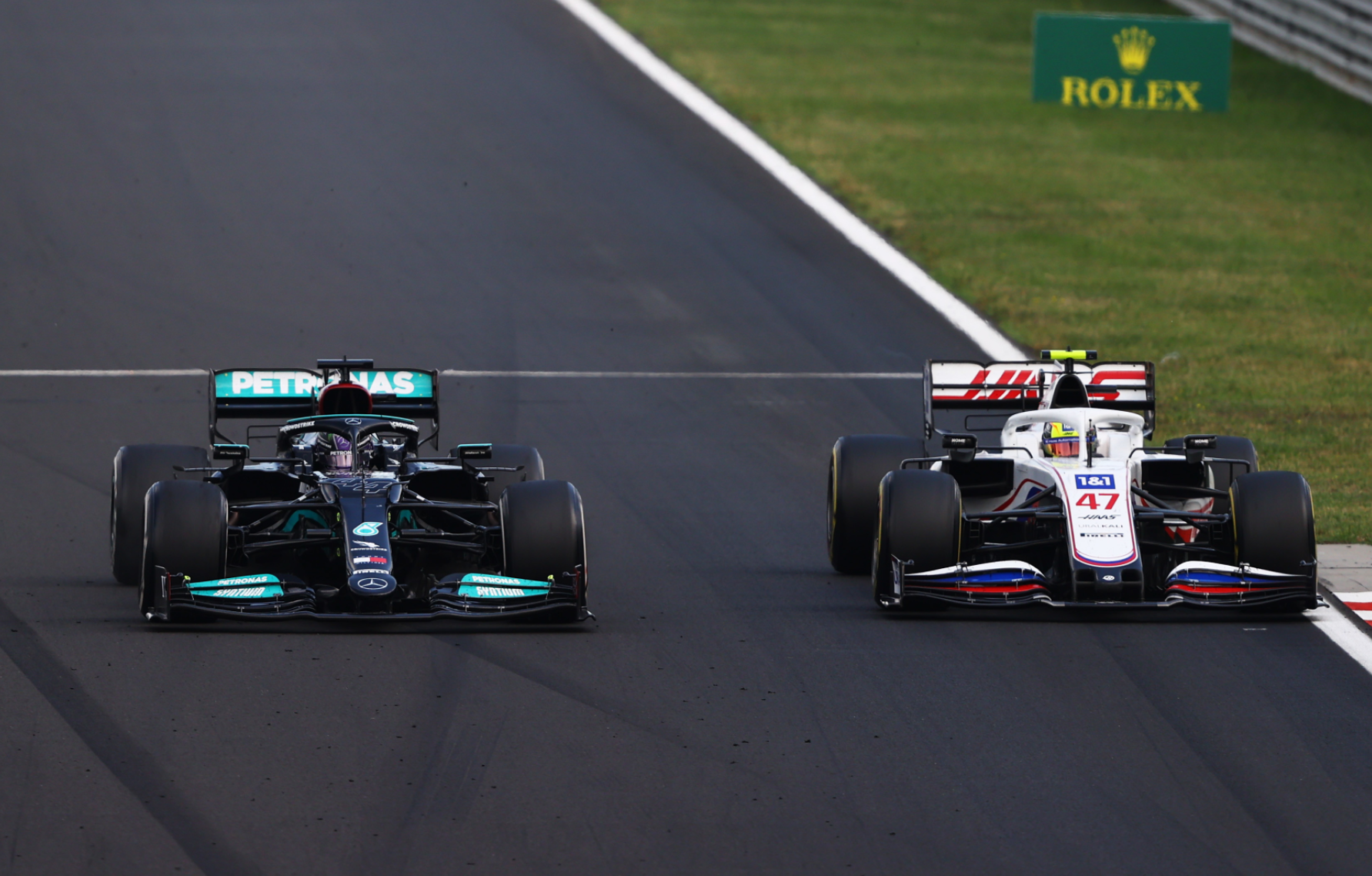
The Hungaroring is a notoriously difficult track on which to overtake and the World Champion was struggling. He had successfully passed Antonio Giovinazzi and Mick Schumacher but was unable to get close enough to Pierre Gasly‘s AlphaTauri to fashion a move.

Mercedes decided a two-stop strategy was the way forward and pitted Hamilton on lap 20. Once in fresh air, he was immediately the fastest car on track by a fair margin and crucially undercut Verstappen and Ricciardo when they stopped a lap later.

Hamilton gradually picked drivers off, either when they pitted or on track – an audacious move around the outside of Yuki Tsunoda at Turn 4 the highlight – and soon enough found himself up to fifth.

Meanwhile, at the front, a leading pair of Ocon and Sebastian Vettel had emerged after Hamilton’s overdue tyre change. The Williams of Nicholas Latifi held on to third for an impressive spell, allowing them to open up a gap. The unlikely leader eventually pitted on lap 38 – a lap after Vettel – and emerged narrowly ahead of the four-time champion.

Hamilton spent a few laps stuck behind Carlos Sainz in fourth but built enough of a gap to pit for medium tyres and rejoin in fifth. At this point he was three seconds faster than any other car on track, but in his path lay a formidable obstacle – Fernando Alonso.

Fernando Alonso and Lewis Hamilton battle at the Hungarian Grand Prix.
Image credit: XPB Images

The Spaniard is never one to back down from a wheel-to-wheel battle, and here he was further incentivised to help protect his teammate’s lead.

The old rivals produced a thrilling battle as Alonso used every trick in the book to keep the faster Mercedes behind. He somehow succeeded in doing so for 10 laps before a lock-up into Turn One finally released Hamilton.

But, by that point, there were only six laps remaining. Hamilton quickly dispatched Sainz in third and closed in rapidly on Ocon and Vettel, but it was too late. Ocon completed an incredibly mature drive, keeping his head whilst leading a race for the very first time, to take the chequered flag.

Behind the top five, the AlphaTauris finished line astern in sixth and seventh, with Gasly stealing the point for fastest lap on the final tour, and Williams finally got their first points since Germany 2019 with Latifi eighth and Russell ninth.

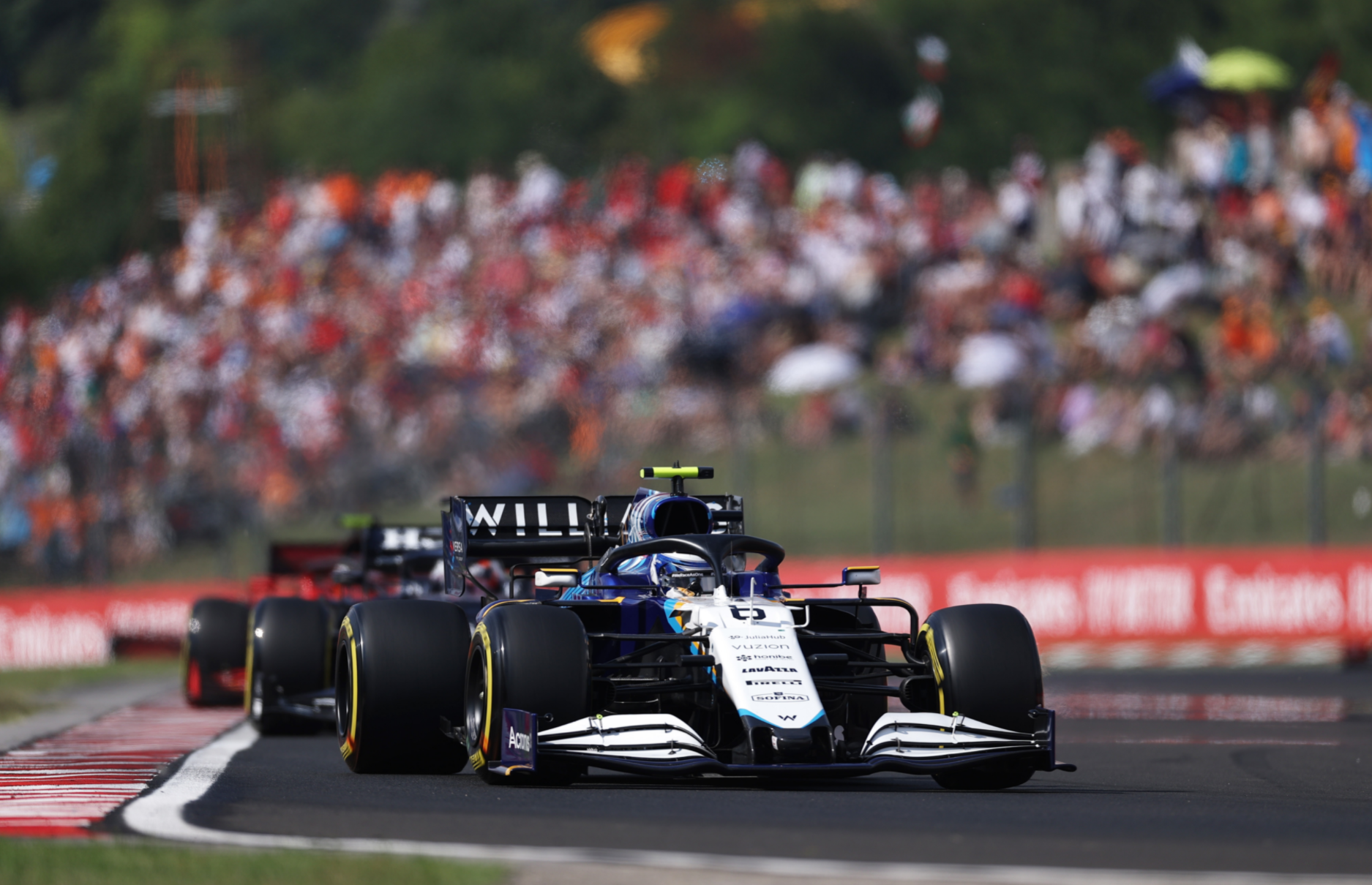
Nicholas Latifi running in the midfield.
Image credit: Getty Images

Verstappen fought valiantly with – as his engineer put it – half a car to earn the final point in tenth, but saw Hamilton retake the lead of the championship.

There was more drama to come after the chequered flag, however, as Vettel was disqualified. His Aston Martin had developed a fuel pump issue late on and the FIA were unable to take the one-litre sample required by the regulations. The disqualification is under appeal, but it looks likely that Vettel will sadly lose a well-deserved podium.

Sainz is promoted to third, which means – bizarrely – half of his four podiums have now come belatedly.

Why Didn’t Hamilton Pit?

Mercedes basically found themselves between a rock and a hard place.

With Hamilton at the front, it would have been brave for Mercedes to pull into the pits and potentially hand over pole position not knowing what everyone behind you is planning. And, more importantly, if they had done so and everybody had followed them in, they would have struggled to release their driver into a stream of cars coming down the pit lane.

Lewis Hamilton overtakes Mick Schumacher.
Image credit: Getty Images

Hamilton said after the race that the team had believed more rain was coming and their was no radio traffic between driver and team during the lap behind the safety car. Perhaps they thought it was banned – as some on social media also initially thought – with that being the case for the regular parade lap.

But as this was the effective third lap of the race, no such regulation was active. That is a silly mistake if so that may have contributed to what, in hindsight, was clearly the wrong call.

Either way, it set up a vintage Hamilton comeback. One which appeared to have taken a lot out of him as he visibly struggled to remain standing on the podium. Hamilton later revealed he fears he may be suffering from ‘long COVID’. Let’s hope the summer break gives him some time to continue his recovery.

More Sparks in the Title Fight

Tensions between Red Bull and Mercedes were already beyond simmering heading into the Hungarian Grand Prix, and this will not have done anything to calm them.

For the second race in a row, a Mercedes made contact with a Red Bull. Aside from the obvious implications in terms of points, the cost of the ensuing damage is piling up for the Austrian team, in the first year of a budget cap.

Carnage at the first corner of the Hungarian Grand Prix.
Image credit: AFP

Mercedes Team Principal Toto Wolff apologised to his opposite number, Christian Horner, but the Red Bull boss didn’t appear to be particularly appeased and asked if Wolff would be paying the bill.

“I’m sure he wasn’t that sorry to see the result. I’m sure he didn’t tell Valtteri to do that but the consequences of that for us are brutal. In a cost cap environment, that needs looking at by the FIA.”

In addition to Hamilton reclaiming the title lead, Mercedes have also passed their rivals in the constructors’ standings. And the update brought to Silverstone by the reigning champions appears to have moved them back level on performance. The Silver Arrows had the edge all weekend on a track which has not been their strongest in recent years.

For all the drama we have had to the halfway point of the season, it is effectively back to square one with both championships practically level.

Four weeks to rest and recuperate now, and then we go again.

The Hungarian Grand Prix in 60 Seconds

Answering the Burning Questions

How will Hamilton and Verstappen act in the wake of their controversial clash? As it was, they were not the source of the drama into Turn One. Whilst there were still a few barbed remarks, the relationship seemed respectful enough in the public eye.

Who will come out on top at a track with similar characteristics to Monaco but where Hamilton has won eight times? Well, Ocon actually, as we all predicted…

Can Ferrari keep up their impressive recent form? They showed strong pace again. Leclerc was bumped out of what would have been second place, but an eventual podium for Sainz will make up for that.

2021 British GP report | Hamilton wins at home after Verstappen clash

Finally, the flashpoint.
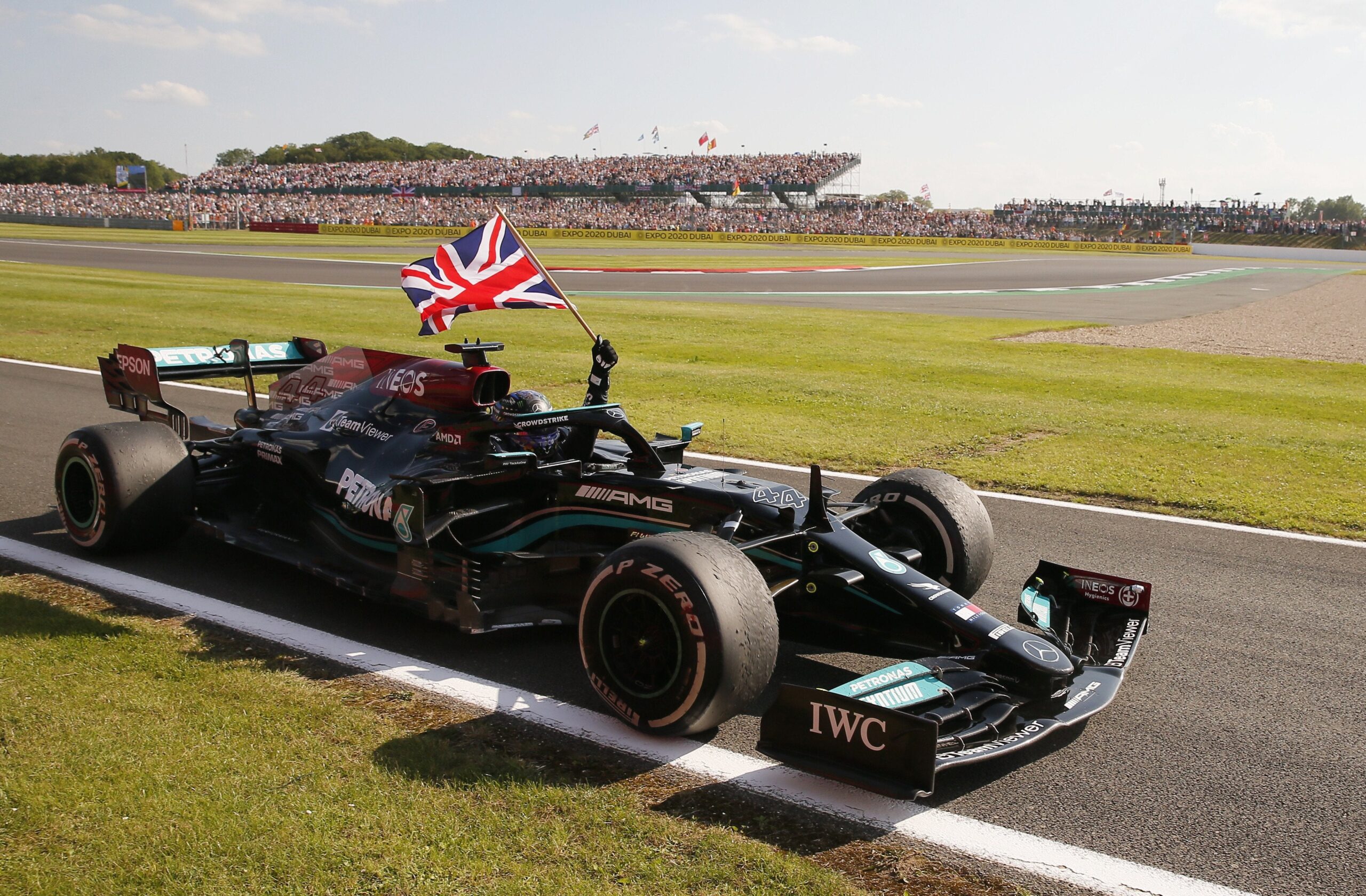
Lewis Hamilton celebrated his victory at the British Grand Prix.
Image credit: Reuters

Lewis Hamilton delighted his home fans with victory at the British Grand Prix after recovering from a first-lap clash with title rival Max Verstappen.

Saturday’s sprint qualifying experiment had put Verstappen on pole, leaving Hamilton disappointed after a great performance in the regular qualifying format on Friday evening.

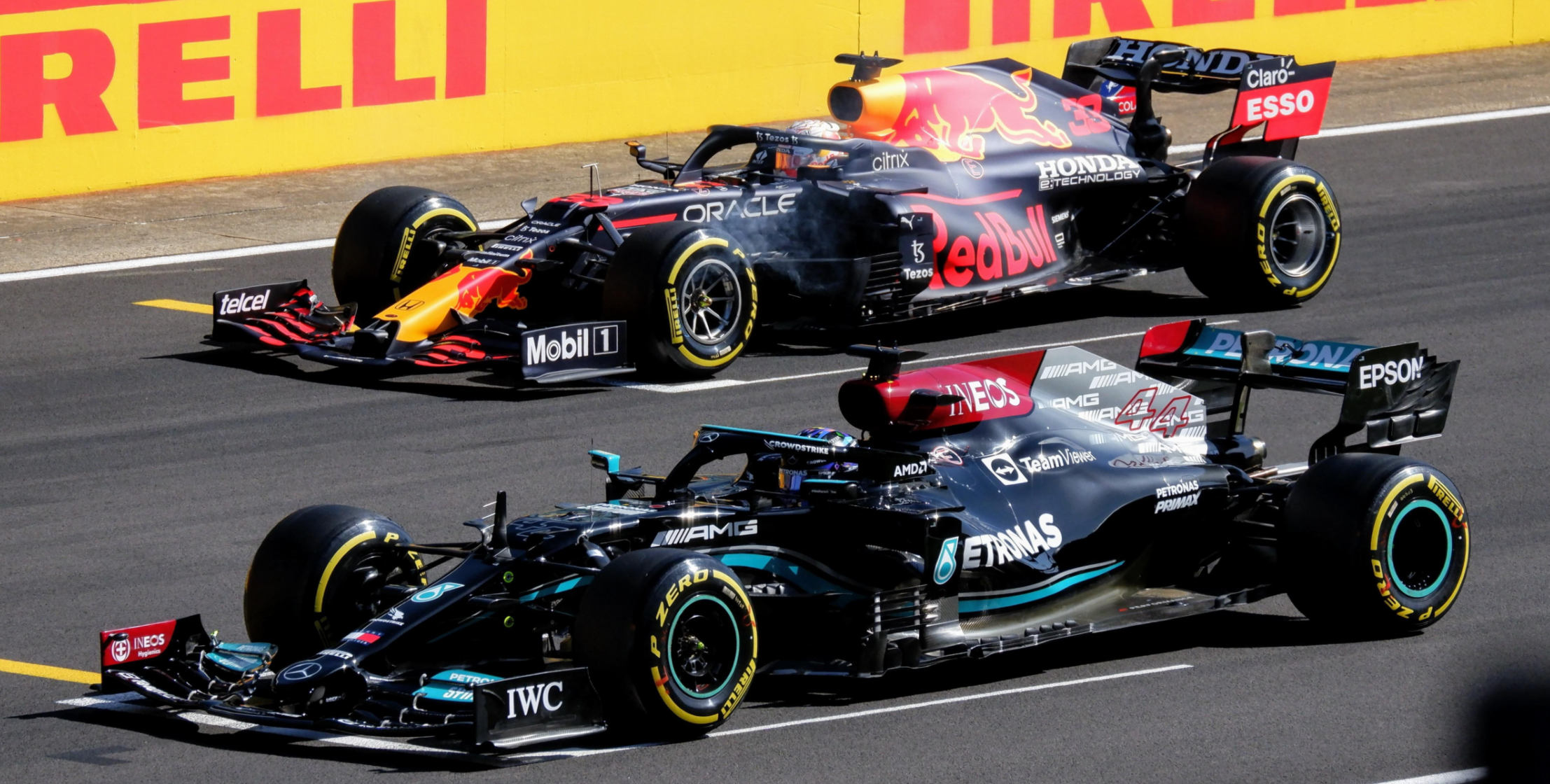
When the lights went out on Sunday, though, it was the World Champion who got away better. The pair fought tooth and nail for half a lap, regularly wheel-to-wheel and once brushing tyres on the Wellington Straight. Hamilton took a wide line around Luffield to get better drive and closed in on Verstappen down the old pit straight. The Red Bull defended but Hamilton sold him a dummy to move up the inside as the pair approached Copse at nearly 200 mph.

And then the clash – which has been narrowly avoided on numerous occasions this year – finally occurred.

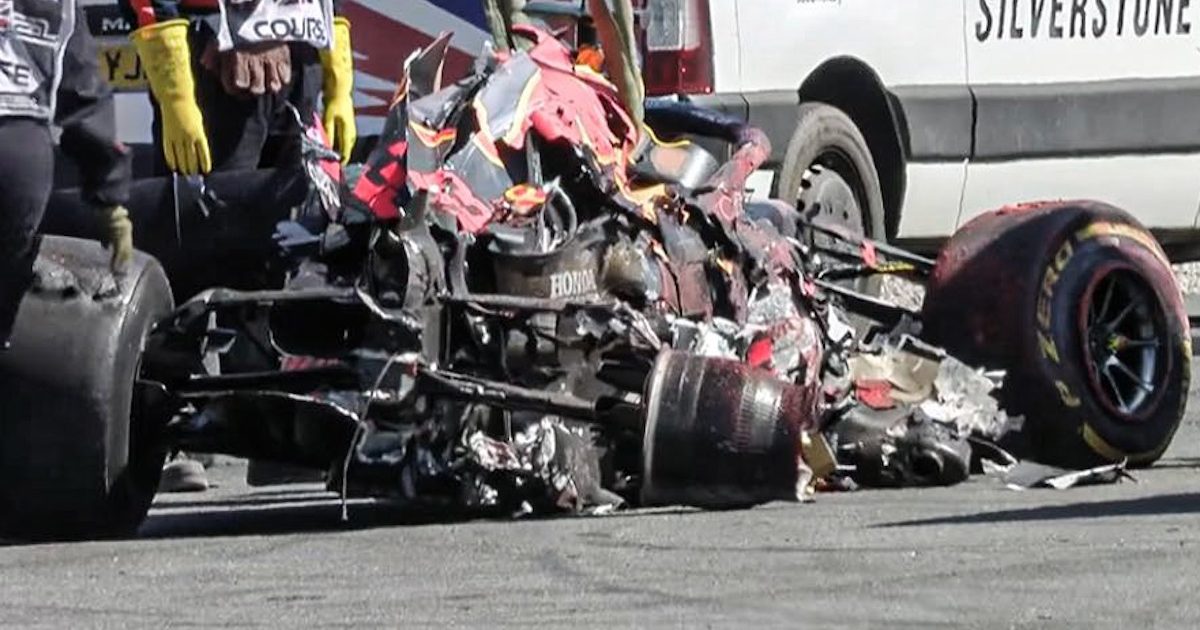
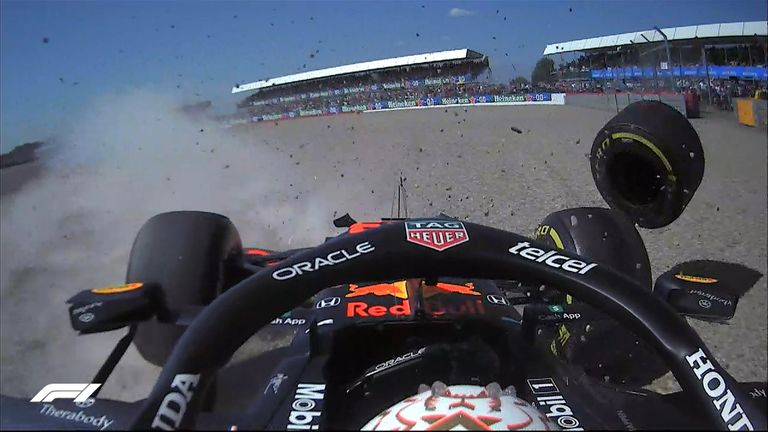
Hamilton’s right front and Verstappen’s left rear touched and the Dutchman was sent spearing into the wall at a terrifying speed. Whilst clearly winded and shaken, he was able to walk away from the accident and transported to hospital for cautionary checks.

The wreckage of Max Verstappen's Red Bull.

The Mercedes, meanwhile, had survived with minor damage and the race had been red flagged.

Once the barriers had been repaired, we witnessed our third standing start of the weekend with Charles Leclerc the unlikely polesitter. Hamilton sat in second – the damage to his car repaired with a bit of superglue – with his teammate, Valtteri Bottas, in third and fellow home hero Lando Norris in fourth.

The Ferrari held Hamilton at bay on the run to the first corner, but behind them Norris started well and passed Bottas for a provisional podium spot.

That would – somewhat surprisingly – remain the order through to the pit stops. Hamilton was generally within two seconds of the leader but couldn’t get close enough to fashion a move, despite occasional power issues for the Ferrari.

The Briton had been given a ten-second penalty as a result of his first-lap collision so an undercut was out of the question. He ran longer than those following, pitting on lap 28 and rejoined in what would effectively become fourth place.

A slow stop for Norris had left him behind Bottas and he didn’t fight as his compatriot stormed past into Copse on lap 31.

As Hamilton closed in rapidly on fresher tyres, his teammate was asked to move aside and that left just Leclerc – nine seconds up the road with 12 laps remaining.

By lap 50 of 52, Hamilton was within the slipstream of the Monegasque. Once again he found himself pulling alongside the leader on the run to Copse. This time, slightly further back, he backed out of it but Leclerc – aware of his competitor’s presence – ran wide and Hamilton was through.

Lewis Hamilton and Charles Leclerc at the British Grand Prix.
Image credit: AFP

The crowd roared and the World Champion repaid their support with his first victory since the Spanish Grand Prix back in May.

Leclerc came home an excellent second for his first podium of the year, with Bottas in third and Norris fourth – the young Briton now impressively moves up to third in the standings.

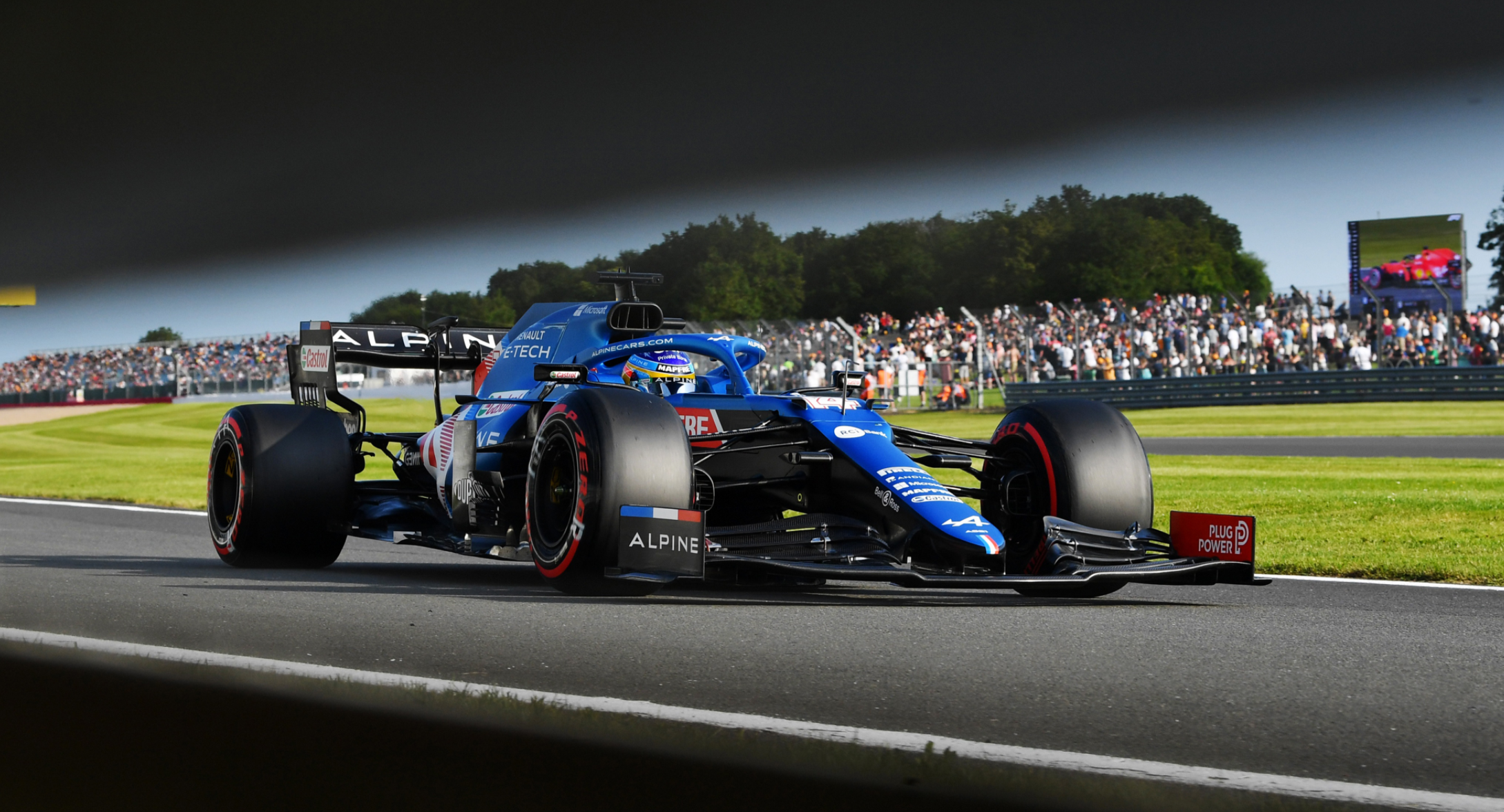
Daniel Ricciardo in the other McLaren held off Carlos Sainz for fifth and earned his best result yet in papaya. Fernando Alonso took a commendable seventh after his sprint qualifying heroics on Saturday, with Lance Stroll, Esteban Ocon and Yuki Tsunoda completing the top 10.

The Biggest Moment of the Season So Far

This collision had been coming. For months, if not years.

Hamilton and Verstappen have come within millimetres of each other on more than occasion this season.

Generally – throughout their time in F1 – Hamilton has been the one to back out. His approach has more often than not been focused in the long term, on the championship. Verstappen, on the other hand, has usually been in a position where he has nothing to lose.

Lewis Hamilton and Max Verstappen on the grid for the Sprint.

This time, crucially, those roles were reversed, but Verstappen’s approach remained the same.

This season, Hamilton was shoved wide at the first corner in Imola, and was very accommodating as his rival launched a divebomb up the inside a few weeks later in Spain. He learnt a long while back – and the hard way in 2011 – that staying out of trouble is often the best way to earn titles. But now, with the Red Bull the class of the field recently and Verstappen having opened up a 33-point lead, he found himself in a position to take risks again.

That has not been the case for a long time, and perhaps Verstappen thought he simply had the better of Hamilton. The Dutchman’s approach has always been comparable with Ayrton Senna‘s mantra of ‘Either you back out or we crash’.

Here at Silverstone, Hamilton did not back out and they did crash. And it was Verstappen who came off worse.

On board Max Verstappen's scary crash.

In hindsight, as the man with the significant points advantage, he should have been more circumspect. But his natural competitiveness and youthful hotheadedness – which has clearly not been totally ironed out just yet – saw him continue to take risks. Twice before their collision, Hamilton had avoided the Red Bull.

At the first corner, Verstappen came back onto the track sharply after running wide and then used up all the track at Brooklands despite entering the corner behind Hamilton.

In the end, a small penalty for car number 44 felt about right. It follows the precedent set by recent incidents where a driver on the inside has clipped the wheel of one on the outside, with an extra five seconds perhaps for the speed involved.

This was certainly not solely Hamilton’s fault. He understeered wide of the apex on cold tyres in a heavy car – he actually had more steering lock on than when hitting the apex during his battle with Leclerc – but Verstappen could also have left more space. Indeed, Hamilton backed out of a very similar situation with the situations reversed in the sprint 24 hours earlier.

The comments made by Christian Horner and Helmut Marko – who claimed Hamilton should receive a race ban – were frankly ridiculous, inflammatory and unnecessary.

Whatever your opinion on the incident, it has undeniably reignited a title battle that looked to be slipping away from Mercedes and likely provided a real spark between the two protagonists. Hamilton lifted the trophy on Sunday, but F1 was the biggest winner.

What Did We Make of Sprint Qualifying?

Fernando Alonso at the British Grand Prix.

This was due to be the main talking point until the lap 1 drama unfolded. But it’s still worth mentioning on a weekend where F1 trialled the biggest change to its format for decades.

Personally, I remain unconvinced. It didn’t sit right with me that the fastest driver over one lap didn’t earn pole position. The sprint on Saturday cheapened the regular qualifying session and acted as a spoiler for the main race, revealing certain elements of teams’ race pace and tyre life that would normally remain a mystery until the headline event.

As for the sprint itself, the first couple of laps were, of course, thrilling, but the remaining 15 were something of a procession as those out front were barely seen and a DRS train formed in the midfield. Fernando Alonso‘s extraordinary start provided most of the remaining entertainment as he slowly fell backwards after moving up from 11th to 5th in the first few corners.

Ross Brown and co are clearly determined to add more events to the race weekend, but they must be wary of quantity over quality on an ever-increasing calendar.

However, a close friend who has never really been interested in F1 messaged me after the race – initially commenting on Hamilton’s “big ball energy”… – to say that he had been drawn in by the new weekend format, with it sounding more interesting to a casual viewer. So, it has clearly had the desired effect.

If something like this ends up as a special occasion at three or four races a year, that could certainly work. The sprint race itself needs some tweaking. Perhaps a reverse-championship-order sprint for a few points to really embrace the mayhem; although the budget cap means teams are unlikely to go for that. Whatever they choose, for the love of god, just call it a race rather than ‘Sprint Qualifying’. It’s quite clearly a short race, and all the members of the media desperately trying to avoid calling it as such was a bit cringeworthy.

The British Grand Prix in 60 Seconds

Answering the Burning Questions

Will the Sprint Qualifying format be a success? A disaster? Somewhere in between? See above. Let’s go with somewhere in between.

Can Mercedes get back on terms with Red Bull at one of Hamilton’s most successful tracks? One way or another, yes.

Will their long overdue upgrades make a big difference? The updates certainly seem to have brought them closer. With Verstappen out of the race and Sergio Pérez stuck at the back, though, it was hard to tell.

2021 Austrian GP report | Verstappen reigns supreme again in Austria

More Austrian dominance for the man becoming the clear title favourite.
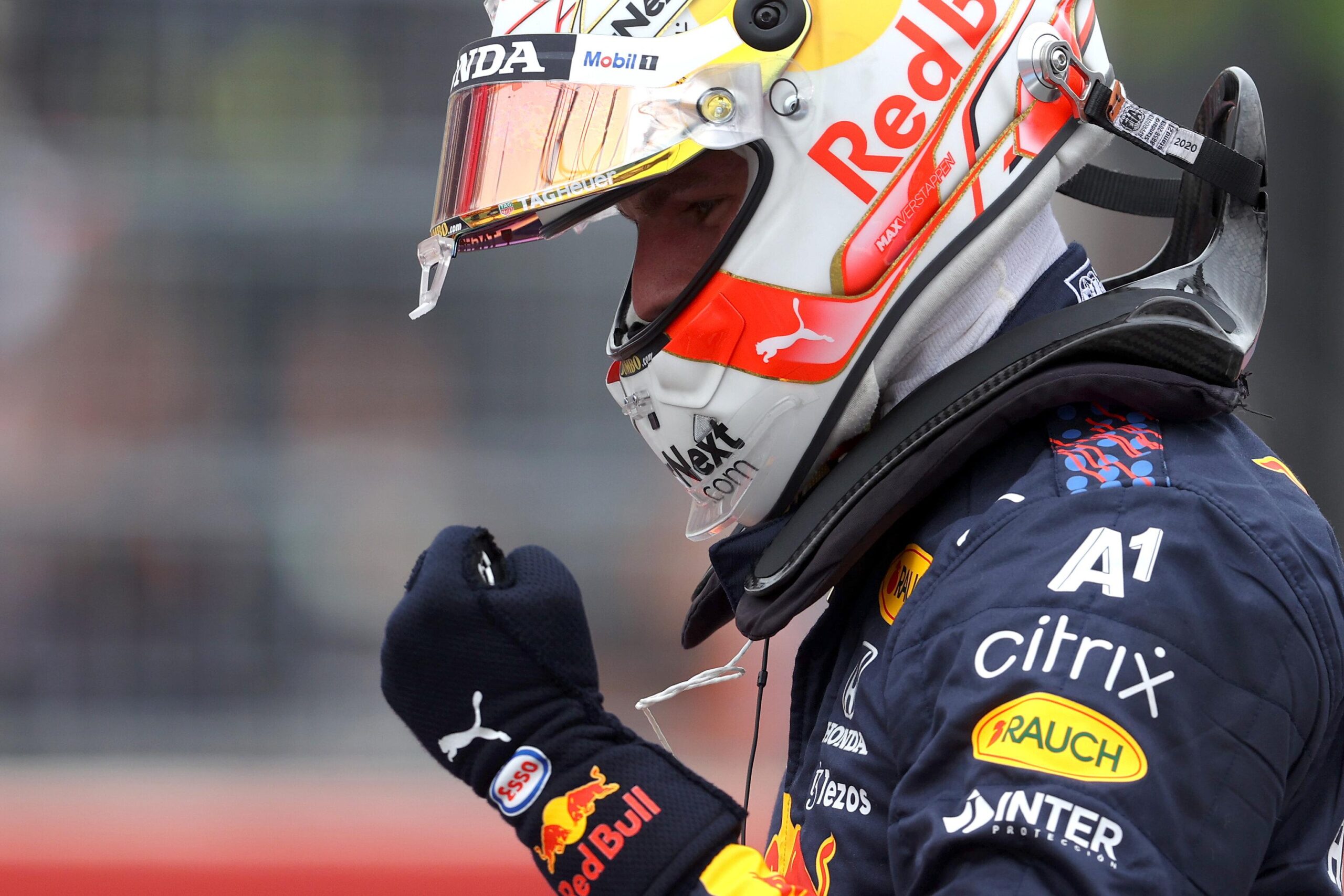
Max Verstappen sends the Orange Army wild by winning the Austrian Grand Prix.
Image credit: Getty Images

Seven days after his first domination at the Red Bull Ring, it was a similar serene drive to the win for Max Verstappen at the Austrian Grand Prix.

As predicted, with no freak mechanical issues or weather to intervene, the Dutchman delighted the swathes of fans clad in orange.

Mercedes hoped to have found something to reduce the gap to their rivals in the days since the Styrian Grand Prix. But that was clearly not the case when they found themselves down in fourth and fifth on the grid, behind both Red Bulls and the excellent Lando Norris.

Once the lights went out, Verstappen sailed off into the distance and did not look back. He had a gap easily large enough to pit late on and earn himself the fastest lap – by nearly two seconds – and took the first grand chelem of his career, having also claimed pole position and led every lap.

Lewis Hamilton probably would have settled for more damage limitation in the shape of a second place, and he looked on for just that once he’d found a way past Norris on lap 20. But, just before his pit stop, a piece of crucial aero fell off the back of his car, leaving him with massively reduced rear downforce and costing him half a second per lap.

Lando Norris and Lewis Hamilton battle for second place.
Image credit: Motorsport Images

It remains something of a mystery what caused this. The World Champion did not run especially wide when the bodywork made a break for it – he was running over the kerbs at Turn 10 as normal. Team Principal Toto Wolff believes it was simply a case of fatigue as teams are forced to make parts last longer amid the new cost cap for 2021.

So, further bad luck for Hamilton and he was helpless to defend as teammate Valtteri Bottas and Norris repassed him. That left the 36-year-old in fourth and he is now a massive 32 points behind his title rival in the standings.

The Future May Be Orange, but It’s Also British

Whilst Verstappen demonstrated once again what we all know – that he will be a superstar for many years to come – there were two other drivers who showed their considerable potential.

Norris and George Russell.

Norris’s qualifying lap was extraordinary. He took his McLaren to within five hundredths of a second of the all-conquering Verstappen to take his first ever front row grid slot.

Lando Norris at the Austrian Grand Prix.
Image credit: Motorsport Images

And Russell was equally impressive, dragging his Williams into Q3 for the first time and ending up eighth on the grid after a Sebastian Vettel penalty.

On race day, Norris defended against the Mercedes pair with nous and composure far beyond his years, even prompting Hamilton to say over the radio, “Such a great driver, Lando”. That is something you very rarely hear from a driver mid-race.

Bottas would only succeed in passing Norris after the young Briton received a debatable penalty for forcing Sergio Pérez wide following a safety car restart early in the race. And the Mercedes driver hardly disappeared into the distance once in front as Norris tailed him home to finish just two seconds back and earn his fourth career podium.

Further back, Russell had recovered from an iffy start to run in a legitimate 10th place through solid race pace and was heading for his first point with Williams. But then came Fernando Alonso. The 23-year-old defended hard from the man he has formed an unlikely bromance with, but eventually had to concede to the Alpine‘s far fresher tyres with just three laps to go.

After a mechanical retirement in the previous race removed Russell from eighth, his luck may not have improved but he continues to earn fans, including Alonso: “I felt a little bit sad for George because he drove an amazing weekend. When I saw P10, I was hoping anyone apart from him…but that’s the sport. He will have more opportunities hopefully for podiums and wins in the future.”
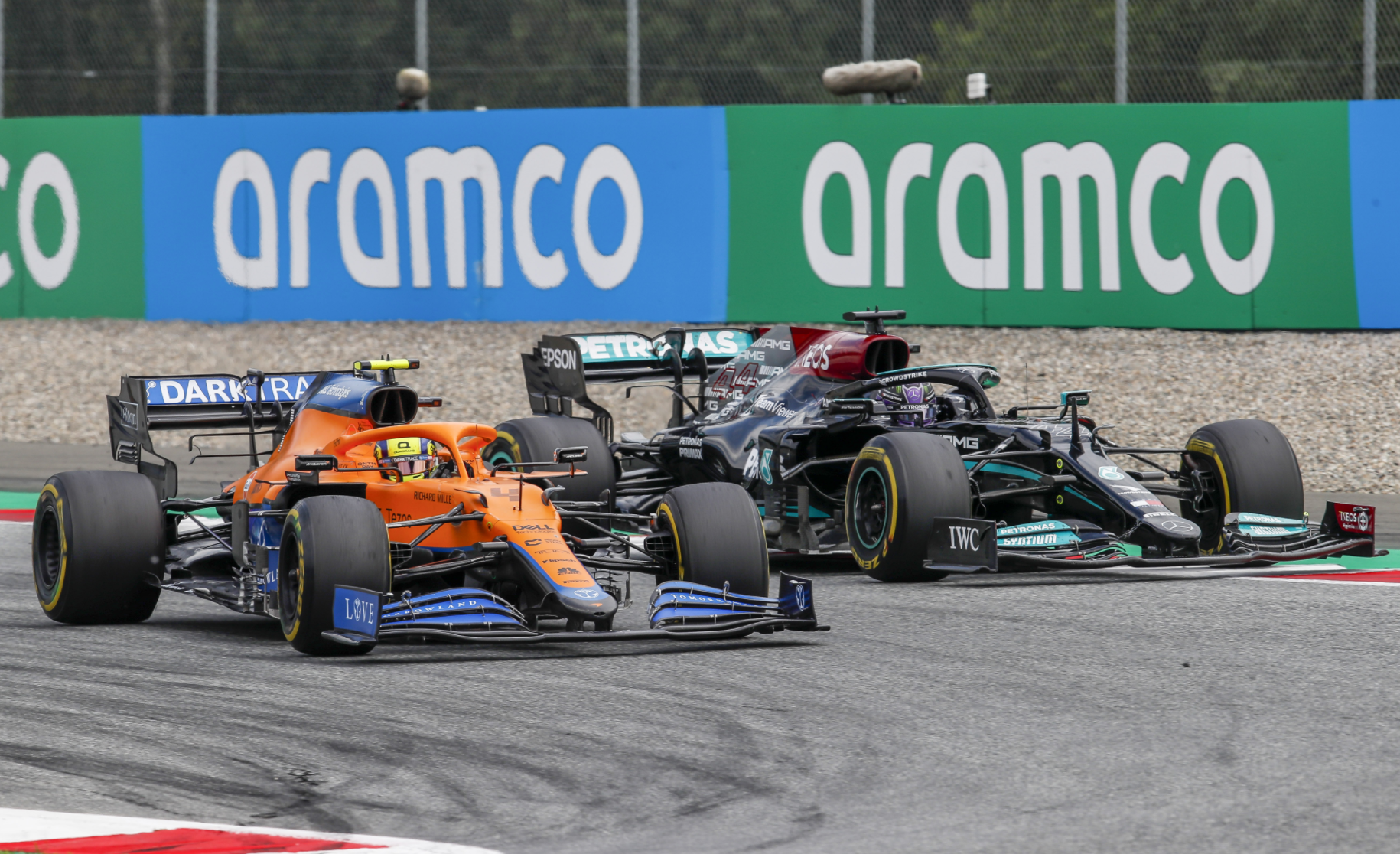
George Russell at the Austrian Grand Prix.
Image credit: Getty Images

Earning compliments from legends like Hamilton and Alonso shows just how much respect these two young drivers have earned over their two and a half years in F1.

In Verstappen, Norris, Russell and Charles Leclerc, the future of the sport looks in safe – and exciting – hands.

Were the Penalties Fair?

The move for which Norris earned his penalty, was mirrored by Pérez himself as he ran Leclerc wide twice later in the race. Each incident earned a five-second penalty.

It is good to see consistency from the stewards for once – though perhaps not in the long term – but were they consistently right or wrong on this occasion?

It’s tricky. The issue is Turn 4, where the two main incidents happened. It is a demanding corner with significant adverse camber and a gravel trap on the outside. So, this was not simply a case of Norris opening the steering up and running Pérez out of road – something we have seen go unpunished many times before anyway. It was more a case of the McLaren naturally understeering towards the edge of the track.

So, the only way to avoid contact or forcing the car on the outside wide would be to get off the throttle and cede the position. Is that something the lead driver on the inside line should ever have to do?

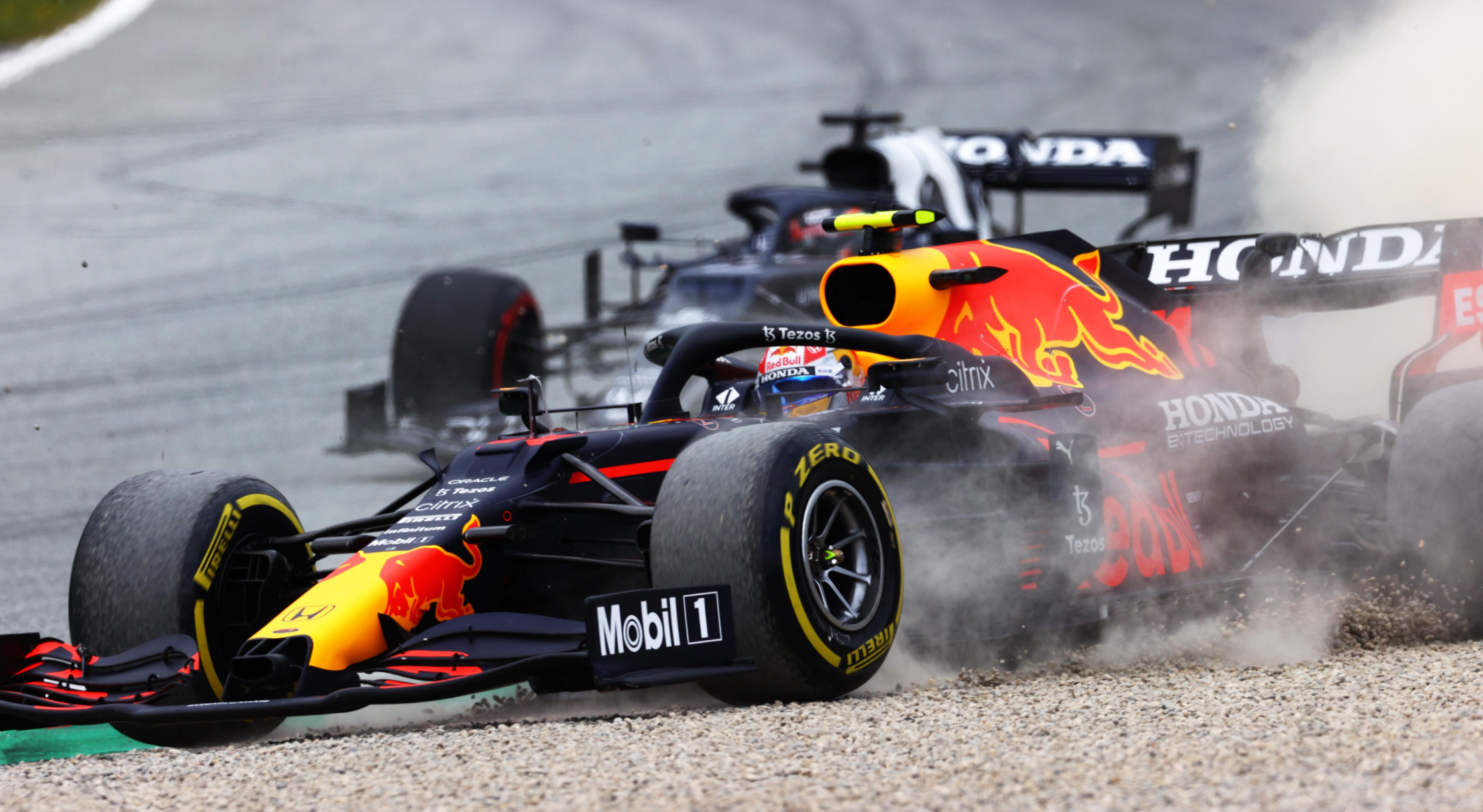
Sergio Pérez in the gravel.
Image credit: Getty Images

The penalty seems more harsh given that it was on the first full lap of racing, when incidents are normally treated with more leniency due to cold tyres, cold brakes and the general mayhem. Case in point: Leclerc not even being investigated for clumsily ending Gasly’s race a week ago, a few seconds earlier in the lap.

Whatever your opinion on the decisions, the penalty points system is clearly broken.

Two penalty points for the incident leaves Norris on ten points – although two will be wiped before the next race – which is just two away from a race ban.

I have touched on the penalty points system as recently as the Azerbaijan Grand Prix – when Norris and Nicholas Latifi were each given three points for tricky situations in which they found themselves somewhat helpless – and they remain unfit for purpose.

They should be reserved for seriously dangerous driving – such as the unpunished moment between the Haas driver in Baku – and safety violations that put people at risk.

Six instances of Norris’s arguably justified defence should be nowhere near worthy of a race ban.

And don’t forget the bewildering decision to hand Latifi and Nikita Mazepin a post-race stop-and-go penalty for ignoring double yellows, but none of the other drivers who appeared to go through them at least as quickly…

The Austrian Grand Prix in 60 Seconds

Answering the Burning Questions

Can Mercedes find anything to challenge Red Bull more than last weekend? Nope.

Will the softer tyres make much of a change to the pecking order? Alpine appeared to find some more pace but events conspired to prevent them utilising it.

Any chance of some rain this time? *sigh* Of course not.

2021 Styrian GP report | Verstappen and Red Bull dominate at home

A race that probably could have used some rain.
Max Verstappen celebrates winning the Styrian Grand Prix.
Image credit: Getty Images

Max Verstappen strengthened his grip on the championship with a dominant win in Red Bull‘s back yard at the Styrian Grand Prix.

It was a weekend where the Red Bulls ruled, topping every session except Practice 3, and once Verstappen had successfully navigated the start and the first couple of corners, it looked unlikely that he would be challenged.

In truth, a challenge looked unlikely as soon as the forecast rain failed to appear.

Mercedes may have been able to compete in terms of race pace seven days earlier, but that was at Paul Ricard. The French track has been a strong track for the Silver Arrows since it returned to the calendar; the Red Bull Ring generally has not.

Max Verstappen leads the Styrian Grand Prix as Lewis Hamilton, Lando Norris and Sergio Pérez battle behind.
Image credit: Getty Images

In the early stages of the race, Lewis Hamilton managed to keep his title rival close enough to see the now sturdier Red Bull rear wing a few seconds up the road. But as they approached the pit stop window, Verstappen began to turn the screw. And once into the second stage of the race, any hopes of Mercedes utilising a tyre wear advantage to make a race of it also dissipated as Verstappen extended his advantage without drama.

Unlike in France, there was nothing Hamilton and his team could have done differently on strategy this time – Verstappen simply had them covered on outright pace.

The Dutchman eventually reached the flag over 30 seconds ahead of Hamilton, once the Britain had stopped for a set of softs and a consolation bonus point for fastest lap. And it should have been a double podium for the home team.

After all the talk of pit stop regulations – more on that later – it was ironically a botched Red Bull stop which cost Sergio Pérez. Having navigated past the once again excellent Lando Norris, Pérez appeared to have Valtteri Bottas covered in their fight for the final podium spot. But a slow stop dropped him back behind the Finn and a gamble to switch to fresh medium tyres narrowly failed. One more lap would have done it. Pérez broke into the DRS window on the last lap but stood no chance of passing through the final five corners.

The Red Bulls at the Styrian Grand Prix.
Image credit: Getty Images

Norris ran a lonely but effective race to finish fifth and impressively remain above Bottas in the standings. The Ferraris reversed their form from the last grand prix. In France, they started well but fell badly through the field. Here, a poor qualifying from Carlos Sainz and a clumsy opening lap by Charles Leclerc were rectified by impressive race pace which saw the pair recover to sixth and seventh respectively.

That means Ferrari narrow the gap to McLaren slightly after Daniel Ricciardo failed to score points. The Aussie struggled once again in qualifying and, after he had made amends with an excellent opening lap, a temporary loss of power saw him plummet back down the order. The Honey Badger just can’t catch a break right now.

Lance Stroll came home a solid eighth, Fernando Alonso continued his return to form in ninth and Yuki Tsunoda had a better weekend to take the final point.

It’s back to Spielberg again in a week’s time and Mercedes won’t be enjoying the prospect of another chastening dent to their title defence. Can we hold out any hope for a more interesting race? Perhaps. The tyres are a step softer and the two races in Silverstone last year showed how much of a difference that can make. And who knows – maybe it could even bloody rain when it’s supposed to this time…

A Storm in a Pit Stop

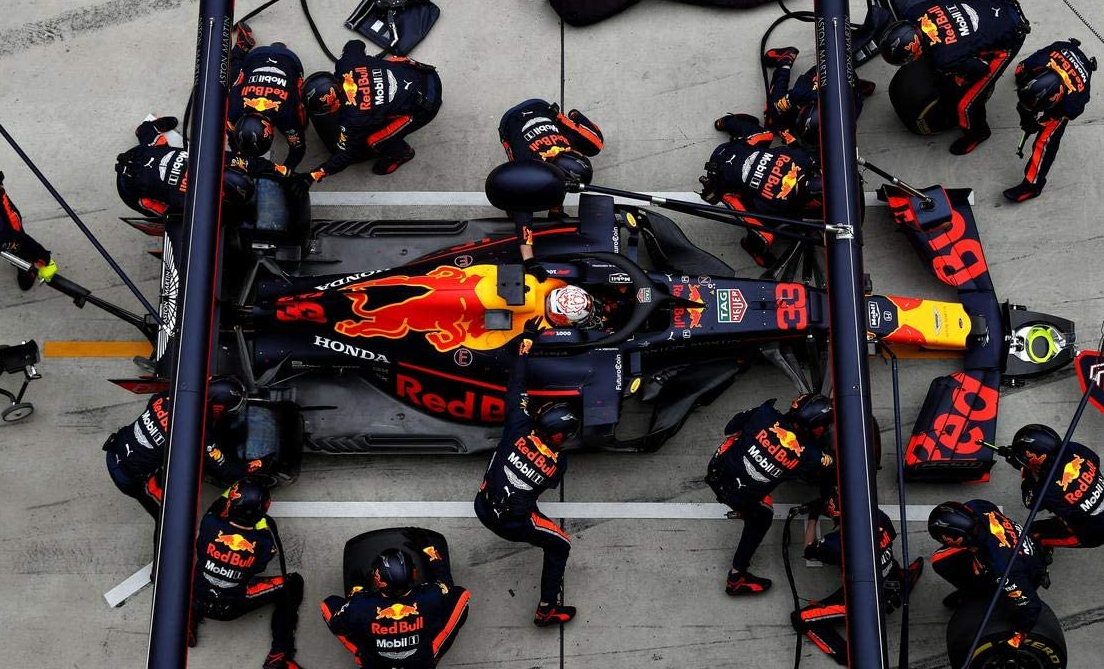
An overhead shot of a Red Bull pit stop.
Image credit: Getty Images

There was a lot of talk in the run-up to the Styrian Grand Prix about a new technical directive regarding pit stops.

“This is an outrage!” screamed large portions of social media. “It’s the FIA trying to help Mercedes against Red Bull!” yelled armchair experts as their tin foil hats slipped over their eyes.

The reality is that this will make very little difference and – more to the point – if it does affect any teams, they were exploiting a loophole and endangering their own pit crews.

The technical directive mandates a minimum 0.15-second delay between the wheel nuts being confirmed as tight and the mechanic operating the jack dropping the car, and 0.2 seconds from the jack going down to the driver receiving the signal to leave the pits.

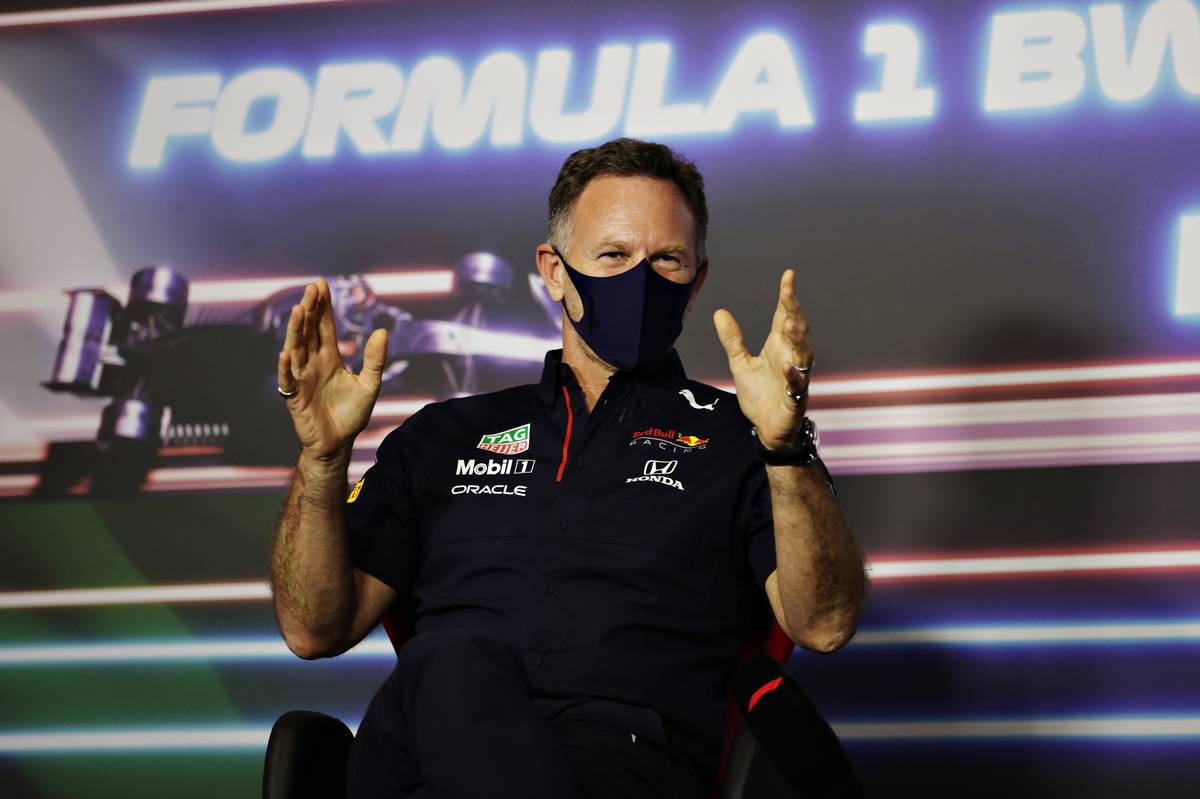
Christian Horner, of course, piped up – windbag that he is – to claim that, “To have to hold the car for two tenths of a second, you could almost argue it’s dangerous because you’re judging your gaps. The guy that’s releasing the car is having to make that judgement, and I think that it’s not been well thought through.”

Christian Horner at a press conference.
Image credit: XPB Images

That is nonsense. There will be no judging a 0.15-second gap. For the same reason that an Olympic sprinter or an F1 driver starting in less than that is deemed to have jumped the start. That is quite simply the absolute fastest a human being can react.

If you doubt me, please go and attempt to react in under 150ms here: https://humanbenchmark.com/tests/reactiontime

All this clarification does is ensure that there are no automated systems in play. Systems that would speed up times but reduce safety. It’s very easy for Horner to give his two cents, sat on a comfy chair on the pit wall… But it’s a different matter entirely when a 900kg, 1000 bhp Formula 1 car is millimetres away from doing you significant damage.

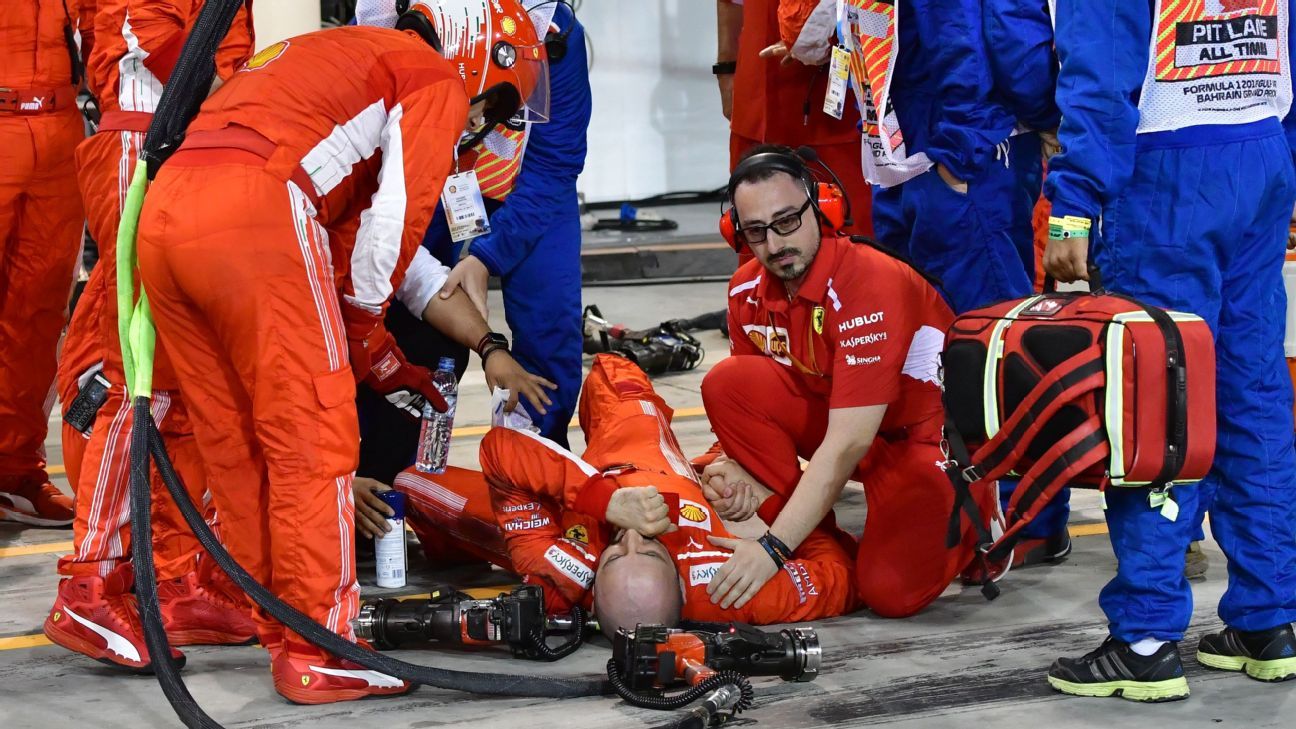
Let’s not forget, it was only three years ago that a Ferrari mechanic had his leg broken when an automated system gave Kimi Räikkönen an errant green light.

The Ferrari mechanic injured by Kimi Räikkönen at a 2018 pit stop.
Image credit: Giuseppe Cacace

Loose wheels bouncing down the pit lane are equally dangerous.

And again, if there are no illegal systems at play, Horner should have nothing to worry about. So, let’s just all move on shall we? It will probably all have been forgotten about by the time it comes into play at the Hungarian Grand Prix anyway.

The Styrian Grand Prix in 60 Seconds

Answering the Burning Questions

Can Mercedes turn around their form on Red Bull’s home track? Nope.

Will we see a wet and wild weekend? As is tradition, the likelihood of a wet race went from 90% on Friday, to 40% on Saturday, to 0% on Sunday morning. The best we got was a few drops in Practice 2. Typical.

Can Ferrari solve their race pace/degradation issues? Yes, Sainz produced an impressive first stint to overcut most of the midfield.

2021 French GP report | Verstappen wins strategic battle

The hunter becomes the hunted.
Max Verstappen celebrates winning the French Grand Prix.
Image credit: Getty Images

Max Verstappen and Red Bull bested their title rivals in a strategic rollercoaster at the French Grand Prix.

Paul Ricard had historically been a Mercedes track – Lewis Hamilton comfortably winning both races since it returned to the calendar in 2018 – but Red Bull were immediately on the front foot this weekend.
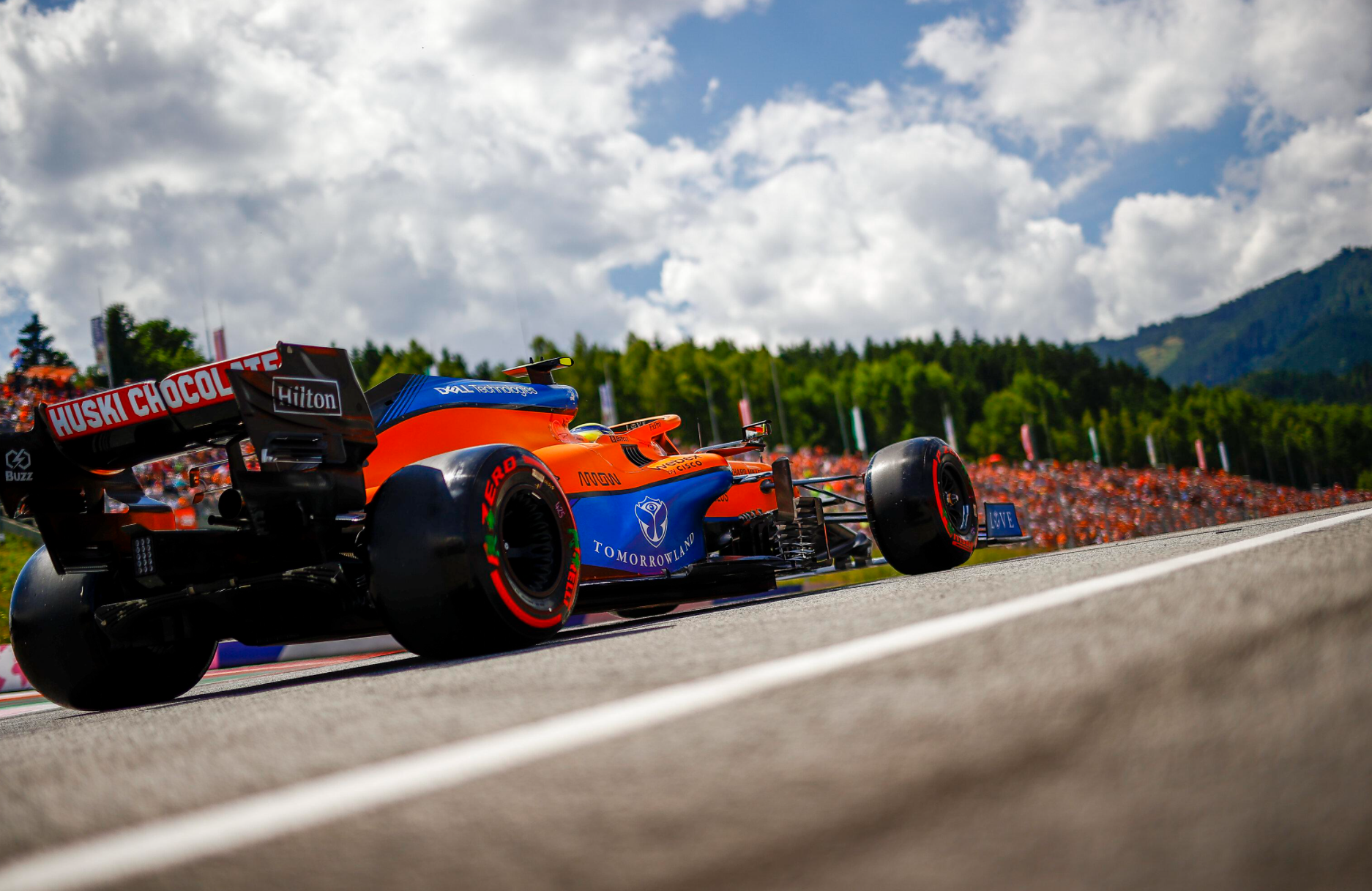
Mercedes, and Hamilton in particular, once again struggled to find a setup for their car. But the World Champion did what he so often does and produced the goods when it really mattered to join Verstappen on the front row.

And that front row soon became the lead when Verstappen was caught out by a tailwind into the first corner; the Dutchman running wide and handing the advantage to his rival.

Max Verstappen runs wide at the first corner.
Image credit: AFP

Hamilton held that lead through the first stint and had extended his advantage to around three seconds when Mercedes triggered the front-running pit stops by bringing in Valtteri Bottas. Red Bull responded a lap later to protect against the undercut but Mercedes, crucially, left Hamilton out.

When car number 44 stopped on the next lap, it became evident that the Mercedes strategists had severely underestimated the power of the undercut. Verstappen swept by into the first corner with the helpless Hamilton left frustrated as his team apologised over the radio, saying they “didn’t really know what had happened there”.

Hamilton channelled his frustration into an immediate attack. The Mercedes pair stalked Verstappen, following within two seconds in an attempt to force him to use up his tyres. It worked, but it ultimately forced Red Bull into a race-winning call.

Wary of another situation like Spain this year or Hungary 2019, Red Bull decided to make what Team Principal Christian Horner later described as a “ballsy call” to pit Verstappen from the lead. The Dutchman emerged with an 18-second gap to chase down in 20 laps.

Max Verstappen entering the pits.
Image credit: Getty Images

But chase them down he did. The gap initially reduced at a rate of two seconds per lap, and Bottas failed to slow him down on tyres which were now well past their best. But Hamilton had done his trademark tyre whispering and for a brief moment the gap appeared to be holding steady at around five seconds as they navigated through backmarkers.

Once in clear air, however, Verstappen upped his speed and Hamilton was once again helpless as the Red Bull dived to his inside to reclaim the lead with a little over a lap remaining. A crucial 14-point swing in the drivers’ standings which leaves the Dutchman with a healthy lead heading to Red Bull’s home track in Spielberg.

Behind the leading pair, Sergio Pérez had been easier on his tyres and passed Bottas for the final spot on the podium. The McLarens had also shown excellent race pace to move up to fifth and sixth, Lando Norris leading home Daniel Ricciardo on a far stronger weekend for the Honey Badger.

Pierre Gasly continued his strong form to finish seventh at his home grand prix, with Fernando Alonso and the Aston Martins of Sebastian Vettel and Lance Stroll completing the top 10.

Sebastian Vettel, Esteban Ocon and Antonio Giovinazzi at the French Grand Prix.
Image credit: Getty Images

It was a shocking day for the Scuderia as the red cars fell from fifth and seventh on the grid to finish outside the points in 11th and 16th. Ferrari got their strategy all wrong and have now lost third in the standings to McLaren.

More Mercedes Mistakes

Speaking of strategy… The Mercedes strategists are on a horrible run of form.

First, they undercut when they should have overcut in Monaco. That lost Hamilton two places on a circuit where strategy is of the utmost importance and condemned him to seventh place. In Azerbaijan, another undercut and a sluggish pit stop saw Hamilton fall from first to third. And now, in Le Castellet, they were mugged twice by a far sharper Red Bull team.

The power of the undercut was evident. Before the front-runners had pit, Ricciardo undercut both Gasly and Carlos Sainz when his team had only been attempting to jump the former. But Mercedes inexplicably chose to leave their leading man out for an extra lap, overly confident in his three-second cushion.

And to what end? Tyres which were one lap younger than those of Verstappen?

Lewis Hamilton at the French Grand Prix.
Image credit: Mercedes

Once the first mistake had been made, there was still a chance to make amends. The other thing that had been clear to see during the race was that tyre degradation was far higher than expected. But it was again Red Bull who reacted more quickly, bringing in Verstappen and forcing Mercedes to attempt to make it to the end. The usually cool Bottas vented his frustration over the radio that his pleas for a two-stop had been ignored.

Is this just a few bad races, or is Mercedes’ strategy actually the most significant chink in their armour?

For years, the seven-time World Champions have been described as a well-oiled machine, but their superiority over the field has often masked their strategic deficiencies. It doesn’t particularly matter when you mess up if the only competition is your other car…

In a genuine title battle, they have been exposed before.

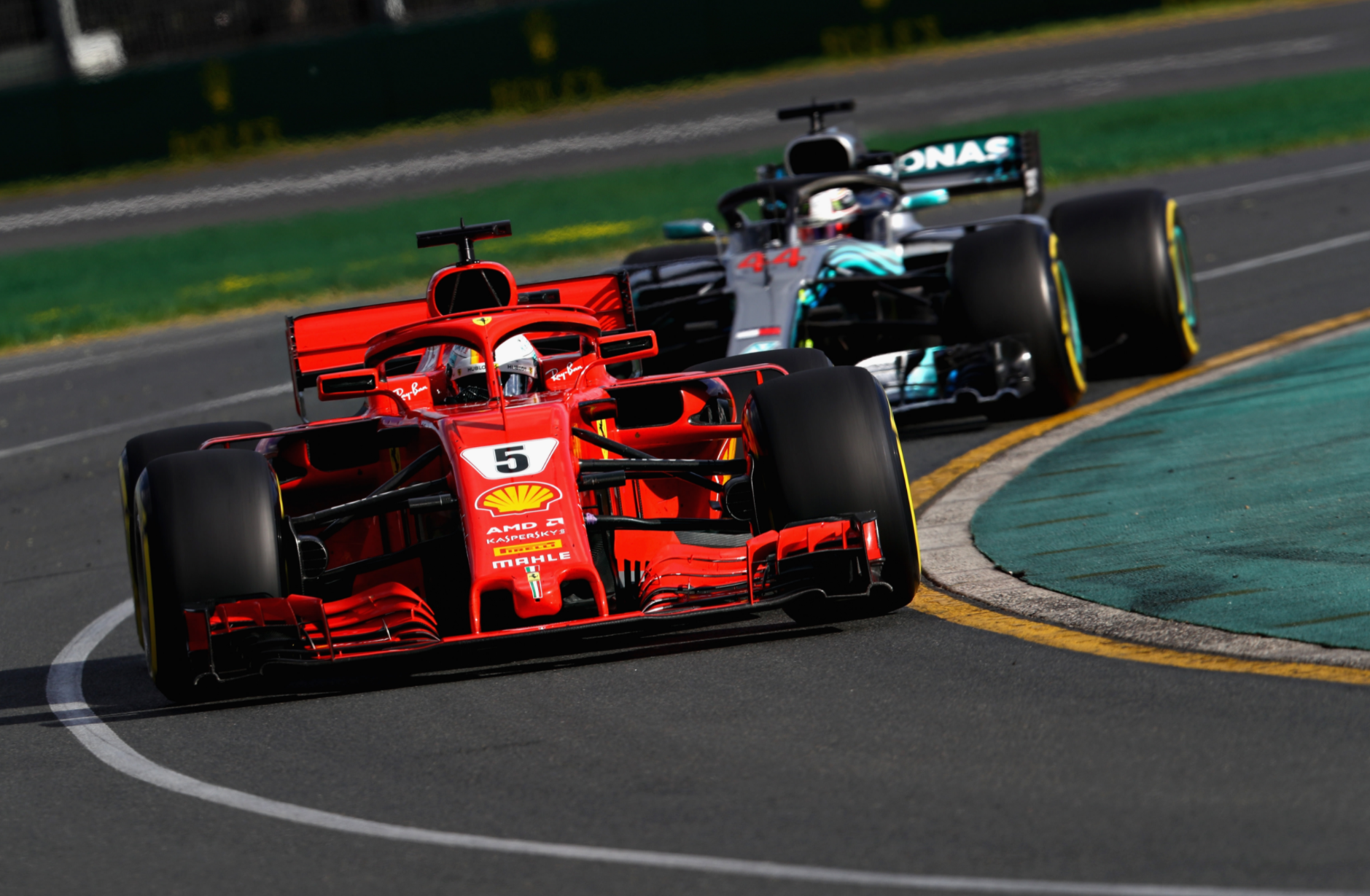
Sebastian Vettel and Lewis Hamilton at the 2018 Australian Grand Prix.
Image credit: Getty Images

During their fight with Ferrari in 2018, there were numerous mistakes. They miscalculated the VSC delta in Australia, losing Hamilton a win. In China, they failed to pit him under a Safety Car. The same thing happened in Austria. They kept him out too long at the US Grand Prix and handed Kimi Räikkönen a win. The list goes on.

Even in such a dominant march to the title as 2020, there were many operational errors. Be it failing to see that the pit lane was closed in Italy, advising Hamilton he could do a practice start in the wrong place in Russia, or the pit stop debacle in Sakhir.

Red Bull, on the other hand, come across as ruthlessly efficient at the moment. And they also appear to have the slightly faster car.

So, if Mercedes want to stand a chance of winning either title this year, they will have to make sure these issues are ironed out sharpish. Even with Hamilton to occasionally flatter their decisions.

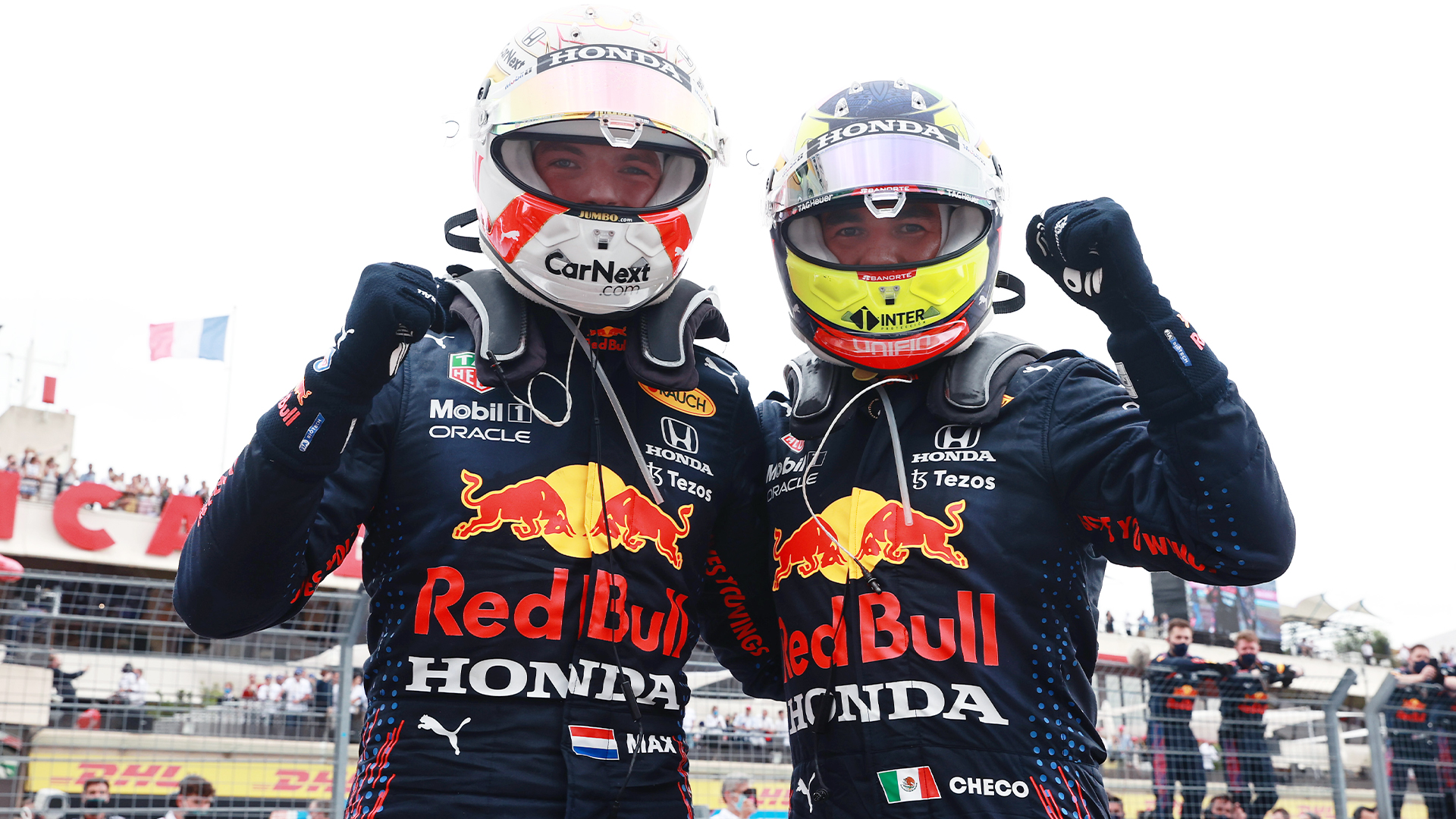
Max Verstappen and Sergio Pérez celebrate a double Red Bull podium at the French Grand Prix.
Image credit: Getty Images

The French Grand Prix in 60 Seconds

Answering the Burning Questions

Can Mercedes recover from two tough weekends? It was better, but Red Bull completed their hat-trick nonethless.

Will we see any more tyre dramas? No explosions thankfully, but the degradation spiced things up.

Will the new wing tests have a noticeable effect on the competitive order? Not really. That whole drama has basically been forgotten about already.

2021 Azerbaijan GP report | Pérez wins as Baku serves up more mayhem

Just your usual chaotic Azerbaijan Grand Prix.
Sergio Pérez celebrates winning the Azerbaijan Grand Prix.
Image credit: Getty Images

Sergio Pérez took a surprise win at the Azerbaijan Grand Prix as both title contenders, Max Verstappen and Lewis Hamilton, failed to score points.

Charles Leclerc had made it back-to-back pole positions against the odds on Saturday. Hamilton was ecstatic to have recovered to second on the grid, after a very challenging start to the weekend for Mercedes, and Verstappen was just behind in third.

The order at the front remained the same as the lights went out, but it was always going to be a matter of time before the Ferrari succumbed to the faster cars behind. Hamilton used his extra straight-line speed to take the lead after two laps and Verstappen followed suit at the start of lap 7. Pérez had made good progress from sixth on the grid and was also able to dispatch the Ferrari a lap later.

Hamilton was just about able to hold the chasing Bulls at bay. His low-downforce setup meant that he had the top speed to keep out of reach on the straights but was unable to break away as he lacked his rivals’ grip in the middle sector. With Verstappen closer than ever and Hamilton’s tyres long past their best, Mercedes brought him into the pits on lap 12. However, the World Champion had to be held in his box as Pierre Gasly trundled past and, with a pair of quick in-laps, the Red Bull drivers were both able to overcut him.

Over the next hour, Hamilton pressured Pérez but never looked close enough to truly challenge him. Even a safety car on lap 31, when Lance Stroll had a scary crash as his tyre exploded at over 300 kph on the main straight, didn’t change much at the front. It looked as though we had our finishing order wrapped up as Verstappen delivered a fastest lap with five laps remaining. But then…

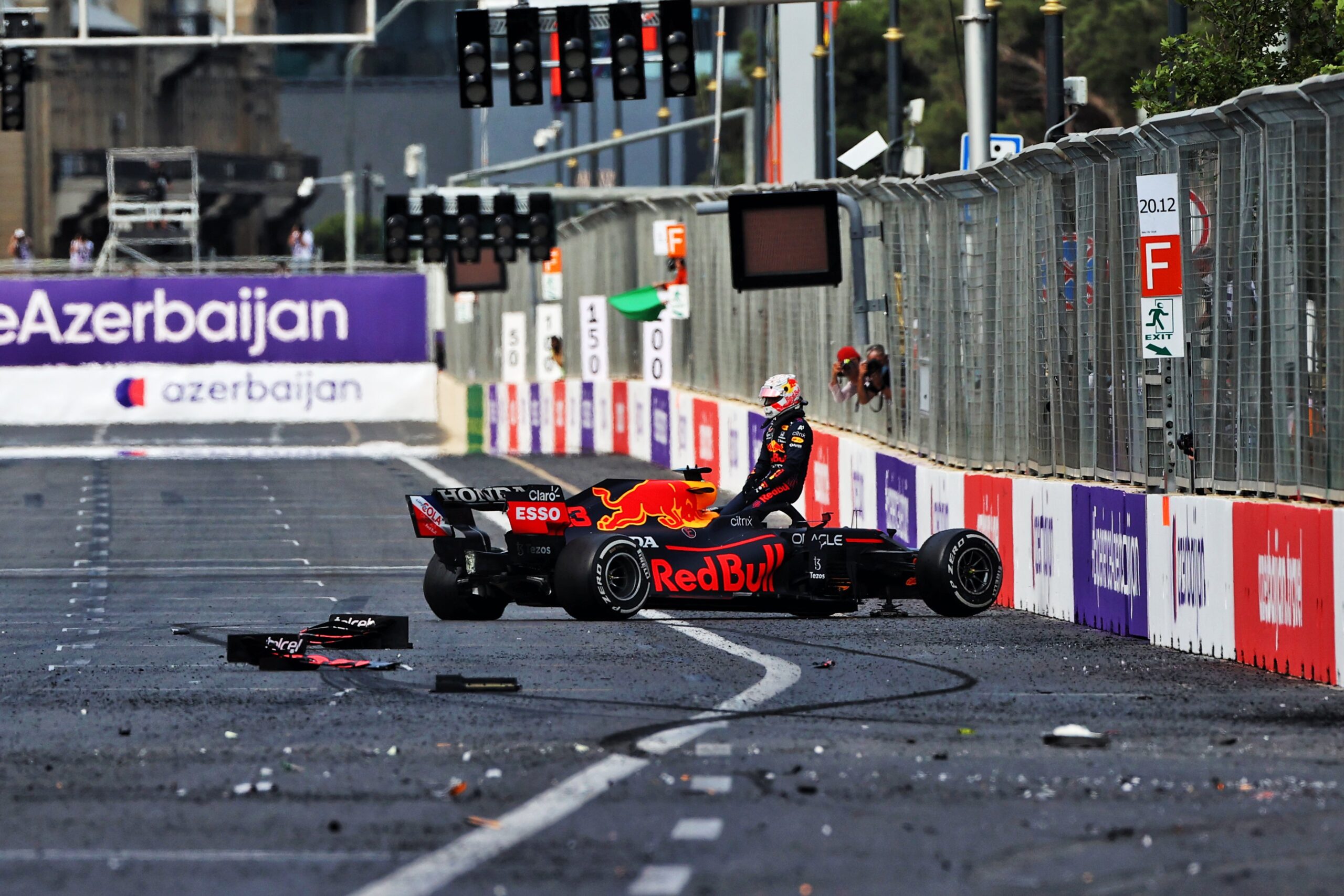
Max Verstappen surrounded by wreckage after his crash at the Azerbaijan Grand Prix.
Image credit: XPB Images

Just as Stroll’s left-rear tyre had failed him, Verstappen’s decided it too was done for the day. The Red Bull speared into the barriers at an equally terrifying speed, leaving shrapnel scattered across the track. Verstappen was unhurt but understandably distraught to have had a win snatched away so late on.

With questions now very much being asked of the stability of the Pirelli tyres, Race Director Michael Masi deployed the red flag.

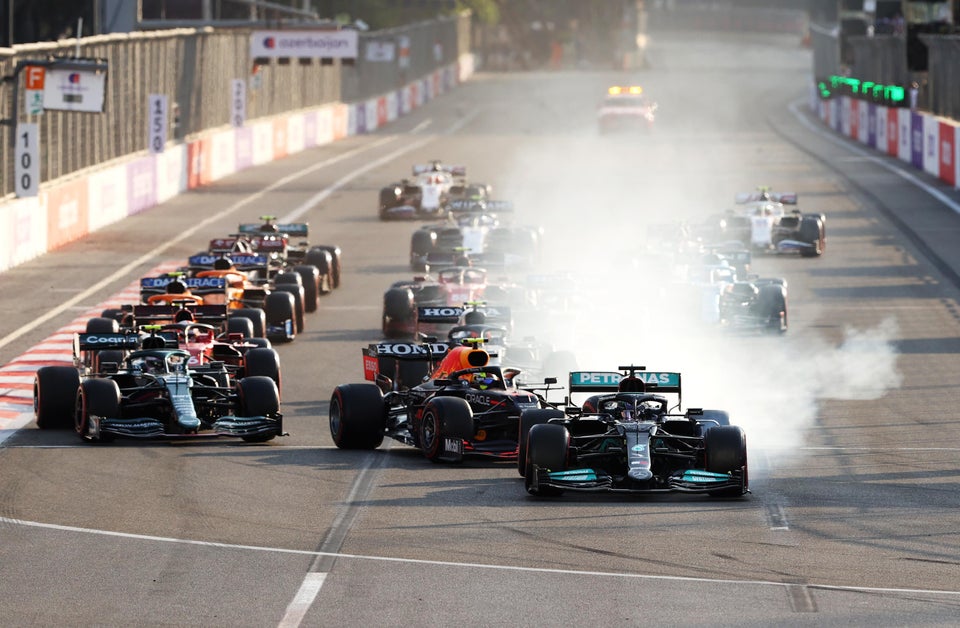
After a considerable wait, and with all the cars now on soft tyres, the field lined up on the grid for a two-lap sprint to the finish. As the lights went out for a second time, Hamilton got away well and was immediately alongside Pérez. But this race had one more significant twist in its tale.

Lewis Hamilton locks up into the first corner.
Image credit: Getty Images

As Pérez came over to defend the position, Hamilton swerved to the left. In doing so, he accidentally knocked a switch on his steering wheel which is designed to warm up the brakes. It brings the brake bias forward to around 90% and that meant, as Hamilton touched the brake pedal, he instantly locked up and went straight on at Turn 1, rejoining at the back of the field. A tiny mistake with massive consequences.

Pérez successfully held onto his lead to take the chequered flag and earn his second F1 victory. It would transpire that his car was minutes – if not metres – from failing him, as his team asked him to park the car seconds after he crossed the line.

An unusual podium was completed by Sebastian Vettel and Gasly. Vettel drove an incredible race, from 11th on the grid to second at the line. Starting on fresh tyres, he pulled out the longest first stint of anyone to move up to fifth, before passing Gasly after the first safety car. A well-deserved Driver of the Day performance as the four-time champion continues to look more at ease in his new, green machine.

Gasly was also excellent, following up an impressive fourth in qualifying with genuine race pace. He then came out on top in an enthralling last lap battle between himself, Leclerc and Lando Norris to earn his third podium.

Sebastian Vettel celebrates his podium at the Azerbaijan Grand Prix.
Image credit: XPB Images

Fernando Alonso produced his best result since returning to the sport, snatching sixth from Yuki Tsunoda after the restart. Nonetheless, it was a much-improved weekend for the Japanese rookie, who has struggled since his impressive debut in Bahrain. Carlos Sainz – whose race was ruined early on when he took an unscheduled trip down an escape road – finished eighth, ahead of Daniel Ricciardo and Kimi Räikkönen.

So, in the end, it was all a bit much-ado-about-nothing for Verstappen and Hamilton in terms of the title battle. After both drivers significant ups and downs over the weekend, they leave Baku with the same number of points as when they arrived.

As much as that costly slip of a finger will have hurt Hamilton, if you had offered him the opportunity to leave this weekend with as many points as Verstappen on Friday – when Mercedes were struggling to even break into the top 10 – he would likely have taken it…

Who Said the Second Red Bull Seat Was Cursed?

After a hit-and-miss start to his Red Bull career, Pérez thoroughly proved his worth this weekend.
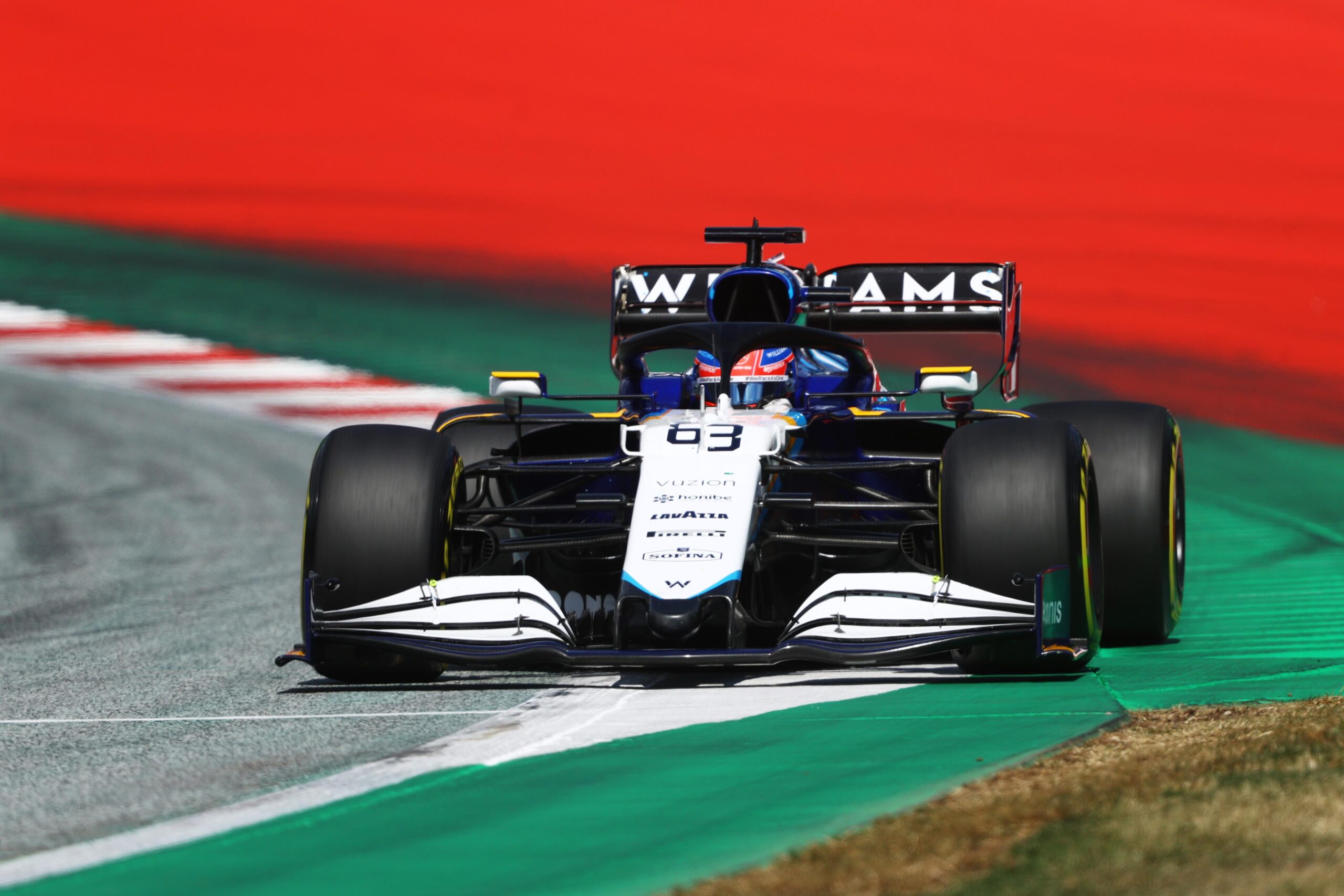
The Red Bull team waves Sergio Pérez home.
Image credit: Getty Images

On Friday, the Mexican said he now finally felt at home in the car, and he backed that up with his level of performance throughout the event. He was legitimately ahead of Verstappen on more than one occasion and then did exactly what he was brought into the team to do on Sunday. That is, provide support to Verstappen in the fight for the win and be there to capitalise should any unforeseen dramas befall the lead driver.

In Baku, the usual roles were reversed with Mercedes outnumbered two to one in the fight for the lead. And the difference that made in the strategic battle was clear to be seen.
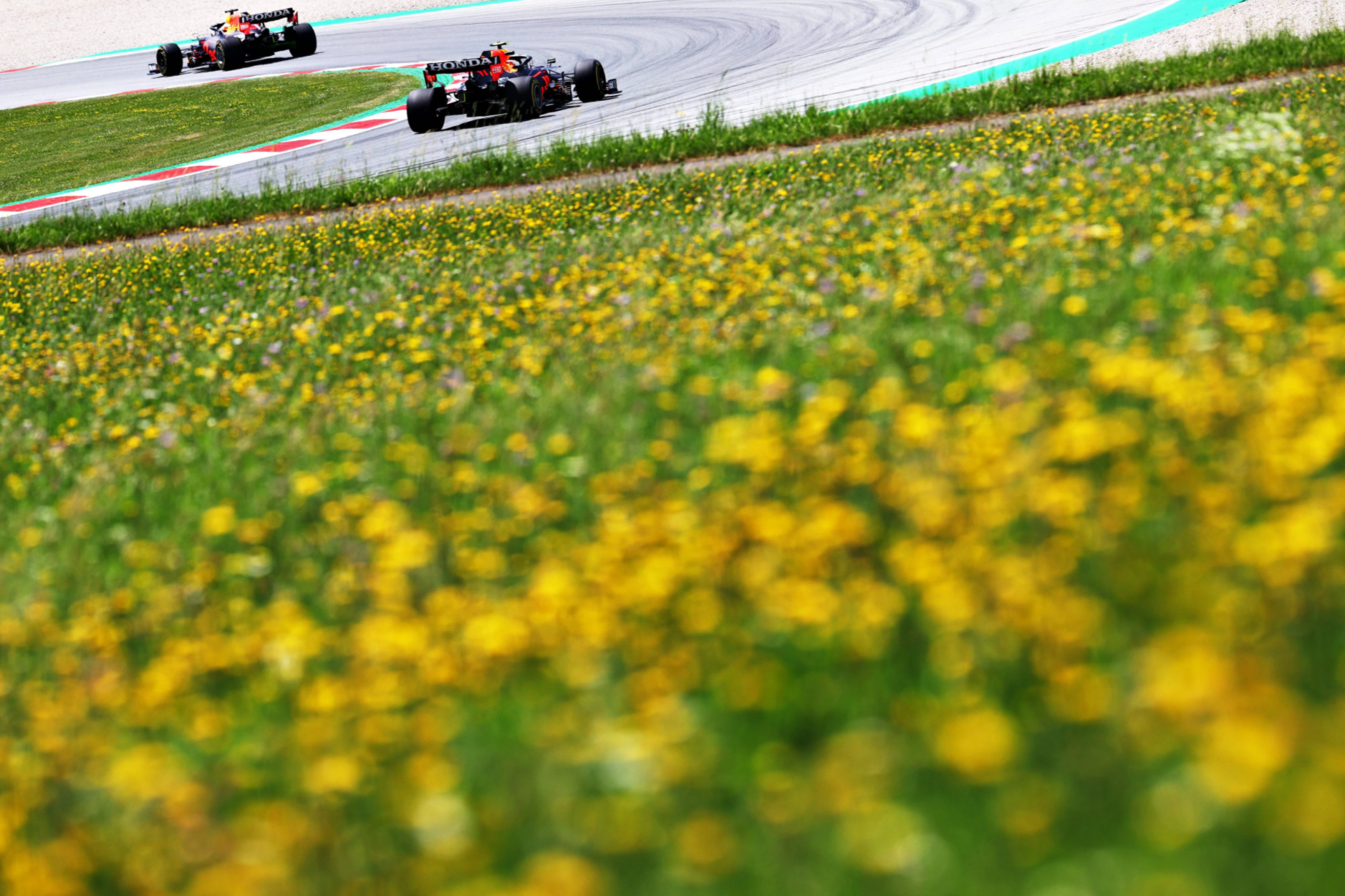
Pérez is now only 30 or so points behind the leading pair. One more shock result like this – twinned with the consistency for which he is renowned – and he could even consider himself genuinely in the title battle.

Penalty Points and Late Calls

Along with the questions to be answered by Pirelli, Masi and the FIA will have a few of their own.

Leclerc described the delay in deploying the Safety Car for Verstappen’s incident as “a joke”. It took nearly 20 seconds for double-waved yellow flags to appear and almost a minute and a half for the Safety Car, just as Pérez was approaching the start-finish straight again.

This came after Lance Stroll had been heard on the radio, pleading for a red flag as he sat in his wrecked car, rightly terrified of the cars screaming past him at full speed.

Lance Stroll's crash at the Azerbaijan Grand Prix.
Image credit: Getty Images

There also remains the issue of the penalty points system. I have questioned the current method of distributing points before, and this weekend displayed those issues once again.

Norris was handed three penalty points after finding himself in a tricky situation, with the stewards even acknowledging that he had almost no time to react to a red flag. And Nicholas Latifi was then also handed three points after receiving a clearly misleading radio call from his engineer in which he was told repeatedly to “stay out” when the intended message had, in fact, been to come through the pit lane but not stop.

F1 is, of course, a team sport, but if Latifi were to amass the 12 points required for a race ban, Williams would still race – just with a different driver. If this situation happened four times and Latifi remained blameless in each one, how is that remotely fair on the driver?

And all this whilst a genuinely dangerous action by a driver – as Nikita Mazepin swerved into his teammate’s path at full speed – goes unpunished…

The Azerbaijan Grand Prix in 60(ish) Seconds

Answering the Burning Questions

How will Hamilton and Mercedes respond after their tough weekend in Monaco? Not that well…

Will the ‘flexi-wings’ actually make a difference? People just kind of stopped talking about them amid the drama.

And will Toto Wolff follow through on his threat of a protest? Seemingly not.

Can McLaren’s straight-line speed help them challenge for a podium? They seemed to have untapped potential through the weekend but will be content with P5 and P9.