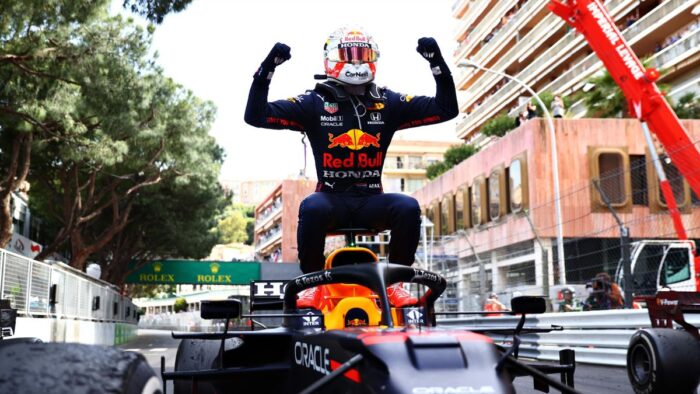
2021 Monaco GP report | Verstappen takes first Monaco win

Ecstasy for Verstappen, agony for Leclerc, frustration for Hamilton.
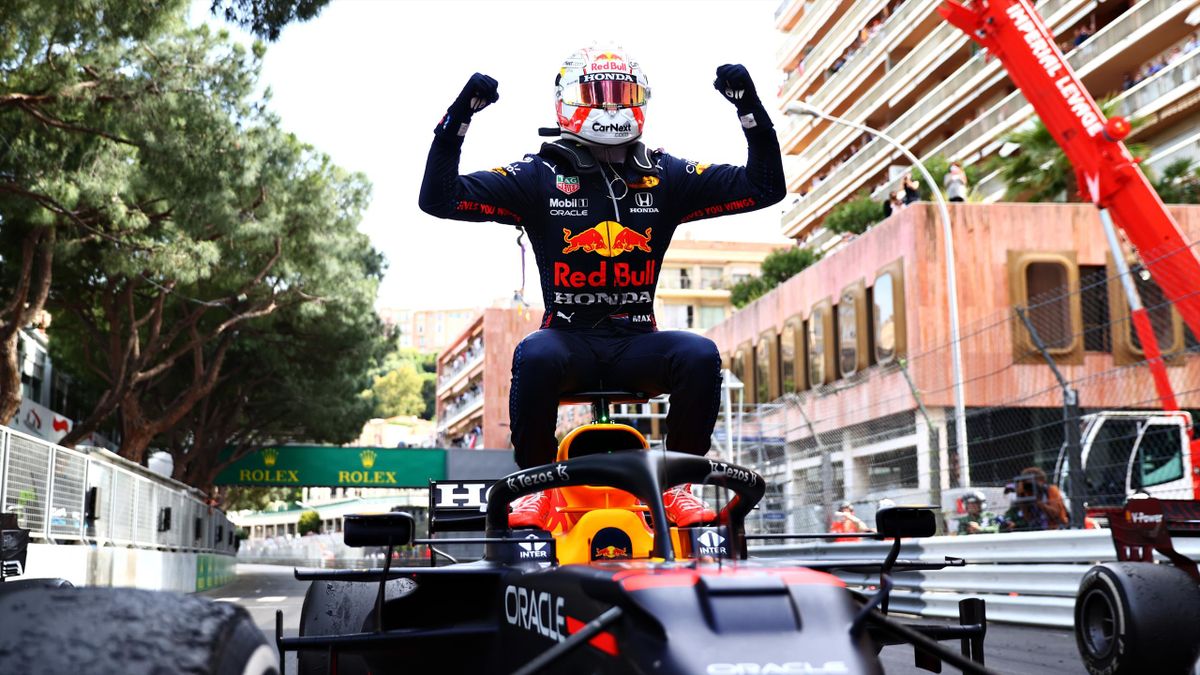
Max Verstappen celebrates winning the Monaco Grand Prix.
Image credit: Getty Images

Max Verstappen took his first win at the Monaco Grand Prix as all his main challengers gradually fell by the wayside.

It appeared that Charles Leclerc had broken his Monaco curse when his gearbox was deemed safe to start the race after he had crashed in qualifying on his way to claiming pole position. But the curse returned with a vengeance on his installation lap and the Monegasque was cruelly consigned to watch his home race from the garage by a terminal driveshaft issue.

That left Verstappen effectively on pole and, once he had survived Valtteri Bottas‘s attack into the first corner, the race was his to lose. Bottas shadowed him for the first few laps as all the drivers managed their pace to conserve tyre life but, as they moved closer to the first stops, the Mercedes started to fall away from the Red Bull and into the clutches of Carlos Sainz in third place.

Further back, Lewis Hamilton was still stuck behind Pierre Gasly in sixth, after a nightmare qualifying session. The World Champion could not get the required temperature into his tyres and was left displeased that his team had not pursued an approach which he had suggested. Mercedes decided to attempt an undercut with Hamilton on lap 30 but found themselves still behind the AlphaTauri driver when he responded with a stop one lap later.

And things were about to get worse.
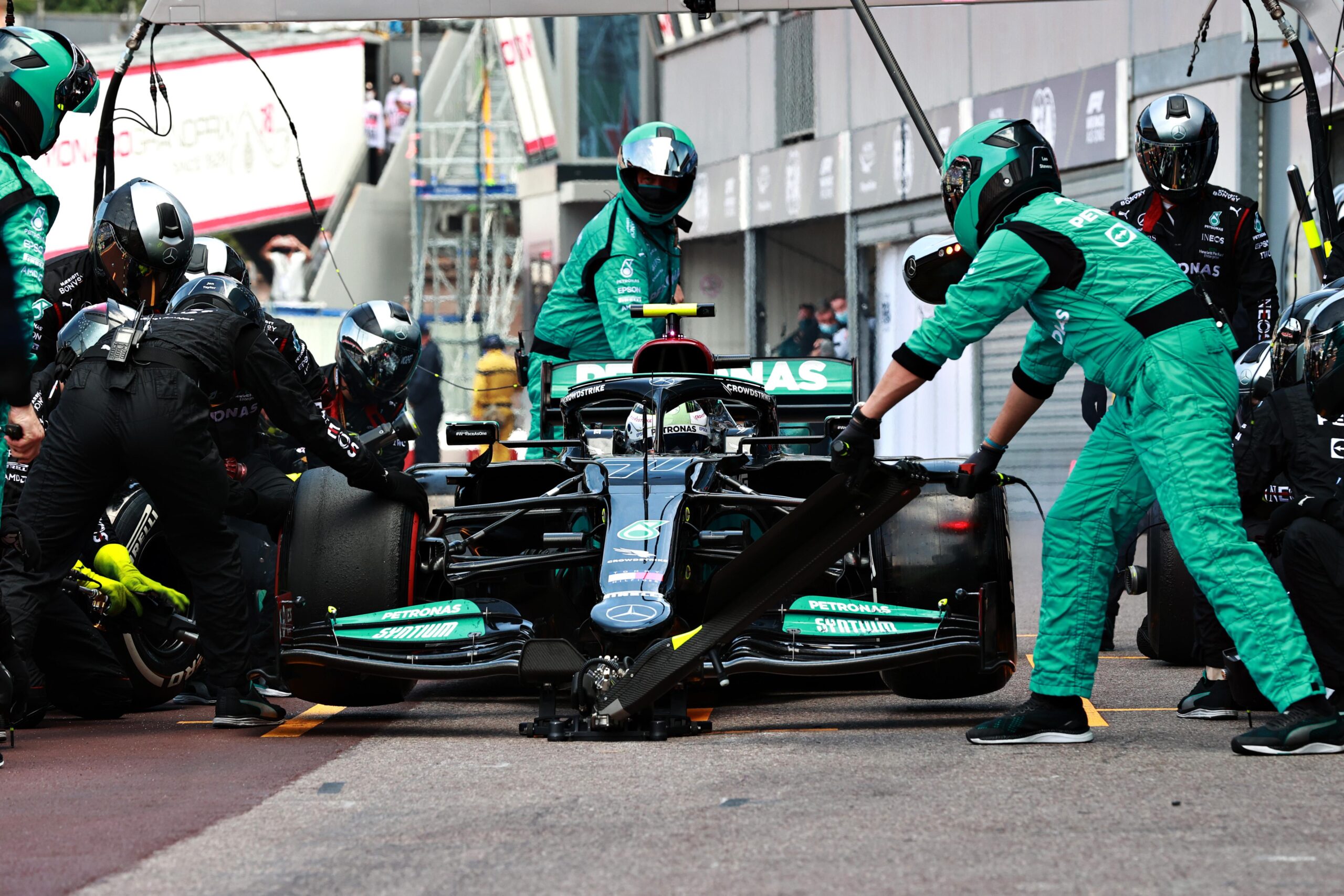
Valtteri Bottas's neverending pit stop.
Image credit: Getty Images

Having run long and exploited the clean air that provided, first Sebastian Vettel and then Sergio Pérez successfully jumped Hamilton. Meanwhile, teammate Bottas was forced to retire when the wheel gun stripped the nut on his front right during his pit stop. It had turned into one of those Germany 2019-esque races for the Silver Arrows.

Out front, Verstappen was having no such dramas and serenely sailed to the chequered flag, keeping a comfortable gap to the chasing Sainz throughout. The Spaniard provided some consolation for Ferrari after Leclerc’s heartbreak with a strong second place, but was a little disappointed as he felt that he could have challenged for pole and victory without the Q3 red flag caused by his teammate’s crash.

Lando Norris completed another excellent weekend – sporting the beautiful, one-off Gulf livery – and held off a late charge from Pérez to claim his second podium of the season and move up to third in the standings.
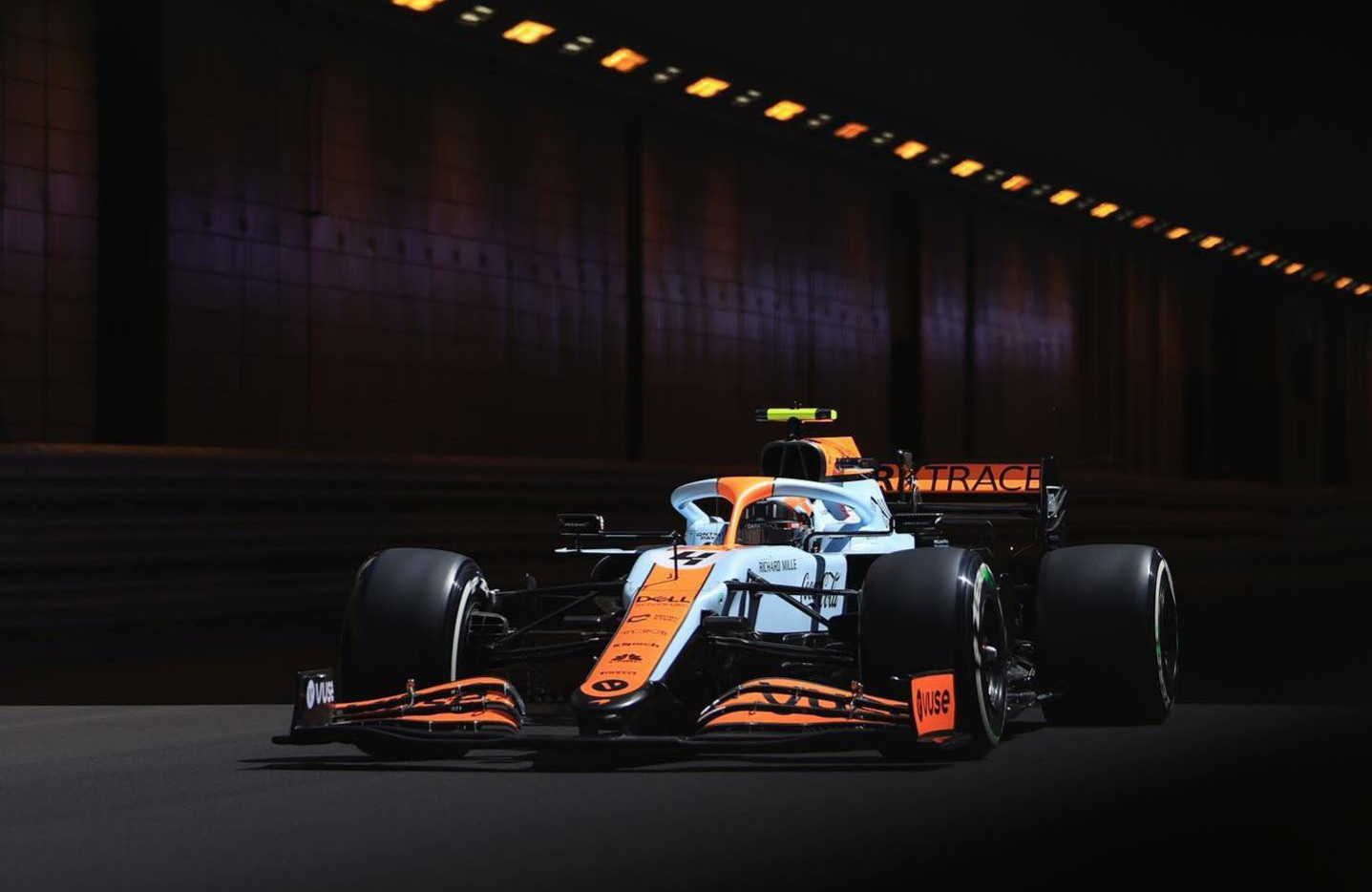
Lando Norris in the one-off McLaren Gulf livery.
Image credit: Kym Illman

Vettel, Gasly and Hamilton predictably stayed in that order for the remainder of the race, Hamilton successfully pitting late on to claim the bonus point for fastest lap. Behind him, Lance Stroll made an alternative strategy work, starting on the hard tyres and moving up from 13th on the grid to finish eighth. Esteban Ocon finished a further half a minute down the road in ninth and Alfa Romeo‘s Antonio Giovinazzi claimed the final point – his first of the season.

It was a weekend not lacking in drama but the racing on Sunday was a typically mundane affair. And the Monegasque director – Monaco is the only race to use its own broadcast director – cut away from the one bit of wheel-to-wheel action that we did get… None of that will bother Verstappen and Red Bull, however, who have taken the lead in both championships. The momentum in the title battle switches once again.

Now, how will a very different street circuit – Baku in two weeks’ time – suit the cars?

Where Did That Ferrari Pace Come From?!

The Ferraris often flatter to deceive with their Friday pace, but this time they remained at the top of the timing charts throughout the weekend. So, how did that happen? Did they bring a major upgrade?
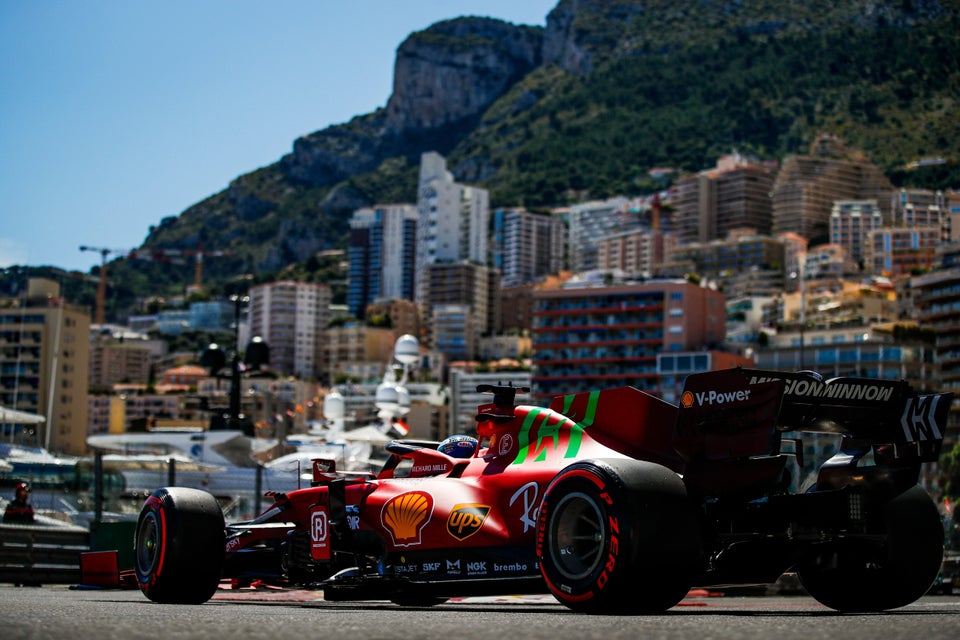
Charles Leclerc at the Monaco Grand Prix.
Image credit: DPPI

Well, I’m afraid to say – to any members of the Tifosi currently throwing their red caps in the air and declaring an imminent title charge – that is likely to be a one-off.

Ferrari have often gone well around the streets of the Principality – Vettel came home second in the previous two Monaco Grands Prix and 2017 saw a Ferrari 1-2. Their traditional short wheelbase makes the car nimble through the tight turns and, this year, the Monaco layout masked their still considerable deficiency when it comes to straight-line speed.

Even so, the drivers were surprised by their competitiveness.
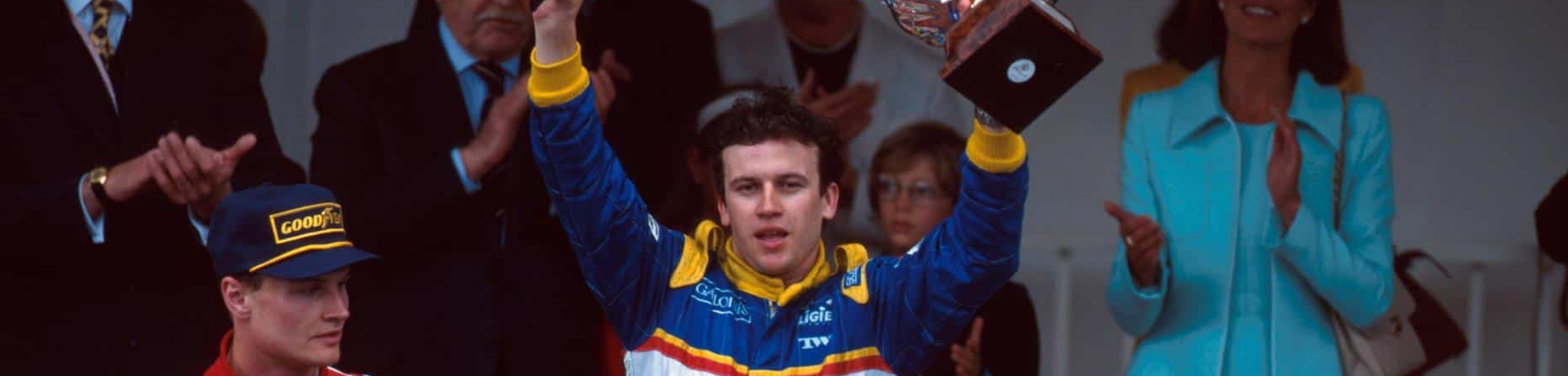
“It is quite a big surprise,” Leclerc said. “Surely we were very competitive in Sector 3 in Barcelona, but again it’s a very different track and we were maybe expecting Red Bull and Mercedes to have something more for here, but apparently they didn’t and we were just very competitive from the start. So it was good, but until quali we didn’t believe we could fight for pole, so it’s a surprise.”

Whilst this likely isn’t the appearance of an unlikely championship contender, Ferrari can be very pleased with their progress since last year’s hugely disappointing campaign. Even the confines of Monaco wouldn’t have saved the SF1000. They can expect to compete at or near the front again in Hungary and Singapore – if that race happens – and now appear to be in a private battle with McLaren for third in the title. A feel good story for the two former giants of F1.

Vettel Finds Form, Ricciardo Loses It Again

Sebastian Vettel brushing a barrier at the Monaco Grand Prix.
Image credit: DPA Picture Alliance

It has been well documented that the drivers who switched teams for 2021 have been struggling to adapt due to the lack of testing. But Vettel appears to have finally made a breakthrough in the Aston Martin. He was far closer to Lance Stroll in Portugal and Spain than he had been at the first two grands prix of the year, and in Monaco he showed his experience, comfortably outperforming the Canadian in every session.

An impressive eighth in qualifying was turned into an even better fifth on Sunday, thanks to smart strategy and some guts during that wheel-to-wheel battle with Gasly. Vettel earned a well-deserved ‘Driver of the Day’ and will now look to build on this for the coming races.

Daniel Ricciardo, however, went in the opposite direction. After a much-improved performance in Spain saw him take a solid sixth place and finish ahead of teammate Norris for the first time, the wheels came off at what is his most successful circuit. The Aussie won here in 2018, after being robbed of victory in 2016, so moving aside to be lapped by Norris on Sunday will have been a bitter pill to swallow.
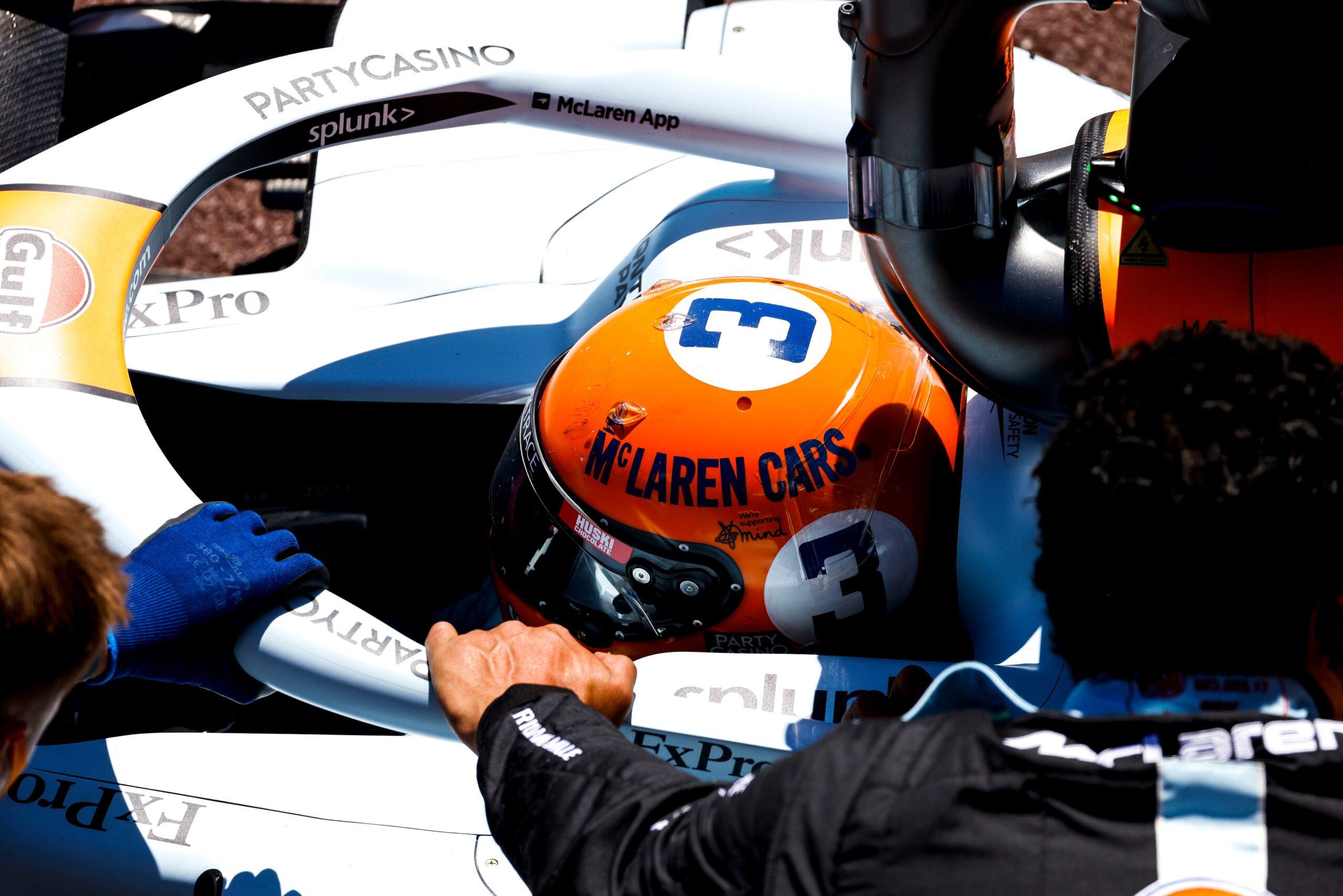
Daniel Ricciardo's retro helmet design.
Image credit: Motorsport Images

Most worrying of all, he is at a loss to explain his lack of speed. “All weekend, even crossing the line a lot of laps I felt good, I was like that’s a good lap. And I think at one point I was 1.2s slower than say what Lando had just done, so no answers at the moment.”

He will need to find some answers quickly, or he risks having his reputation questioned in the manner Vettel’s was when Ricciardo joined Red Bull in 2014 and consistently outperformed him.

The Monaco Grand Prix in 60 Seconds

Answering the Burning Questions

Will Mercedes or Red Bull be on top around the twists of the Circuit de Monaco? Red Bull, if not Ferrari!

Can Max Verstappen make up for the many laps he spent stuck behind Lewis Hamilton in 2019? He can, in some style.

Will any teams surprise with their performance at this unique track? See above…

Who will have the best unique helmet design? The Williams drivers’ designs in honour of the team’s 750th race were nice, as were the McLaren Gulf specials, but I’m going for Bottas’s cartoon design.
2020 Spanish GP report | Hamilton stays cool in the Spanish heat

Another win, another record.
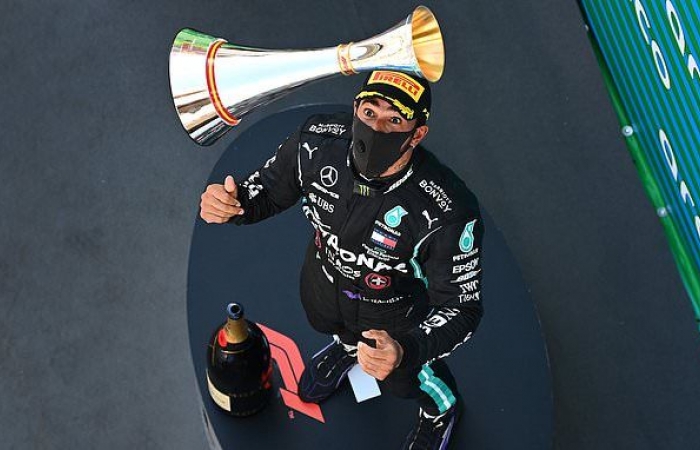
Lewis Hamilton wins the Spanish Grand Prix.
Image credit: Getty Images

Lewis Hamilton took a dominant victory at the 2020 Spanish Grand Prix and moved one clear of Michael Schumacher to claim the outright record for the most podiums in F1 history with his 156th visit.

There were hopes in the paddock of another closely fought race, after last week’s 70th Anniversary Grand Prix exposed a potential Achilles’ heel for the champions as they struggled with their rear tyres and Max Verstappen snatched an unlikely win. But those hopes were quickly extinguished when Hamilton “pulled the pin”, as Martin Brundle put it, and built a gap of almost ten seconds to the Red Bull in preparation for his first pit stop.

The usual Mercedes 1-2 in qualifying had been broken up by a poor start from Valtteri Bottas, the Finn suffering from a lack of a slipstream on the long run to the first corner and being passed by Verstappen and the opportunistic Lance Stroll. The Finn recovered to third quickly enough but spent the rest of the grand prix failing to get close enough to Verstappen in order to mount a real attack. Even on soft tyres towards the end of the race, he just didn’t seem to have the requisite pace and crossed the line 44 seconds behind his teammate, after making a late stop to claim the fastest lap.

It was a chastening weekend for Bottas, who is seeing his title aspirations crumble once again. “I have no idea what the points difference is,” he said, “but it is way too big and I can see again the championship drifting away. I will always bounce back, but right now I want to be somewhere else other than this.”

During the latest triple-header, the championship has transformed from a two-horse to a three-horse race and he is looking increasingly like the third horse.

Image credit: Mercedes

Hamilton, meanwhile, was imperious throughout – only denied his seventh career ‘grand chelem’ by his teammate’s late dash for the fastest lap and so “in the zone” that he didn’t realise he had passed the chequered flag.

Behind the front three, the Racing Points were ‘best of the rest’. Stroll continues to defy his critics and is really starting to cement his position as more than just a ‘rich boy driving for his dad’s team’; the Canadian took fourth ahead of teammate Sergio Pérez after the Mexican received a five-second penalty for ignoring blue flags.

Carlos Sainz completed the top six with a strong drive at his home grand prix, seemingly having solved the overheating issues that have plagued his McLaren recently.

A Little Redemption in Red

Sebastian Vettel made the best of another bizarre Ferrari strategy to salvage seventh, impressively making a set of soft tyres last 36 laps and holding off a train of faster cars towards the end.

The incompetency of the Ferrari strategists has become a running joke at this point and they continued to add fuel to the fire here. A bizarre radio exchange played out for the world to hear as Vettel was ignored, then told to push, then told to go to the end, and finally had to tell his team the sums they needed to do for him.

Image credit: Reuters

The tension between the four-time world champion and his team is palpable and it feels as though both parties are just waiting for the season to be over.

Ferrari may also find themselves in hot water as it has now transpired that Charles Leclerc drove for two laps without his safety harnesses secured after his engine had cut out and spun him at the final chicane on lap 36. A massive lapse in common sense and safety that the FIA may feel the need to make an example of.

Pressure Continues to Increase on Albon

In the break before racing at Spa-Francorchamps last season, despite all the team’s previous reassurances, Pierre Gasly was replaced at Red Bull by Alexander Albon. But, as we head to this year’s Belgian Grand Prix, the team find Albon arguably underperforming as badly as the Frenchman was 12 months ago.

Red Bull are desperate for their second car to get, at least, reasonably close to Verstappen’s pace to aid their strategy options when attempting to outsmart Mercedes. Albon has certainly showed promise at times, but there is surely only so long people can continue to make excuses for him.

The London-born Thai driver is averaging a deficit of over half a second to his teammate in qualifying and, whilst he has often produced great recovery drives on a Sunday, that is still only getting him back into a position that would be the least expected of him.

Alexander Albon at the Spanish Grand Prix.
Image credit: Getty Images

This weekend, he did improve his qualifying slightly – if only to sixth on the grid – but was hampered in the race as Red Bull possibly used him as a guinea pig to test out the hard tyre for his teammate out front. That put him back into the many ‘DRS trains’ forming through the midfield and he only managed fight back to eighth place.

The fact is, however, that if he had shown the pace to get past the Racing Points into fourth earlier in the race, Red Bull would likely not have taken the gamble to switch to the hard tyres.

It was apparently Gasly being lapped by Verstappen in Hungary last year that was the final straw for the Red Bull bosses, so one wonders what must have been going through Albon’s head as he moved aside for his teammate here in Spain.

The Spanish Grand Prix in 60 Seconds

Answering the Burning Questions

Will Mercedes experience issues with their tyres again? Nope.

And can Red Bull then challenge for another win? Also nope.

Will Sebastian Vettel leave his Silverstone troubles behind him? To some extent, yes. A rightful driver of the day.

How will Sergio Pérez deal with the strain of driving an F1 car post-virus? He coped fine, seemingly. Even with it being one of the hottest races in years.

Will anyone pull a Maldonado? Again, nope.

So, where were we?

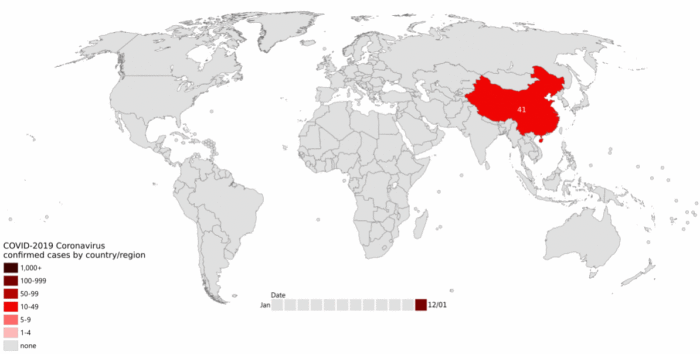
Well, we were in Melbourne, about to start another Formula 1 season…and then the world changed.

It has, in fact, changed beyond all recognition in the space of a few short months. Social distancing is the new normal – masks, gloves, two metre gaps, elbow bumps – and the Black Lives Matter campaign has swept around the globe after the death of George Floyd.

These have been truly unprecedented times, but, as curves have been flattened and lockdowns lifted, the world of sport is slowly, cautiously peering out from the rubble.

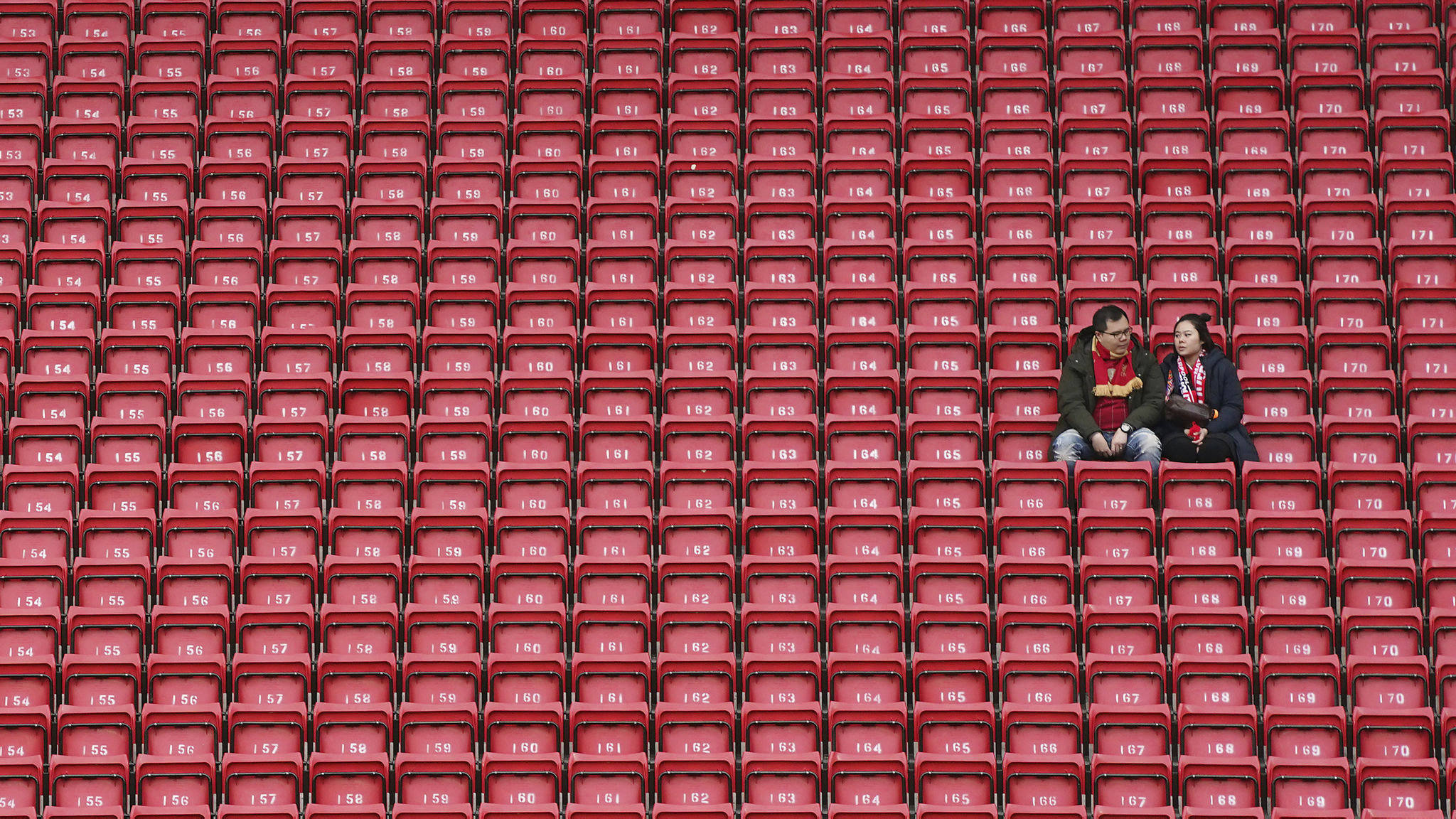
Empty stands in a COVID world.
Image credit: AP

With cases reducing in most countries and both testing kits and protective equipment now far more readily available, many sporting bodies have decided that, with the correct safety measures in place, it is safe to resume.

Premier League football has now restarted, with players and staff being tested twice a week, a maximum of 300 key people allowed inside the stadium and regular disinfection of equipment.

So, how will F1 look upon its return?

Formula 1’s ‘New Normal’

As sports go, the core elements of F1 are already fairly socially distanced; drivers are in their own cars, in the most advanced protective equipment and, if they get within two metres of their rivals, then they’ve probably crashed into one another…

This means that most of the changes will be aesthetic and/or behind the scenes.

The new regulations have been produced in conjunction with the WHO and feature all the measures with which we have become accustomed recently – two metre distancing wherever possible, PPE throughout and the expectation that “all attendees show responsible measures are being taken”.

There will be a daily questionnaire regarding potential symptoms to be completed by every member of the paddock, in addition to a contract tracing system, daily COVID briefings and an isolation hut on the premises.

What does it mean in terms of the show? Not a huge amount, really.

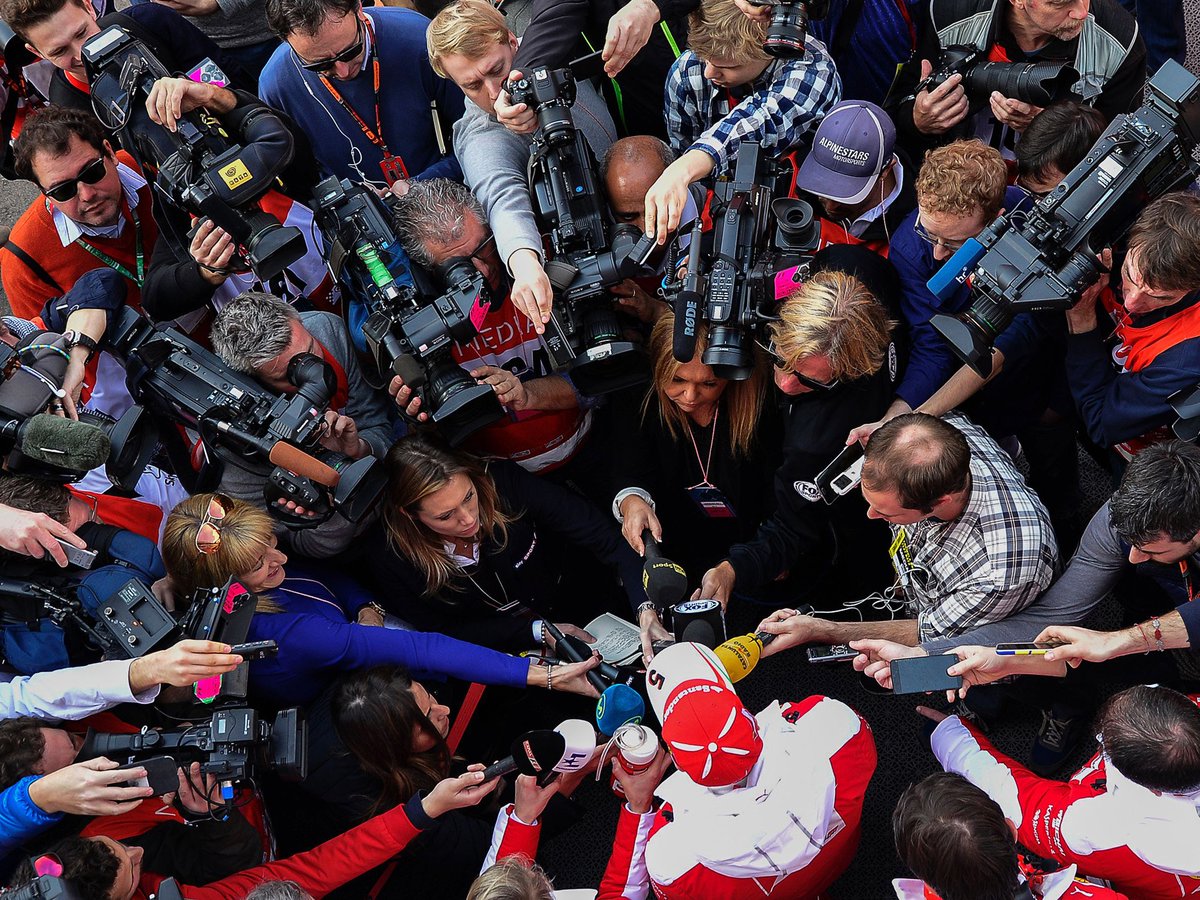
Media scrums will certainly not be seen at any point this year.
Image credit: Speedpix

The grid process is to be shortened significantly. Media scrums are obviously a thing of the past; the media’s entry will be limited to mostly video or ‘pool’ interviews – where all outlets’ questions will be asked together. The weighbridge will be disinfected after each car’s visit and the podium celebrations will be moved to the grid, in order to enable two metre spacings between the steps.

There has been no word on the champagne as yet; maybe they’ll spray disinfectant instead.

What Could the Calendar End up Looking Like This Year?

It seems astonishing, in hindsight, that the opening Grand Prix of the year very nearly went ahead. It may well have done, too, but for a member of the McLaren crew testing positive for the virus on the Thursday night.

In the aftermath, grands prix were gradually postponed, with Monaco being the first to fully cancel its 2020 event. The difficulty of assembling the infrastructure necessary for a street race made the event impossible, even with restrictions beginning to relax.

The same obviously applies to the street races in Singapore and Baku, who duly followed suit, and the Australian, Dutch, French and Japanese Grands Prix weren’t far behind, cancelling for a variety of reasons.

The requirement for a season to qualify as a World Championship is a minimum of eight races. The talk of a three continent requirement can be put to bed after Managing Director Ross Brawn confirmed that, in the exceptional circumstances of the COVID-19 crisis, this “recommendation” will not have to be met.

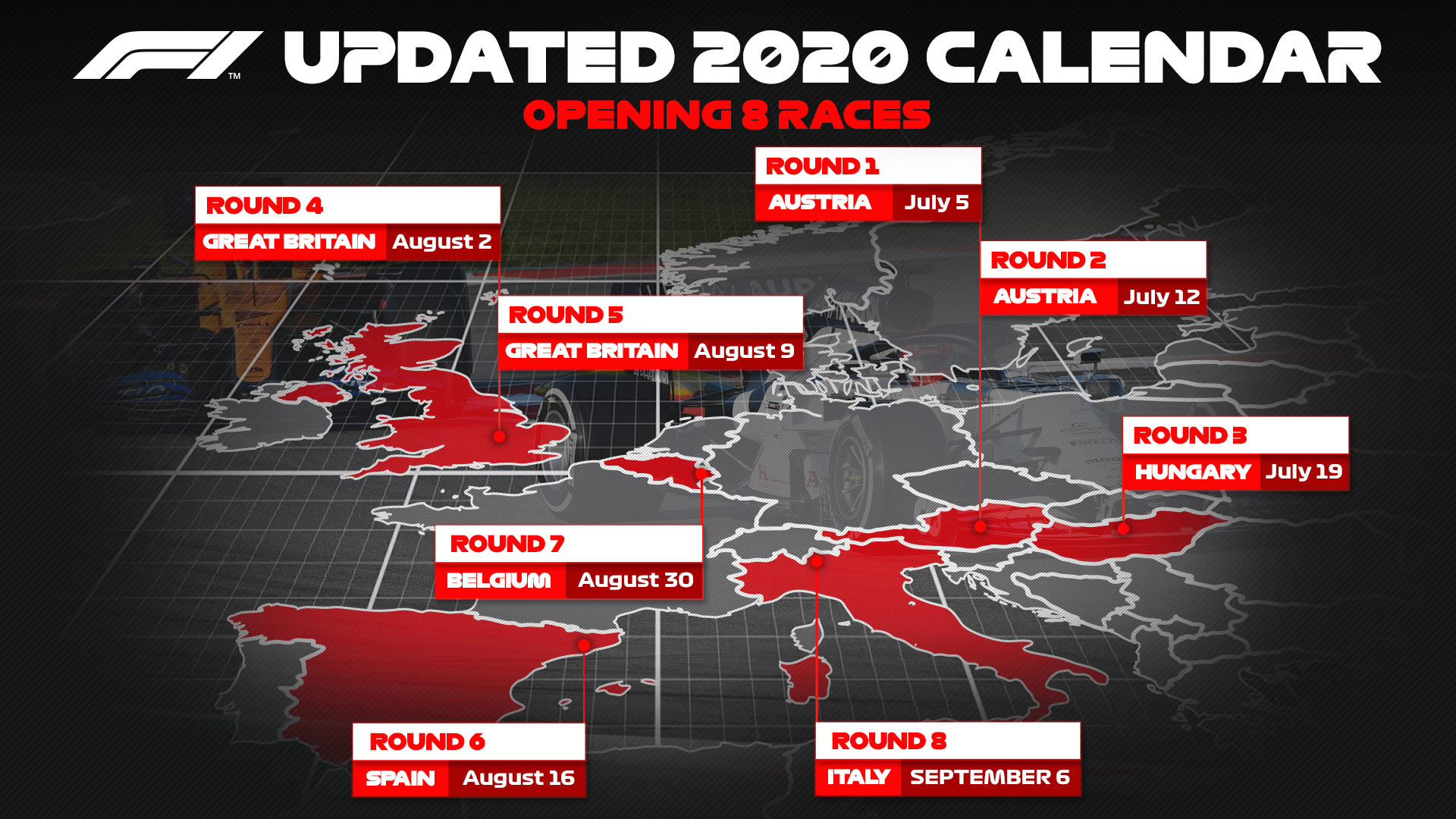
The FIA released a rescheduled calendar in early June, with the first eight races confirmed. They include – for the first time in F1’s history – a second race in both Austria and Great Britain; which have been named the Steiermark GP and the 70th Anniversary GP, respectively. The aim is to hold between 15 and 18 races overall, with the season potentially stretching into early 2021.

The latest calendar update.
Image credit: Formula 1

Beyond this, things remain largely up in the air. The races in Canada and Vietnam continue to be a possibility and there may even be another double-header in China, ironically. Bahrain and Abu Dhabi look fairly solid bets to host at least one race.

The United States is far from over its Coronavirus struggles, whilst Mexico and Brazil appear to be going in the wrong direction, so the prospect of races there seems problematic. However, with Liberty Media waiving race fees and, in fact, paying to rent the facilities, there are some old faces throwing their hats into the ring.

From the more recent past, Hockenheim is looking likely to host a race, having dropped off the calendar for 2020. But blasts from the past such as Imola have been mentioned; both Estoril and Algarve in Portugal (and even Mugello in Italy) are being considered.

It’s hard to say currently how many races we’ll end up with and where they’ll be, but let’s just be glad that we have a championship at all.

Since You’ve Been Gone

So, if you’ve been out of the F1 loop during lockdown, what have you missed? Here are the main headlines…

Silly Season Before the Season Even Began

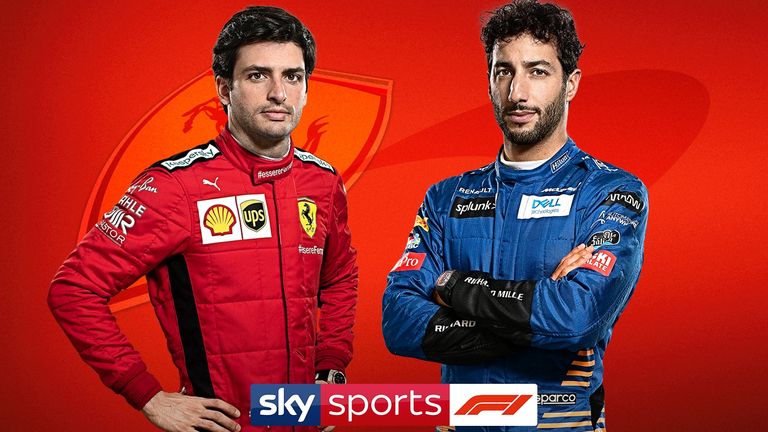
Carlos Sainz and Daniel Ricciardo in their new team overalls.
Image credit: Sky Sports F1

In the space of a couple of days, the F1 merry-go-round suddenly kicked into gear, sparked by Sebastian Vettel‘s announcement that he would be leaving Ferrari at the end of 2020. Within a few hours, Carlos Sainz was confirmed as his replacement and, not long after that, Daniel Ricciardo announced he was swapping the yellow of Renault for the papaya orange of McLaren in 2021.

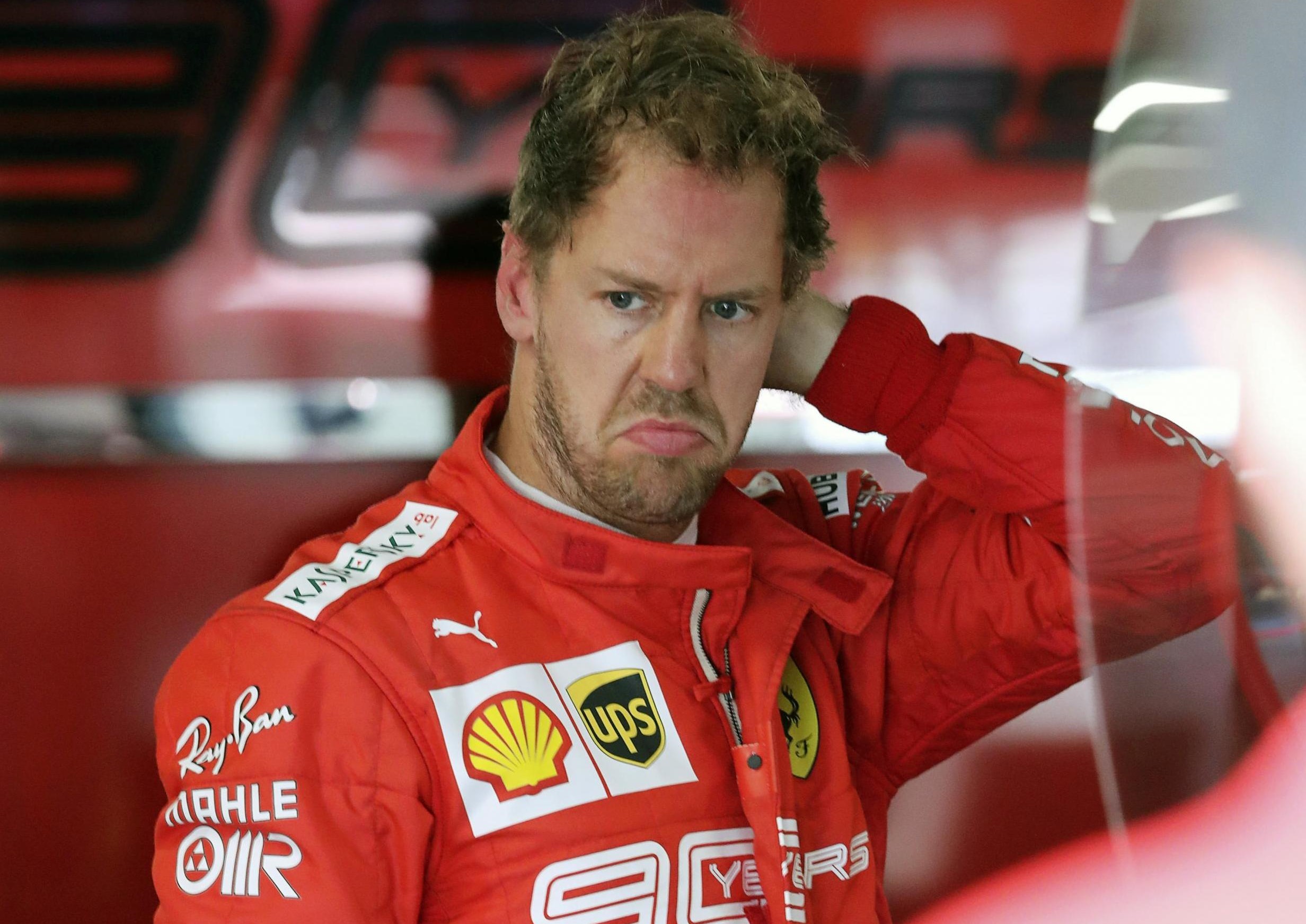
Vettel stated that “the team and I have realised that there is no longer a common desire to stay together beyond the end of this season”. Was he just burnt out after years of near misses and disappointment with the Scuderia? Or was it the team that have decided they want some fresh blood?

Either way, it can’t have been easy to give up on his dream of emulating his idol, Michael Schumacher, with a championship at Ferrari and his options for 2021 now look limited.

There were initial rumours of a Mercedes seat, but Toto Wolff has all but ruled that out, leaving his best chance at Renault. Will Vettel take a chance on what is currently a midfield team, with former teammate Ricciardo clearly having jumped ship? Or will he retire?

It would be a great shame for the sport to lose a four-time world champion, but you sense recently that his love for F1 has been dwindling a little.

An unhappy Sebastian Vettel.
Image credit: The Canadian Press

It is an incredible chance for Sainz, however. Many have seen him as a future de facto number two to Charles Leclerc, but let’s not write him off so soon. It is worth remembering that he largely matched Max Verstappen whilst the pair were at Toro Rosso and a stellar 2019 season refreshed memories of his considerable potential, after an uninspiring spell at Renault.

Ricciardo will be hoping that McLaren can continue their current upward trend and take advantage of the new regulations, which have now been delayed by a year to 2022. Unless he miraculously challenges for the title this year, it will have to be said that his Renault experiment was a failure.

It surely won’t wipe that perpetual smile off his face, though, and a pairing of the Australian and Lando Norris will certainly make 2021 an entertaining season for McLaren, in every sense.

Hamilton Leads the Fight

For once, that headline has nothing to do with Lewis Hamilton‘s dominance on the track.

The world champion has launched ‘The Hamilton Commission’ with the aim of increasing diversity within motorsport. “The time for platitudes and token gestures is over”, wrote Hamilton in a column for The Sunday Times. “Despite my success in the sport, the institutional barriers that have kept F1 highly exclusive persist.”

The 35-year-old has campaigned passionately during the enforced break, with a series of powerful statements on social media and participation in the peaceful BLM protest in Hyde Park.

And F1 has now followed his lead by launching the ‘We Race As One’ initiative, which has the aim to “impact long-lasting change, particularly regarding diversity and inclusion”. All cars will display a rainbow, comprising the colours of the 10 teams, throughout the 2020 season and the sport will also show support for key workers and families amid the fight against COVID-19.

As stated at the top of this article, the world has changed.

But maybe it was time for a change.

2019 Singapore GP report | Vettel snatches victory from frustrated Leclerc

A Singapore Ferrari 1-2…just as everybody predicted…
Sebastian Vettel wins the Singapore Grand Prix
Image credit: Motorsport Images

Sebastian Vettel completed a hat-trick of victories for Ferrari with an unexpected turn of speed under the lights at the 2019 Singapore Grand Prix. Coming into the weekend, the drivers, the team and their competitors were writing off their chances – even the ever-pessimistic Toto Wolff said early in the weekend he expected Max Verstappen to be their only competitor.

But, from Saturday morning, the red cars showed a sudden improvement after a seemingly very successful aerodynamic upgrade was fitted. Charles Leclerc claimed a stunning pole position, on the ragged edge of adhesion, and in doing so stole it away from his teammate Vettel, who had produced a great first run but failed to improve on his second attempt. Come Sunday, however, it would be Vettel returning the favour in the race as he benefitted from an accidental undercut on his teammate to take the victory.

Behind the two prancing horses out front, Verstappen grabbed what had seemed an unlikely podium thanks to a strategic error from Mercedes dropping Lewis Hamilton from second to fourth. The champion’s teammate, Valtteri Bottas, followed him home in fifth with Alexander Albon just behind.

What could have been a thrilling finale, with the Mercedes closing in on fresher tyres, somewhat petered out thanks to a string of late safety cars which gave the Ferraris the breathing space – certainly in regards to tyre life – they required. However, the sight at each of the numerous restarts of two Ferraris and Verstappen heading into Turn 1 at Singapore probably set off some PTSD in a fair few Ferrari fans…

Behind the big three teams, Lando Norris put his recent run of bad luck behind him to claim ‘best of the rest’ and Pierre Gasly will have quietened some critics with a strong run to eighth place. The last points were collected by Nico Hülkenberg, who completed a decent recovery drive after a somewhat overambitious move on Carlos Sainz on the first lap, and Antonio Giovinazzi.

How Did Vettel End Up Ahead?

Leclerc led away from pole and controlled the first part of the race, as the front-runners crawled round Singapore’s abundance of turns painfully slowly, attempting to conserve their tyres. This slow pace meant the field remained close together though and produced some head-scratching amongst the strategy teams as the gap usually created between the top six and the rest of the field was not there for the leaders to emerge into after their stops.

Hamilton called for an undercut on Leclerc but Mercedes didn’t oblige and so Ferrari pitted Vettel to attempt the undercut on Hamilton himself. It was very effective – as it turned out, arguably, too effective. They expected Vettel to make up a second or two but, even with a pretty average pit stop, he made up well over three seconds and when Leclerc emerged from the pits a lap later, he was narrowly behind his teammate.

The young Monegasque was understandably perplexed and irked. He repeatedly came on to the radio asking what had happened, why it had happened and what was going to happen next. No particularly enlightening answers were forthcoming and, try as he might, he could not fashion even a sniff of an overtake and came home a discontented second.

Image credit: LAT Images

Vettel didn’t let the fortunate circumstances dampen his enjoyment of a long-awaited victory and brought out the old one-digit-salute for the first time in over a year. He also likely felt that this was justice for whatever precisely went on during that messy and controversial Italian Q3. Leclerc, after calming down somewhat, did mostly toe the company line and showed maturity in his reaction to missing out on the win through no fault of his own.

Could they have swapped the drivers? Potentially – and apparently that idea was discussed – but Vettel’s excellent out lap put him in the position to inherit the lead. Being told to relinquish a win, after the season he has had and the controversies in Canada and Italy, would surely have crushed him. It was probably the right call.

This will only serve to further increase tensions within the team, though. Imagine if Ferrari had been this competitive earlier in the year…

And How Did Mercedes Get It So Wrong?

We are all used to Mercedes as a no-nonsense, well-oiled machine in the hybrid era but there have been a few slip-ups (no oil pun intended) recently.

Obviously, whilst clearly a chastening weekend for all involved at Mercedes, the German Grand Prix was something of a lottery and they were far from the all only team to be caught out. Here, however, their call to keep Hamilton out seemed clearly foolish to most armchair strategists watching on. The driver’s call to undercut Leclerc would likely have seen him win the race but, once Mercedes had missed their chance to do so, they decided to gamble on going long.

A safety car in the time that Hamilton was still out would most likely have done the job. But this high-risk approach seems to go against the normal Mercedes sensible, efficient ethos – you don’t leave your strategy calls in the lap of the gods, hoping for a miracle. Without that kind of intervention, they were reliant on the out-of-position cars, that hadn’t stopped, holding up the defacto leaders and the world champion’s tyres were always likely to cry ‘enough’ before then.

Lewis Hamilton at the Singapore Grand Prix.
Image credit: Daimler AG

And so it was that Mercedes had to bail out of the gamble and awkwardly ask Bottas – who is supposedly in a fight with Hamilton for the title, remember – to slow down dramatically so he didn’t pass his teammate and drag Albon through with him. James Vowles even worked it beautifully for the memers of the world by using his infamous ‘Valtteri, it’s James’ line again…

Any hope the team had of salvaging something from the situation by utilising the fresher tyres was then dashed by that series of late safety cars.

Is this a case of complacency from the Silver Arrows, with the title all but wrapped up halfway through the season? Are they now focusing on a bigger update for the start of next year so as not to reveal their latest secrets to their rivals? Or have they just been a bit unlucky in the last three races? Whatever the true answer, if they don’t win in Russia next weekend, it will be the longest winless run for Mercedes since the start of the hybrid era.

A Rollercoaster for Ricciardo

Daniel Ricciardo seemed in high spirits (not that that’s exactly noteworthy) coming to Singapore off the back of a great fourth place in Monza and he then followed that up by sealing a solid seventh position on the grid. It was not to last though as he was disqualified from the qualifying session for a technical infringement.

Ricciardo and Renault clearly took umbrage with the penalty but had no option other than to except it and move on, even if it was later revealed to be “after he benefitted from an advantage measured at one microsecond [0.000001s] due to a kerb hit that caused his MGU-K to over-rev on his slowest lap of Q1.” Unfortunately, rules are rules. If you give the teams an inch they will take a mile and if you give them a microsecond they will probably find a way to take a second.

Daniel Ricciardo at the Singapore Grand Prix.

So come Sunday, the Aussie unsurprisingly decided to go for it. He was doing an excellent job of carving through the field, if pushing his luck at points, and looked to have put himself in a net points-paying position but a clumsy move on Giovinazzi left him with a puncture and left him back near where he started.

It was a shame to see. Whilst clearly an excellent driver, at points you have to wonder whether Ricciardo earned his reputation for overtaking by ‘licking the stamp and sending it’ to drivers who would rather just get out of the way of what was normally a faster Red Bull.

Either way, the Honey Badger will leave Singapore, reset and come back fighting again in Sochi.

Answering the Burning Questions

Can Sebastian Vettel recover from a crushing weekend in Monza? He can!

Will the Mercedes or Red Bull be the best car around Marina Bay? Or maybe even Ferrari?! It was mostly just great to see such a fight between all three but seemingly the Ferrari did have an unexpected edge.

How will Alexander Albon cope in his first true head-to-head test against Max Verstappen? It was a solid performance on a very difficult and unforgiving track. But he will need to build on it and close the gap further.

Will Verstappen get through the first corner unscathed this weekend? Yes.

Can Renault keep up the momentum from their strong result in Italy? The car had promising speed but a minor technical glitch and a couple of crashes got in their way.

The Singapore Grand Prix in 120 Seconds

The Strategy View

2019 Italian GP report | Leclerc delights home crowd with second victory in a week

And the Tifosi goes wild!
The podium at the Italian Grand Prix.
Image credit: LAT Images

Seven days after Charles Leclerc took his maiden victory, but one that was tarnished by a tragedy on a sad weekend for motorsport, the 21-year-old took about as joyous a victory as you could ask for at the 2019 Italian Grand Prix – a first win for a Ferrari at Monza in nine years, in front of a jubilant Tifosi.

Leclerc claimed pole position on Saturday, amid ridiculous scenes where most drivers failed in their attempt to take their final runs. (More on that later.) He started well enough and held off a challenge from Lewis Hamilton into the first corner. But once his teammate, Sebastian Vettel, had spun on lap 4 and was effectively out of the race, Leclerc was left with the weight of Italian expectation solely on his young shoulders.

Mercedes had the strategic upper hand. They could attempt the ‘undercut’ with Hamilton and run the sister car of Valtteri Bottas long, in something of a pincer movement. And so it transpired. Ferrari reacted to Hamilton’s earlier stop and pitted Leclerc one lap later; a good in-lap and a quick stop ensuring that the Ferrari driver came out ahead but Hamilton then set about a charge, ramping up the pressure whilst he had a tyre advantage.

The world champion fashioned two chances. Leclerc defended robustly, to the very edge of acceptability, as he has done ever since Max Verstappen rudely barged him out of the way in Austria. On lap 23, Hamilton got along side on the run to the second chicane and Leclerc squeezed him in the braking zone, leaving less than a car’s width. He escaped a penalty but was shown the black and white flag for unsportsmanlike behaviour – effectively F1’s equivalent of a yellow card in football. So when, on lap 35, Leclerc locked up at Turn One, cut the chicane and made a late move to defend from Hamilton as they rounded Curva Grande, one could argue he was fortunate not to receive his second yellow. But the stewards did not investigate and Hamilton didn’t get another chance as his tyres began to fade.

Leclerc wasn’t in the clear yet though as the second half of the Mercedes pincer was closing in. Bottas, on tyres that were eight laps younger, had been steadily closing the gap and claimed second place when Hamilton himself locked up into the first corner on lap 42. The Finn couldn’t put up as stern a challenge as his teammate, however, and never truly threatened Leclerc, who held on to take the chequered flag and spark fervent euphoria amongst the partisan home crowd.

He becomes the third driver in recent memory to win on their Ferrari debut in Monza; the other two being Fernando Alonso and Michael Schumacher – not bad company, eh?

Meanwhile on the Other Side of the Garage…

Another Italian Grand Prix, another costly spin for Vettel. And this one was even more costly -both for his standing in the race and within the team.

He has now been out-qualified seven times in a row by his teammate. Some of those, including this weekend where Leclerc seemingly did his best not to give Vettel a tow, have come with a caveat. But it does seem Leclerc just has a bit more speed at the moment and it feels like he has subtly grabbed hold of Vettel’s number one status and is now refusing to let go, like a feisty young pup with his new favourite toy.

This is the latest in a line of mistakes from Vettel, now lasting well over a year, and this one was particularly amateurish. He spun all by himself whilst entering the Ascari chicane and then rejoined the track in an incredibly dangerous manner, taking out the unfortunate Lance Stroll in the process. He put himself in a position to be T-boned by another car, eight days after a young man was killed in that exact way. That’s shocking from such an experienced driver – a director of the GDPA, no less.

In fact, it was quite an amateurish weekend all round. There was the utter shambles of Q3, where seven of the nine drivers ran out of time before starting their final runs as they all jockeyed for position, determined not to be at the front of the train without a slipstream. There was Stroll rejoining the track in exactly the same manner as Vettel, just after being hit by him, and forcing Pierre Gasly into the gravel. And then a couple of unsafe releases to top it off.

There was also a terrifying F3 crash on Saturday morning which brought into question the presence of ‘sausage kerbs’, with one having launched the car of Alexander Peroni 15 feet into the air. A scary moment, especially with the death of Anthoine Hubert so fresh in minds throughout the paddock, but fortunately Peroni escaped with just a fractured vertebra. It was promptly removed for the rest of the weekend but there must be a better solution for enforcing track limits. I say bring back gravel traps – maybe a relatively thin strip of gravel with tarmac run-offs beyond for safety’s sake.

A Good Weekend for Renault

It has been a trying season for Renault. Expectations were high after the signing of Daniel Ricciardo, with the team claiming they would be aiming to close the gap to the top three teams. But they have produced a mediocre car with poor reliability and found themselves slipping back from where they were last year.

This was a better weekend, however. Renault’s engine has generally been closer to a laughing stock than the class of the field but, for whatever reason, it seemed to work for them at the most power-sensitive track on the calendar. Whether it was the new spec engine which they introduced recently, nailing the setup here in Monza or a combination of the two, the Renault pair were never too far from the front.

Nico Hülkenberg at the Italian Grand Prix.
Image credit: XPB Images

And there were no slip ups on Sunday. The two yellow cars kept their noses clean, avoided the occasional chaos around them and brought home an invaluable haul of 22 points. This instantly propels them up to a comfortable fifth in the constructors and they can now set about chasing down McLaren and aim to at least reclaim what they see as their rightful position as ‘best of the rest’.

A Quick Word on Penalties

It would appear that the teams, the FIA and FOM have agreed on a new approach when it comes to applying penalties in the wake of the controversy regarding Sebastian Vettel’s win-that-wasn’t in Montreal this year.

We can see from incidents such as those between Leclerc and Verstappen in Austria and then Great Britain that the stewards have decided to be more lenient and let the drivers battle it out on track more. Race Director Michael Masi even came out after the race and explained their decisions – which is very refreshing and one of the things I called for in my post addressing the Vettel penalty.

I’m all for the drivers battling it out – I think we all are. But there was one point I noted from Masi’s explanations. He stated that if Leclerc and Hamilton had made contact, when the former squeezed the latter off the track, it would have been a penalty rather than the black and white flag. This seems problematic – it is almost encouraging contact between drivers. In avoiding a dangerous move by another driver, the ‘victim’ of said move is putting themselves most likely off the track and doing the aggressor a favour at the same time. We are in danger of veering towards the diving issue in football where players are required to produce theatrics in order to force the officials to make the right decision…

The Italian Grand Prix in 60 Seconds

Answering the Burning Questions

Can Ferrari take another win and send the Tifosi wild with a first win in almost 10 years? Yes!

Will Alexander Albon build on his promising Red Bull debut? It was another solid performance but the decision to stay on the outside of Sainz was slightly naive and cost him positions.

Can Sebastian Vettel take the fight to Charles Leclerc and recover some credibility? That would be a pretty resounding no.

The forecast is for rain…could we have another Germany on our hands?.. Sadly not. It rained before and after the race…typical…

Will Max Verstappen bounce back or could we be about to see a string of errors like early 2018? It was a good fight from the back but another somewhat clumsy error at the first corner.

Any more ‘silly season’ twists incoming? Nothing to report.

2019 German GP report | Verstappen wins utterly chaotic race

What a difference a year makes…
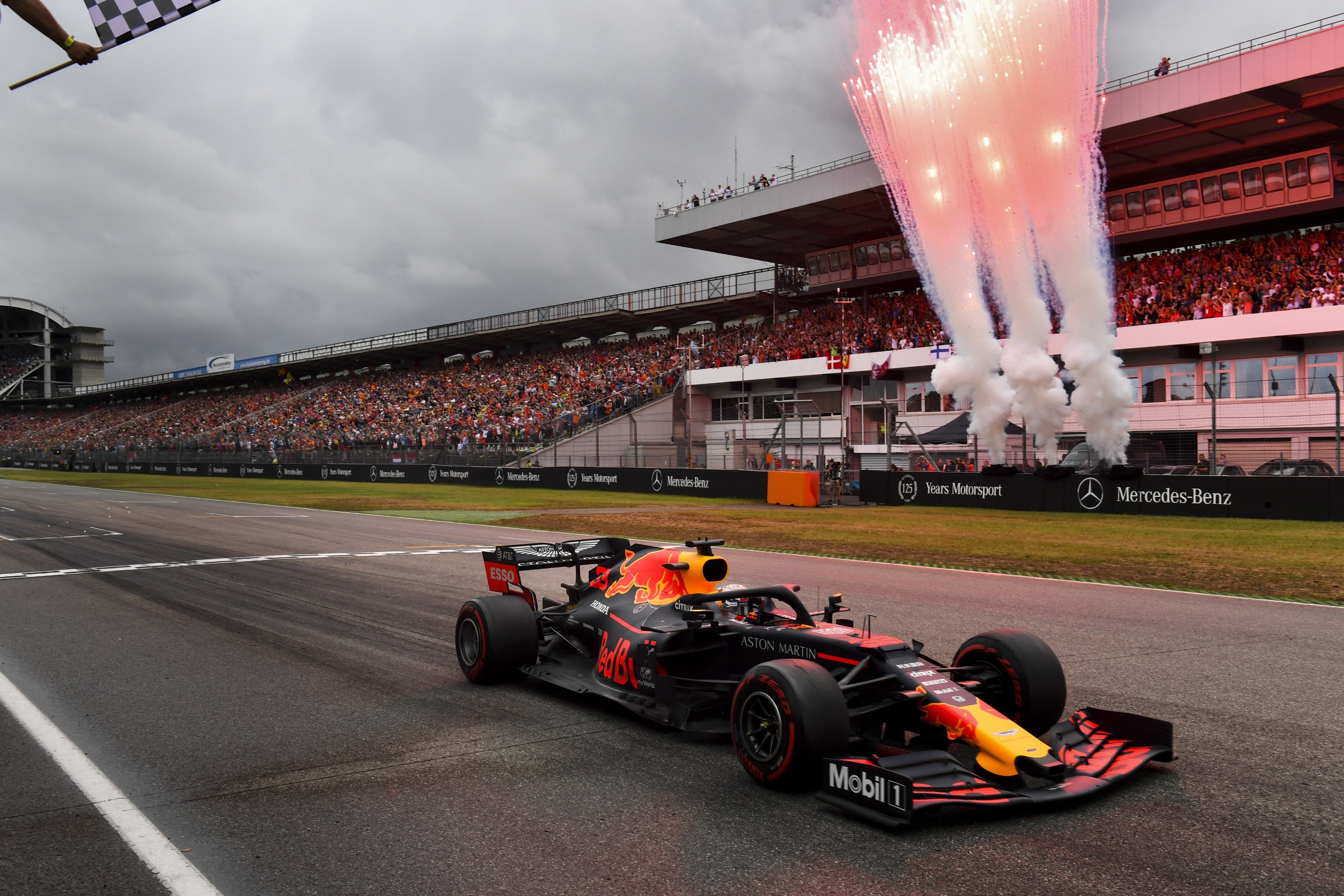
Max Verstappen wins the German Grand Prix.
Image credit: LAT Images

Max Verstappen came home to take a popular victory at the 2019 German Grand Prix after an incredibly eventful race which was dominated by ever-changing weather conditions. The race started under a safety car but, after it came in, we experienced the first post-safety-car standing start. And from there, the madness never really stopped.

Strap yourself in: this might be a long write-up.

Lewis Hamilton led away from pole but Verstappen, alongside him on the front row, suffered severely with wheelspin and dropped back behind Valtteri Bottas and the Alfa Romeo of Kimi Räikkönen. There was normally a car in a run-off area during the next few laps as the drivers struggled with cold tyres and a slippery track. Räikkönen held on to his impressive 3rd place for a couple of laps but was passed by Verstappen just before Sergio Pérez became the first casualty of the race, spinning his very jittery Racing Point and being collected by the wall. That brought out the first safety car of the day and the first wave of pit stop panic. Most cars came in for intermediate tyres and, in the pandemonium, Ferrari were punished with a fine for an unsafe release having sent Charles Leclerc out directly into Romain Grosjean’s path.

The rain stopped and the track began to dry up, but teams suspected more was on the way and were instructing their drivers to try and take care of their tyres. Daniel Ricciardo experienced an all-too-familiar Renault engine blow-up on Lap 15 and Leclerc used the ensuing Virtual Safety Car for a cheap pit stop. Suddenly he was the fastest car on track by two seconds a lap and rapidly closing in on the front three. A bit more rain had begun to fall but Kevin Magnussen and then Sebastian Vettel – who had started the race from the back of the grid – took the gamble of pitting for dry tyres; after initially sliding around, they began to set fastest sectors and those in front decided to follow suit.

Red Bull fitted the mediums to Verstappen, which take longer to heat up than the soft tyres. The Dutchman span – but survived with a neat 360 – and berrated his team over the radio for not giving him the softs. Another Renault engine blow-up – this time for the luckless Lando Norris – brought out another VSC on Lap 28. The race was about to turn on its head.

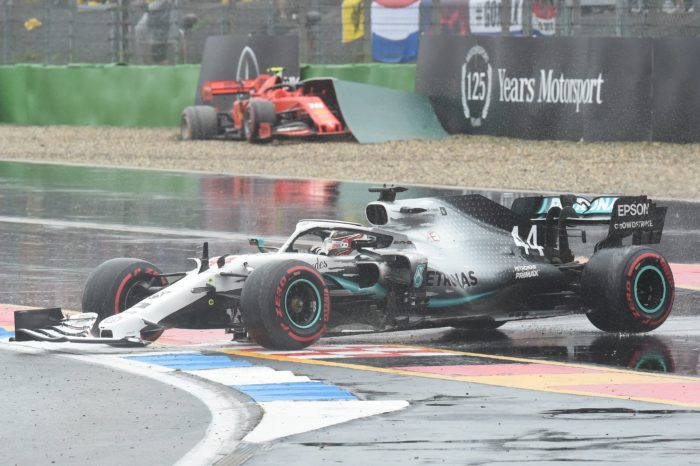
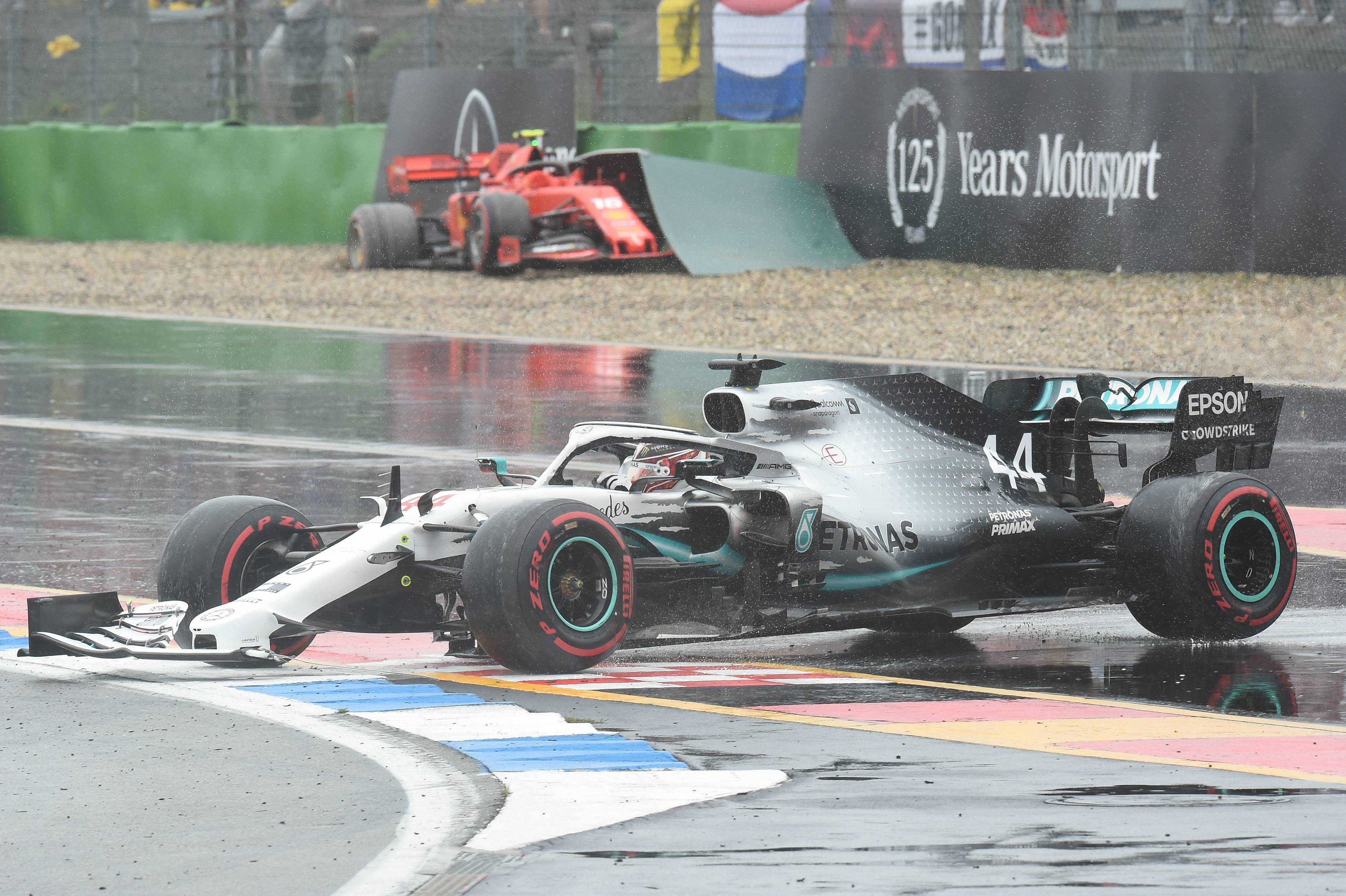
Leclerc benefitted again, pitting for soft tyres and leapfrogging Bottas for 2nd place. Hamilton, who had been controlling the race superbly from the front up to this point, then also pitted for softs. This top two would not last long however as Leclerc ran wide on to the slippery drag strip on the outside of the final corner and aquaplaned into the barriers and out of the race. Moments later, with a safety car already called, Hamilton suffered a near carbon copy of the incident but just about managed to keep the car moving, having bounced off the barriers. He had lost his front wing though and would need to pit.

Image credit: AFP

This meant, firstly, he had to go the wrong side of the bollard at pit entry – which would earn him a five second penalty – and, secondly, that his engineers were not ready. Thus ensued a fairly comedic 50-second pit stop with engineers bumping into each other as they tried to replace the nose and changed their mind on which tyres to fit. Hamilton did eventually re-join in 5th; some blushes spared by the gap he had held and the safety car. In the meantime, most had now changed back to inters and the new top 5 was Verstappen, Nico Hülkenberg, Bottas, Alexander Albon, Hamilton.

The Mercedes cars worked their way back into the top 3 within a few laps and then, with that elusive podium in sight, agonisingly, Hülkenberg recreated the Leclerc/Hamilton incidents but with the Leclerc result of bogging down in the gravel and retiring. This brought out yet another safety car. Verstappen and Vettel pitted but the Mercedes did not. Just three laps after the restart, all the drivers came in for dry tyres and Racing Point’s gamble to fit them to Lance Stroll’s car during the safety car period meant that he was suddenly, unbelievably leading the race.

It didn’t take long for Verstappen to retake the lead of the race but we were left with a provisional podium of Verstappen, Stroll and the Toro Rosso of Daniil Kvyat. Then another uncharacteristic error from Hamilton saw him spin at turn 1 on Lap 54, whilst chasing down. The championship-leader narrowly kept it out of the barriers but was forced to pit for new tyres and rejoined in last place. And then, just when Mercedes thought things couldn’t get any worse, Bottas – whilst chasing Stroll for 3rd – recreated Hamilton’s spin from a couple of laps prior but couldn’t keep it out of the barriers. He hit the wall, about as hard as Toto Wolff’s hand hit his desk, and was out of the race too. The safety car made its fifth appearance.

It returned to the pits on Lap 59, leaving a five-lap sprint race to the end. The race still had time for one more retirement as Pierre Gasly drove into the back of Albon whilst battling for 6th; a poorly-timed mistake from the under-fire Frenchman, with excellent performances from both the Toro Rosso drivers that are eyeing up his seat. Verstappen finished the job and sealed an almost flawless victory – his second of the season. Meanwhile Vettel, who had been steadily working his way through the field at various points of the race, sent the home fans wild by passing Stroll and then Kvyat for an unlikely 2nd place.

Behind Verstappen and Vettel, Kvyat took the final place on the podium – Toro Rosso’s second ever podium. Stroll held on to 4th, Sainz – who had at one point spun out and had to put it in reverse – claimed 5th, and Albon 6th. After the race, the two Alfa Romeos – who had finished 7th and 8th on the road – were given 30 second time penalties for driver aid infringements. This promoted the Haas drivers of Romain Grosjean and Kevin Magnussen, who had conspired to crash into each other once again during the final laps, along with Hamilton to 9th and Robert Kubica to 10th. In a season where he has perenially been running in last place, the least likely of points scorers to cap the least likely of races.

And breathe.

Redemption in Red

Image credit: Ferrari

A year on from his title-swinging, gut-wrenching crash in the rain at Hockenheim, Sebastian Vettel produced an inspired fight through the field to finish 2nd, having started the race at the very back of the grid.

It was not only a tale of the difference a year can make for Vettel, but also the difference 24 hours can make. For the second time in three races, he experienced a technical issue in qualifying as his Ferrari developed a turbo problem and he was unable to set a competitive time. Last place on the grid with rain forecast for Sunday always felt like a chance for redemption and that’s exactly how it played out.

Vettel, who was born just half an hour’s drive down the road from Hockenheim, got straight down to business. He was up to 10th by Lap 5; 7th by Lap 8. For the most part of the race he was then generally running in the low end of the top 10 – changing surprisingly little despite the madness going on around him. But he came alive towards the end of the race, using the straight line speed of the Ferrari and some tactical nous to pass cars before and after the final safety car period and collecting a well-deserved 2nd place.

It is a much-needed result for himself and his team. And particularly fitting that it occurred on the effective anniversary of his lowest point, in Germany last year. For a team that has been much-criticised for their strategic calls in recent years, Ferrari barely put a foot wrong in such a manic race and made up numerous positions for both cars with opportunistic pit stops.

Will this prove to be a turning point for team and driver? Time will tell. But it’s certainly a step in the right direction.

A Miserable Anniversary for Mercedes

For a team that had won nine of the first 10 races this season, one would imagine that this was just another weekend. But no, this one really mattered to the dominant force of recent F1 history that is Mercedes-Benz: it was one of their two home Grands Prix; they were celebrating (complete with special livery and fancy dress) the 125th anniversary of motorsport and their 200th Grand Prix; this was the one race they had given access to the Netflix crew of Drive to Survive. So for things to have gone this way will have especially hurt them.

In fairness, there were few truly major errors; it was mostly a domino effect from a few small ones. They dominated the first half of the race. Particularly so Hamilton, despite still suffering from illness, but that ended with the first switch to dry tyres. In hindsight, it was a bad call. Hamilton had a very comfortable lead and was saying that he didn’t think the switch was the right call – it was still raining after all. Could they have waited for a lap or two to see how things were progressing? Yes, but of course that is easy to say now. Either way, the call was made, Hamilton ran wide and then brought about an embarrassing pit stop as he was forced to pit immediately whilst the team had been waiting for Bottas with different tyres. The whole episode made the fancy dress element of their celebrations seem suddenly very clownish.

A few laps later, they were back running 2nd and 3rd but this is where the wheels were really about to fall off – literally in the case of Bottas. Again, in hindsight, they probably should have pitted Hamilton under the safety car and were overly wary of the five-second time penalty dropping him too far back when the drying track was about to make that issue far worse. But the drivers were about to outdo the strategists in terms of their mistakes with synchronised spins at Turn 1.

Hamilton rescued his but Bottas did not and his was far more costly. Hamilton does not present his competitors with an opportunity to claw back that many points in the title race very often. And for it to happen just as the Mercedes hierarchy is about to decide on their driver line-up for 2020 and beyond is particularly unfortunate. You have to wonder if Bottas will mentally recover from this setback.

It seemed Toto Wolff had decided after the race that they would not be making such a song and dance about any celebration in the future: “It shows that you shouldn’t fool around with stuff – you should concentrate on the job, we are not superstitious, but we should focus on the job at hand.”

The German Grand Prix in 90 Seconds (It needed the Extra 30)

Answering the Burning Questions

Will the run of great races continue? Oh yeah. And then some.

Can Bottas can do anything to claw back some of Hamilton’s championship lead? He had the opportunity but fluffed his lines.

Will Leclerc and Verstappen have another epic battle? Not this time. Verstappen battled with Bottas, Leclerc battled with the slippery drag strip.

Can Gasly continue the progress he made at Silverstone? No. He crashed badly during practice and drove into the back of the sister car of Albon.

There are a few updates this weekend. Whose will have the biggest impact? Hard to tell in the rain but judging by earlier in the weekend, Racing Point seemed to have made a big jump.

Could we actually have a wet race?? We could and did. And it was great.

2019 Canadian GP report | Hamilton wins…but that’s not the headline

A good race; a greater controversy.
Lewis Hamilton and Sebastian Vettel on the podium at the 2019 Canadian Grand Prix.
Image credit: Motorsport Images

Let’s get the basics out of the way. Lewis Hamilton claimed victory at the 2019 Canadian Grand Prix and Mercedes continued their clean sweep of wins.

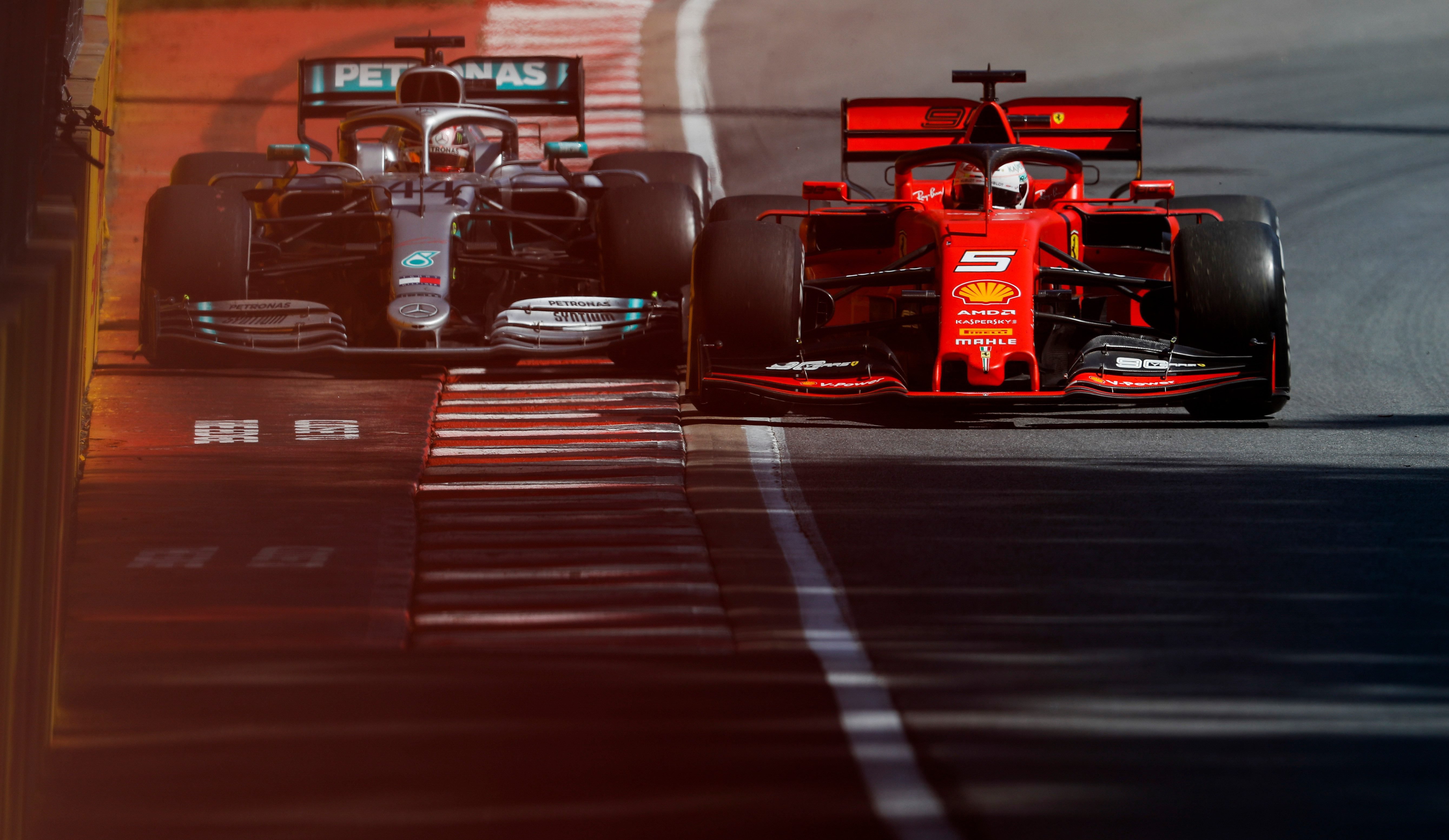
However, it was in very controversial circumstances after Sebastian Vettel was given a five-second penalty for obstructing Hamilton as the German rejoined the circuit having ended up on the grass at Turns 3 and 4. More on that later. (In fact, most of the post will be about it as it’s all anyone is going to be talking about.) But firstly, let’s quickly address the rest of the race. (Feel free to scroll down if you’re only interested in the controversy…)

The front two were near enough in a race of their own throughout with Vettel’s teammate, Charles Leclerc, never quite in the fight and Hamilton’s teammate, Valtteri Bottas, a distant fourth. Leclerc will be pleased at least to bounce back from his eventful – for all the wrong reasons – home race two weeks ago with a solid podium but he still needs to work on his qualifying performances. Despite often looking the faster Ferrari through the practice sessions, he has made mistakes when it really counts and left himself with a lot to do on Sunday. Bottas unfortunately reverted to Bottas 1.0 and was never really on Hamilton’s pace all weekend. A very scruffy Q3, where he was lucky to escape the barriers after a spin, saw him start 6th. He then lost a position at the start, spent numerous laps stuck behind slower cars and is now 29 points behind his teammate in the standings.

Daniel Ricciardo continues to look more and more at home in the Renault, demonstrating his late-braking talents – which he had seemed to be struggling to dial in to his new car at the start of the year – to keep Bottas behind him for far longer than he had any right to. The Honey Badger ended the race a commendable 6th and was followed home by the sister Renault of Nico Hülkenberg to complete an excellent weekend for the French team on a track at which they had not expected to be all that successful.

Max Verstappen recovered well to 5th after unfortunate timing with a red flag in Q2 left him starting 9th on the grid, whilst teammate Pierre Gasly’s struggles continued as he went in the opposite direction, from 5th to 8th. Lance Stroll had an excellent home race, progressing from 17th on the grid to finish 9th, claiming two well-deserved points to silence some of his critics, at least for a while. And finally a quick mention also for the unfortunate Lando Norris, whose rear suspension seemingly melted thanks to severely overheating brakes – something I have never seen before in the sport – which put paid to a very promising race for the youngster. His car unusually left stranded at the side of the pit exit – because it was not in a dangerous position – evoked memories of the 90s where broken cars would be scattered around the track, abandoned. And of course he used his retirement to produce yet another meme.

What We’re All Here to Talk About

Now then. Where to begin…

What Happened

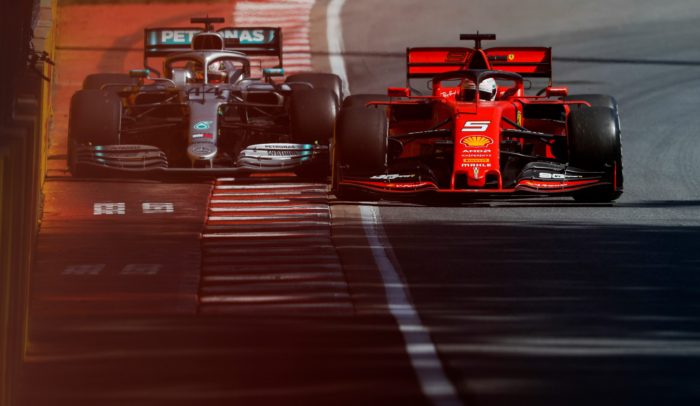
In arguably the battle of the year so far, Hamilton had been right on the tail of his long-term rival for some time. After the pit stops, he quickly closed a five-second gap and then began pressuring Vettel in what was shaping up to be a thrilling fight to the end of the race. We had already had nine laps of this when Vettel made a mistake under pressure – certainly not his first – and overcooked his entry into Turn 3, catching a snap of oversteer but in the process having to take to the grass.

Lewis Hamilton and Sebastian Vettel during the defining moment of the 2019 Canadian Grand Prix.
Image credit: LAT Images

This is where the controversy occurs. Vettel rejoined the track very close to Hamilton, who tried to go around the outside but then backed out as he was squeezed towards the wall. Hamilton came on the radio to say that Vettel had rejoined the track dangerously – understandably so when you see the incident from his on-board camera – and after a few minutes of investigation, the stewards handed Vettel a five-second time penalty. With that, the race effectively died. Whilst Hamilton states he continued to try and pass for the remaining laps, and to his credit he certainly didn’t just sit three or four seconds back and coast home, there was no real need for him to take any risks.

Vettel spent the remainder of the race understandably fuming and then, in bizarre scenes, parked his car as far as he could from the designated spot in parc fermé and stormed off to Ferrari hospitality, before being fetched by an official and his media adviser. He then returned for the podium via the Mercedes garage and a brief stop to switch the number boards, placing the ‘number one’ in front of the space where his car would have been and the ‘number two’ in front of Hamilton’s car. Credit where credit’s due: that is a baller move.

Now. For 95% of people, at least judging by social media, this appears to be a slam dunk and not up for debate; it was totally the incorrect decision and a huge injustice for the Ferrari driver. But as I see it – and I have looked into this in massive depth over the last 24 hours – it’s a closer call than that. There are many aspects to examine in little over a second of action and then many different ways to interpret the minutiae. Every point has a caveat and I could easily follow most of the following sentences with a ‘but’ or a ‘however’…and in fact I do a fair few times. Let’s start with the fundamentals: the rules.

The Rules

Here are two pertinent regulations.

The first: “Should a car leave the track the driver may rejoin, this may only be done when it is safe to do so and without gaining any lasting advantage.” Removing this from the bigger picture, putting it plainly in black and white, Vettel did return to the track in an unsafe manner and he did gain a lasting advantage in that if he’d rejoined more slowly and safely, Hamilton would have passed him. Only he didn’t really have the opportunity to do so. He was simply trying to recover control of the car the entire time he was on the grass and in the split second which followed on the track. The first time he checks his mirrors is around the point at which Hamilton had to bail out. Having said that, it’s down to his mistake that he is in that position so why should Hamilton be the one to suffer? (See what I mean about the caveats?..) As Hamilton put it, “I was just driving the normal line so I shouldn’t have been in the position of being close to crashing. It was his responsibility to avoid that, but it ended up being mine. So because of that I lost a chance of passing”.

The second: “Manoeuvres liable to hinder other drivers, such as deliberate crowding of a car beyond the edge of the track or any other abnormal change of direction, are strictly prohibited.” Similarly, whilst Vettel was not in control and thus the ‘deliberate’ aspect can be ignored, Hamilton was certainly hindered. But, by definition, a manoeuvre is ‘a movement requiring skill’, so surely not being in control means this can’t be classed as one. Either way, it has now come to light that a large part of the stewards’ decision came from Vettel’s movements after regaining control. Their data shows that, after checking his mirror, he opened the steering to move towards the edge of the track. Certainly a manoeuvre this time but up for debate whether, by that point, it was impeding Hamilton.

It all boils down to what each fan or member of the F1 paddock wants from the rules. They are a necessary evil. Remember how angry everyone was when Verstappen came on the scene and repeatedly exploited loopholes to defend dangerously? There have to be lines somewhere and, once those lines are drawn, surely they have to be enforced. The gravity of the situation shouldn’t be a factor. If this had happened between Sergio Pérez and Antonio Giovinazzi for 12th place, there is less at stake, and people obviously wouldn’t feel as passionately, but does that mean that the situation should be ruled differently?

Precedent

The bigger picture here is the consistency of rulings. Whilst most fans immediately stated that they are inconsistent, an almost identical incident between Verstappen and, ironically, then-Ferrari-driver Kimi Räikkönen at last year’s Japanese Grand Prix also brought about a five-second penalty. At the time, most seemed to go with the opinion of harsh but fair, and Ferrari obviously thought so. Vettel himself said “Look at Kimi. [Verstappen]’s off the track and he comes back and if Kimi just drives on they’d collide. But it’s not always right that the other guy has to move.” Sound familiar? The late, great Charlie Whiting described it as “a fairly straightforward one for the stewards”.

Here comes another caveat though. There was also a pretty similar incident between Ricciardo and Hamilton at Monaco in 2016 which was not penalised. This one was also for the lead of the race so had the same gravitas as Vettel and Hamilton’s incident. Did that factor in to the decision? Only the stewards will know. At the time, some certainly thought he was lucky to get away with it.

Just one more point to add to this already perplexing and convoluted mire I’ve created. Hypothetically, if Hamilton had kept his foot in and they had both ended up in the wall, what penalty, if any, would fans have expected to be dished out?

An Attempt at a Conclusion

So this is the crux of the matter. Did Vettel rejoin the track in an unsafe manner and cause Hamilton to take avoiding action? Yes. Did he have any control of that once off the track? No. Was it his fault he was off the track and thus out of control? Yes. This could go on and on, further down the rabbit hole.

We as fans have to accept that the stewards have far more information than us to base their decisions on and that they are more experienced than 99% of us. But it would be far easier to do so if there were a consistent panel of respected figures who were accountable and then came out and explained exactly how and why they came to their decisions. Surely that’s not too hard for the senior leaders to put together. The fact that the crowd ends up booing Hamilton – surely an innocent party in this whole debacle – in the absence of anywhere else to direct their anger, is a real shame.

It is hard to come to a definitive conclusion. I remain somewhat on the fence. I am fully for hard racing but I also understand that there have to be rules and, with the rules that we have currently, I can see why they came to the decision that they did. In this instance, they have applied the letter of the law rather than spirit of the law. The bigger question is whether the rules need to be amended. Generally this year the stewards have been more lenient and the public and pundits have seemed happy with it.

I guess it depends whether Liberty Media want the headlines to come from the racing or the controversy. As, if we can be certain about one thing in all this, it is that more lenient stewarding would have resulted in a far better end to the race.

Well, that and the days of ‘Ferrari International Assistance’ being long gone.

Answering the Burning Questions

(I guess I should still answer these…)

Will the track really favour Ferrari as predicted? We’ve heard that a few times this year.. Yes, for once the top two teams were evenly matched.

How much of an improvement will the Mercedes engine upgrade provide? Not a significant one seemingly. Also, one of them blew up…

Will the Wall of Champions claim any new victims? Kevin Magnussen had a brush with it but properly crashed on the other side of the track. And isn’t a champion anyway.

Can Bottas continue to get on top in qualifying or will Monaco prove a turning point? It’s looking more like the latter.

Will Leclerc bounce back from his less-than-ideal home Grand Prix? It was certainly an improvement, if not a great weekend.

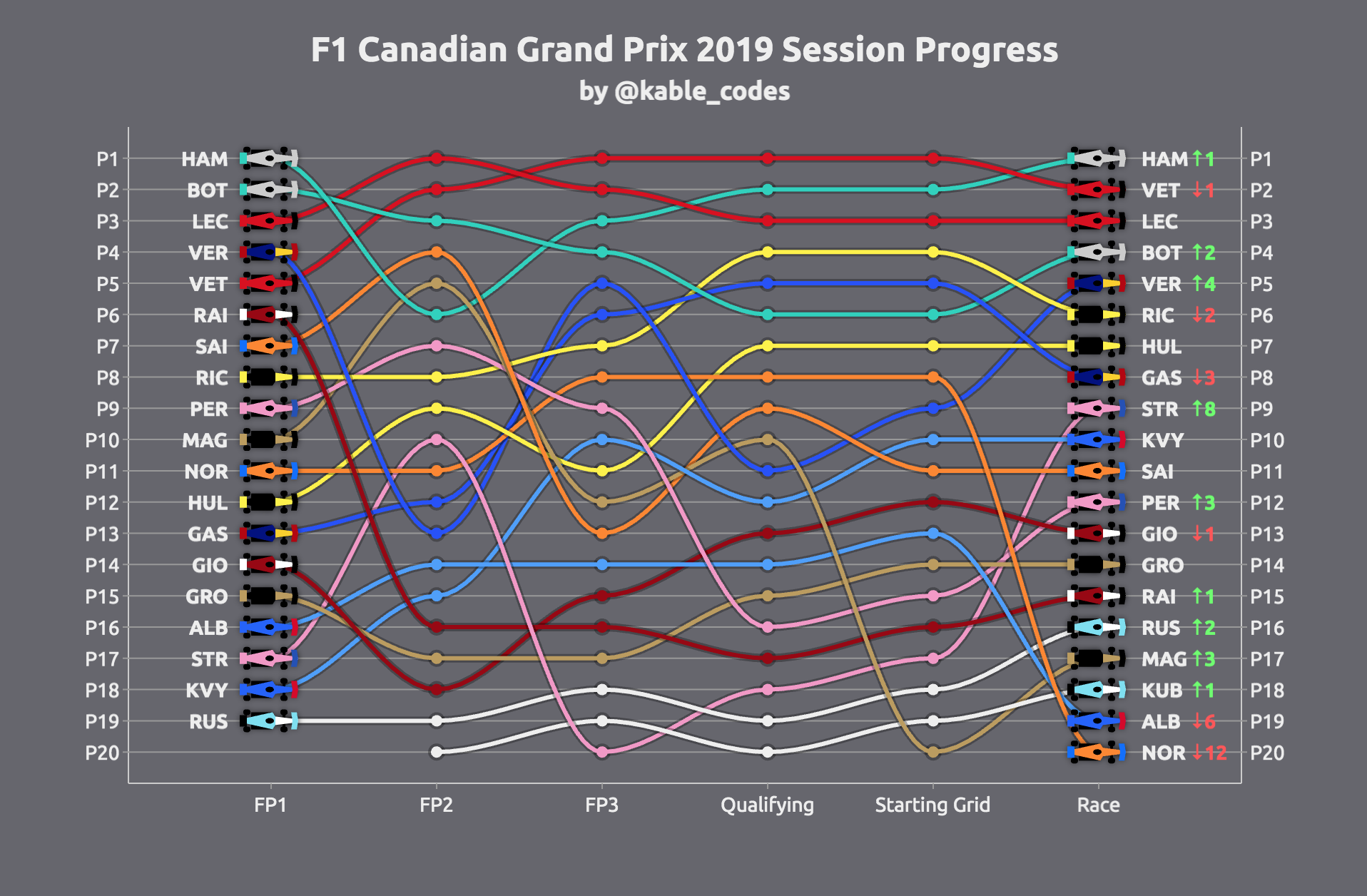
Session Progression