
2020 Eifel GP report | Hamilton wins in Germany to Match Schumacher record

Records are there to be broken.
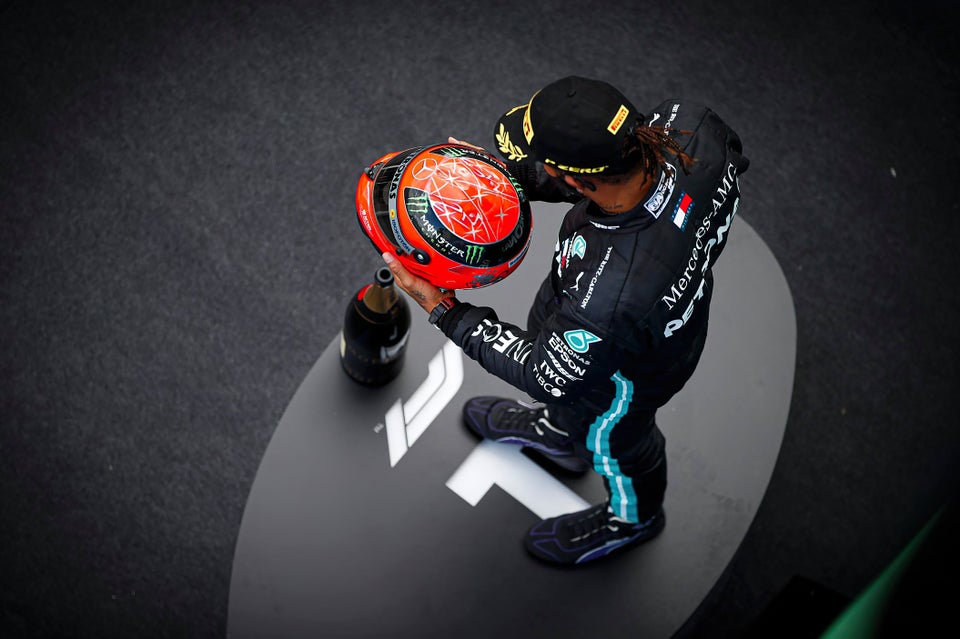
Image credit: LAT Images

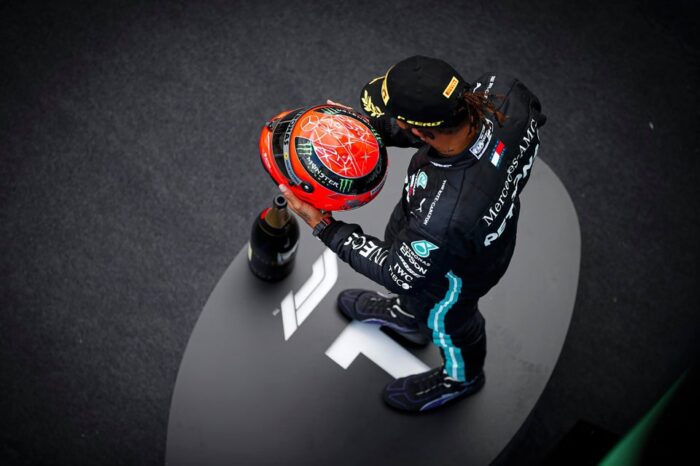
It was a historic day, at a fittingly historic circuit, as Lewis Hamilton won the Eifel Grand Prix at the Nürburgring and, in doing so, matched Michael Schumacher‘s all-time record of 91 race wins. The World Champion had to work for this momentous victory, overcoming an in-form teammate, tricky conditions and a safety car.

Valtteri Bottas had taken an impressive pole on Saturday and kept up that gutsy approach on Sunday as, after Hamilton had made the better start and taken the inside line at the first corner, he kept his foot in whilst running well wide and somehow held onto the lead. Hamilton later mentioned how much that had impressed him.

The Finn kept the lead for 13 laps but, as his tyres began to suffer and Hamilton started to exert more pressure, he locked up into the first corner and dropped behind his teammate. The flat spots on his tyres meant he was forced to pit and change to a two-stop strategy. That may well have worked out in his favour, but a VSC after George Russell’s retirement gave Hamilton and Max Verstappen a cheap pit stop and then Bottas’s day went from bad to worse as a suspected MGU-H failure brought about his retirement. A 69-point deficit in the championship standings is now looking fairly insurmountable.

Insurmountable was a word often used about Schumacher’s records, though, and here we are.

https://www.youtube.com/watch?v=naerwOj5chM

Once his teammate had retired, Hamilton set about keeping the feisty Dutchman in the Red Bull at arm’s length and opened out a lead of around 10 seconds, whilst looking likely to lap every other car in the process. That was all cancelled out by a safety car on lap 44, however. It was another debatable call where a VSC would probably have sufficed and, once the lapped cars had been allowed to pass and catch back up to the field, Hamilton and Verstappen were at a significant disadvantage. In the freezing conditions, high up in the Eifel mountains, their tyres were now far too cold, having sat behind the safety car for a needless amount of time.

They would just about hang on at the restart – the Mercedes DAS system being thoroughly utilised for the first time – and, from there, Hamilton’s win looked secure. Behind the two frontrunners, Daniel Ricciardo held off the challenge of Sergio Pérez to finally earn that elusive podium for Renault. It has been a long time coming – Renault’s last podium was nine years ago – but Cyril Abiteboul’s trip to the tattoo parlour can now be booked. In all the excitement, the Aussie even forgot to do a ‘shoey’, much to his horror when this was pointed out later on…

Carlos Sainz found himself in fifth on a weekend where he had struggled with the latest aerodynamic updates, whilst teammate Lando Norris returned to his 2019 levels of luck with an engine issue denying him a shot at the podium. He nursed the problem for a long time before the anti-stall kicked in, leaving him powerless and, ultimately, sat in a deckchair.

Further back, Pierre Gasly took an opportunistic sixth ahead of Charles Leclerc, who once again outclassed teammate Sebastian Vettel all weekend. Nico Hülkenberg earned driver of the day in eighth after getting an even later call than he had for his previous substitute role in Silverstone. Lance Stroll seemingly developed a stomach bug and was unable to participate so the Hulk rushed to the Nürburgring just in time for Q1. He unsurprisingly qualified last with absolutely no practice but recovered incredibly well on race day and made yet another great case for a race seat in 2021.
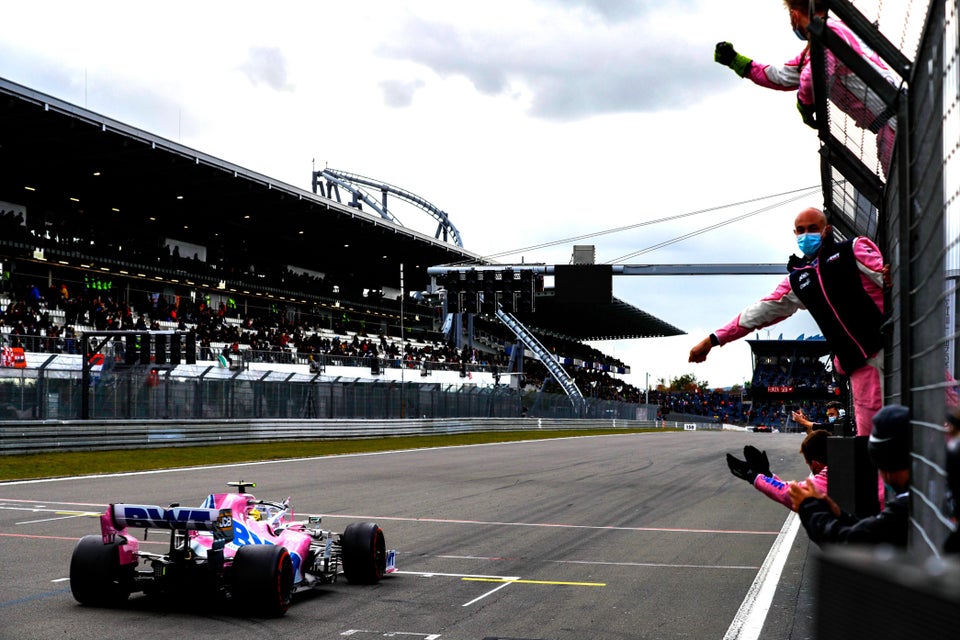
Nico Hülkenberg earned Driver of the Day at the Eifel Grand Prix.
Image credit: Motorsport Images

Romain Grosjean defied a sore finger to score his first points of the season in ninth and Antonio Giovinazzi held off Vettel for the final point, after having been hampered by the timing of the safety car.

Another Tough Day for Albon

Alexander Albon was slightly closer to Verstappen in qualifying – albeit half a second back and behind the Ferrari of Leclerc – and in a decent position to achieve the minimum that Red Bull really want from him. That is, being in fourth so that they can put more pressure on Mercedes in terms of strategy and potentially pick up the pieces from any misfortune out front.

But again, it was not to be.

A lock-up on the first lap led to an early first pit stop and, yet again, it would have to be a recovery drive from there. Having made it back into the top 10, he needlessly cut across in front of sister-teammate Daniil Kvyat; that lost the Russian his front wing and earned Albon a five-second penalty. He was very fortunate to escape without a puncture.

A few laps later he caught the other AlphaTauri of Pierre Gasly and, whilst attempting a pass into the first corner, locked-up again, very nearly spearing into the side of the Frenchman and then radioed in saying, “they race me so hard”. Martin Brundle’s retort in commentary of “Welcome to Formula 1” sums it up really.
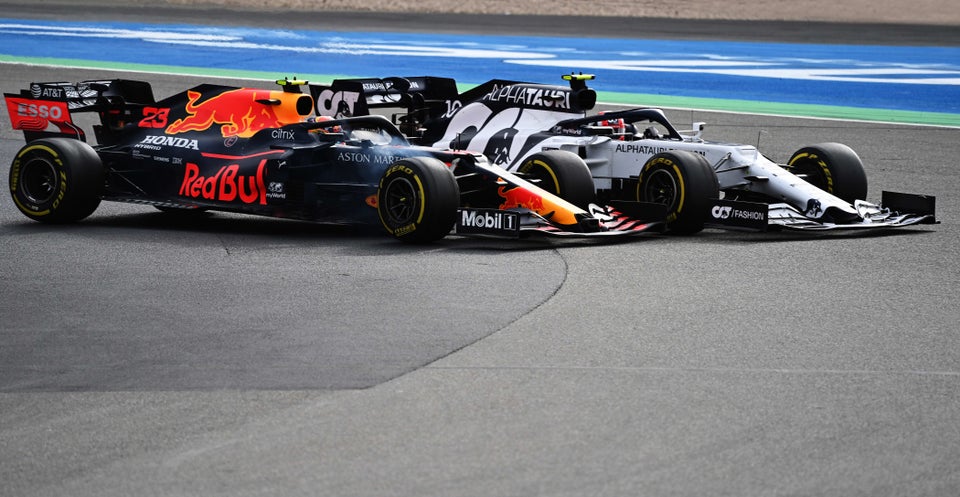
Alexander Albon and Pierre Gasly battle at the Eifel Grand Prix.
Image credit: Getty Images

Albon was forced to retire shortly after as apparently a stone had punctured his radiator. The awkward nature of the radio message conveying to him that he would be retiring, combined with the poor race to that point, has led to some theories that he was retired mid-race out of ’embarrassment’ or to be fired.

Whilst that seems highly unlikely, it is not looking good for the Anglo-Thai driver. With Hülkenberg and Pérez both available next year and persistently proving their worth in tricky circumstances, it seems it is only Helmut Marko’s insistence upon hiring strictly from within the Red Bull driver pool that is keeping him in a job.

How High Can Hamilton Go?

With Hamilton now looking more certain than ever to secure a seventh world title by the end of the year and thus match another Schumacher record, how high can he raise the numbers that will be etched next to his name when he leaves the sport?

The next obvious landmark is 100.

100 poles could well happen this year and 100 wins is starting to seem a certainty at some point next year, considering the level of dominance shown by the Silver Arrows and the lack of evolution between this year’s cars and those of 2021. Some even talk of 10 world titles. But the new regulations in 2022 make anything from then a total unknown at this point and Hamilton is yet to officially sign a contract even for next season.

Wherever the high-tide marks settle, they may well look insurmountable as Schumacher’s did before. But, as the great man himself said, “records are there to be broken”. Maybe it could even be his son, Mick, who breaks them. For now, let’s just enjoy that we are witnessing history being made and great moments like Mick handing over a gift from the Schumacher family to Hamilton to honour his achievement.

The Eifel Grand Prix in 60 Seconds

Answering the Burning Questions

Can Lewis Hamilton match Michael Schumacher’s win record this weekend? He can!

Or can Valtteri Bottas push on after his win in Russia? He certainly pushed on in qualifying, but things gradually unravelled in the race.

Will there be any more stewarding or penalty controversies? Not particularly, other than some debate about the safety car.

Can Alexander Albon have a strong weekend and ease some pressure? Not in the slightest.

Will the cold weather throw up any curveballs? Will we get a wet and wild weekend? The cold weather did spice things up a little. But Friday was too wet to the point of no running and then we only got a few drops of rain on Saturday and Sunday. Until the traditional downpour just after the race, obviously…
Walking away from a big team

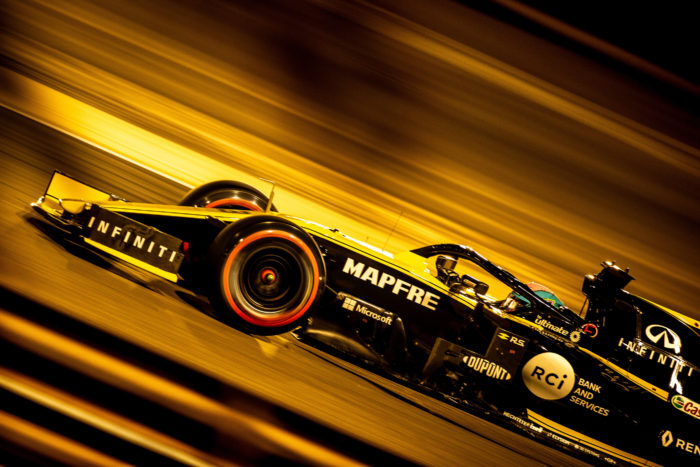
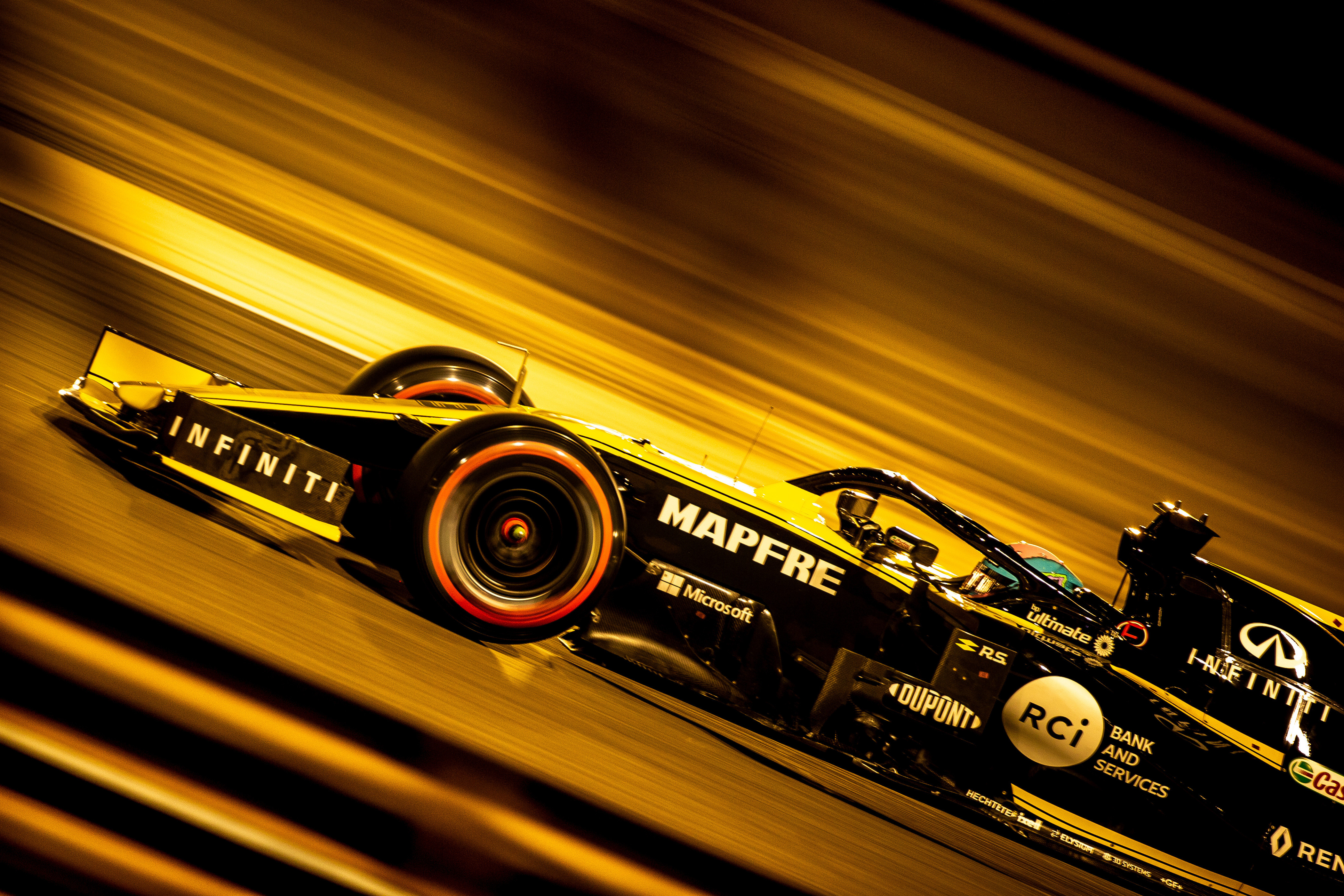
Daniel Ricciardo driving a Renault in 2019.
Image credit: XPB/James Moy Photography

In honour of Daniel Ricciardo‘s first points for Renault, this is a piece on the history of established, successful drivers leaving established, successful teams and how it worked out for them.

I’m only discussing drivers who left of their own accord – or at least as best we can tell without knowing all the ins and outs – so moves such as Damon Hill’s from Williams to Arrows in 1997 as world champion won’t be included. The 50s had a far more fluid driver-team dynamic; for example, Juan Manuel Fangio regularly changing teams depending on which he thought had the best car at that time. So let’s begin in the 60s.

Results are mixed.

Jack Brabham | 1962 | Cooper > Brabham

Jack Brabham won back-to-back championships with Cooper in 1959 and 1960 but during the second of those seasons was already becoming convinced that he could produce a better car himself, particularly once having helped design the T63 that took him to the championship. After a poor showing from Cooper in 1961, Brabham left to start the team this bore his name.

The first few years were not successful. His team suffered poor reliability, not helped by Brabham’s reluctance to spend money, and in 1965 he was beginning to consider retirement. He handed his car over to several other drivers and the lead-driver role to Dan Gurney. During that season, Gurney took the team’s first win but then announced he was leaving to start a team of his own and so Brabham decided to continue.

It was a good decision. Largely thanks to an inspired decision regarding the new engine regulations, 1966 saw Brabham win his third world championship. And in doing so, became the only man to win the world championship in a car that carried his own name. A record that still stands and likely will for a long time.

Success? Definitely.

Emerson Fittipaldi | 1976 | McLaren > Copersucar

Titles in 1972 with Lotus and 1974 with McLaren saw Emerson Fittipaldi become the youngest double world champion in the history of the sport. A record that lasted more than two decades until Michael Schumacher‘s second title in 1995. Fittipaldi finished the 1975 season as runner-up to the Ferrari of Niki Lauda before shocking the F1 world by announcing he was leaving McLaren for Copersucar – a team funded by a Brazilian sugar marketing company and run by his brother, Wilson.

13th place on his debut set the tone for the venture, however. The Brazilian never won again and managed only two podiums in the remainder of his career, staying at the team until retiring at the end of 1980. He moved into management of the team but it folded in 1982.

Meanwhile, James Hunt won the 1976 world title in the seat Fittipaldi had vacated…

Success? Definitely not.

Niki Lauda | 1978 | Ferrari > Brabham

Niki Lauda’s relationship with Ferrari never really recovered from his decision to withdraw from the crucial Japanese Grand Prix of 1976. Having recently returned from his horrific crash at the Nürburgring and in appalling weather conditions, Lauda said “my life is worth more than a title”.

The following year, despite Lauda comfortably winning the championship, tensions continued to grow. The title was won due to consistency rather than outright pace and Lauda disliked his new teammate, Carlos Reutemann. He said he felt let down by Ferrari for them putting extra pressure on him and announced his decision to quit.

He moved to a Brabham team that had struggled for most of the 1970s and sadly for the Austrian not much was to change during his two years there, with unreliability a major issue. That was except for one race and one infamous car – the Brabham BT46B. A radical design that became known as the ‘Fan Car’. It won its first and only race but was never used again; other teams vigorously protested its legality and team owner Bernie Ecclestone did not want any legal complications whilst he worked on his acquisition of the sport’s commercial rights.

At the end of 1979, Lauda retired, stating he had “no more desire to drive around in circles”. He would return in 1982 with McLaren, however, and win the world championship in 1984.

Success? Not at Brabham but the decision was understandable and he got his third title in the end.

James Hunt | 1979 | McLaren > Wolf

Things went steadily downhill for James Hunt at McLaren after winning the 1976 World Championship. His title defence derailed early in the season due to problems with the new car and, whilst that season ended reasonably well, 1978 was a disaster. Lotus had developed very effective ‘ground effect’ aerodynamics and McLaren were slow to respond. The car was eventually revised midway through the season but it did not work. This, along with the death of his close friend Ronnie Peterson, crushed Hunt’s motivation.

Despite a poor 1978, Hunt was still very much in demand. He turned down an offer from Ferrari, due to their complicated political environment, electing instead to move to Walter Wolf Racing. A team which had won its very first race and powered Jody Scheckter to second in the world championship in its first season. However, the team’s ground effect car was uncompetitive and unreliable.

Hunt retired from six of the first seven races and, after the Monaco Grand Prix, announced his immediate retirement from the sport. He could only watch on as Scheckter won the championship in the Ferrari seat he had turned down.

Comebacks almost transpired. First as a replacement for the injured Alain Prost in 1980 but Hunt broke his leg whilst skiing. Then in 1982 he was offered a drive at Brabham by Bernie Ecclestone but turned it down. And even in 1990, at least somewhat due to financial troubles, Hunt considered a comeback with Williams – testing a modern car but running several seconds off the pace.

Success? No. But leaving McLaren was less the issue than turning down Ferrari.

Nelson Piquet | 1988 | Williams > Lotus

Despite winning the title in 1987 at Williams, Nelson Piquet became obsessed with his feeling that he was not being given the undisputed number one driver status he claims was promised to him by the team. Even going as far as saying they actually favoured Nigel Mansell. And so he left for Lotus, having been promised the status he craved there.

Honda, who paid most of his salary, were unhappy with Williams and moved their engines along with the Brazilian. McLaren, also with Honda power, then dominated the next two seasons. Lotus were stagnating and Piquet himself also wasn’t performing. It could be that he was never the same driver after a bad concussion suffered in a crash the previous year, but he significantly harmed his reputation and resorted to attacking his rivals via petty comments in the media.

He later moved to Benetton and won three races in two seasons but never again challenged for the championship.

Success? No and dragged his former team down with him too.

Michael Schumacher | 1996 | Benetton > Ferrari

You could argue that moving to Ferrari is never going to be that much of a risk, certainly compared to some others on this list. But Michael Schumacher left Benetton as the constructors’ champions, having won back-to-back titles himself with them, for a Ferrari team that hadn’t won a drivers’ title since 1979 and had only won two races in the past five seasons.

But Schumacher had grown tired of the way Benetton was run and wanted both an increased salary and a new project.

He got both and we all know how the next decade with the Scuderia played out. After a few years of near misses (or distinctly not missing Jacques Villeneuve’s Williams and subsequently being disqualified from the 1997 season), Schumacher dominated the early 2000s, winning every title available between 2000 and 2004.

Fernando Alonso then arrived and dethroned him with the seven-time champion retiring at the end of 2006. A brief return to the sport with Mercedes in 2010 produced just one podium but Schumacher will always be remembered as the dominant force in Ferrari red.

Success? The success story.

Jacques Villeneuve | 1999 | Williams > BAR

After winning both championships in 1997, Williams had a strange title defence, both in terms of livery – in red for the first time – and performance, without a single win. They had been hampered by the underpowered Mecachrome engine and Villeneuve decided to join the newly formed BAR team for 1999. That decision was also certainly swayed by his friend and personal manager, Craig Pollock, who partly owned the team.

They had lofty ambitions and made boastful claims of winning the championship in their debut year. Claims that ultimately became embarrassing when they failed even to score a point, Villeneuve setting an unwanted record of failing to finish the first 11 races of the season.

During the four seasons that followed, BAR improved somewhat but never enough to take a win. Pollock was sacked in 2002 and, after being outpaced by a young Jenson Button in 2003, Villeneuve left the team. Without a drive, he was forced into a sabbatical before returning for three races with Renault at the end of the year but was off the pace.

He eventually retired from F1 during the 2006 season, whilst racing for BMW Sauber, having effectively been replaced by Robert Kubica after refusing to be part of a potential ‘shoot-out’ with the Pole.

Success? Not at all. A career that nose-dived.

Lewis Hamilton | 2013 | McLaren > Mercedes

When Lewis Hamilton announced he was moving from McLaren to Mercedes for the 2013 season, there were not many that thought it was a wise decision. McLaren were serial winners and, whilst the last few seasons had seen them second or third best, with Red Bull dominant, Mercedes had generally been also-rans since returning to the sport in 2010. But Niki Lauda had convinced Hamilton that it was a wise decision. And boy, was he right.

There was a solid first season with a victory and fourth place in the championship. But then in 2014, having spent years preparing for the new regulations and hybrid engines, Mercedes produced a car that was in a different league to the rest and Hamilton himself found a new level of excellence.

How certain he, or Lauda, were of the Silver Arrows’ impending dominance is up for debate. But Hamilton’s place now amongst the greats is not. He has won four of the last five titles, narrowly losing out to teammate Nico Rosberg in 2016 after a season plagued with unreliability, and is closing in on Schumacher’s all-time records. Records that most thought would never be threatened.

Whether or not, he can pass those records, Hamilton undeniably made the correct career move. McLaren have not won a race since he left.

Success? If Schumacher is the success story then Hamilton is well on his way to replicating that story.

Fernando Alonso | 2015 | Ferrari > McLaren

Fernando Alonso could arguably be on this list on more than one occasion. At the end of 2007, he left McLaren, after the most dramatic and political of seasons, to return to Renault. Alonso won just two races in two seasons there, but his second spell with the French team had only ever been a stopgap on his journey to Ferrari.

He succeeded in joining the Scuderia in 2010 and came agonisingly close to titles in both his debut year and 2012. Poor strategy in the final race put paid to his hopes in 2010 and then, in 2012, Alonso drove arguably one of the best seasons in the history of the sport, regularly dragging an underperforming Ferrari to places it had no right to be but agonisingly lost out to Sebastian Vettel by three points, once again at the final race.

The Spaniard became disillusioned, doubting he would ever be provided with a truly title-winning machine, and made a decision that stunned the sport – to return to McLaren.

In 2008, Alonso ever rejoining McLaren would have seemed unthinkable. Indeed, it still did to most in 2014. But McLaren had linked up with Honda on their return to the sport and Alonso dreamed of emulating his hero, Ayrton Senna, and winning in a McLaren Honda.

Sadly, it was not to be. Honda struggled to catch up with the other engine manufacturers, stifled by massively complex technology and McLaren’s strict regime, and Alonso spent the remainder of his career once again dragging the car to places it had no right to be. But now that was the top ten, rather than the top of the podium.

Success? Alonso’s career decisions have almost become a running joke within the sport. The guy just couldn’t pick the right path. A story of what could have been.

Daniel Ricciardo | 2019 | Red Bull > Renault

Daniel Ricciardo worked his way through the Red Bull junior system, progressing to Toro Rosso in 2012 and then being promoted to the big boy seat in 2014, promptly putting the reigning four-time world champion, Vettel, in his place. Ricciardo beat him fair and square and, when Vettel left the team at the end of the season, he became the team leader.

He then spent the last four seasons picking up plucky wins against the odds and pulling off audacious overtakes from way too far back, or “licking the stamp and sending it” as he’d put it. But the ever-likeable Aussie came to feel that Red Bull were beginning to favour their new golden boy, Max Verstappen, and decided to throw the dice with a move to Renault.

Only time will tell how he will compare to the others on this list. It could be an inspired move like Hamilton or a failed experiment like Villeneuve. Renault certainly have the aim of breaking into the current top 3 in years to come and there are new regulations coming in 2021 that could change the playing field completely.

We will just have to wait and see which part of that field Renault end up in.

Success? TBC.