2020 Turkish GP report | Hamilton clinches seventh title in style

Truly the drive of a seven-time world champion.
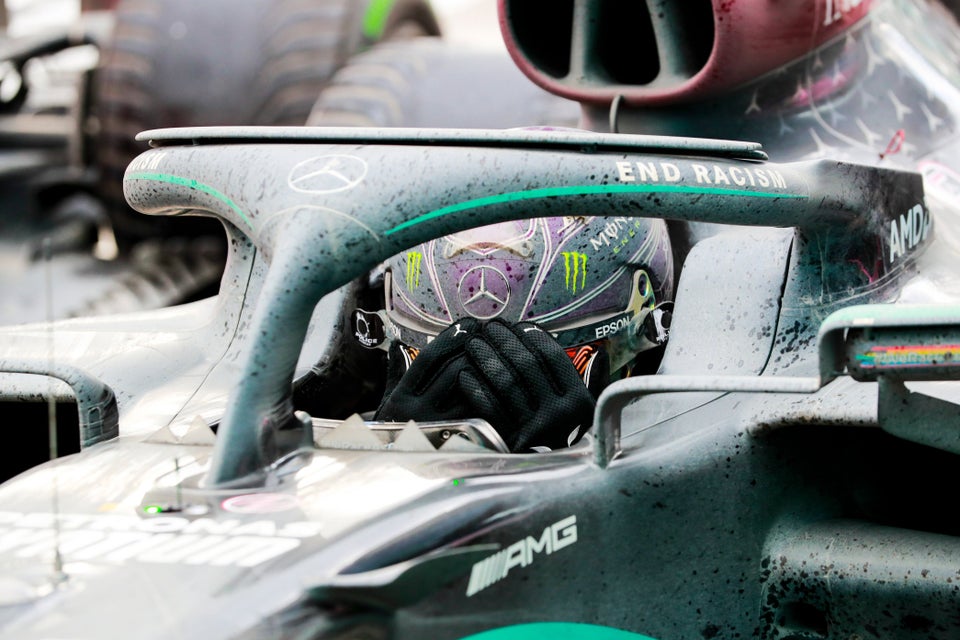
Lewis Hamilton wins the Turkish Grand Prix.
Image credit: LAT Images

On a challenging, grey day in Istanbul, Lewis Hamilton took his 94th grand prix victory and, in doing so, claimed a record-equalling seventh world championship.

As the Mercedes pulled up to the specially marked ‘World Champion’ board, it looked as though it had been to war – intermediate tyres warn down to effectively become slicks, the usually glossy, black finish now matte thanks to a layer of grime and bitumen. In many ways, it had been a war. And Hamilton’s battling performance was one thoroughly fitting of becoming the most successful driver in the history of the sport.

It all started on Friday, with the Mercedes unable to get any heat into their tyres as they – and the rest of the field – slid round what was for all intents and purposes an ice rink, before rain arrived on Saturday to add yet more jeopardy. It speaks volumes that Hamilton was happy with sixth on the grid. Teammate Valtteri Bottas qualified ninth – as Lance Stroll took an incredible maiden pole position – and Hamilton appeared likely to clinch the title, but in an unusually low position.

As the lights went out, the Red Bulls of Max Verstappen and Alexander Albon struggled to get away and fell back down the field. The pack emerged from the first corner with a Racing Point 1-2, ahead of Hamilton and Sebastian Vettel, up from 11th on the grid. Esteban Ocon had been spun by his teammate, Daniel Ricciardo, and Bottas also found himself spinning in sympathy as he reacted to Ocon pointing in the wrong direction.

Halfway around the first tour, Hamilton would make his only error of the day as he missed the chicane of Turns 9 and 10, suffering with cold brakes, and fell back to sixth behind Vettel and the recovering Red Bulls. Those at the front then fell into something of a holding pattern until around lap 10 when the drivers decided to switch their wet tyres for inters, with Verstappen jumping Vettel through the pit stops.

By lap 18, Verstappen was closing up rapidly on the leading pair. The Dutchman had been the bookmakers’ favourite for the race, having looked the most comfortable throughout the weekend, but his impatience would get the better of him. Following Sergio Pérez too closely through the high-speed kink of Turn 11, Verstappen ran wide onto the extra slippery run-off area and performed an unwanted 540° pirouette. To compound his problems, he was then forced to retreat to the pits to replace his flat-spotted tyres.

Stroll continued to lead from his teammate past the halfway point and was displaying some impressive maturity for his first experience heading a grand prix. The track was continuing to dry, though, and his tyres were beginning to struggle. It was the Racing Point’s ability to heat its tyres sufficiently that had produced the surprise pole on Saturday but, as the race progressed, Stroll was now experiencing the other side of that double-edged sword. Pérez and the third-placed Albon were closing in.

Albon would spin on lap 34, however, and thus released the increasingly confident Hamilton. The World Champion started eating into the gap at a rate of about one second per lap and Racing Point made what would turn out to be the poor decision to pit Stroll. He never got the new inters working – the tyres even graining within just a couple of laps – and fell all the way back to eventually finish a hugely disappointing ninth.

So, it had become a battle of F1’s two ‘tyre whisperers’ at the front. The overtake would not take Hamilton long, though, streaking past at the end of the back straight and clearing off into the distance. Within five laps he had built a gap of 15 seconds.
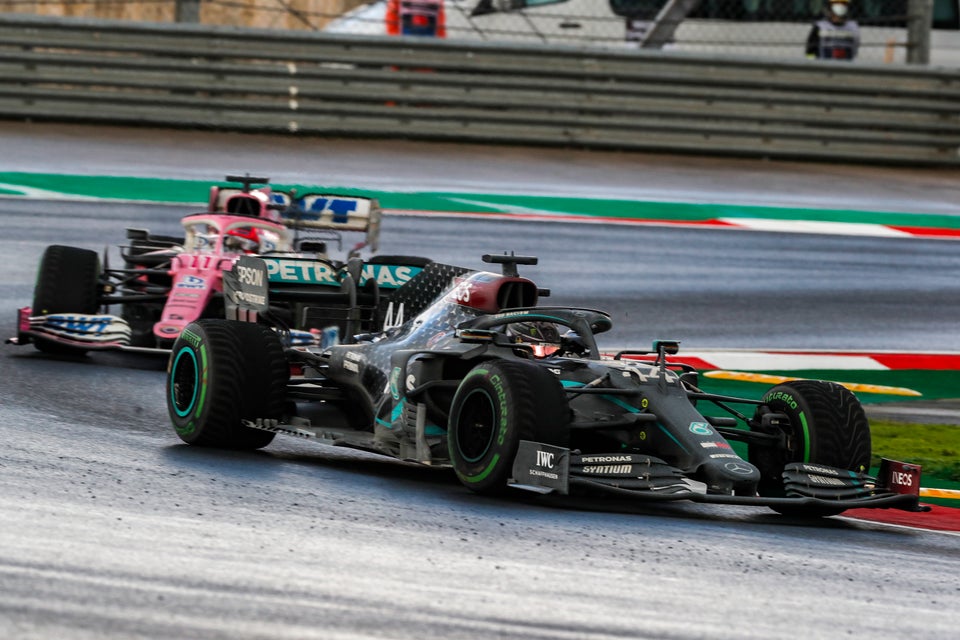
Lewis Hamilton and Sergio Pérez at the Turkish Grand Prix.
Image credit: Motorsport Images/Shutterstock

Further back, Charles Leclerc, who had been steadily working his way through the field, aided by some nicely timed pit stops, passed Verstappen for third place. Verstappen immediately headed into the pits for his third stop of the day, which promoted Vettel into fourth, and the two Ferraris set about closing the gap to Pérez.

To add one final twist to an extraordinary race, rain started to fall again in the final few minutes, with a downpour predicted for the very last lap. Verstappen and Kimi Räikkönen spun in tandem and Mercedes decided to bring Hamilton in for a ‘safety stop’. With thoughts of his infamous 2007 pit stop in China at the forefront of this mind, Hamilton overruled his team and brought the car home without incident for a victory that had required absolutely all of his skill and experience.

On the final lap, meanwhile, Leclerc had passed Pérez after he ran wide at the chicane, only to outbreak himself and lose not only second to the Mexican but also the final podium place to his teammate. A bitter pill to swallow for Leclerc, who was characteristically hard on himself for the mistake, but joy for two drivers, in Pérez and Vettel, who have had tough years for varying reasons. The Mexican makes yet another compelling case for a race seat next year.

The McLarens recovered very well from a disappointing qualifying and were the fastest cars on track at the end of the race. Carlos Sainz very nearly added extra salt to Leclerc’s wounds, crossing the line just a few metres behind, whilst Lando Norris recovered to take eighth and the fastest lap. The Red Bulls filled that McLaren sandwich, with Verstappen ahead of Albon, and Ricciardo secured the final point.

Image credit: LAT Images

Despite being over a pit stop behind the leaders in the early stages, Hamilton crossed the line with his second-largest winning margin ever of 31 seconds. It was a performance reminiscent of his largest winning margin at Silverstone in 2008. A masterclass in truly testing conditions and there were certainly shades of Felipe Massa as Hamilton’s only title rival, Bottas, spun no fewer than six times, before eventually being lapped by his teammate.

It felt very apt that Vettel should be on the podium to celebrate such a momentous occasion with Hamilton. The two have grown close through their title battles and Vettel was the first to congratulate the Briton as he sat, visibly overcome with emotion, in the cockpit. Vettel could be heard saying “it’s a privilege to be witnessing you making history, man”. They have now shared the podium more than any other pairing in history.
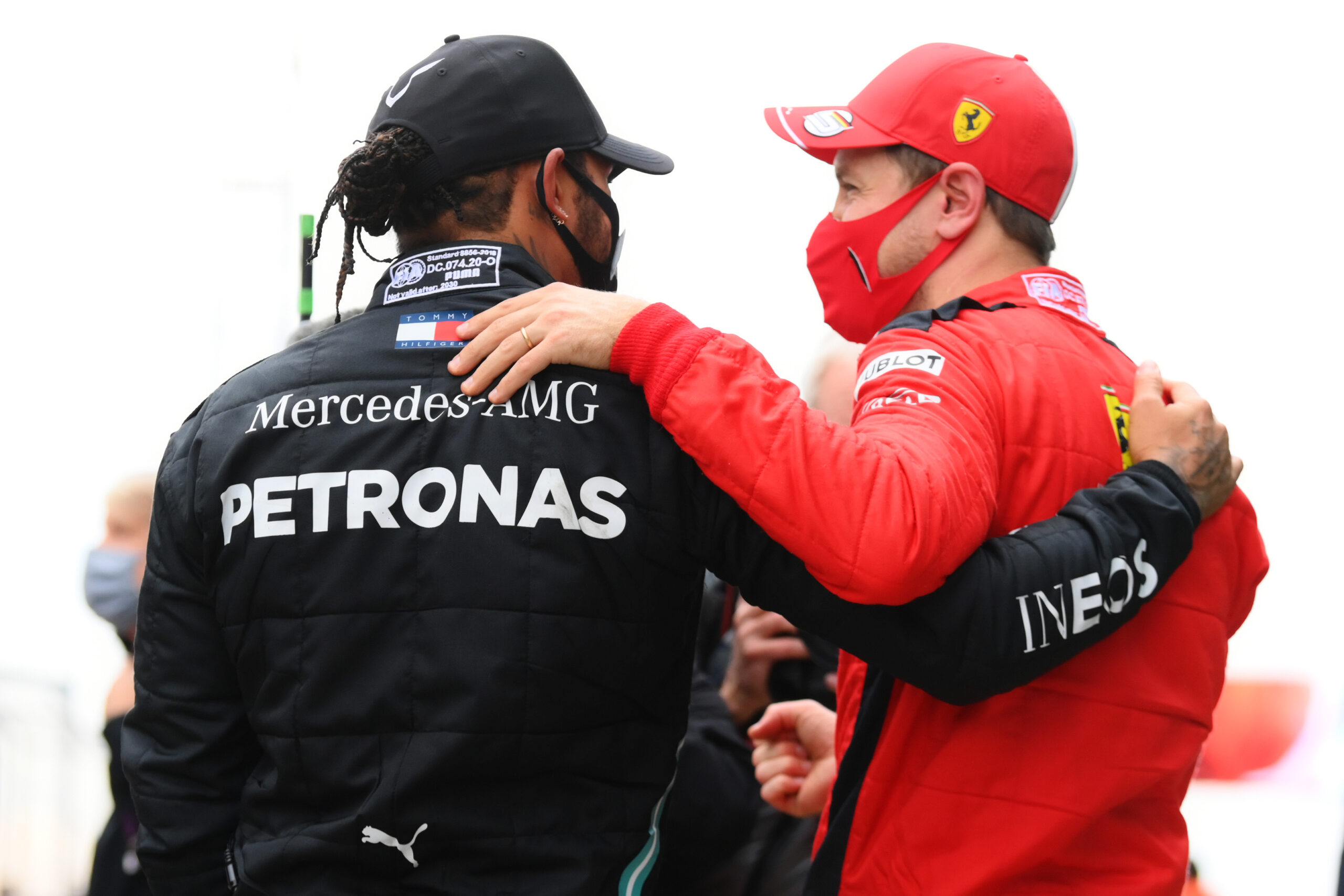
Image credit: Getty Images

Amid the Drama, an Alarming Error

Whilst there was undeniably a lot to deal with on Saturday, there was another worrying mistake made by Michael Masi and those in charge. When the cars were released from the pits for the start of Q2, a group of marshals and most importantly a recovery crane were still completing the removal of Nicholas Latifi’s abandoned Williams.

Alarmingly, Masi then doubled down on the error by later saying, “It was quite close to the barrier, the crane was on its way, and we were given assurances that it would be well and truly clear. Looking at everything, I was more than comfortable with the local assurances on that basis.”

For all his questionable safety cars and red flags this season, when there is a genuinely dangerous situation, the cars were sent out. A perilously wet track and a crane removing a car in the gravel trap should give anyone involved with F1 a sharp shot of PTSD and Martin Brundle sounded noticeably uncomfortable and shocked at what he was witnessing. And for the sake of what? A delay of a few seconds in restarting the session? It should be incredibly simple – the race does not restart until any recovery vehicle is beyond the confines of the circuit.

Vettel described it as a mistake with “zero tolerance”. Please, Mr. Masi, never let us see that happen again.

But the Day Belongs to Hamil7on
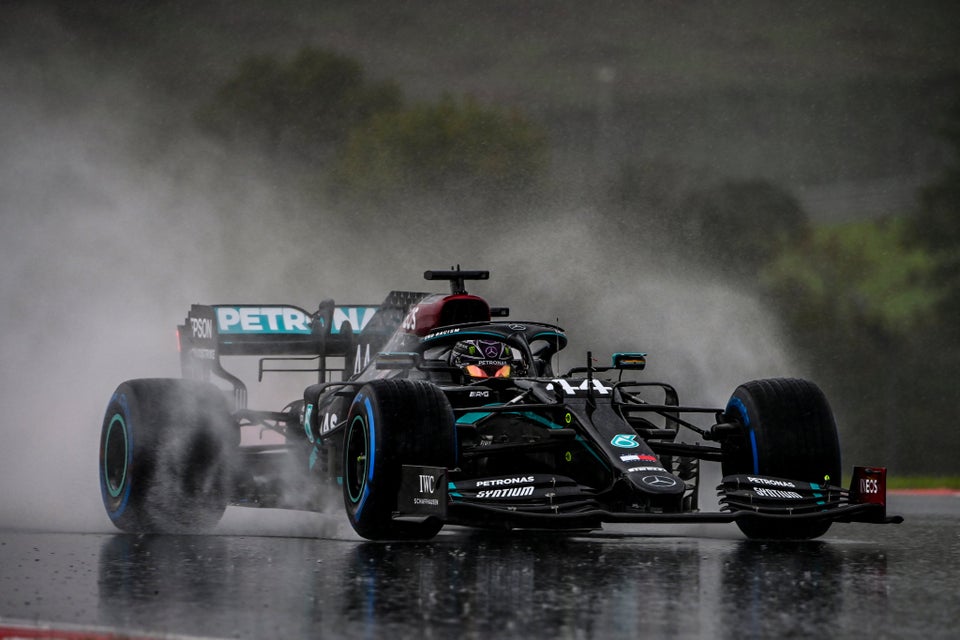
Image credit: Daimler AG

A final word for the man who became – at the very least, statistically – the greatest F1 driver of all time.

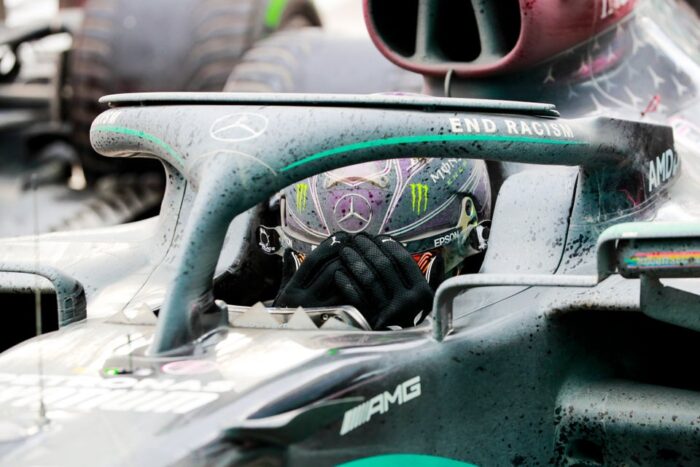
Lewis Hamilton very rarely lets his emotions come to the fore these days. So, it was particularly moving to see him totally overwhelmed by what he has achieved. With the frequency at which his wins come these days, it is easy to forget just how much he has had to overcome to get to this point; to realise his wildest dreams.

For, whilst he often plays down these milestones ahead of the event, he did admit that he had “probably secretly dreamt” of one day matching Michael Schumacher.

In fact, many of the parallels between Schumacher and Hamilton’s achievements are quite astounding. They both achieved their seventh title at the 14th round of their 14th year of Formula 1. And all this, whilst fighting what he describes as the “bigger fight” for equality and diversity.

How much higher can Hamilton go?

After all, he is still rising…

https://www.youtube.com/watch?v=q6hlR0GsOQI

The Turkish Grand Prix in 60 Seconds

Answering the Burning Questions

Can Lewis Hamilton wrap up a record-equalling seventh World Championship? Yes, and in some style.

Will the track grip up over the course of weekend or will they continue skating around as per Practice 1? The rain came and made conditions even harder for the drivers.

Can any of the teams battling for third open up a gap to the others? It was a good weekend for Racing Point, who now have a slight advantage over McLaren in the standings.

Will we see any Vettel-Webber-esque teammate dramas this weekend? Nothing really, aside from the Renaults coming together at the first corner.
2019 Japanese GP report | Bottas wins as Mercedes seal title

Some questionable strategy but, nevertheless, Mercedes are champions.

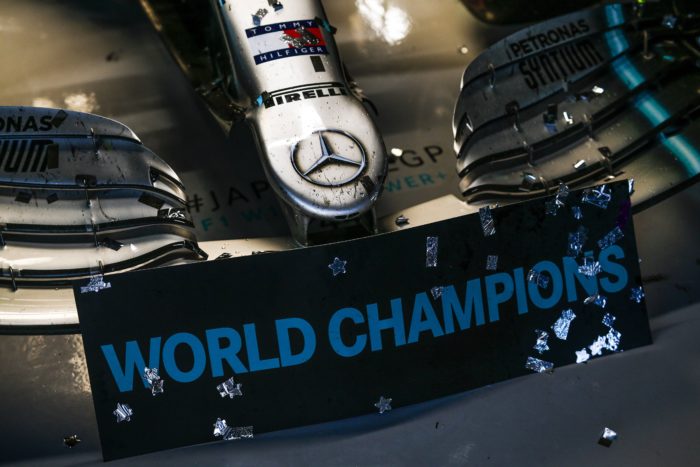
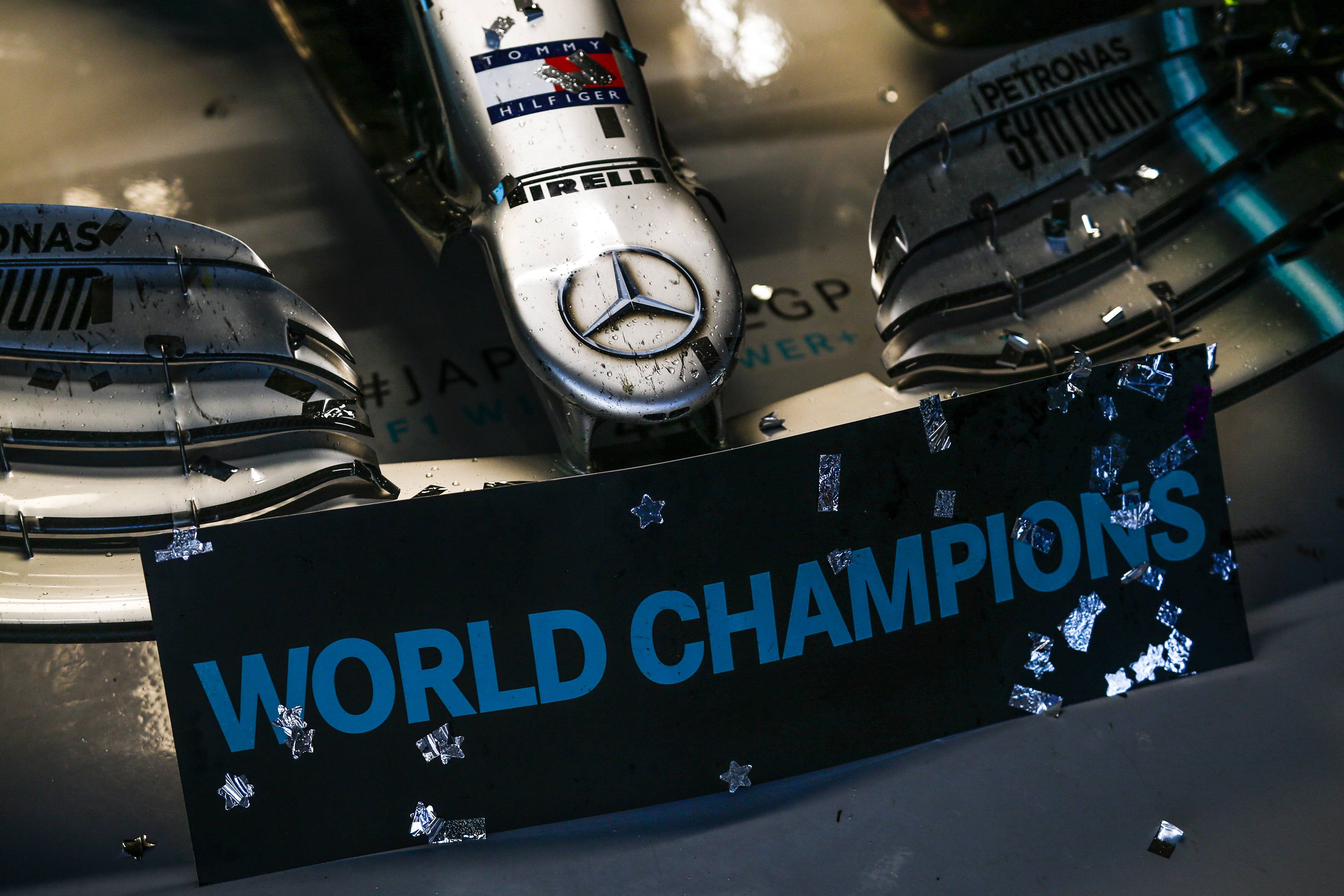
With Ferrari finding new and ever more inventive ways to capitulate, Valtteri Bottas came home a comfortable winner at the 2019 Japanese Grand Prix and sealed the Constructors’ Championship for Mercedes. The result also confirmed that only Bottas or his teammate, Lewis Hamilton, can now win the Drivers’ Championship so that is a record six consecutive world championship doubles for the Silver Arrows.

Whilst some may be tired of the recent domination within the sport, you have to admire the consistency with which the team operate. It is worth remembering that we are witnessing history in the making. In the future, people will surely point back to arguably now the greatest team the sport has ever known. The efficiency with which the German marque is renowned came to the fore at the beginning of the hybrid era in 2014 and the relentless Mercedes machine has rumbled on ever since, crushing all in its path.

It is a shame that Niki Lauda is not around to see them break the record as he was so instrumental in that success. He played a crucial role in convincing Hamilton to join the team and, together with team principal Toto Wolff, formed a fantastic management team. Touchingly, Lauda was remembered by his infamous red cap in the celebratory photos.

As for the race itself, there is a fair amount to discuss.

Typhoon Hagibis swept through the area on Saturday and produced the rarity of a Sunday morning qualifying session. Having looked considerably off the pace in Friday’s practice sessions, Ferrari produced a surprise front row lock-out, with Sebastian Vettel outqualifying his teammate, Charles Leclerc, for the first time since June to take pole position.

However, Ferrari’s joy was to be short-lived as three hours later, at the race start, everything rapidly fell apart.

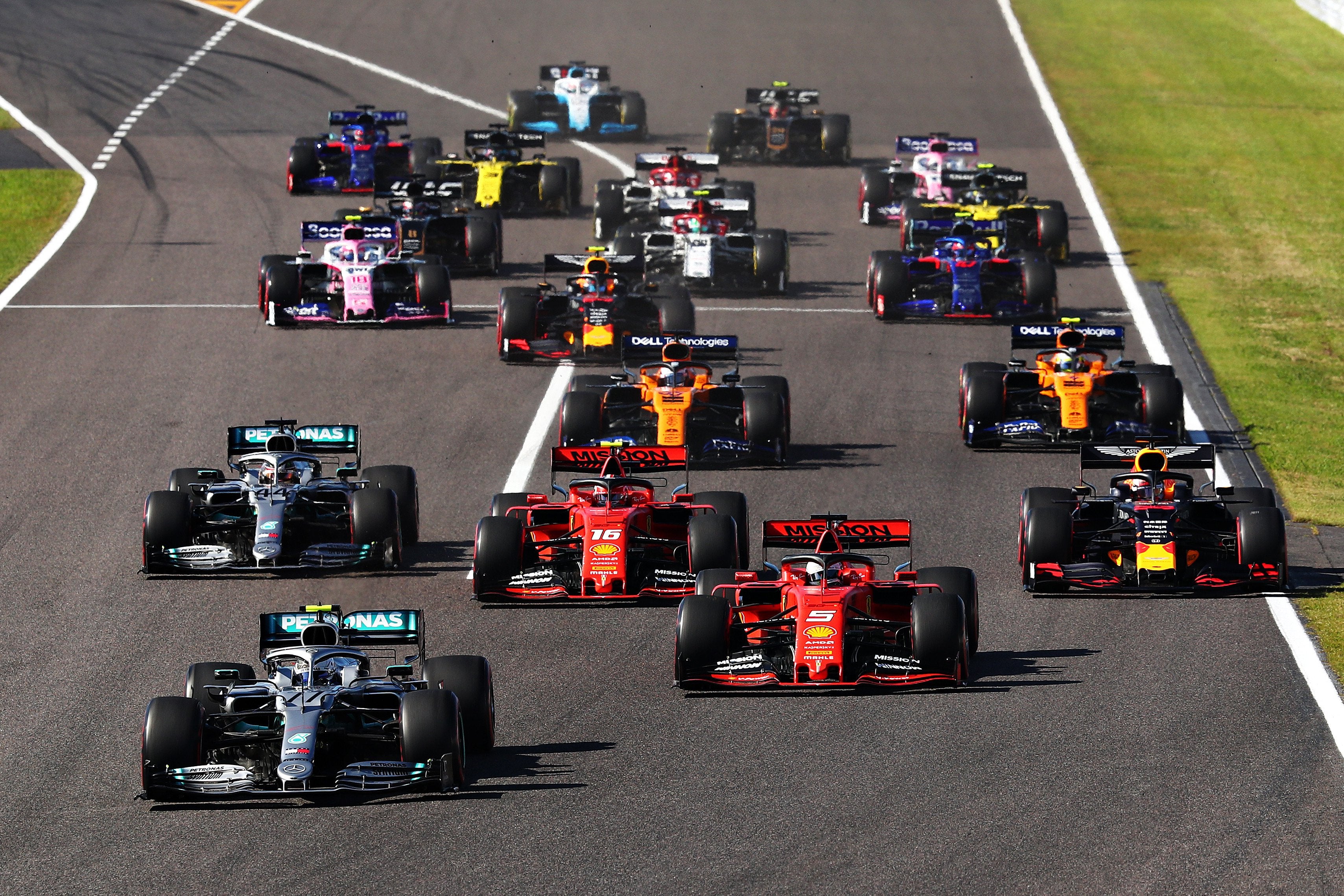
The start of the Japanese Grand Prix.
Image credit: Getty Images

Vettel produced what appeared to be a false start. It would eventually prove to be legal, due to the peculiarities of the regulations and the sensors. Despite moving before the lights went out, Vettel stayed within the confines of his grid slot and, because he braked instantly, was stationary when they did. Thus, it was a legal start.

But not a good one.

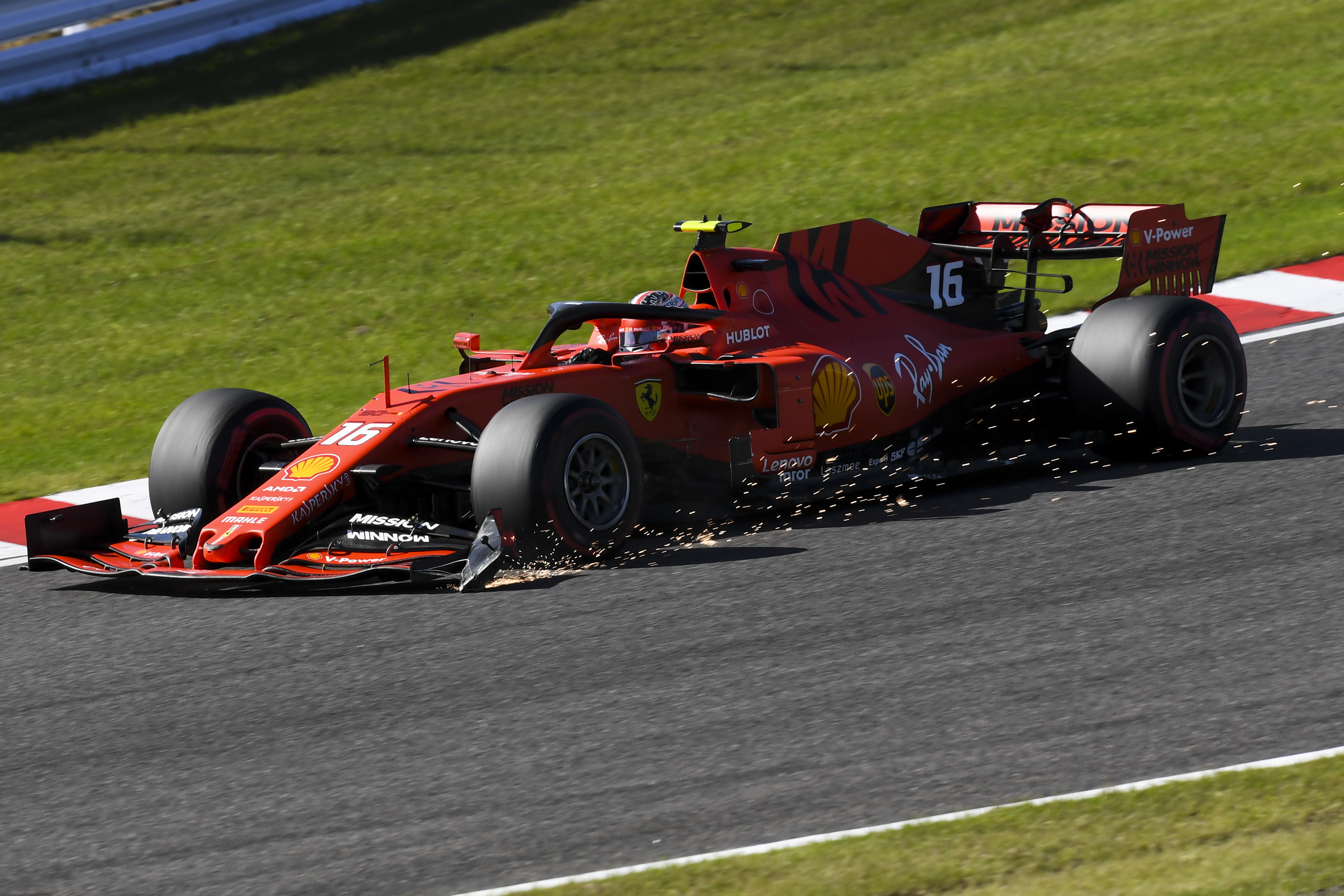
Whether distracted by this teammate or not, Leclerc also got away poorly and Bottas was comfortably leading by the first corner. Hamilton had nowhere to go but Max Verstappen had his eyes on third and set about storming around the outside. Leclerc, however, understeered into him and wrecked the Dutchman’s race – he would retire from the damage on lap 17. Leclerc survived but with damage to his front wing. He pitted on Lap 3, after showering those behind him with bits of carbon fire, and spent the rest of the race fighting back through the field.

The front three of Bottas, Vettel and Hamilton broke away from the pack and it became apparent that strategy would be key. The Ferraris had been suffering with their tyres more and expected to two-stop, whilst Mercedes were aiming for just the one.

Vettel was first to blink on lap 16 and Mercedes responded by pitting Bottas the following lap. Hamilton was left out with the intention of one-stopping but this was always going to be tricky as Saturday’s typhoon had washed the track clean of rubber and left it very ‘green’. The tyres, already damaged by following Vettel, degraded quickly and Hamilton found himself almost a pit stop behind Bottas in the space of a few laps; the world champion was soon on the radio, agitated and confused by his strategy.

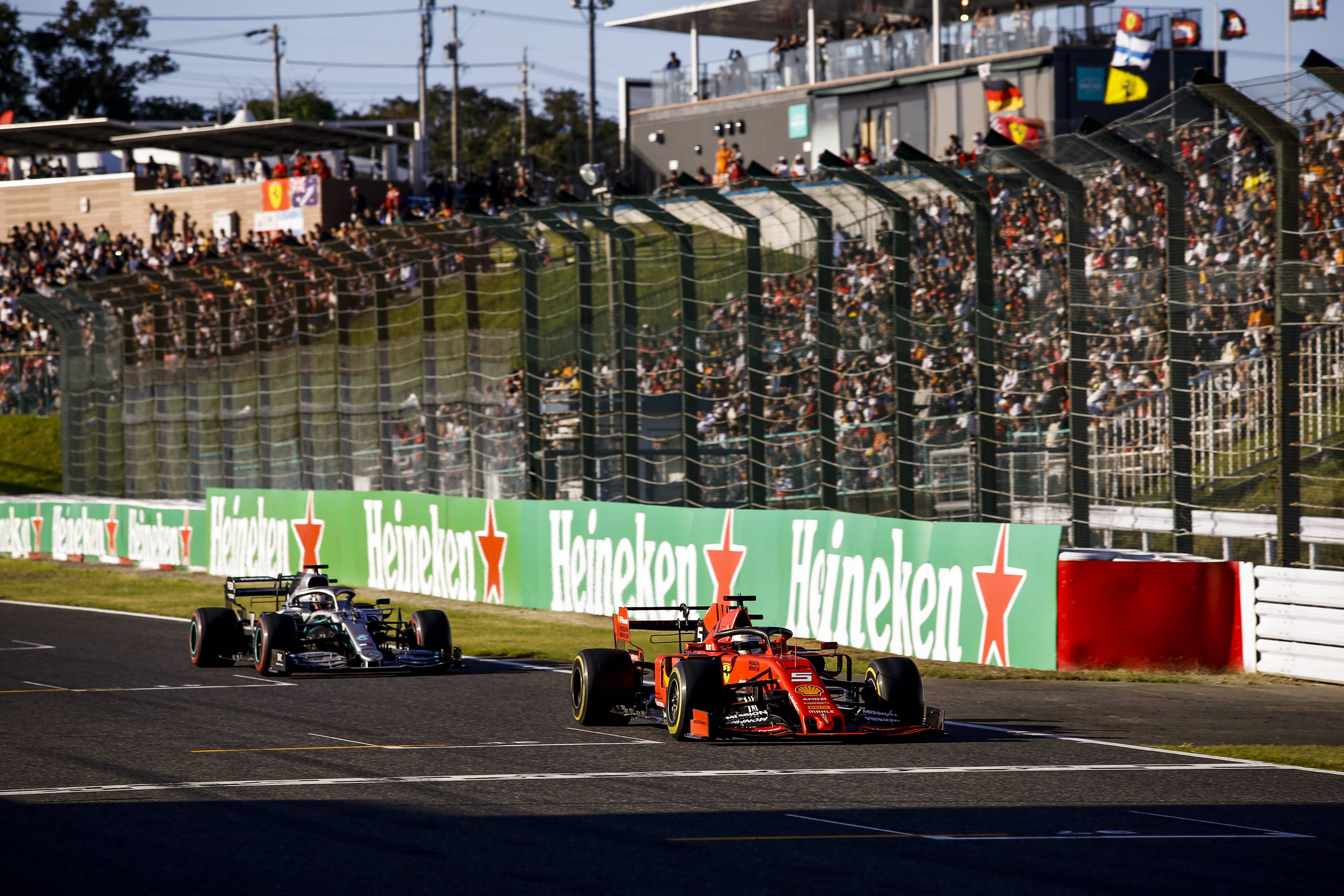
The particularly confusing decision by Mercedes, however, was when they bailed out of the one-stop and pitted Hamilton with 10 laps remaining. Passing the Ferrari of Vettel – with its significant straight-line speed – combined with the layout of Suzuka, was always going to be a tall order, even with fresh tyres. And so it proved to be as he closely followed Vettel home but never truly challenged him.

Sebastian Vettel and Lewis Hamilton at the Japanese Grand Prix.
Image credit: DPA Picture Alliance

Hamilton has shown his expertise when it comes to managing degrading tyres and defending positions many times in the past and would surely have been better off attempting that. The worst case scenario there would be that both Bottas and Vettel pass him and then Hamilton would have pitted anyway as there was well over a pit stop’s time back to Alexander Albon in fourth.

This obsession Mercedes appear to have with the overcut – certainly when it comes to Hamilton – is quite strange considering its lack of success. In this instance, it looks a bit like they were wary of Hamilton and Bottas fighting on track and so removed him from the situation. You get the sense that the Mercedes strategy team may have been a bit flattered by the dominance of their car in recent years.

Either way, Bottas didn’t put a foot wrong out front and picked up a deserved victory – his first since Baku in April.

More Points for Sainz, More Bad Luck for Norris

It was another strong drive for Carlos Sainz and another fifth place come the chequered flag. That moves him up to sixth in the Drivers’ Championship and moves McLaren another step closer to sealing fourth in the Constructors’ Championship. The Spaniard really is showing his full ability now, after a difficult year at Renault in 2018, and is potentially making Red Bull question their decision to release him. Whilst obviously far more experienced, he is only actually 18 months older than Albon and Pierre Gasly…

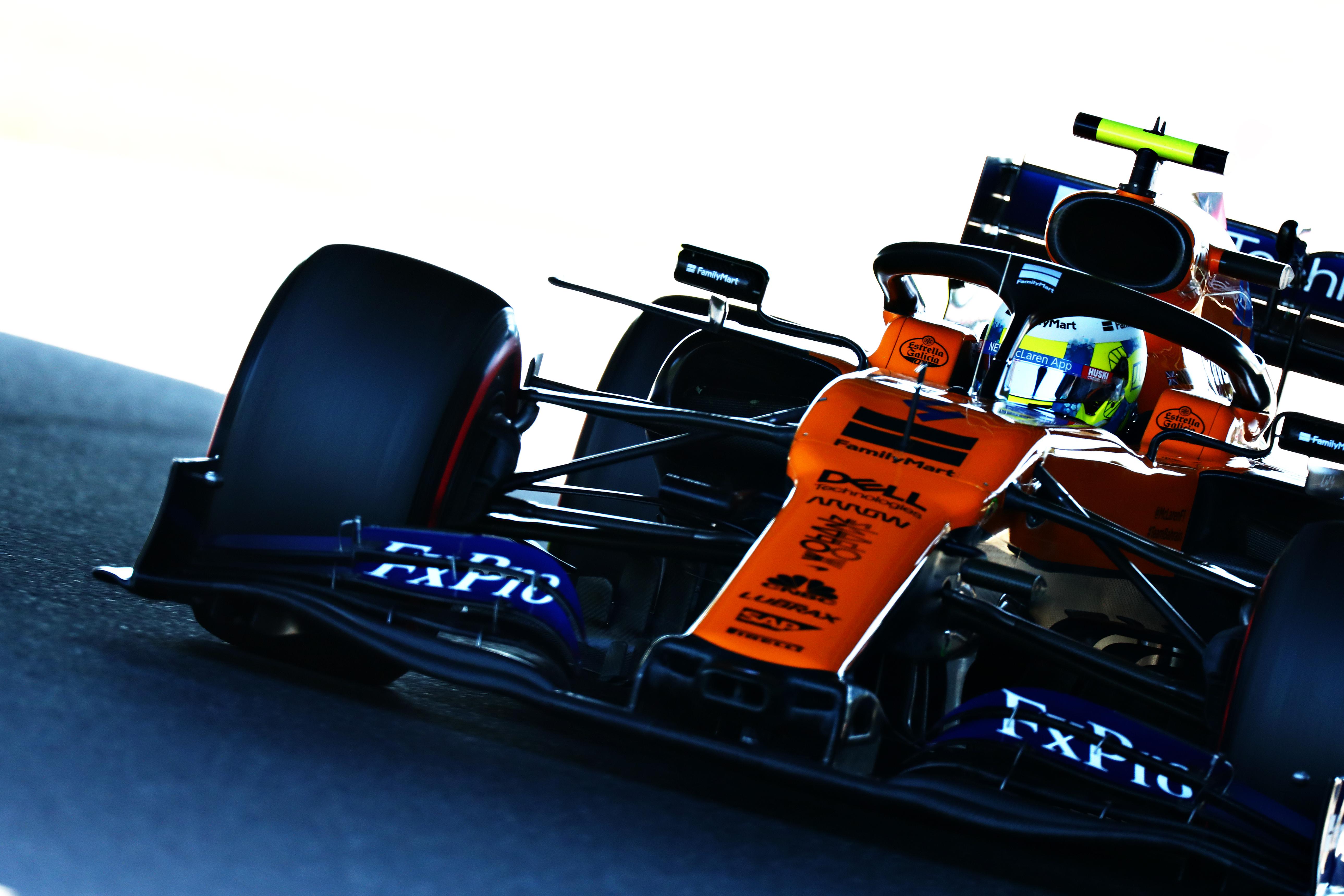
His teammate, Lando Norris, on the other hand, reverted back to form. That form being a promising race ruined by bad luck and factors beyond his control. The teenager was following his teammate comfortably in sixth for the first few laps but then collected some shrapnel from Leclerc’s disintegrating car in his brake duct, which began to overheat.

Lando Norris at the Japanese Grand Prix.
Image credit: Getty Images

To add insult to injury, just as he was about to take an early pit stop to have the debris removed, Albon launched an overambitious divebomb into the final chicane and clumsily punted his friend off the track. Norris recovered to the pit lane, his brake now on fire. He returned to the track and fought gallantly for the remainder of the race, finishing 13th, but it was another haul of points lost.

By rights, Norris should be close behind Sainz in the championship. It has been an impressive debut season for an immensely likeable character and, with some better luck and a bit more experience – particularly when it comes to race starts – the young man from Somerset could really challenge in the next couple of years.

Is Michael Masi Producing Problems?

Speaking of Albon’s overambitious divebomb, which went unpunished, it feels like F1’s stewarding and regulations are suffering from something of an identity crisis.

Michael Masi was a fairly popular replacement when we sadly lost Charlie Whiting on the eve of this season. He was stepping into some particularly large shoes and, for the first few races, he went mostly unnoticed – ergo, he was doing a fine job. But since the backlash caused by Vettel’s – in my opinion justified – penalty in Canada, Masi and co decided to change their tact somewhat and allow harder racing.

I brought up some potential issues after the Italian Grand Prix, when Masi announced that they would now be using the black and white flag more often, which I’m fine with in principle, and that Leclerc would have received a penalty had he made contact with Hamilton, which I think is somewhat ridiculous considering Hamilton had to leave the track to avoid said contact. Read that Grand Prix’s report for a more detailed analysis.

Since Verstappen’s move in Austria, the drivers have started to push the limits, finding out just how much they can get away with. And the answer appears to be a lot.

Hard racing, for me, is two drivers on the very edge but not quite making contact. Think Albon-Kvyat in Hungary this year or, particularly, Hamilton-Alonso in Mexico 2017. That’s surely the kind of racing we want to see.

But suddenly, in the space of a few races, it seems that clumsily throwing your car at the apex – Albon didn’t appear in a position to even make the corner without using Norris as a stopper – and knocking another car out of the way is apparently now okay.

This looks ridiculous when driving the wrong side of a bollard, as per Kevin Magnussen in Russia, gets you a time penalty. The lines are becoming too blurred and the stewards are losing authority. I just hope it doesn’t take a massive incident to provide perspective about what is and isn’t acceptable.

Japan was a sloppy weekend all round when it came to stewarding.

The casual viewer would struggle to understand why Vettel did not receive a penalty for what was a very visible jump start – we had expert analysts guessing at the minutiae, attempting to justify the decision – especially as Kimi Räikkönen received a penalty for an almost identical error at the very last race. It also took the best part of half the race for the stewards to reach their decision.

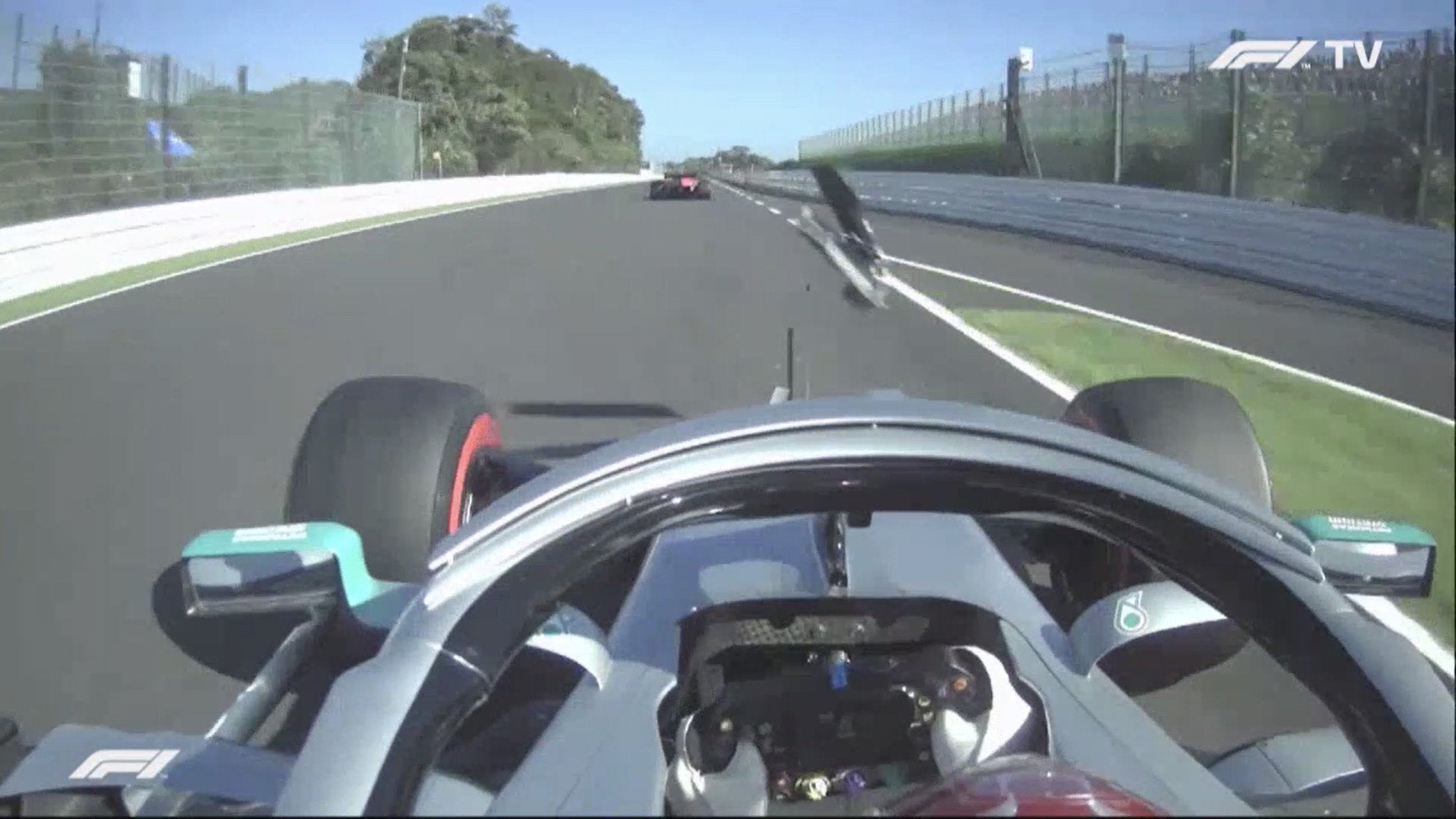
Then there was the fiasco with Leclerc’s damaged car. The blame appears to be shared by Leclerc, Ferrari and the FIA. Firstly, Ferrari called Leclerc in but he ignored the request and responded “Why?!” after having passed the pit entry. One lap later, just after the endplate had flown dangerously close to Hamilton, Ferrari told Leclerc not to come in. But the simple fact is Leclerc should immediately have been shown the black and orange flag and forced to come in by Race Control. Apparently Ferrari ‘promised that they would bring him in on the second lap’, only to go back on their word when the endplate fell off. But who is running the sport again?..

Image credit: Motorsport Images

So much time and effort has gone into safety in recent years and yet we have cars allowed to drive round at full racing speed, leaving a slew of sharp carbon fibre in their wake. That endplate sliced Hamilton’s wing mirror off; I can’t imagine it would have been pleasant had it struck him, just a few inches to the left. We have seen similar incidents in the last decade that resulted in a coma for Felipe Massa and the tragic death of Justin Wilson.

It was plainly obvious that Leclerc’s wing would not survive long and that it would most likely give up at the fastest part of the track. He also had a loose wing mirror which broke off later in the race. No one from Race Control even seemed to acknowledge that.

Leclerc and Ferrari were eventually given five and ten second penalties for the Verstappen incident and then not pitting respectively after the race. But, regardless of the fact that they are quite lenient penalties, why did the decision take so long? The first penalty seemed an absolute slam dunk – it was particularly bizarre that the initial decision was ‘no further action’ before it was then reopened – and five seconds after the race is considerably different to five seconds early in the race with traffic to navigate.

Image credit: Formula 1

Drivers with dangerous damage such as this should be shown the black and orange flag and forced to return to the pits at a reduced speed. It’s as simple as that for me.

And finally, to top things off, the new virtual chequered flag, which officially ends the race, was somehow produced one lap early. This actually changed the race result as Sergio Pérez’s last-lap retirement from eighth place was undone. Imagine if Hamilton had dramatically passed Vettel in the final few corners…

This is the very highest echelon of motorsport and it should feel as such. Right now, it doesn’t.

The Japanese Grand Prix in 60 Seconds

Answering the Burning Questions

Will there be more drama at Ferrari? Of course. But at least there was no drama between the drivers this time.

What effect will the Mercedes upgrade have? Hard to say. On Friday, it looked massive but then the Ferraris locked out the front row.

Are we going to have (lots of) rain with a typhoo heading for Suzuka? Yep. But it was all on the one day and didn’t affect a single session with the Saturday cancellation.

Can Mercedes wrap up the Constructors’ Championship? They can!

Which enthusiastic Japanese fan will have made the best hat? Got to be this one for me.