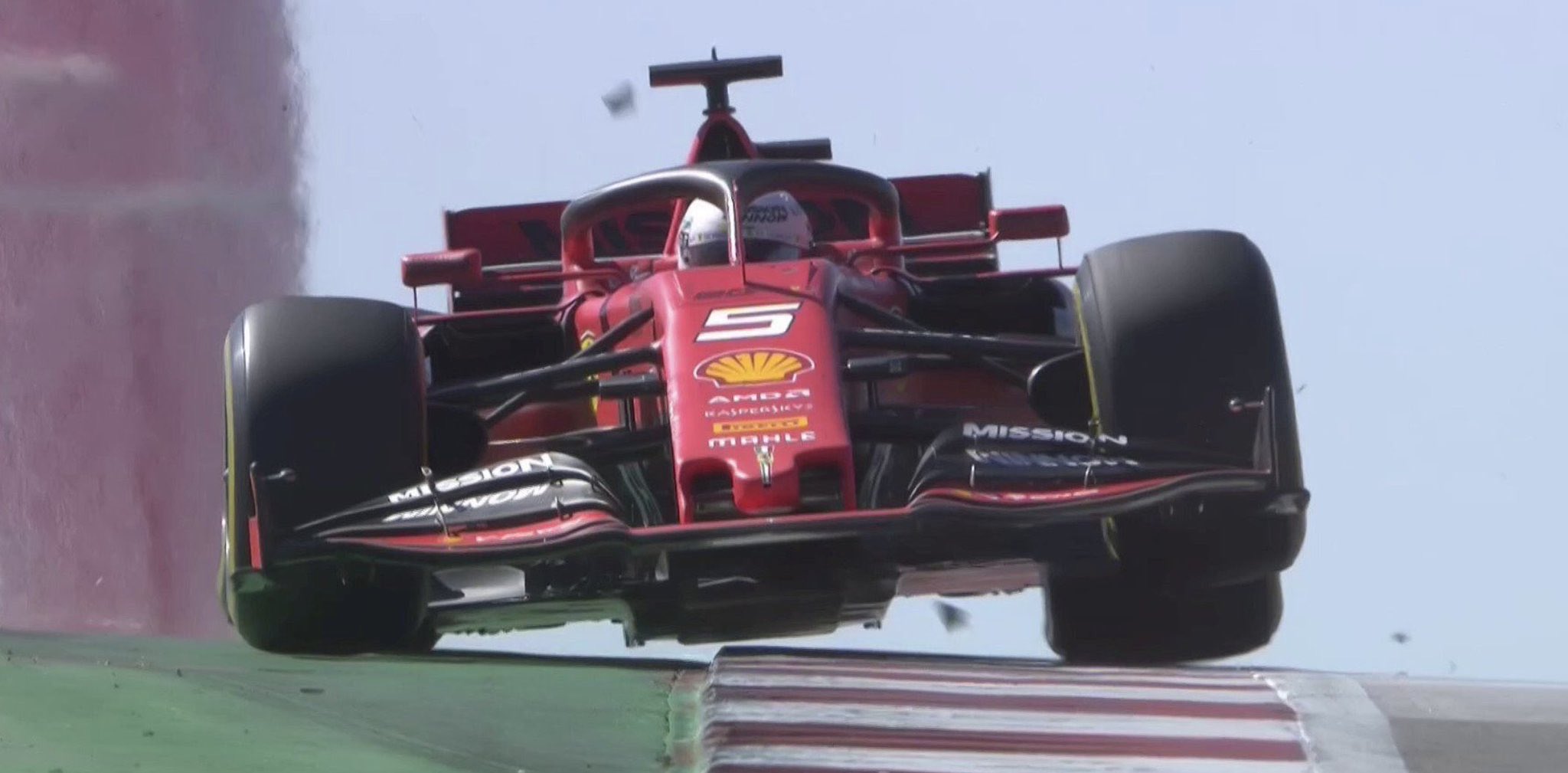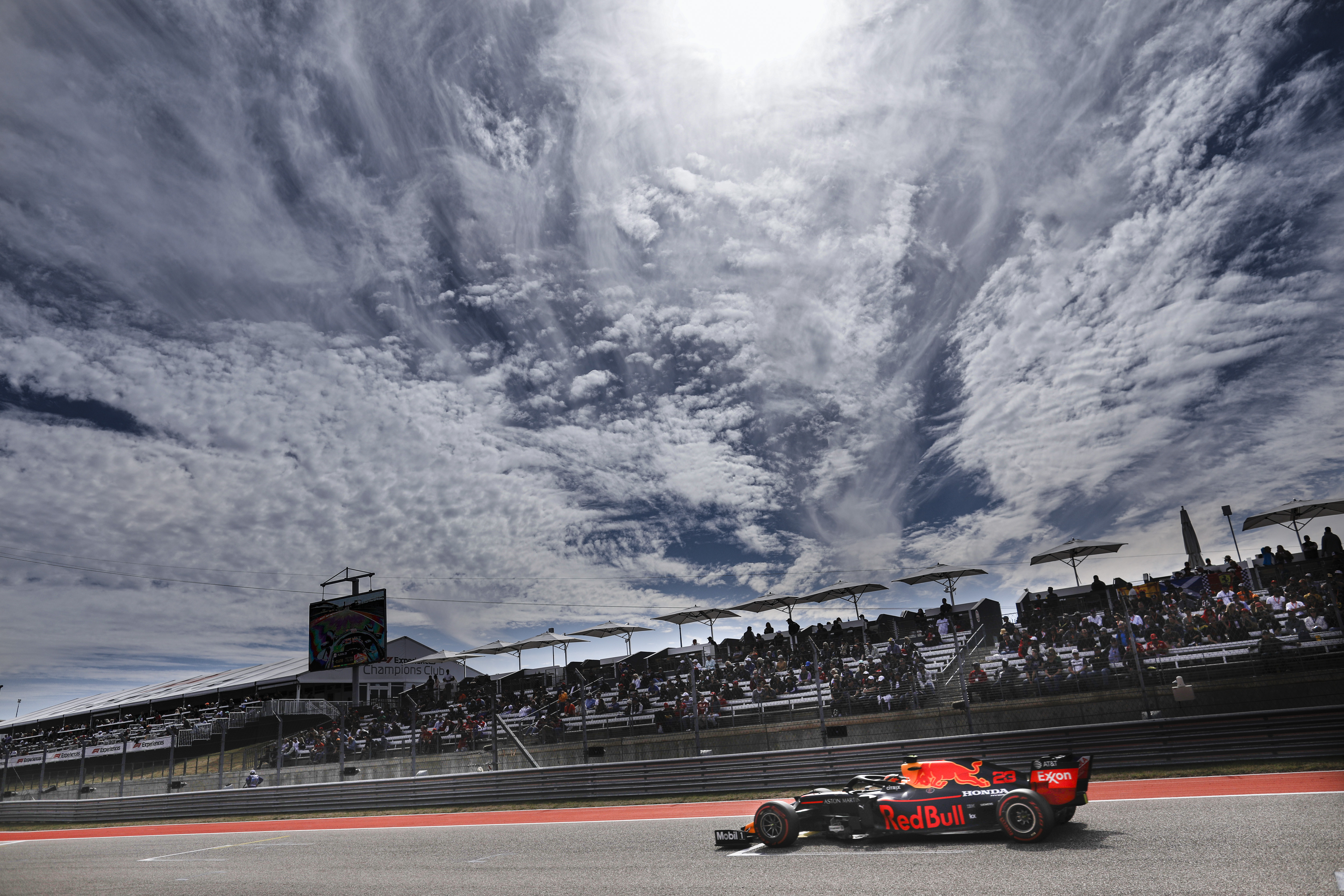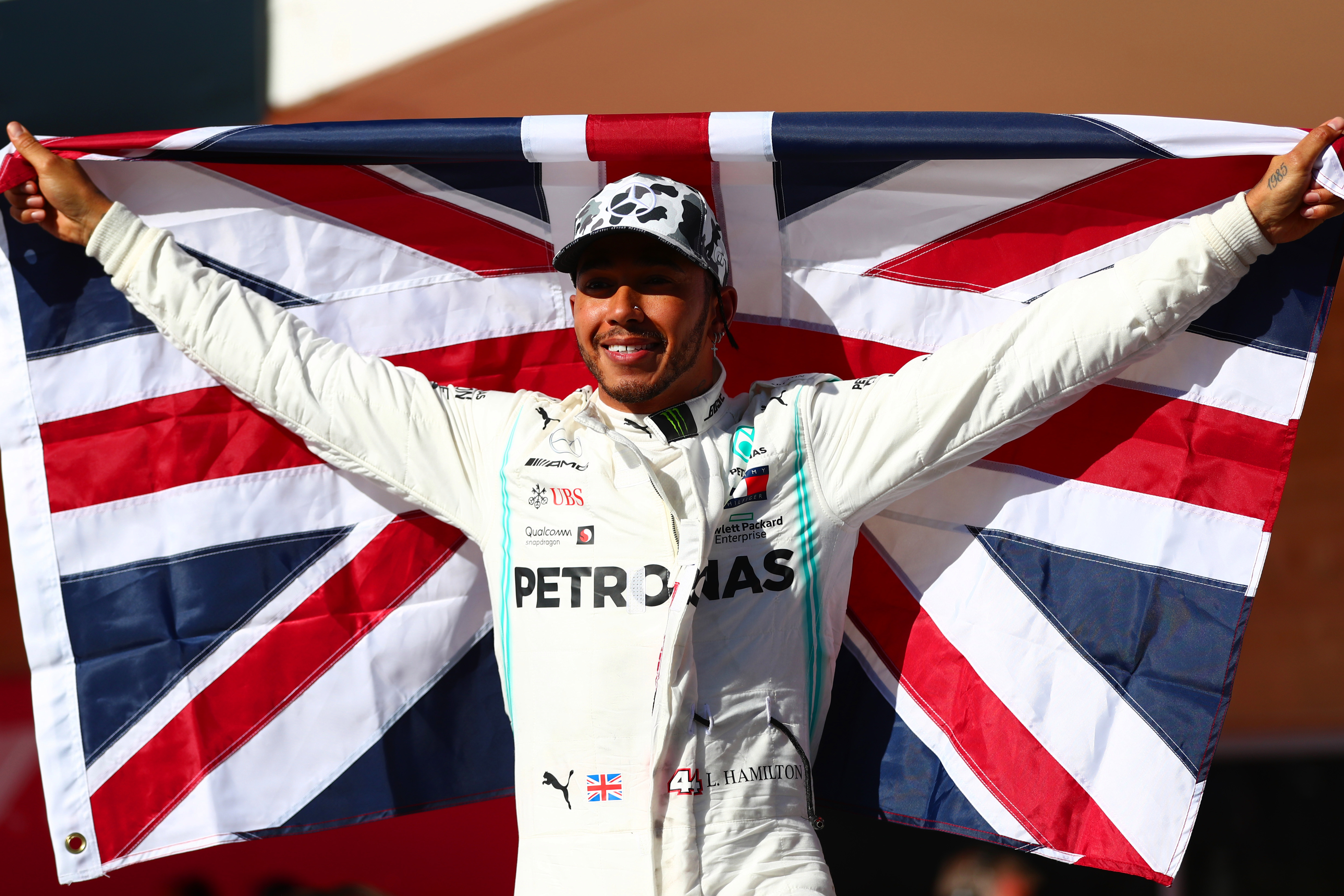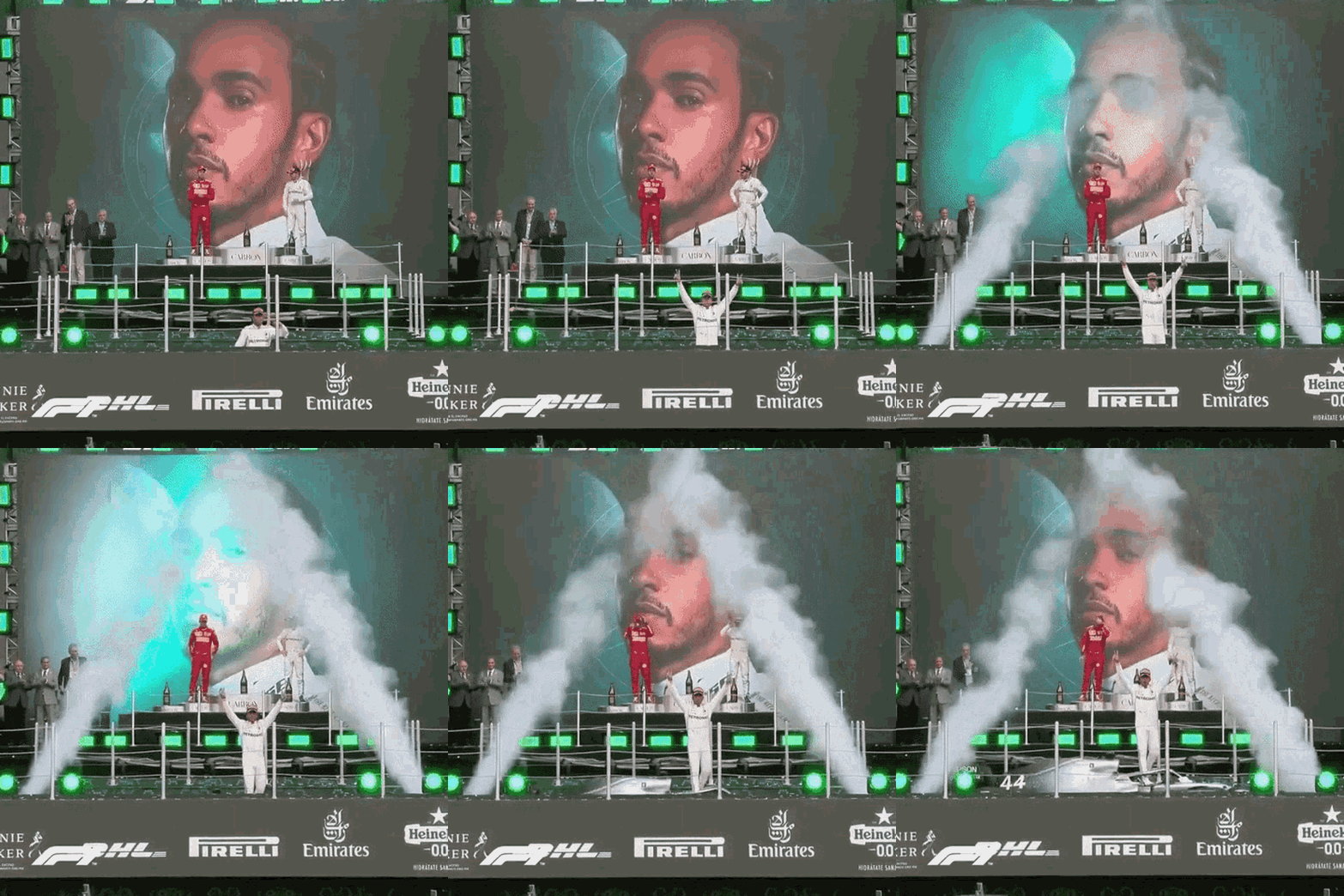
2019 Abu Dhabi GP report | Hamilton rounds out championship year with grand slam

That’s a wrap on F1 2019.
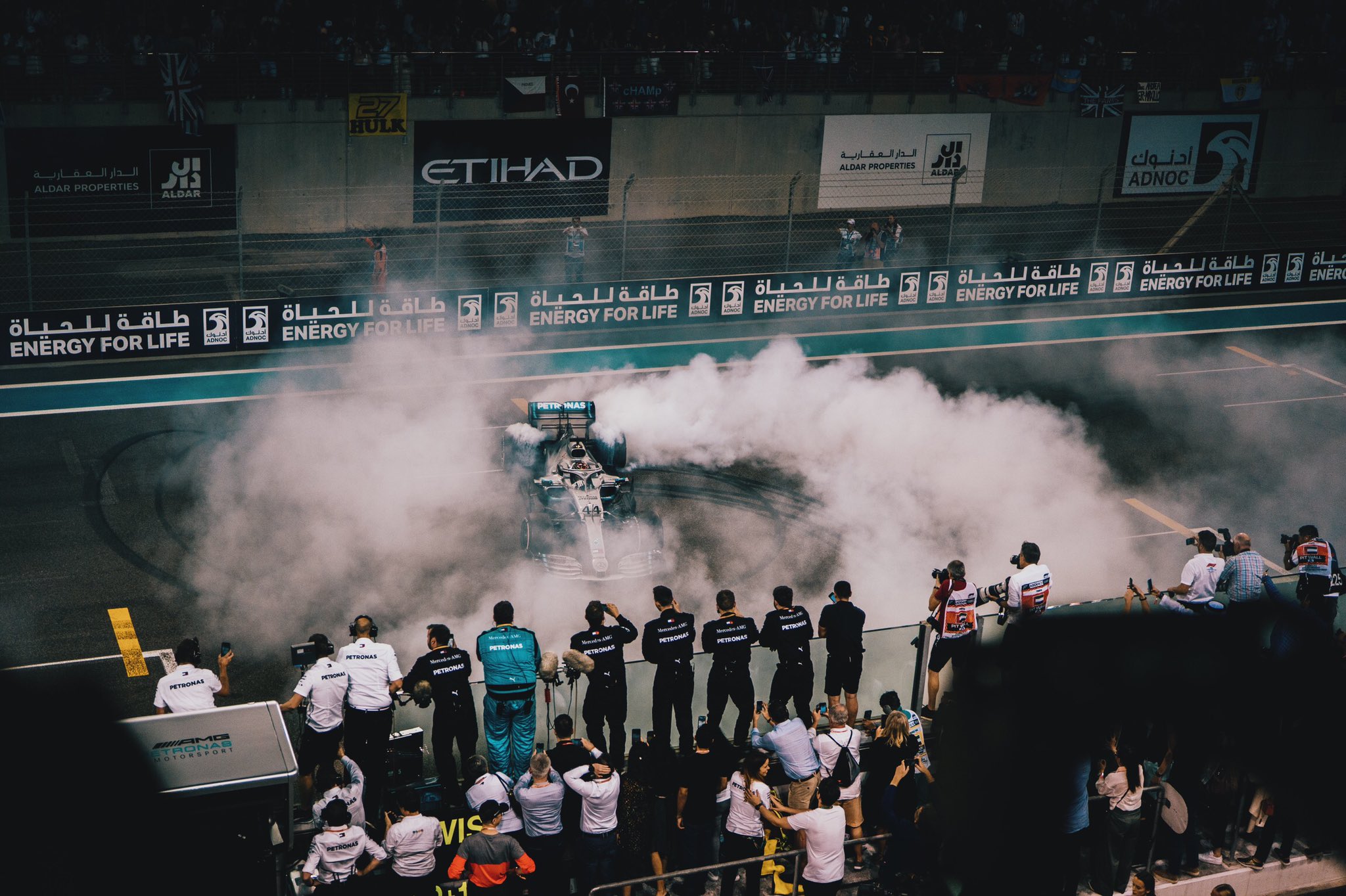
Image credit: Mercedes-AMG F1

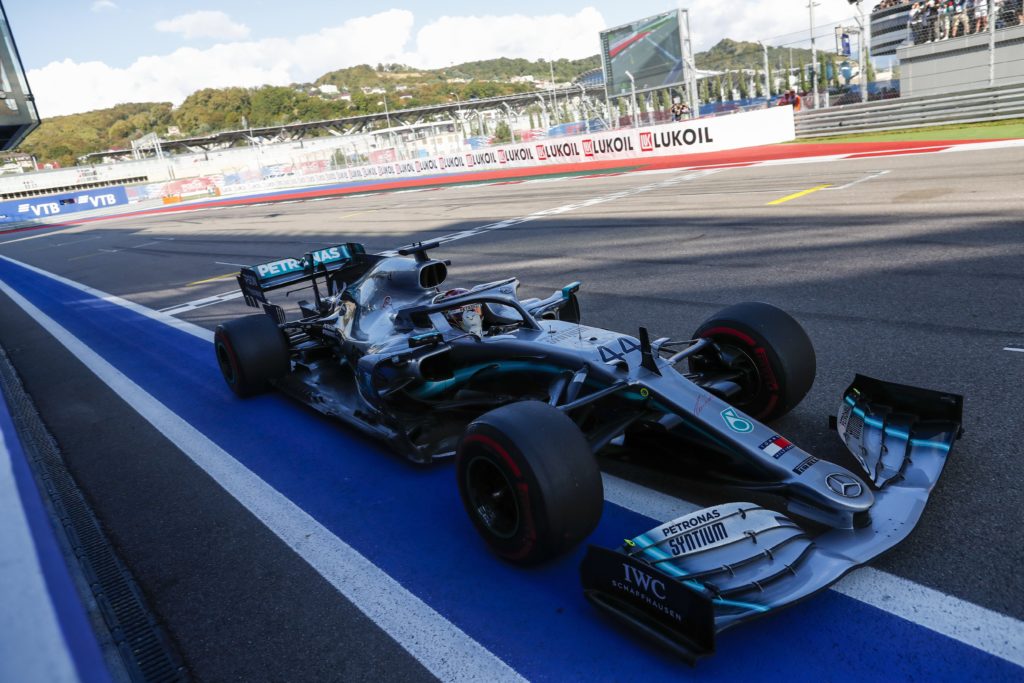
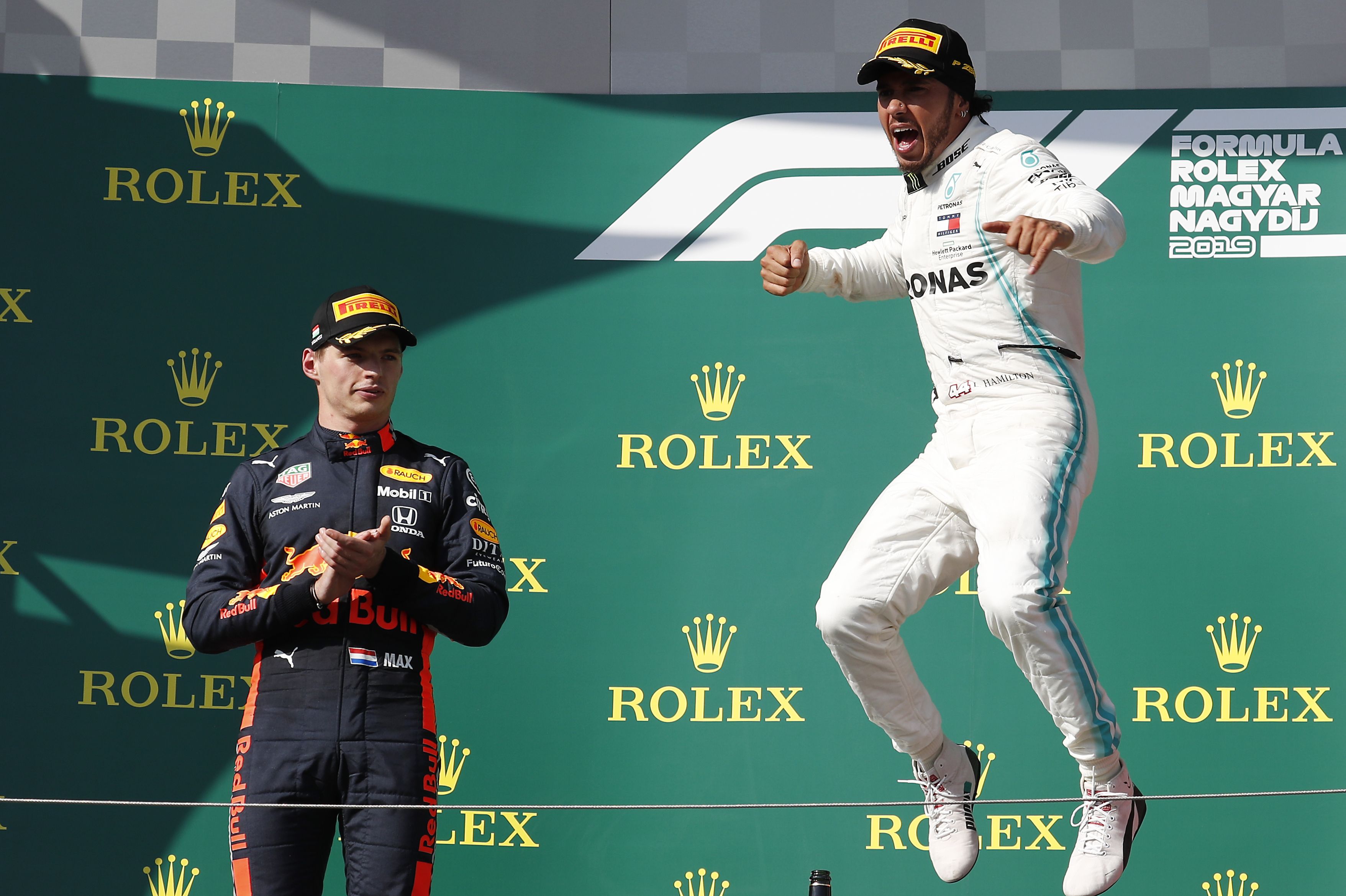
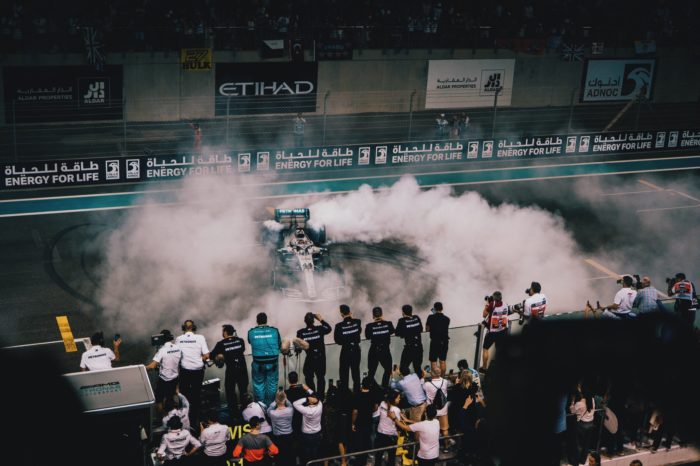
Lewis Hamilton finished the year at the 2019 Abu Dhabi Grand Prix in the fashion he has spent much of it – leading from the front. And in the most emphatic fashion so far this season, as he took his only ‘grand chelem’ – achieved by claiming pole, the win, the fastest lap and leading every lap – of the year.

That is the his sixth grand slam, moving him beyond Alberto Ascari and Michael Schumacher to outright second on the all-time list, two behind the late, great Jim Clark. Yet another record for Hamilton to set his sights on.

The race itself was sadly a fairly standard Abu Dhabi affair – a pretty dull race with the action limited mostly to Valtteri Bottas’s fight through the field from the back of the grid. The Finn’s job was also made slightly harder by the bizarre lack of DRS for 18 laps, apparently caused by a ‘data server crash’.

As Martin Brundle had feared may be the case, Hamilton ‘checked out’ at the front of the field, controlling his pace and keeping a comfortable lead throughout. He showed just how much pace he had to spare by setting the fastest lap of the race on reasonably old hard tyres when many behind had pitted for new, softer ones in the final few laps.

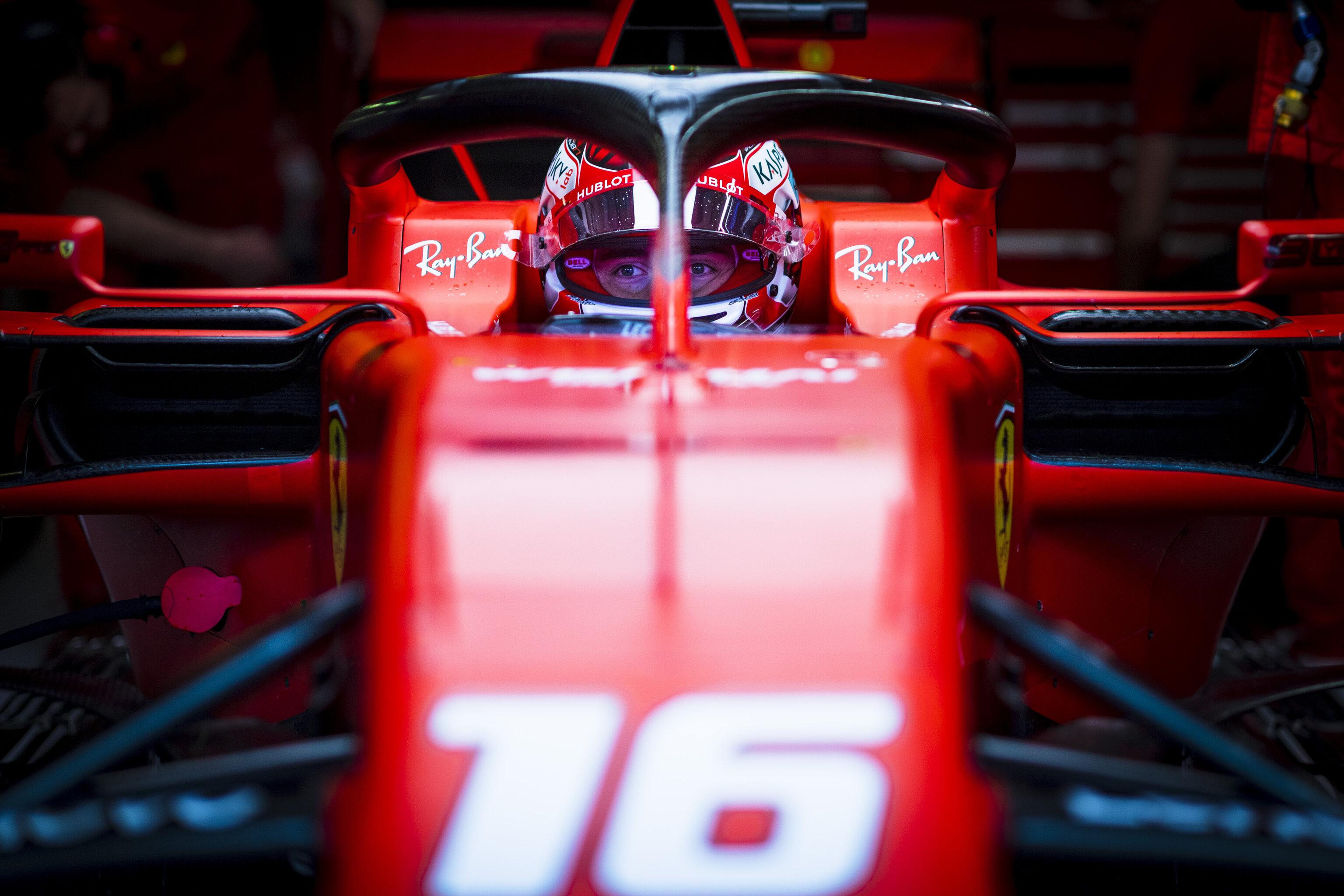
The fight for the other podium positions was slightly spicier. Charles Leclerc passed Max Verstappen on the first lap as the Red Bull seemed to initially struggle heating its tyres. But Verstappen ran 13 laps longer and comfortably passed the Ferrari, having rejoined just four seconds back on far fresher tyres, despite nursing a subtle engine issue throughout the race. Leclerc then switched to a two-stop strategy and just about managed to hold off the closing Bottas in the closing laps. Leclerc had spent the entire race aware that he could well be disqualified for a technical infringement from Ferrari before the race but, after a post-race investigation, the team were fined €50,000 and his third place stood.

It was another amateur-ish mistake from F1’s most experienced team – simply a case of the amount of fuel Ferrari had said was in Leclerc’s car being significantly different from the actual amount once it had been checked by the FIA. If they are to put together a real title challenge in 2020, Ferrari will have to iron out these basic operational failings…as well as the rather larger ones such as strategy and their drivers crashing into each other…
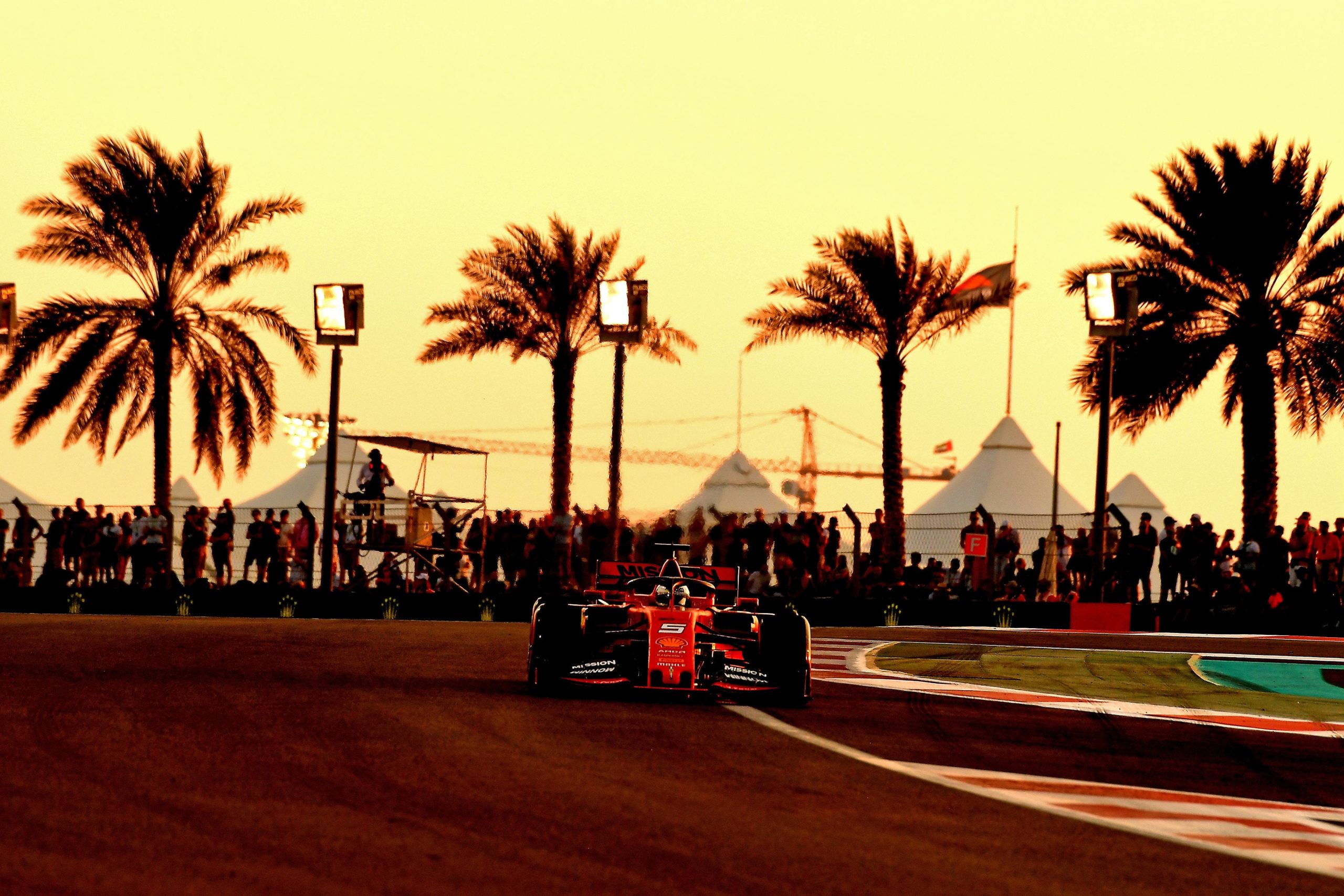
Sebastian Vettel at the 2019 Abu Dhabi Grand Prix.
Image credit: Foto Colombo Images

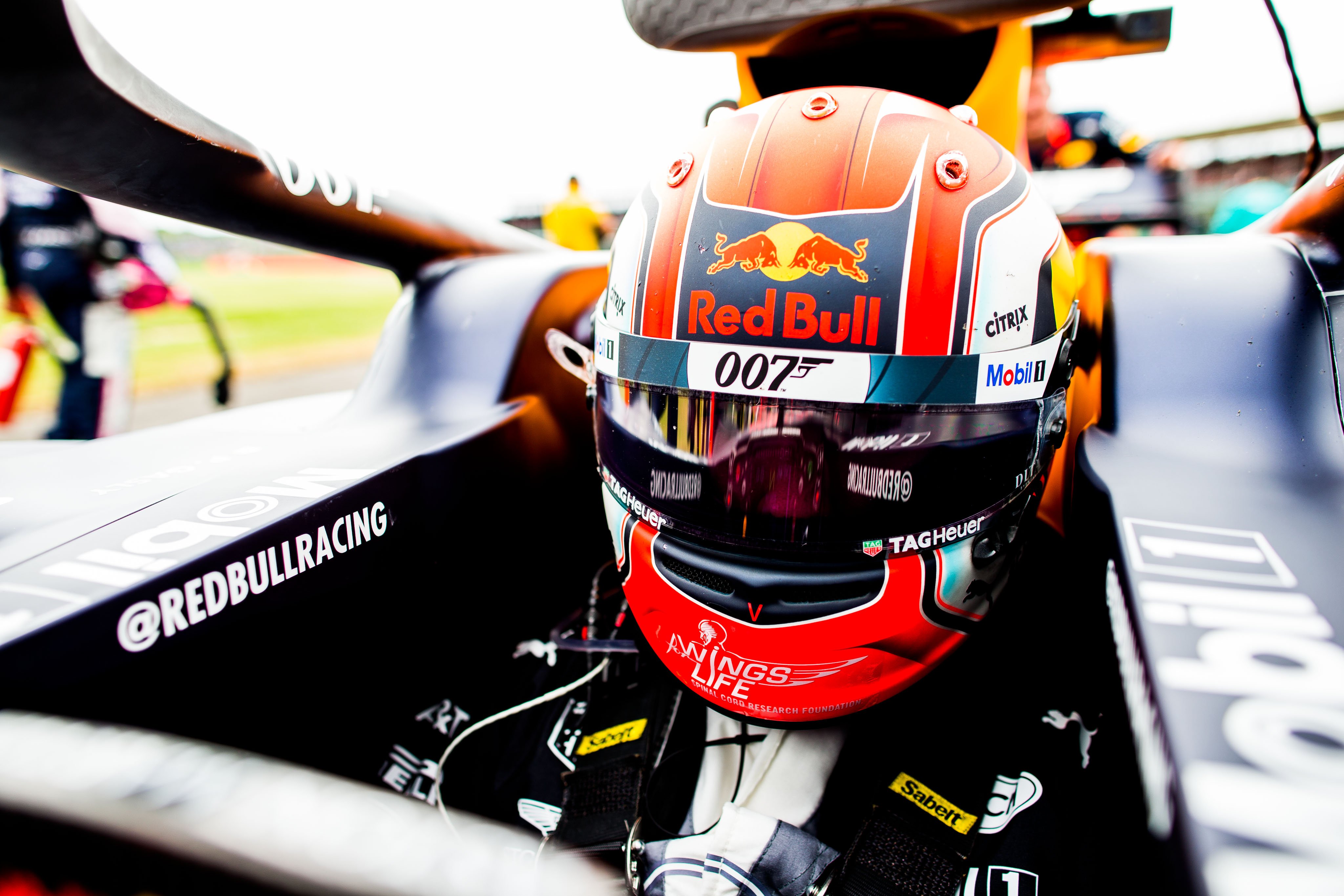
Sebastian Vettel came home a fairly underwhelming fifth, followed by the other Red Bull of Alexander Albon, the Anglo-Thai finishing a disappointing 52.5 seconds behind his teammate. Whilst, overall, Albon has done a solid job in what has undeniably been a big ask of a rookie driver, that is similar to the gaps we were seeing between Verstappen and Pierre Gasly before his demotion. With a proper preparation for next year, Albon will surely have better foundations to build on for 2020 but he will have to be consistently and markedly closer to the superstar on the other side of the garage to cement his place in both the team and the sport for the future.

Sergio Pérez claimed ‘best of the rest’ thanks to some trademark tyre conservation and a good strategy, nicking seventh from Lando Norris on the last lap with what he described as “one of the best moves in my career”.

Sainz Leaves it Late to Snatch Sixth

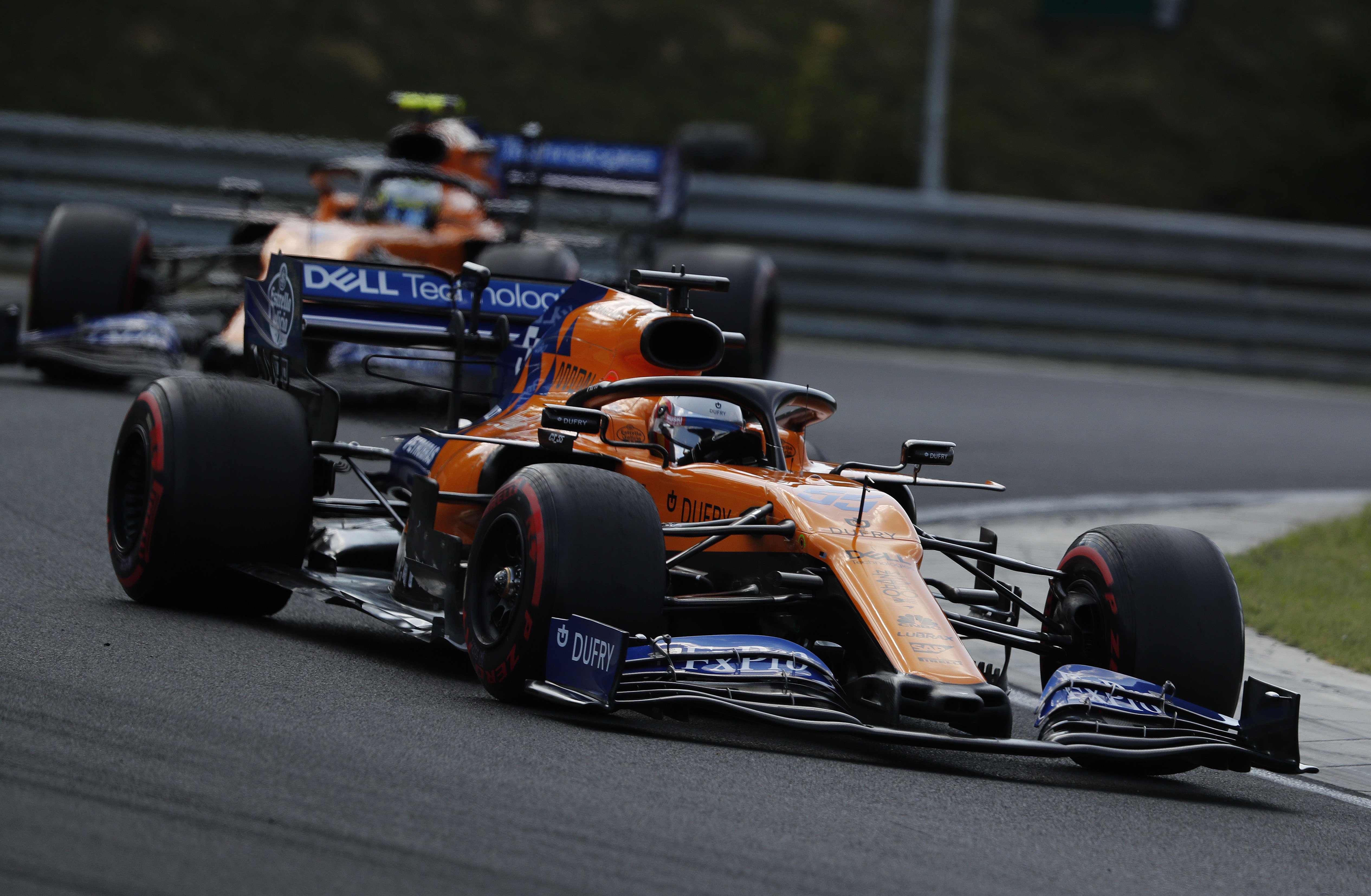
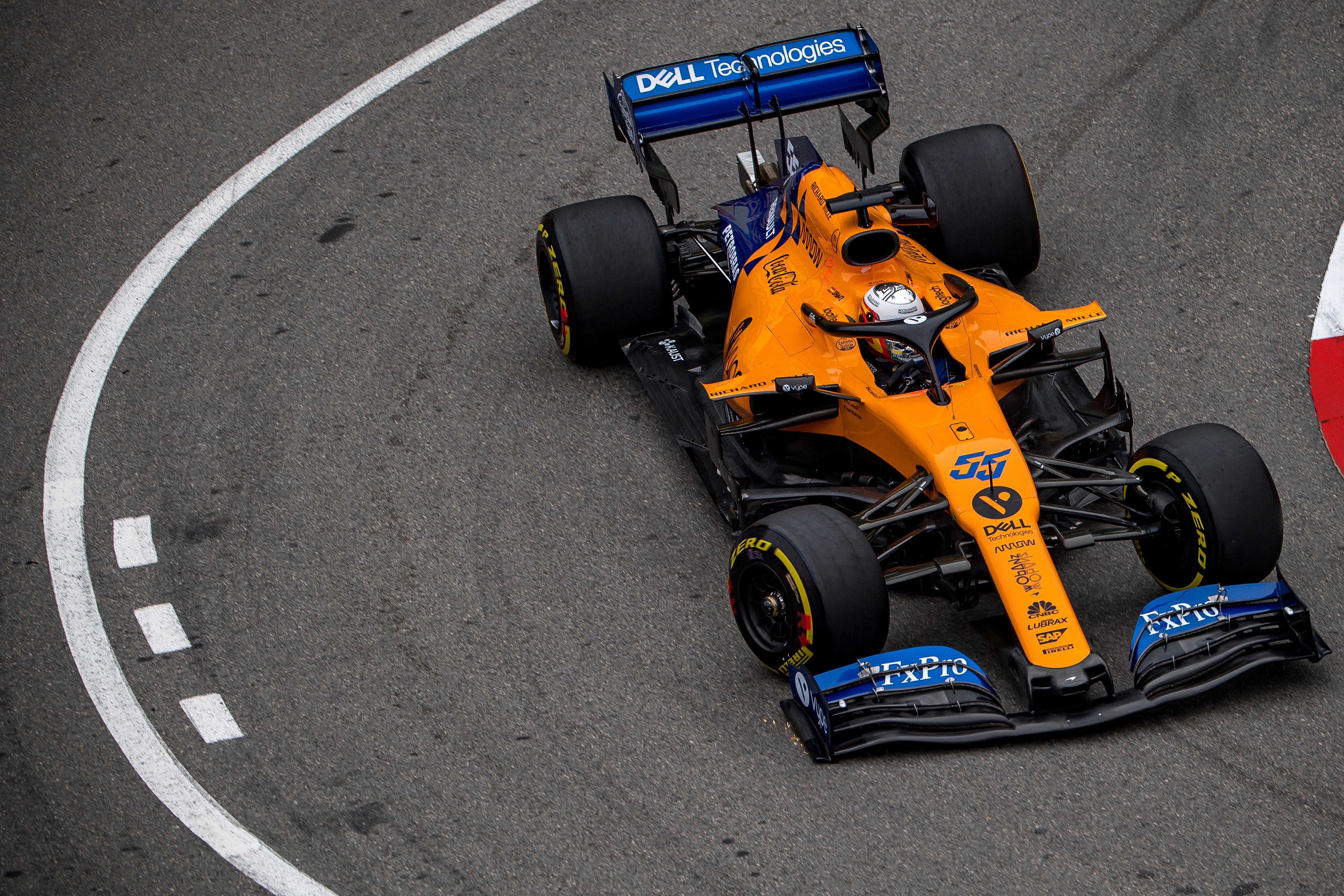
Another move on the last lap – this time with a McLaren being the overtaker rather than the overtaken – brought Carlos Sainz the single point he required to seal sixth in the Drivers’ Championship, with the Spaniard clearly ecstatic with the manner in which he claimed it.
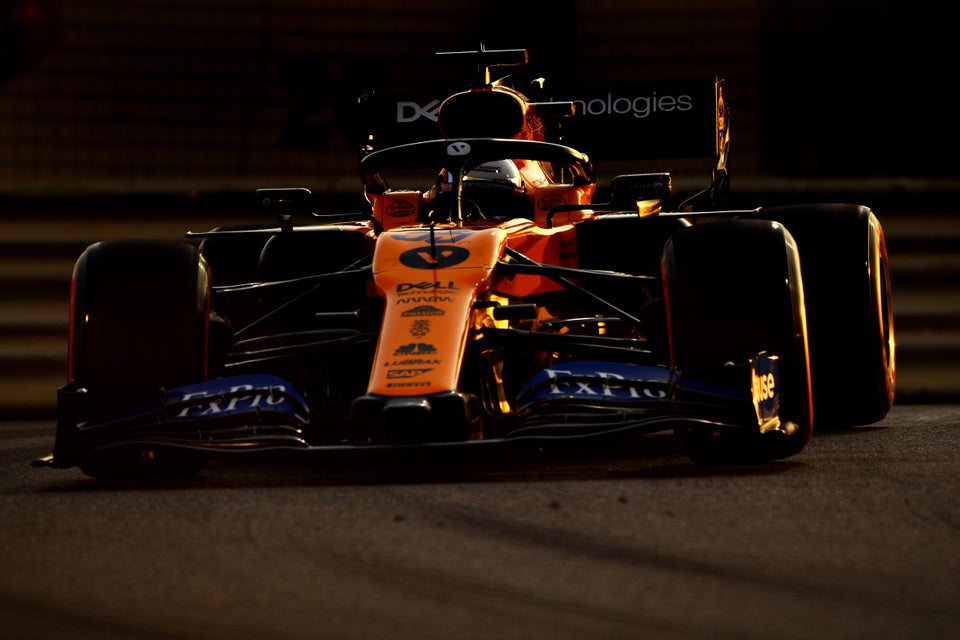
Carlos Sainz at the Abu Dhabi Grand Prix.
Image credit: Sutton

Sainz absolutely deserves that sixth place. Whilst it has obviously been made possible by two drivers getting half a season each in the second Red Bull, the level of consistency achieved by the Spaniard has been excellent and he nearly broke the 100-point barrier despite a fair share of bad luck. He lost a haul of points in Bahrain through a coming together with Verstappen and more via a botched pit-stop in Italy.

Surely Red Bull are looking somewhat longingly at Sainz now as they struggle to find a driver worthy of their second seat. Verstappen and Sainz were very evenly matched as teammates in their rookie years and it seems that, in the last 12 months certainly, Sainz has pushed onto another level and is relishing his role as team leader at McLaren.

Tension between their respective fathers supposedly played a part in Sainz not being considered for the Red Bull drive when Daniel Ricciardo dropped the bomb that he was leaving for Renault last year. But you have to wonder, with a Verstappen-Sainz pairing, would Red Bull have been able to truly challenge Ferrari for seconds in the Constructors’ Championship this year?

Verstappen Claims the Other ‘Best of the Rest’

Whilst, at times, Ferrari and Red Bull have looked very fast – the Ferrari particularly in qualifying and the Red Bull particularly at altitude – over the course of the season, the Mercedes team has been somewhat in a class of one.

With his second place in Abu Dhabi – and a helping hand from the Ferrari clash last weekend – Verstappen claimed third in the championship and what is effectively ‘best of the rest’ beyond the Silver Arrows. It is another deserved unofficial crown, as Verstappen has surely stood out, alongside Hamilton, as the star of the field this year.
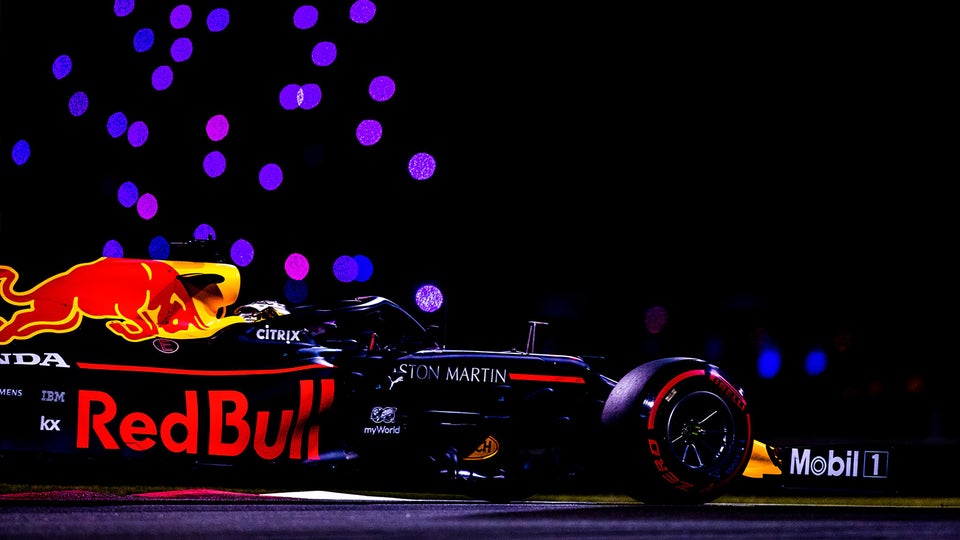
Image credit: Red Bull

Where, in past seasons, he had shown unquestionable raw speed but flashes of immaturity and rashness, this year has been nearly devoid of those flies in the ointment. There were perhaps a couple of overambitious moves but that comes with the territory when you are a bold driver like Verstappen.

If Red Bull can actually start a season competitively for once next year, and Verstappen can keep his head once faced with a real title battle, 2020 could even be a case of him going for ‘best of the best’.

But the final word must go to Hamilton.

Having been challenged more consistently by the other teams since the summer break, the world champion’s superlative performance at the Yas Marina Circuit was a pointed reminder to the prentenders to his throne that he is still very much the king.

The Abu Dhabi Grand Prix in 60 Seconds

Answering the Burning Questions

Who can go into the winter break on a high? Certainly Hamilton. But Verstappen and Leclerc will be pretty content too.

How will relations be between the two Ferrari drivers and within the team? There was a hint of tension with Leclerc missing his final qualifying lap and seeming to blame Vettel but really it was the team’s fault. That was followed by another silly error from the team on race day… Will any heads roll over the winter break?

Who will claim third in the Drivers’ Championship? Verstappen, pretty comfortably in the end.

Can Hülkenberg get a podium in possibly his last ever race?? Of course not. A token Driver of the Day award though!
2019 United States GP report | Bottas wins the battle, Hamilton wins the war

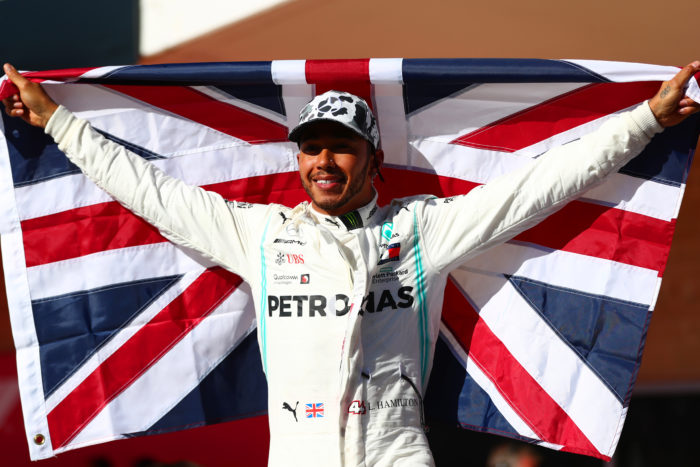
It’s number six for Lewis Hamilton.
Lewis Hamilton at the United States Grand Prix.
Image credit: Getty Images

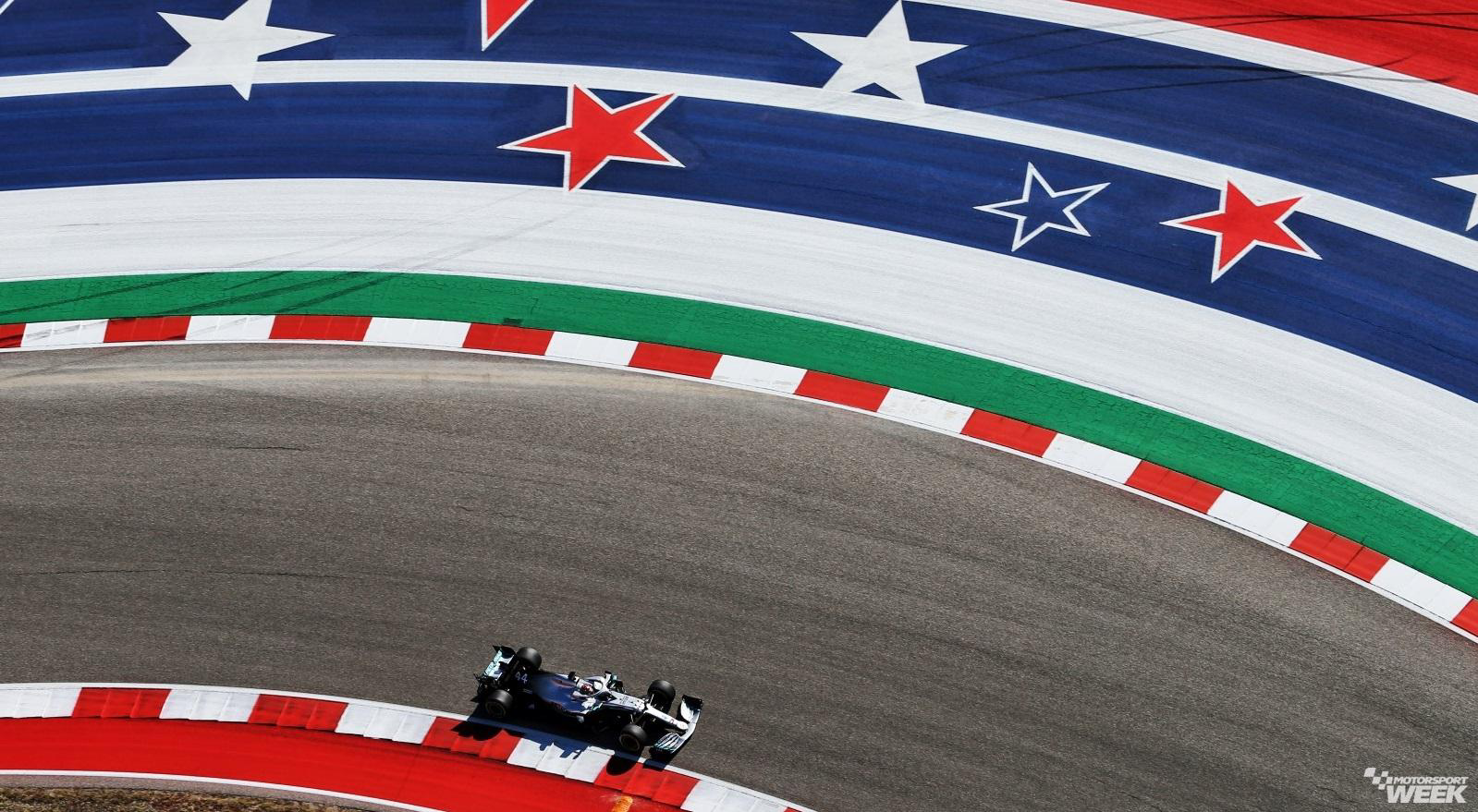
A fine drive from Valtteri Bottas meant he took his seventh victory in Formula 1 at the 2019 United States Grand Prix but it wasn’t enough to deny Lewis Hamilton his sixth world championship.

After a poor Saturday – certainly by his high standards – Hamilton started fifth on the grid but produced a champion’s performance on race day. Clearly determined to make amends, Hamilton had passed both Ferraris within a matter of seconds as they struggled to turn on their tyres, including a particularly impressive move around the outside of Sebastian Vettel through Turn Eight. Bottas held a comfortable lead throughout the first stint with Max Verstappen and Hamilton a few seconds back.

Red Bull triggered the first pit stops with an attempted undercut on lap 13 and Mercedes responded with Bottas, both drivers now on a likely two-stop strategy. This left Hamilton to go long and attempt another now-somewhat-trademark ‘tyre whisperer’ massage session in order to make a one-stop work. He stopped on lap 24, leaving him 32 laps to eke out of his hard tyres.

Bottas pitted on lap 35 and rejoined six seconds behind Hamilton. He initially closed on his teammate quickly but, when the tyre differential had reduced slightly and backmarkers began to come into play, the drivers appeared to be in something of a stalemate. With the remaining laps ticking down, it looked as though Hamilton was on the verge of repeating his feat from a week ago in Mexico and making a contra strategy work perfectly. But in the end Bottas’s fresher tyres were enough and, after a good battle with some strong defence from Hamilton, the Finn took the lead with four laps to spare. Verstappen, who had also been steadily closing in, was foiled by yellow flags from Kevin Magnussen’s stricken Haas in the last couple of laps and was unable to pass.

Bottas took the chequered flag to claim his fourth victory of the year and, in doing so, showed that he can maintain some momentum after the summer break, where in years gone by his challenge has faded. But it was still not enough and Hamilton took second place and an unbelievable sixth World Championship with two races to spare.

Image credit: Formula 1

Further back, Vettel’s rear suspension had dramatically failed early on; the German doing well to keep his suddenly three-wheeled Ferrari pointing in the right direction before pulling over in a convenient spot. His teammate, Charles Leclerc, had a slightly better afternoon but a pretty lonely one and came home a distant fourth. Sceptics – including Max Verstappen, who was even quoted as saying “that’s what happens when you stop cheating” – are already suggesting that the recent FIA clarification of technical rules regarding power units has impacted Ferrari’s performance.

One race is too early to make those of kind of sweeping assumptions. This was not a track layout that ever looked to particularly favour Ferrari’s package and there main issue appeared to be with the tyre temperatures. The next race in Brazil will likely be similar so let’s all try and reserve judgement until the season finale in Abu Dhabi. If their clear straight-line speed advantage has disappeared there, then maybe we can all consider grabbing our pitchforks and/or tin foil hats.

Alexander Albon recovered well to fifth after a first corner incident. We have still barely seen the Anglo-Thai in a straight fight with teammate Verstappen since his swap to Red Bull but he has continued to put in solid performances in the unenviable position of joining a team mid-way through your rookie season and being matched up against the flying Dutchman.

Alexander Albon at the United States Grand Prix.
Image credit: DPPI

Behind him, Daniel Ricciardo narrowly held off a charging Lando Norris for sixth place after the young Briton had taken a late pitstop and charged back through the field from 10th. It was a better weekend for McLaren – with Carlos Sainz following his teammate home in seventh – after Mexico where a pit stop error cost Norris and there was the mystery of Sainz’s lack of pace on the hard tyre.

Also, a quick mention for Sergio Perez who claimed a points-paying position having started in the pit lane, even with Daniil Kvyat producing another desperate final lap divebomb just seven days after doing the same to Nico Hülkenberg. This one earned him a penalty too. The Torpedo is back to torpedo-ing. Is he costing himself a seat at Toro Rosso next year? Sorry, make that Alpha Tauri…or whatever they’re called.

Lewis Hamilton: Six-Time World Champion

Image credit: Getty Images

Hamilton was already undeniably in the pantheon of the greats. But he is now closing in on staking a strong claim to be the best driver in the history of the sport.

A sixth world championship moves him clear of the great Juan Manuel Fangio and just one behind the record seven titles of Michael Schumacher. He is also now closing in on most of Schumacher’s various other records. 83 wins compared to Schumacher’s 91, 150 podiums compared to 155. If all seasons are converted to having the current points system, Hamilton is now at 3788 with Schumacher having taken a total of 3961. These are records that could easily change hands in the next 12 months.

The world champion’s prowess over a single lap in qualifying has long been known and he already stands far out on his own when it comes to the record for pole positions. But more recently, and particularly this season, he has shown he is just as good on a Sunday. As previously mentioned, he is now infamous for his tyre management. Mercedes Technical Director James Allison, who has worked with many greats including Schumacher himself, described Hamilton’s “instinctive ability” when it comes to the subtle technicalities of racing – such as tyre management and fuel conservation – as “remarkable” and has spoken of the “metronomic consistency of his race performances all year”.

Hamilton really does have very few – if any – weaknesses these days. After the season, I plan to do a post truly comparing him to the previous greats but, for the moment, let’s just appreciate that we have seen a fantastic driver further cement his legend and move closer to what had previously appeared to be unassailable records.

Congratulations, Lewis. The lad from Stevenage done good.

The United States Grand Prix in 60 Seconds

Answering the Burning Questions

Can Hamilton wrap up the title? Of course he did.

…When Hamilton wraps up the title, will there be any impressive theatrics from the Americans/Liberty? There was a parking spot but that was about it. Maybe the champion being lifted up to the podium last weekend in Mexico would have been more fitting.

With its varied layout, which car will COTA suit the best? Red Bull gave a good charge but Mercedes appeared to just have the edge for most of the weekend.

Can Verstappen stop his recent run of mishaps? There was a small bit of contact at the first corner, and later on with a kerb, that caused minor damage but it was a strong weekend overall.

Chances of another Kimi win?.. Bwoah, sadly not.

2019 Mexican GP report | Hamilton win leaves him on brink of title

Ferrari mess up a 1-2, Hamilton wins, Lando’s luckless, water is wet.
Lewis Hamilton wins the Mexican Grand Prix.
Image credit: Daimler AG

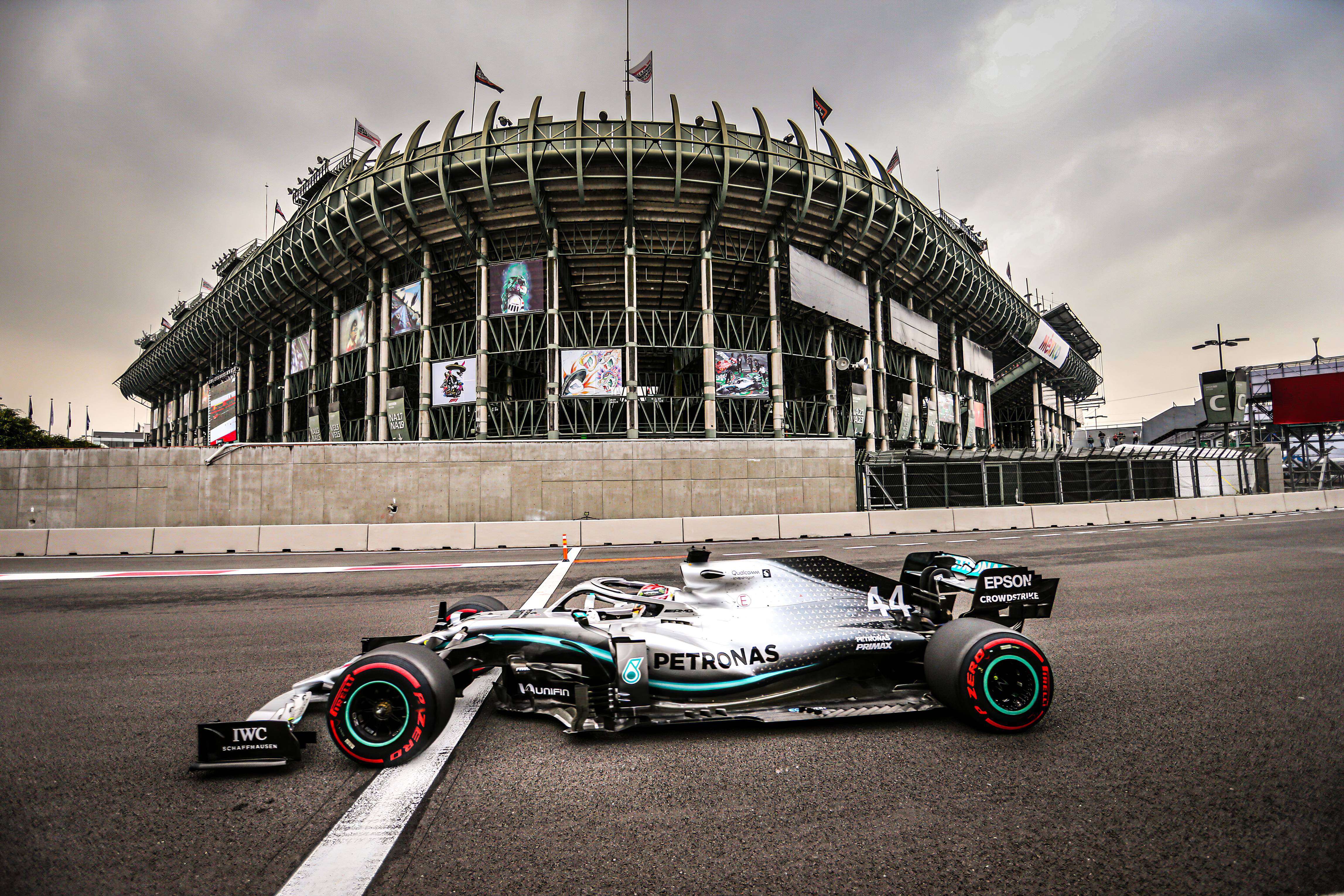
Lewis Hamilton came away with a surprise win at the 2019 Mexican Grand Prix after Mercedes had struggled through Friday and Saturday on a track that has not been kind to them in recent years.

Max Verstappen had initially taken pole position but was given a three-place grid penalty for ignoring yellow flags after Valtteri Bottas’s nasty crash in the dying seconds of Q3, which left the Finn winded. It was a needless penalty to risk as Verstappen already had pole secured through his previous flying lap but the Dutchman appeared characteristically unrepentant in the press conference.

So a fired-up Verstappen on race day was something of an inevitability. Last year, that approach won him the race; this year, it did not.

Hamilton made a good start but was squeezed onto the grass by Sebastian Vettel – in previous years that may well have earned him a penalty but not with the current approach by the stewards – and that left him with Verstappen on his inside into Turn One. They nearly touched, Verstappen following Vettel’s lead by also squeezing Hamilton to the edge of the track. Hamilton then got a big slap of oversteer and failed to make the corner, leaving Verstappen nowhere to go except joining him on the grass.

The pair recovered to fifth and eighth but Verstappen’s opportunistic move on Bottas in the stadium section resulted in a puncture and a long trip back to the pits.

At the front, it would become a tale of divergent strategies.

Charles Leclerc had retained the lead at the start and led until pitting on lap 15, committing to a two-stop strategy. Alexander Albon would also be pitting twice, having stopped a lap earlier, but the rest of the leaders would go with what transpired to be the faster option of the one-stop.

Mercedes, for once, decided to go with the undercut for Hamilton and pitted him on lap 23, leaving Vettel and Bottas to go much further. The world champion feared they had pitted too early as his two rivals continued on and on at a decent pace. But it turned out to be the perfect move.

After Bottas and Vettel pitted on laps 36 and 37 respectively, and Leclerc came in for his second stop on lap 43, Hamilton appeared to be in trouble – easy prey for the chasing pack. Vettel had 14-lap-younger tyres and his teammate was closing the gap by a second a lap. It looked set for a showdown in the last few laps, as all four drivers converged, but Hamilton had preserved his tyres perfectly and was able to hold his challengers at arm’s length – two seconds in F1 terms – to the chequered flag.

Ultimately, it was a slow-burner of a race that looked ready to explode but the fuse went out just before reaching the fireworks.

Nonetheless, it was a very satisfying win for the Briton and his Mercedes team at a race from which they did not expect a lot. And one that takes him to the very brink of the title. If either he takes at least four points or Bottas doesn’t win next weekend then he is guaranteed a sixth World Championship. Even with a likely coronation, the Americans will have to go some to beat the Mexican post-race ceremony, which featured the race-winning car and driver appearing from below the stage à la Beyoncé…

Is the Old Verstappen Back?

Many spent the first half of this year waxing lyrical about how Max Verstappen had finally matured and it certainly did appear that way. But was it true?

Since the summer break, Verstappen has been on a run not too far from the one he had in early 2018, with first corner incidents at four of the last six races. Certainly, he was blameless in Japan and unfortunate here, but he is back to just always seeming to be involved in something and that often comes down to where a driver is positioning their car.

The move on Bottas was overambitious and clearly hot-headed as, even without the contact, he was just giving Bottas DRS and a tow down the straight immediately after. And on his way back through the field, there was also a slightly clumsy move on Magnussen, followed by overtaking the Dane whilst off the circuit – there doesn’t seem to have been any explanation as to why this wasn’t penalised.

It is that red mist and seeming lack of foresight that he will need to improve upon if he ends up in a genuine title fight in the next couple of seasons. Not lifting whilst passing the scene of Bottas’s crash on Saturday was potentially excusable, due to the lack of the electronic yellow flags, but his demeanour when asked about it was belligerent and arrogant.

The ‘Orange Army’ are quick to remind that he is still only 22 but should five seasons of F1 experience not trump that?

Image credit: Motorsport Images

Meanwhile, on the other side of the garage, the slightly older but much less experienced Albon had another solid race. And he has now outscored Verstappen in their time together by 46 points to 27.

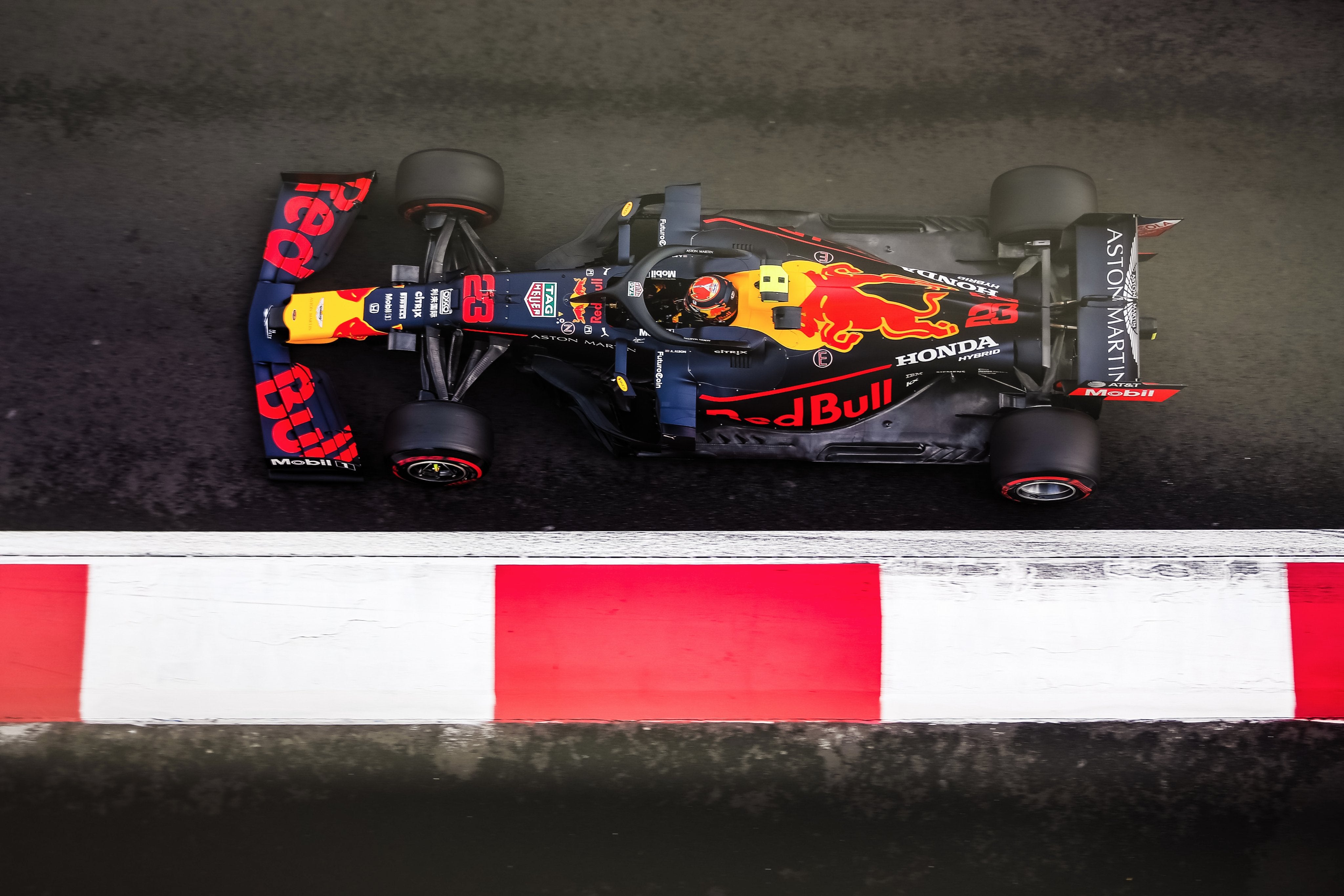
His pace is getting stronger as he acclimatises to car and team, as shown by matching Verstappen’s qualifying time to the thousandth of a second in Suzuka. He didn’t look overawed whilst battling with the big names this weekend, maintaining third position in front of Hamilton for the first stint in Mexico, and he is making an increasingly compelling case to be kept on for the Red Bull seat in 2020.

Pérez Sends the Home Crowd Wild

I mean, he always does – all he has to do is drive through the stadium section without putting the car in the wall – but rightly so this weekend with a strong drive to seventh and ‘best of the rest’.

Sergio Pérez and Daniel Ricciardo fought hard for that unofficial honour in the final few laps as the Australian closed in on new, softer tyres but he was unable to pull off a trademark divebomb, locking up and running over the grass into Turn One.

Image credit: Renault

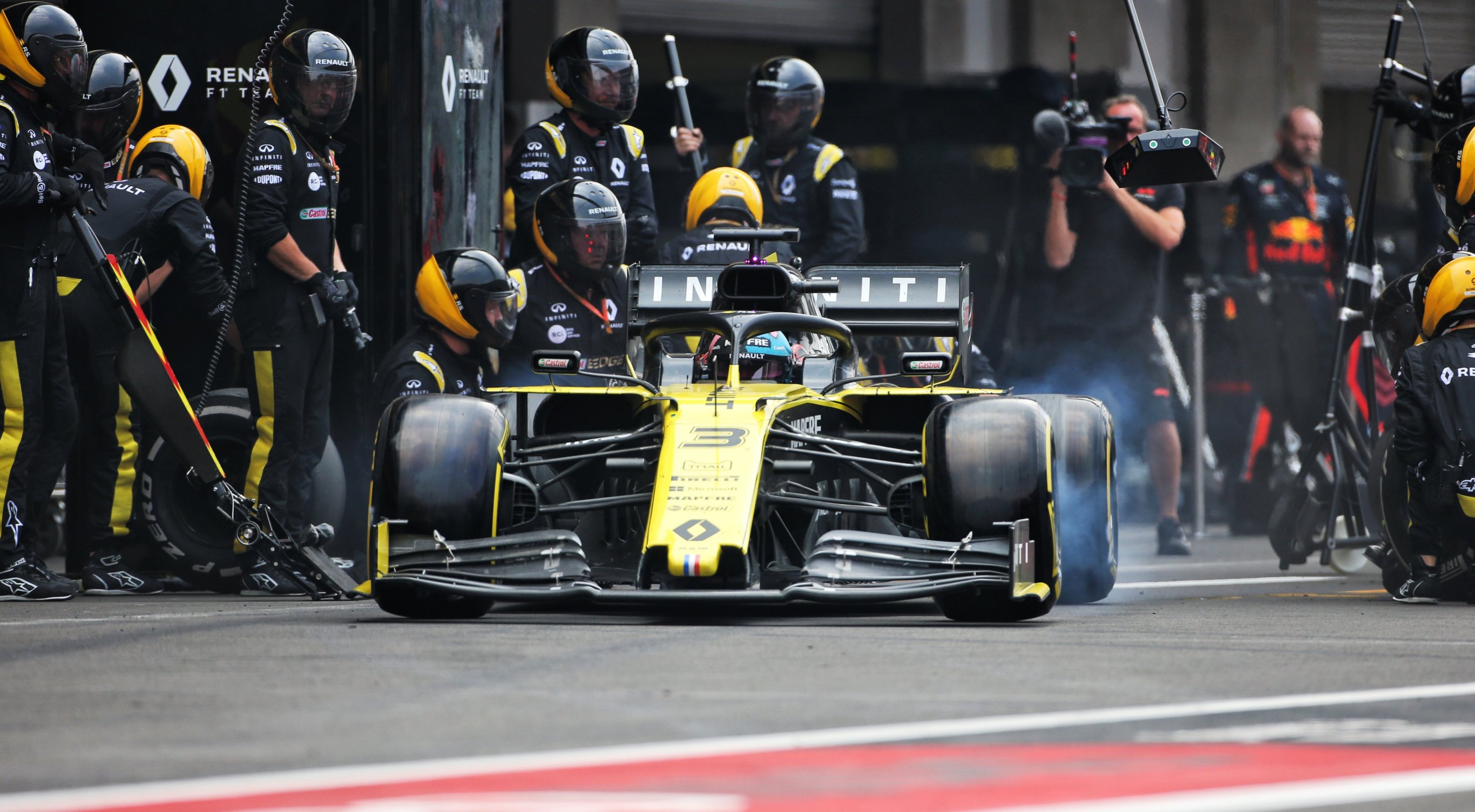
There was some further drama behind them as, during their battle over the final two points positions, Daniil Kvyat punted Nico Hülkenberg into the barriers at the very final corner. The German limped over the finish line with no rear wing and the Russian was given a penalty that dropped him to 11th and promoted his teammate, Pierre Gasly, to ninth.

It was a poor day for McLaren who, having been running fourth and sixth early on, found themselves pointless at the chequered flag. Lando Norris’s appalling luck continued as a pit stop error left him stranded at the end of the pit lane with a loose wheel. And Carlos Sainz just had no pace once on the hard tyre, was forced to stop again, and gradually faded into obscurity, finishing 13th. They’ll hope to be back mixing it with the big teams in Texas.

The Mexican Grand Prix in 60 Seconds

Answering the Burning Questions

Can Lewis Hamilton clinch the world title this weekend? Not quite. But it’s as good as done, barring any kind of 2007-esque cataclysm.

Or can Valtteri Bottas use the momentum of his win in Japan to take the challenge to his teammate? Not really. It could have been worse after that Q3 crash, though.

Which car will deal with the low altitude best? Hard to say. A 1-3 for Mercedes but Ferrari were very strong and who knows what Verstappen could have achieved?

Will there be any more drama between Charles Leclerc and Max Verstappen? Leclerc was one of the few drivers that Verstappen didn’t end up in some kind of drama with.

With thunderstorms forecast over the weekend, could we have our first wet Mexican race? Nope. It poured every evening though… Typical.

2019 Russian GP report | Hamilton takes surprise victory in Sochi

Strange words to hear but an unlikely Mercedes win…
Lewis Hamilton wins the Russian Grand Prix.
Image credit: Motorsport Images

Lewis Hamilton made the most of a Mercedes strategy gamble and some good fortune to take his ninth win of the season at the 2019 Russian Grand Prix.

Considering Mercedes are the only team to win in Russia since its debut in 2014 – even the unofficial Grands Prix in 1913 and 1914 were won by Benz, before their merger with Mercedes – it may seem a strange prospect that they were the underdogs this time around. But the characteristics of the front-running cars have changed. Ferrari’s class-leading straight-line speed, combined with the successful aerodynamic upgrade they brought to Singapore, saw them as the class of the field.

Through the Friday practice sessions, it appeared it may be a fight between Ferrari and Max Verstappen’s Red Bull as Mercedes struggled to get on top of their setup. Come qualifying, however, they had made some progress and Hamilton produced a trademark lap to claim a spot on the front row, albeit four tenths shy of Charles Leclerc’s equally impressive pole time.

But pole is something of a poisoned chalice at this track.

The long run down to the first corner – officially Turn Two – gives those behind a slipstream and puts the polesitter in an uncomfortable position. And so it proved to be again as Sebastian Vettel stormed past from third on the grid to take the lead. There was clearly some kind of agreement and the Ferrari drivers and engineers then spent the first phase of the race bickering about who should be in front. (More on that later.)

Image credit: AFP

Having spent most of the last three races trying to navigate past a slightly slower Ferrari on race day, Mercedes decided to take an alternate strategy and start on harder tyres. As it turned out, this would win them the race.

Shortly after the Ferrari pit stops, Vettel’s MGU-K went bang and the German ground to a halt. This brought out the Virtual Safety Car and played into the Silver Arrows’ hands, allowing Hamiton to take his pit stop and rejoin ahead of Leclerc. Something Mercedes Technical Director James Allison described as “deliciously ironic”.

Immediately after the VSC, a full safety car was called for a George Russell crash, which actually played slightly back into Ferrari’s hands. With Leclerc on harder, older tyres, Ferrari decided to take a gamble of their own and pit him for new softs under the safety car, dropping him behind only Valtteri Bottas and giving him the upper hand for the remaining 20 or so laps.

As it was, Mercedes handled the situation perfectly and just about kept the hungry, young Ferrari driver at arm’s length for the remainder of the race.

Whilst undoubtedly fortunate, Mercedes put themselves in that position strategically and showed their strong race pace on Sunday. Arguably, the narrowly faster car has lost the last three races. But that just shows how fine the margins currently are between the top two teams – with Verstappen forever snapping at their heels – and that is great for Formula 1.

McLaren Best of the Rest

Behind the top two teams, Verstappen came home a fairly lonely fourth and Alexander Albon produced a decent – if also quite fortunate – fightback to finish fifth after what had been a sloppy weekend. One that may prove crucial in his quest for next year’s Red Bull seat.

But it was McLaren who were the stars of the midfield.

Steadily improving throughout the weekend, after initially struggling to get on top of their setup on Friday, the papaya cars found themselves fifth and seventh on the grid – after a penalty had been applied to Verstappen – and with excellent starts converted that to fourth and sixth, Carlos Sainz even challenging Hamilton for third into Turn Two.

Carlos Sainz at the Russian Grand Prix.
Image credit: Getty Images

Over the course of the race, the faster cars got past – as did Sergio Pérez when Lando Norris got a bit too involved in fighting a Red Bull – but sixth and eighth on the day takes the team into triple figures in the Constructors’ Championship for the first time since 2014. That’s a real sign of the progress they’ve made and the direction they’re going in.

Fourth in the standings is now looking very likely. And with the deal to return to Mercedes power from 2021 announced this weekend, things are looking promising for a team that has been trying to rebuild what was a true empire of the sport. Just think how many more points they would have this year without those costly Renault enging blow-ups…

The future’s bright, the future’s (papaya) orange.

What Was Going on With the Ferrari Team Orders?

Nobody is coming out and officially saying what deal was agreed within Ferrari regarding the start of the race.

It would appear, though, that Leclerc had agreed to give his teammate the tow to Turn Two to ensure he got ahead of Hamilton and produced a Ferrari one-two. However, it would also appear that if Vettel got past during that sequence that he was due to hand the lead back to Leclerc. Vettel did get past but did not hand the place back and, from there, things started to get a little complicated.

Image credit: Getty Images

Vettel made the point that he would have passed Leclerc anyway and that the other Ferrari should get closer before he can pass. He certainly had a point with the latter – he would have left himself in the clutches of a certain Lewis Hamilton had he allowed Leclerc through at any point during that first phase of the race. The former, though, I’m not totally convinced by.

If Leclerc were purely thinking of himself, I think he would have emerged from Turn Two as the leader. He could have moved right to give Hamilton the tow – knowing the Mercedes has less straight-line speed and seeing that he had got away poorly – and then defended the inside line of the corner.

By cutting a deal with both drivers that had some very grey areas, they were always putting themselves in an awkward position. Particularly given the current climate within the team, with it plain to see that there is something of a power struggle going on between the two drivers.

As it was, they were forced to run Vettel long on his first stint and effectively pass the lead to Leclerc in that way. Whilst giving the German fresher tyres and the chance to fight back on track was arguably a decent compromise, it all felt a bit uncomfortable and Vettel didn’t sound too pleased. Sadly, it would prove to be a moot point anyway as his SF90 pulled up next to the crash barriers on lap 26.

As has generally been the case this season, the Ferrari team orders seem to be producing more issues than they are solving. And, with the car now looking likely to be competitive for the remainder of the season, there could be more flashpoints to come to test the inter-team harmony. If Ferrari then convert this current strong form into a title battle next year…expect real fireworks for 2020.

The Russian Grand Prix in 60 Seconds

Answering the Burning Questions

Has that Ferrari upgrade changed the pecking order this season or was Singapore an outlier? It would appear to have legitimately changed the pecking order.

Can Sebastian Vettel push on now having put some demons to rest with a win? Qualifying pace was still lacking but he produced a strong performance on Sunday before team orders and a failed engine got in the way.

Will tensions rise further in the Ferrari camp? Yup.

Will we see the longest winless run for Mercedes in the hybrid era? Nope.

Who will come out on top in the McLaren/Renault fight this weekend? McLaren had the edge and now have a tight grip on fourth in the standings.

Will Valtteri hear from James during the race? Certainly not in the meme sense.

How awkward will the cool down room with Putin be this year? There was no Putin thankfully. But Hamilton did hug a giant Russian doll which was a little odd.

2019 Hungarian GP report | Hamilton stages comeback to snatch victory

The Hamilton-Verstappen duel we’ve all been waiting for.
Lewis Hamilton celebrates winning the Hungarian Grand Prix.
Image credit: AP

Lewis Hamilton and his Mercedes team produced a tale of redemption, after their messy weekend in Germany, to take a dramatic late victory at the 2019 Hungarian Grand Prix.

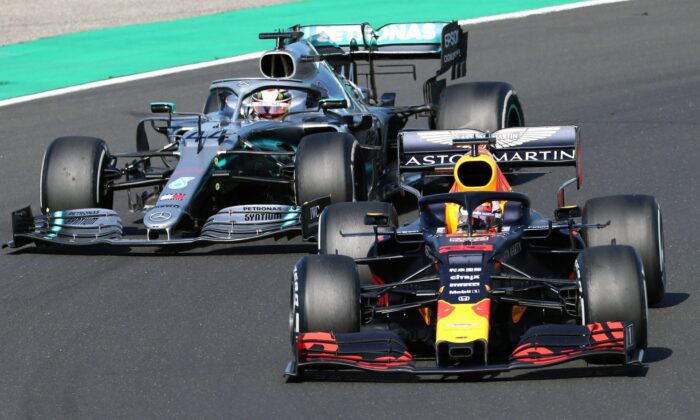
Max Verstappen had continued his excellent recent form to pip both Mercedes drivers – Hamilton and Valtteri Bottas – for his first ever pole position on Saturday. He then just about survived with the lead intact to the first corner, despite running three-wide with Hamilton and Bottas, and from there it looked his race to lose on a track where it is notoriously difficult to overtake.

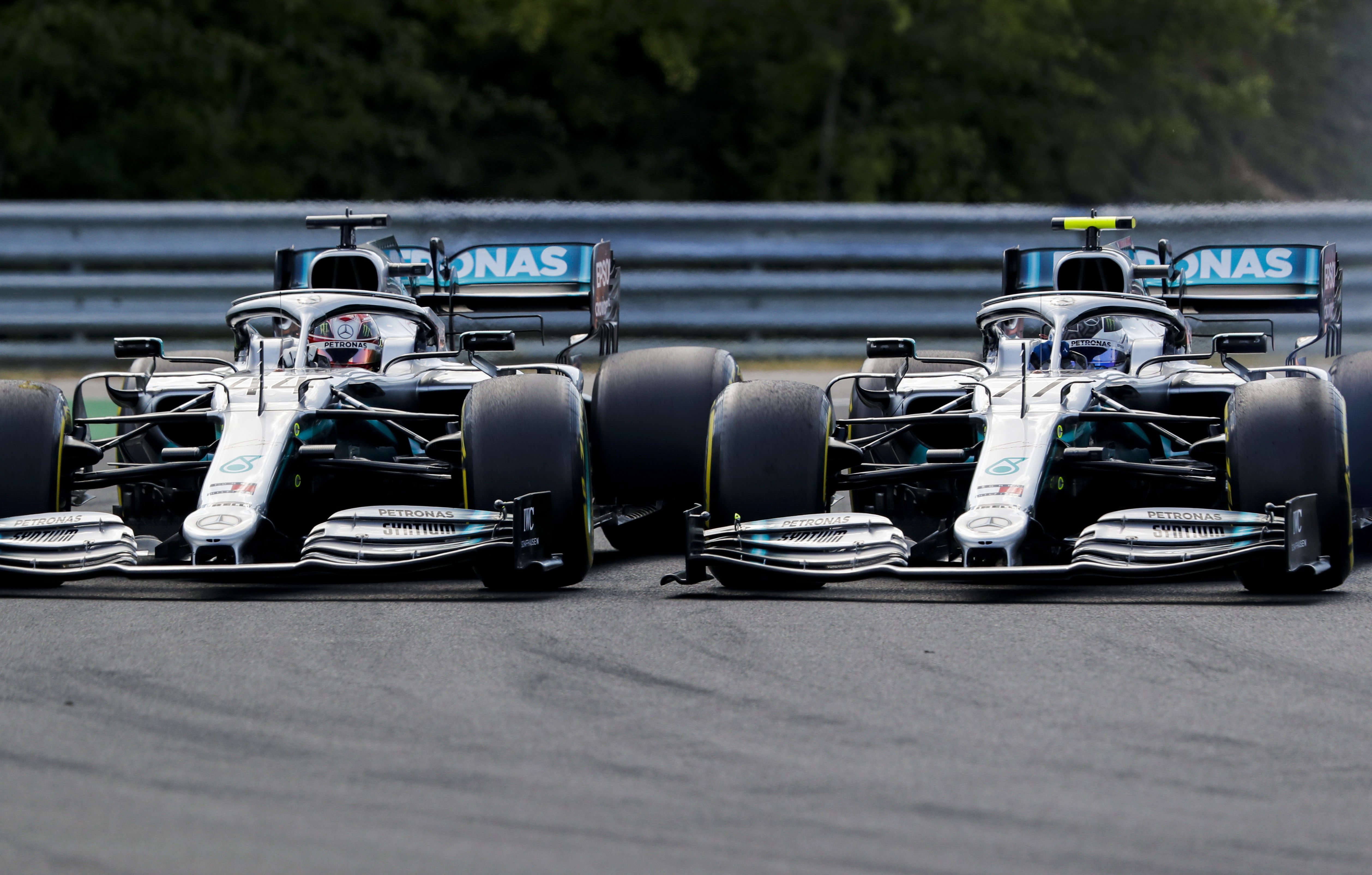
Behind him, the two Mercedes battled through the first few corners. Bottas did so clumsily though, locking up twice and then clipping his front wing first against the rear tyre of his teammate and then that of Charles Leclerc’s Ferrari. Both escaped without punctures but Bottas’s wing was damaged to the extent that he was forced to pit for a replacement and would emerge in last place, with a long race ahead of him.

The top two of Verstappen and Hamilton steadily pulled away from the Ferrari pair; it becoming apparent fairly quickly that this was to be a two-horse race. At first there was something of stalemate but as Verstappen’s tyres began to fade, Hamilton closed up to the back of the Dutchman and forced Red Bull to pit him early on lap 25, as they feared a pit stop by Mercedes would produce an ‘under-cut’ and give Hamilton the lead. Mercedes stretched the championship-leader’s first stint as far as they could – for another six laps – with the hope of fresher tyres at the end of the race. Hamilton rejoined and immediately closed the gap; a six-second lead gone in just over three laps.

Thus ensued the duel that Formula 1 fans have been craving for a long time. Of course, the two drivers have battled for position on track before, but it has rarely been in closely-matched cars and, generally, Hamilton has been very cautious – looking at the bigger picture of his own title fights and knowing Verstappen’s tendency to take no prisoners. But here, it was different. Hamilton has a far more comfortable lead in the championship and, at this point, his closest competitor is arguably Verstappen. So he went for it. Specifically around the outside of the deceptively tight Turn Four, at 150 mph over a blind crest. He nearly pulled it off too but for a snap of oversteer which sent him wide into the run-off area.

The first four corners of that lap were captivating, with excellent attacking and defensive driving from the two. But now, it was the turn of the Mercedes strategy team to excel.

With no threat to their second place coming from behind, they decided to roll the dice and pit Hamilton for a set of medium tyres, hoping he could claw back the 20-second gap in the remaining 22 laps as Verstappen’s tyres aged. For a while, it looked overly ambitious, with the gap still at over 15 seconds seven laps later, but then Hamilton turned it on and Verstappen’s tyres faded badly; the gap suddenly decreasing by more than 1.5 seconds per lap. By the time Hamilton had reached the back of the Red Bull, there was little Verstappen could do to defend. There was to be no repeat of the dramatics from earlier and Hamilton neatly swept around the outside of Turn One with a little under four laps remaining and claimed his eighth victory of 2019.

A totally different race to the chaos in Germany but certainly still an enthralling one – plenty of action, interesting strategies and nail-biting tension at the front. Formula 1 enters its summer break on a high.

Ferrari Finish Third But Now Have the Third Quickest Car

Ferrari were always likely to struggle in Budapest but will be disappointed to have finished a full minute behind the leader. This was a track that in recent years has very much suited their car, with its downforce and speed through slow corners, but this year’s machine has almost the exact opposite traits. They now have a significant straight-line advantage but are somewhat hopeless in slow to mid-speed corners. And whilst Red Bull have made impressive progress in reducing the gap to Mercedes, Ferrari have faltered.

Image credit: Callo Albanese

They were left to their own private race for the final step on the podium and it was Sebastian Vettel who used a similar strategy to Hamilton’s to catch and pass his younger teammate a couple of laps from the end. An impressive 39-lap stint on the medium tyres left the German able to switch to the softs for the remainder of the race and reel in Leclerc on similarly fading tyres to Verstappen’s at the front.

It was continuation of Vettel’s recent upturn in form and/or luck but he will be fully aware that there is a long way to go for the team. They found themselves with clearly the third quickest car this weekend. That is something that will provide some embarrassment at Maranello – this was supposed to be their year, remember? And Red Bull were supposed to be in a rebuilding phase as they acclimatised to a Honda engine.

At least the races after the summer break will present an opportunity for the Scuderia, with Spa and Monza both heavily reliant on straight-line speed. And oh how the Tifosi could do with a victory at home right now…

Pressure Mounts on Bottas and Gasly

With ‘silly season’ in full swing and lots of rumours swirling regarding their seats, both Bottas and Pierre Gasly could have done with a solid race heading into the summer break. But neither managed one.

Toto Wolff has now openly admitted that it is a straight choice between Bottas and Esteban Ocon – the Mercedes reserve driver, waiting in the wings after missing out on a seat this year – and that the Mercedes management will be using the summer to weigh up their options. But the Finn made a less-than-compelling case in Hungary. Fortunate not to wreck both Mercedes cars’ races with that early contact, he certainly damaged his own and then did a somewhat average job of working his way through the field, eventually being held behind Kimi Räikkönen’s Alfa Romeo for an underwhelming eighth place finish.

The Mercedes at the Hungarian Grand Prix.
Image credit: Motorsport Images

His mental state after that mistake in Germany was dicussed; did that play a part in his sloppy performance on Sunday? Either way, that would appear to be his championship hopes all but over. Potentially his Mercedes career too.

Meanwhile, at Red Bull, Gasly is a driver under even more pressure. He has been given more time than probably any other driver in Red Bull’s history when performing so badly but now, after once again being lapped by his teammate and failing to pass a McLaren, is that time up?

Helmut Marko had announced very recently that Gasly would stay on for the remainder of the season but there was a pointed shift in the comments made by both himself and team principal Christian Horner after this race. Horner stating that “we shouldn’t be racing Saubers [sic] and McLarens”. The issue being that Gasly’s lack of performance noticeably cost them this weekend – a driver closer to Verstappen’s level should have been within 20 seconds of Hamilton and would then have prevented the strategy that won Mercedes the race.

With Red Bull now legitimately challenging Ferrari for second in the Constructors’ Championship, every point counts. And Gasly is not providing many unfortunately.

Sainz and McLaren Continue to Impress

Image credit: McLaren F1

Speaking of the McLarens, the fact is that they are racing with Gasly…and winning. Once again, they punched above their weight, running comfortably in fifth and sixth until Lando Norris was again unlucky with a slow pit stop, on a track that they thought might cause them problems. Norris recovered well through the field to earn a couple of points at least in ninth, whilst Carlos Sainz finished fifth for the second successive race and is now only five points behind Gasly in the standings.

McLaren have thoroughly embarrassed Renault – comfortably outperforming them with their own engine and doing so in a season where the French team were aiming to close the gap to the top three. And, after struggling with the Renault car somewhat last year, Sainz is really showing his quality and consistency in 2019. It’s worth remembering that he generally matched Verstappen in their year together at Toro Rosso.

A word also for Williams, who seem to have had something of a breakthrough with their understanding of their car, and particularly George Russell. The young Briton narrowly missed out on claiming a spot in Q2 – a feat which would have seemed unthinkable prior to the weekend – and then finished ahead of Lance Stroll and Antonio Giovinazzi on legitimate pace on Sunday. In doing so, he is ensuring that his name is at least mentioned in regards to that Mercedes seat, even if Toto Wolff – probably correctly – thinks it is a little early for him.

The Hungarian Grand Prix in 60 Seconds

Answering the Burning Questions

Surely the upward curve of increasingly dramatic races can’t continue?! Well, the curve maybe didn’t continue upwards but I wouldn’t say it went particularly downwards either.

Can Bottas mentally recover from his costly crash in Germany? A good performance on Saturday but come Sunday, it would appear maybe not.

Will his performance last race prove to be a turning point for Vettel? Quite possibly. Time will tell but it was another better weekend for him.

Can Verstappen continue his good form and head into the summer break as an outsider for the title? He certainly continued his good form. The title looks maybe a taller order than it did prior to Sunday but he’s an outside bet nonetheless.

Will we get the Pierre Gasly from Silverstone or Hockenheim? Turns out it was specifically the Gasly from Austria – getting stuck behind a McLaren and lapped by Verstappen.

2019 British GP report | Hamilton wins for record sixth time

History for Hamilton, fun for the fans.
Image credit: Getty Images

With some help from a fortunately timed safety car, Lewis Hamilton took a record-breaking victory at the 2019 British Grand Prix.

Having been pipped to pole position by his teammate Valtteri Bottas on Saturday, Hamilton came out of the blocks quickly and looked thoroughly determined to make amends. After a few laps getting increasingly close to the Finn’s gearbox, Hamilton made his move with a clever cut-back through Brooklands and looked to have the job done. But Bottas had other ideas. With the passionate home crowd still roaring, he pulled back alongside Hamilton and regained the lead into Copse Corner.

That was to prove the championship-leader’s best opportunity as he spent the rest of the first stint generally between 0.5 and 0.8 seconds behind. But when Bottas pitted on lap 16, Hamilton and his team saw an opportunity to mix up their strategy. He stayed out as long as he could, knowing that Bottas would need to stop again, with the aim of a one-stop race and the hope for a safety car. The latter duly obliged. By that point however, Hamilton had already put himself into a commanding position.

Even without a safety car, he was about to pit and rejoin a couple of seconds behind his teammate. Hamilton could then have sat behind Bottas, waiting for him to pit again and he showed just how much extra pace he had when he set the fastest lap on the last lap of the race, despite being on 30-lap-old hard tyres.

Bottas was actually fortunate to retain his 2nd place as those behind him had also pitted under the safety car and he was the only driver in the top six that needed to pit again. As it was, some antics from those following made his job far easier.

The Action Behind the Mercedes

Charles Leclerc and Max Verstappen picked up where they left off in Austria and this time the young Ferrari driver was going to make sure he gave as good as he got. He defended magnificently – at times towards the boundaries of acceptability, but always within them – lap after lap, in a battle that will likely be remembered for a long time to come and continues what is shaping into a fantastic rivalry. However, for all his excellent work, the Red Bull team produced a quicker pit stop which edged Verstappen out in front. Leclerc was not done though and immediately seized on a mistake by the Dutchman to regain his position. They then continued their fight until the safety car, where a delayed stop for Lelerc left him down in 6th.

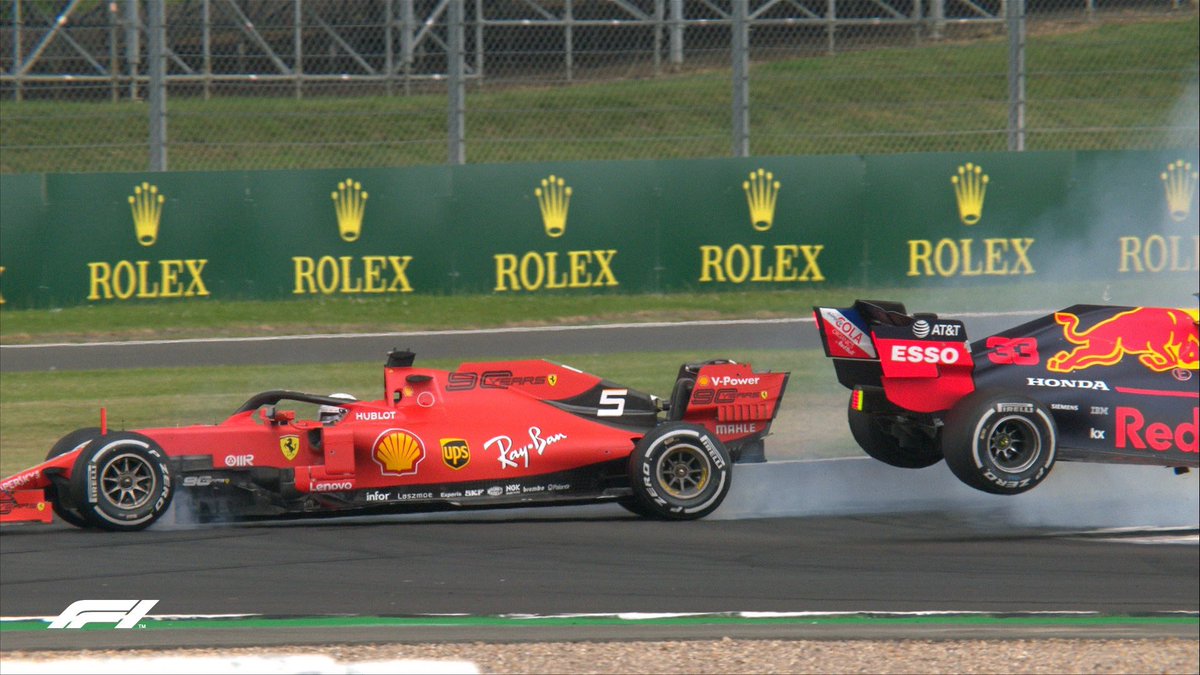
Sebastian Vettel benefitted the most from the safety car and found himself up in 3rd on a weekend where he had been consistently off the pace. Verstappen, having been let past his team mate Pierre Gasly, began to close the gap on Vettel and on Lap 37 he made a move around the outside of Stowe. He was ahead but had ran slightly wide which allowed the German to close back up as they approached the chicane at the end of Vale. Vettel aimed for a small gap that was barely there and, once Verstappen had fully closed it off, was over-committed and had nowhere to go but into the back of the Red Bull. In desperation, he locked up and slammed into Verstappen’s gearbox, sending him flying sideways over the chicane.

Sebastian Vettel and Max Verstappen collide at the British Grand Prix.
Image credit: Formula 1

Verstappen impressively kept the car moving through the gravel and would recover to 5th, whilst Vettel had damaged his Ferrari more significantly and, once a ten-second penalty had been added on, would finish dead last.

It is another high profile mistake from the four-time world champion and will increase the pressure on him even further as we approach the German Grand Prix – the scene of his infamous crash last year that caused a swing in the championship he would never recover from and marked the beginning of this series of mistakes that has now run the length of an entire season. His young teammate has seemingly rectified his qualifying issues – having said he had changed his approach after the Canadian Grand Prix – and is now looking thoroughly the stronger Ferrari driver. Indeed, despite the issues with strategy and slow pit stops that were out of his control, he recovered to finish 3rd after the drama had unfolded ahead of him, and described it as “the race I enjoyed most in my F1 career”.

More Drama Throughout the Field

The action was not limited to the front six cars. Lando Norris continued his excellent form to run as best of the rest early on in the race, having passed the Renault of Daniel Ricciardo and then held him off impressively. However, it was his teammate, Carlos Sainz, who was the biggest benefactor of the safety car in the midfield, with it promoting him to 7th place, having started 13th. The Spaniard then did well to hold off an eager-to-divebomb Ricciardo for the final few laps and inherited 6th after the Vettel-Verstappen incident. The safety car sadly had the opposite affect on Norris who was left in the same situation as Bottas – but without a Mercedes to recover the lost time of a second stop – and ended 11th.

Haas had another weekend to forget. Amid ongoing dramas with their joke of a title sponsor, Rich Energy – seriously, they formulate tweets that read like a Donald Trump parody account – their two drivers crashed into each other on the first lap and were then soon forced to retire. What looked a promising season, when they qualified in 6th and 7th at the season-opener, has turned into a nightmare. They are now on average the second slowest car, particularly on Sundays as they continue to struggle with the tyres, and Romain Grosjean is surely wearing his team’s patience paper-thin with his current run of errors – even managing to spin into the wall at the pit exit during Practice 1.

A Few Extra Shout-Outs

The sheer amount of action in the race has left little room for much more analysis, so just a few quick words for those who deserve them.

Pierre Gasly had a long-overdue but nonetheless much-improved weekend. With the aim of helping him find some form, the Red Bull bosses decided he would be given Verstappen’s setup, with just the ability to tweak a few aspects to his liking. It seems to have worked wonders as he was the faster Red Bull through the practice sessions, came much closer to matching his teammate in qualifying and then finished a season-best 4th, having been in amongst the action of the top 6 throughout the race. He now needs to keep this up to reduce the rumours around his seat as silly season heats up.

Image credit: Red Bull Racing

Daniil Kvyat, having been somewhat put in his place on Saturday by teammate Alexander Albon, slowly but surely made his way up from 17th on the grid to finish an impressive 8th. Albon though was unfortunate on Sunday and further enhanced his reputation through the weekend on a track where he took the victory in F2 last year.

Speaking of last year’s F2, the 2018 champion, George Russell, continued his clean sweep over Robert Kubica on Saturday and then converted that to a best-ever finishing position of 14th in the race. Williams are slowly closing the gap on the midfield and it is Russell who is generally passing any cars that drop near him.

Although Hamilton’s 26 points were the only ones gained by British drivers at the British Grand Prix, Norris, Russell and Albon are all showing that British motorsport – or Thai-British motorsport in Albon’s case – has a very bright future.

Answering the Burning Questions

Can Red Bull and/or Ferrari take momentum from their performance in Austria and challenge Mercedes again? Ferrari looked closer earlier on but come race day it was Red Bull who may have challenged, had Verstappen been able to pass Leclerc. Mercedes were most likely in a class of one again though.

Will there be another controversial stewarding decision to make? The Vettel penalty was pretty much a slam dunk and the fact nothing between Leclerc and Verstappen was even investigated is pleasingly consistent.

Will McLaren continue to cement their place at the front of the midfield? Yes. Norris was unfortunate whilst Sainz was fortunate. Renault were certainly closer but it’s McLaren who came out with the most points.

Is Gasly capable of a decent result that would alleviate at least some pressure? Yes!

Can Hamilton make amends for last year’s British GP disappointment and send the home crowd wild? And if so, will he crowdsurf again? Yes and yes.

The British Grand Prix in 60 Seconds

2019 French GP report | Hamilton cruises to victory

Something of a damp squib after the high drama (or at least controversy) of last race.
Lewis Hamilton at the 2019 French Grand Prix.
Image credit: AFP

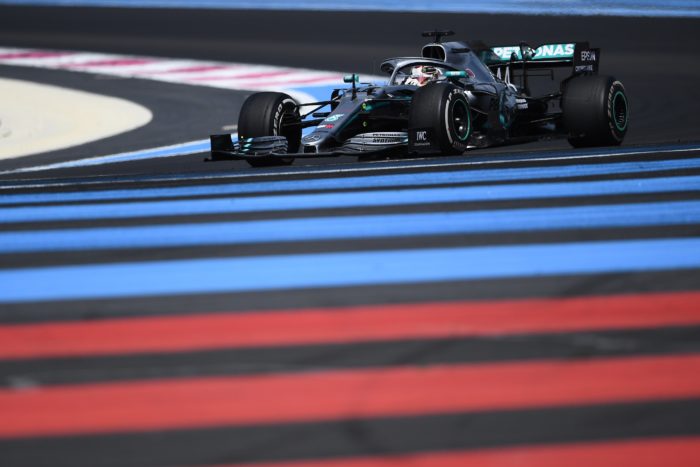
Damp squib or not, there is no denying Lewis Hamilton‘s brilliance at the front of the 2019 French Grand Prix.

It was all something of a walk in the park; albeit a hot, sweaty, tiring walk. Through the practice sessions, the balance of power had somewhat swung between himself and his teammate – Valtteri Bottas arguably even appearing to have the edge ahead of qualifying – but when it hit crunch time it was the reigning champion who delivered, as he so often does. An 18-second gap to 2nd place is an age in modern Formula 1. The mantra of winning as slowly as possible has become increasingly accepted, with the limit on engines meaning they are only used as much as is absolutely required. Hamilton’s lead in the championship is looking increasingly insurmountable.

Behind the two Mercedes, Charles Leclerc drove an excellent race to the final step of the podium, even closing and pressuring Bottas in the last couple of laps in what appeared to be an inferior car. Whilst his more experienced teammate, Sebastian Vettel, toiled – recovering from 7th to 5th after a poor qualifying – the young Monegasque shone. This was exactly the race he needed after a run of bad luck and costly mistakes had left him further back in the championship than was a true reflection of his quality. This was a very mature performance and one that will potentially turn senior Ferrari heads.

Vettel remains the de facto lead driver but, with it looking increasingly like Ferrari will not be involved in a serious title challenge this season, perhaps they’re better off letting their drivers fight and gaining Leclerc some valuable further experience.

Time Running Out For Gasly?

Whilst the locals were happy with quasi-French Leclerc’s podium, they must have been somewhat embarrassed by yet another lacklustre performance from their man at Red Bull. The Honda upgrade may not have made a noteworthy difference to the Red Bull performance but Max Verstappen still put in another solid performance to split the Ferraris and take another haul of points. Gasly, meanwhile, claimed one solitary point thanks to a 10-second penalty for Daniel Ricciardo.

Christian Horner recently made a pointed remark regarding Helmut Marko ‘softening in his old age’ but there are surely now discussions happening behind the scenes as to how you solve a problem like Pierre. The excuse of acclimatising to the car must be long gone but Gasly is still alarmingly far behind his teammate. Even with a softer tyre in Q2 than most of his competitors he only scraped into the top 10. How much longer can this continue? Daniil Kvyat was bumped down to Toro Rosso for far less… Admittedly with Verstappen crying out for his seat.

What saves Gasly could just be a lack of competition as it is surely too soon for Alexander Albon and there would be a significant slice of humble pie involved in re-promoting Kvyat…

A Renaissance in Papaya Orange

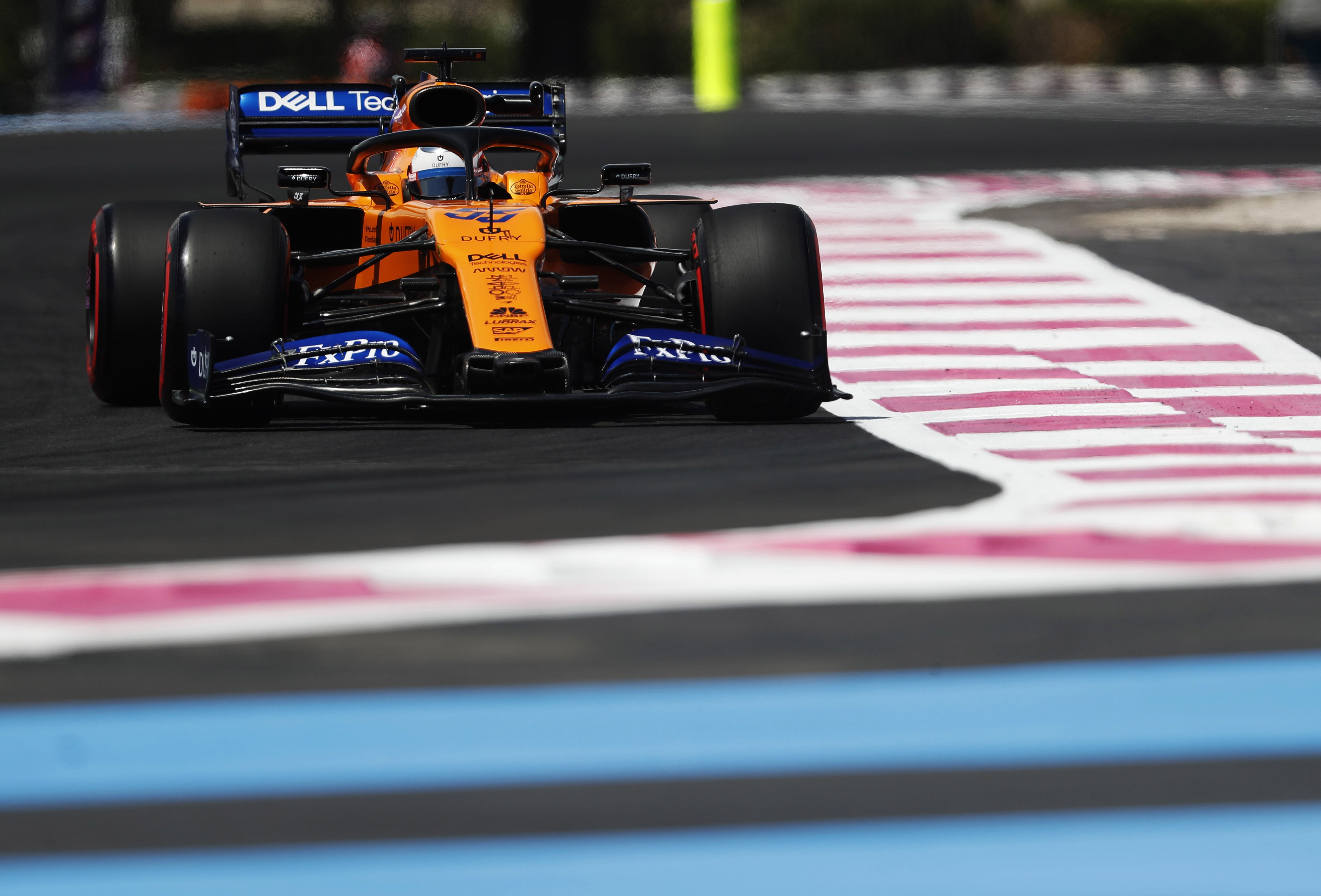
Carlos Sainz at the 2019 French Grand Prix.

The story of the weekend was arguably McLaren’s performance. 5th and 6th on the grid and out-qualifying the Ferrari of Vettel clearly meant a huge amount to the team as they celebrated on the pit wall. They had not expected to be particularly strong on this track after all. Coming into the weekend, all the attention had been on Renault’s upgrades and whether they could move clear of the midfield pack. But it was the other cars with the French engines that were to do so.

Come race day, the two orange cars held their own and looked comfortable for 6th and 7th – after Vettel had predictably passed them – only for Lando Norris to experience hydraulic issues in the closing stages of the race and agonisingly lose three places on the final lap. He regained one after Ricciardo’s penalty but 9th was not befitting of another excellent drive from the young rookie.

Nonetheless, this has been an excellent spell for the McLaren team. Their new Team Principal, Andreas Seidl, appears to be another solid addition to a much-improved leadership team as they continue their steady ascent towards former glories.

Championship Over?

With Mercedes seemingly having developed a car with no clear weaknesses this season and five-time world champion Hamilton hitting his stride, is the championship as good as done in June? The Briton has now opened up a 36-point gap over teammate Bottas after four wins on the trot. And the odds are he is just getting going.

Hamilton has generally always become stronger as the season progresses and he gets more comfortable with the car. Was Bottas 2.0 for real early in the season or was it just Hamilton getting his eye in? His new steely persona seemed to be visibly slipping as he crouched forlornly in the background after qualifying on Saturday and such a dominant performance one day later will surely have him wondering how, and if, he can compete with his illustrious teammate.

Image credit: LAT Images

Can the Finn make a fight of this championship still? The next race in Austria has been a strong one for him in recent years so he will really need to make the most of that. And maybe grow a 2nd beard?..

Oh and Ferrari…well, Vettel is now more than three clear victories behind Hamiton in the standings. I’ll leave it at that.

Answering the Burning Questions

Will Vettel’s penalty be overturned? Will the situation actually be resolved this weekend? No and yes, respectively. People even seemed to have moved on for the mostpart.

Can Bottas or Ferrari do something to reduce Hamilton’s momentum towards another title? Just a plain no for this one.

Can Renault’s aero upgrade help keep up the progress they’ve made in the last two races? McLaren stole their limelight but it was another decent race for the French team. Can’t say the upgrade made a noticeable difference though.

Will we have the same ridiculous trophy as last year? Yup. And a giant version of it next to the podium.

What effect will the new Honda engine have on Red Bull? Not much of one.

Will anyone make it through the race without a migraine from those stupid lines in the run-off area? I did, just about.

The French Grand Prix in 60 Seconds

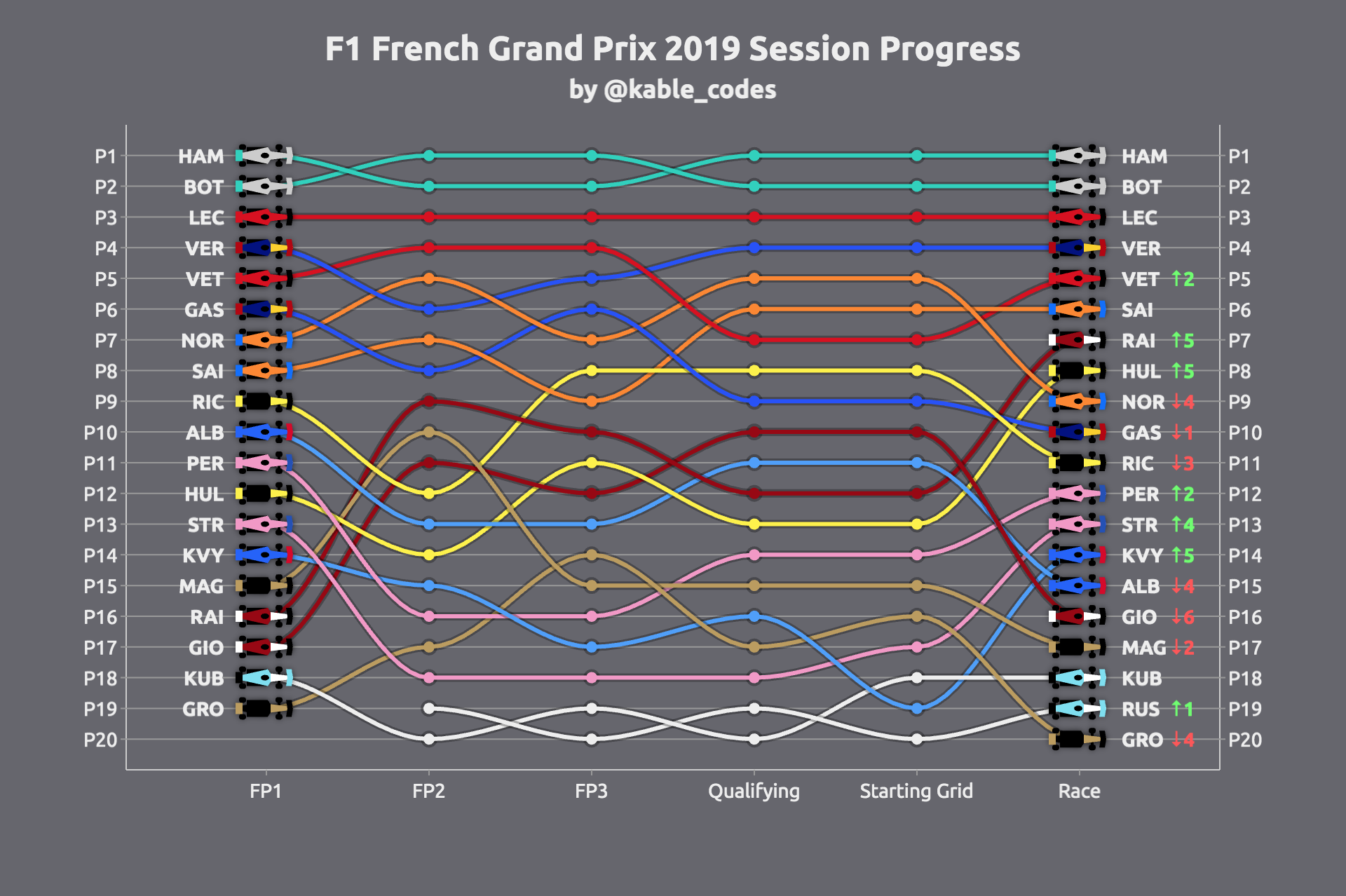
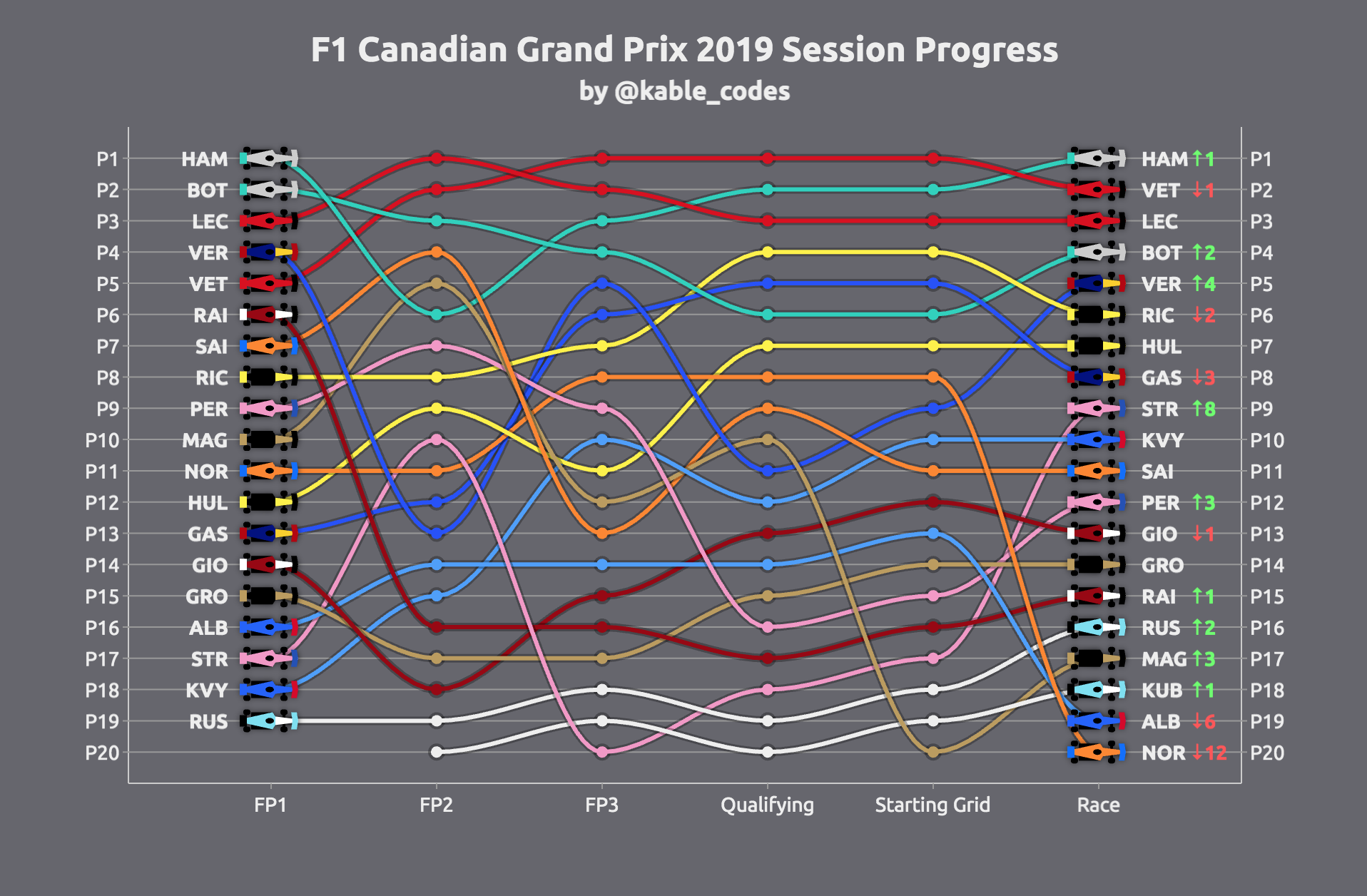
Session Progression

A Quick Public Service Announcement

I’m heading off to Glastonbury in the morning (to work in a smoothie stall for a week) so there will be a bit of radio silence. And next week’s report will probably be a day or two late.

See you on the other side.

2019 Canadian GP report | Hamilton wins…but that’s not the headline

A good race; a greater controversy.
Lewis Hamilton and Sebastian Vettel on the podium at the 2019 Canadian Grand Prix.
Image credit: Motorsport Images

Let’s get the basics out of the way. Lewis Hamilton claimed victory at the 2019 Canadian Grand Prix and Mercedes continued their clean sweep of wins.

However, it was in very controversial circumstances after Sebastian Vettel was given a five-second penalty for obstructing Hamilton as the German rejoined the circuit having ended up on the grass at Turns 3 and 4. More on that later. (In fact, most of the post will be about it as it’s all anyone is going to be talking about.) But firstly, let’s quickly address the rest of the race. (Feel free to scroll down if you’re only interested in the controversy…)

The front two were near enough in a race of their own throughout with Vettel’s teammate, Charles Leclerc, never quite in the fight and Hamilton’s teammate, Valtteri Bottas, a distant fourth. Leclerc will be pleased at least to bounce back from his eventful – for all the wrong reasons – home race two weeks ago with a solid podium but he still needs to work on his qualifying performances. Despite often looking the faster Ferrari through the practice sessions, he has made mistakes when it really counts and left himself with a lot to do on Sunday. Bottas unfortunately reverted to Bottas 1.0 and was never really on Hamilton’s pace all weekend. A very scruffy Q3, where he was lucky to escape the barriers after a spin, saw him start 6th. He then lost a position at the start, spent numerous laps stuck behind slower cars and is now 29 points behind his teammate in the standings.

Daniel Ricciardo continues to look more and more at home in the Renault, demonstrating his late-braking talents – which he had seemed to be struggling to dial in to his new car at the start of the year – to keep Bottas behind him for far longer than he had any right to. The Honey Badger ended the race a commendable 6th and was followed home by the sister Renault of Nico Hülkenberg to complete an excellent weekend for the French team on a track at which they had not expected to be all that successful.

Max Verstappen recovered well to 5th after unfortunate timing with a red flag in Q2 left him starting 9th on the grid, whilst teammate Pierre Gasly’s struggles continued as he went in the opposite direction, from 5th to 8th. Lance Stroll had an excellent home race, progressing from 17th on the grid to finish 9th, claiming two well-deserved points to silence some of his critics, at least for a while. And finally a quick mention also for the unfortunate Lando Norris, whose rear suspension seemingly melted thanks to severely overheating brakes – something I have never seen before in the sport – which put paid to a very promising race for the youngster. His car unusually left stranded at the side of the pit exit – because it was not in a dangerous position – evoked memories of the 90s where broken cars would be scattered around the track, abandoned. And of course he used his retirement to produce yet another meme.

What We’re All Here to Talk About

Now then. Where to begin…

What Happened

In arguably the battle of the year so far, Hamilton had been right on the tail of his long-term rival for some time. After the pit stops, he quickly closed a five-second gap and then began pressuring Vettel in what was shaping up to be a thrilling fight to the end of the race. We had already had nine laps of this when Vettel made a mistake under pressure – certainly not his first – and overcooked his entry into Turn 3, catching a snap of oversteer but in the process having to take to the grass.

Lewis Hamilton and Sebastian Vettel during the defining moment of the 2019 Canadian Grand Prix.
Image credit: LAT Images

This is where the controversy occurs. Vettel rejoined the track very close to Hamilton, who tried to go around the outside but then backed out as he was squeezed towards the wall. Hamilton came on the radio to say that Vettel had rejoined the track dangerously – understandably so when you see the incident from his on-board camera – and after a few minutes of investigation, the stewards handed Vettel a five-second time penalty. With that, the race effectively died. Whilst Hamilton states he continued to try and pass for the remaining laps, and to his credit he certainly didn’t just sit three or four seconds back and coast home, there was no real need for him to take any risks.

Vettel spent the remainder of the race understandably fuming and then, in bizarre scenes, parked his car as far as he could from the designated spot in parc fermé and stormed off to Ferrari hospitality, before being fetched by an official and his media adviser. He then returned for the podium via the Mercedes garage and a brief stop to switch the number boards, placing the ‘number one’ in front of the space where his car would have been and the ‘number two’ in front of Hamilton’s car. Credit where credit’s due: that is a baller move.

Now. For 95% of people, at least judging by social media, this appears to be a slam dunk and not up for debate; it was totally the incorrect decision and a huge injustice for the Ferrari driver. But as I see it – and I have looked into this in massive depth over the last 24 hours – it’s a closer call than that. There are many aspects to examine in little over a second of action and then many different ways to interpret the minutiae. Every point has a caveat and I could easily follow most of the following sentences with a ‘but’ or a ‘however’…and in fact I do a fair few times. Let’s start with the fundamentals: the rules.

The Rules

Here are two pertinent regulations.

The first: “Should a car leave the track the driver may rejoin, this may only be done when it is safe to do so and without gaining any lasting advantage.” Removing this from the bigger picture, putting it plainly in black and white, Vettel did return to the track in an unsafe manner and he did gain a lasting advantage in that if he’d rejoined more slowly and safely, Hamilton would have passed him. Only he didn’t really have the opportunity to do so. He was simply trying to recover control of the car the entire time he was on the grass and in the split second which followed on the track. The first time he checks his mirrors is around the point at which Hamilton had to bail out. Having said that, it’s down to his mistake that he is in that position so why should Hamilton be the one to suffer? (See what I mean about the caveats?..) As Hamilton put it, “I was just driving the normal line so I shouldn’t have been in the position of being close to crashing. It was his responsibility to avoid that, but it ended up being mine. So because of that I lost a chance of passing”.

The second: “Manoeuvres liable to hinder other drivers, such as deliberate crowding of a car beyond the edge of the track or any other abnormal change of direction, are strictly prohibited.” Similarly, whilst Vettel was not in control and thus the ‘deliberate’ aspect can be ignored, Hamilton was certainly hindered. But, by definition, a manoeuvre is ‘a movement requiring skill’, so surely not being in control means this can’t be classed as one. Either way, it has now come to light that a large part of the stewards’ decision came from Vettel’s movements after regaining control. Their data shows that, after checking his mirror, he opened the steering to move towards the edge of the track. Certainly a manoeuvre this time but up for debate whether, by that point, it was impeding Hamilton.

It all boils down to what each fan or member of the F1 paddock wants from the rules. They are a necessary evil. Remember how angry everyone was when Verstappen came on the scene and repeatedly exploited loopholes to defend dangerously? There have to be lines somewhere and, once those lines are drawn, surely they have to be enforced. The gravity of the situation shouldn’t be a factor. If this had happened between Sergio Pérez and Antonio Giovinazzi for 12th place, there is less at stake, and people obviously wouldn’t feel as passionately, but does that mean that the situation should be ruled differently?

Precedent

The bigger picture here is the consistency of rulings. Whilst most fans immediately stated that they are inconsistent, an almost identical incident between Verstappen and, ironically, then-Ferrari-driver Kimi Räikkönen at last year’s Japanese Grand Prix also brought about a five-second penalty. At the time, most seemed to go with the opinion of harsh but fair, and Ferrari obviously thought so. Vettel himself said “Look at Kimi. [Verstappen]’s off the track and he comes back and if Kimi just drives on they’d collide. But it’s not always right that the other guy has to move.” Sound familiar? The late, great Charlie Whiting described it as “a fairly straightforward one for the stewards”.

Here comes another caveat though. There was also a pretty similar incident between Ricciardo and Hamilton at Monaco in 2016 which was not penalised. This one was also for the lead of the race so had the same gravitas as Vettel and Hamilton’s incident. Did that factor in to the decision? Only the stewards will know. At the time, some certainly thought he was lucky to get away with it.

Just one more point to add to this already perplexing and convoluted mire I’ve created. Hypothetically, if Hamilton had kept his foot in and they had both ended up in the wall, what penalty, if any, would fans have expected to be dished out?

An Attempt at a Conclusion

So this is the crux of the matter. Did Vettel rejoin the track in an unsafe manner and cause Hamilton to take avoiding action? Yes. Did he have any control of that once off the track? No. Was it his fault he was off the track and thus out of control? Yes. This could go on and on, further down the rabbit hole.

We as fans have to accept that the stewards have far more information than us to base their decisions on and that they are more experienced than 99% of us. But it would be far easier to do so if there were a consistent panel of respected figures who were accountable and then came out and explained exactly how and why they came to their decisions. Surely that’s not too hard for the senior leaders to put together. The fact that the crowd ends up booing Hamilton – surely an innocent party in this whole debacle – in the absence of anywhere else to direct their anger, is a real shame.

It is hard to come to a definitive conclusion. I remain somewhat on the fence. I am fully for hard racing but I also understand that there have to be rules and, with the rules that we have currently, I can see why they came to the decision that they did. In this instance, they have applied the letter of the law rather than spirit of the law. The bigger question is whether the rules need to be amended. Generally this year the stewards have been more lenient and the public and pundits have seemed happy with it.

I guess it depends whether Liberty Media want the headlines to come from the racing or the controversy. As, if we can be certain about one thing in all this, it is that more lenient stewarding would have resulted in a far better end to the race.

Well, that and the days of ‘Ferrari International Assistance’ being long gone.

Answering the Burning Questions

(I guess I should still answer these…)

Will the track really favour Ferrari as predicted? We’ve heard that a few times this year.. Yes, for once the top two teams were evenly matched.

How much of an improvement will the Mercedes engine upgrade provide? Not a significant one seemingly. Also, one of them blew up…

Will the Wall of Champions claim any new victims? Kevin Magnussen had a brush with it but properly crashed on the other side of the track. And isn’t a champion anyway.

Can Bottas continue to get on top in qualifying or will Monaco prove a turning point? It’s looking more like the latter.

Will Leclerc bounce back from his less-than-ideal home Grand Prix? It was certainly an improvement, if not a great weekend.

Session Progression

2019 Monaco GP report | Hamilton takes emotional victory

Niki would be proud.
Lewis Hamilton and Sebastian Vettel at the 2019 Monaco Grand Prix.
Image credit: Getty Images

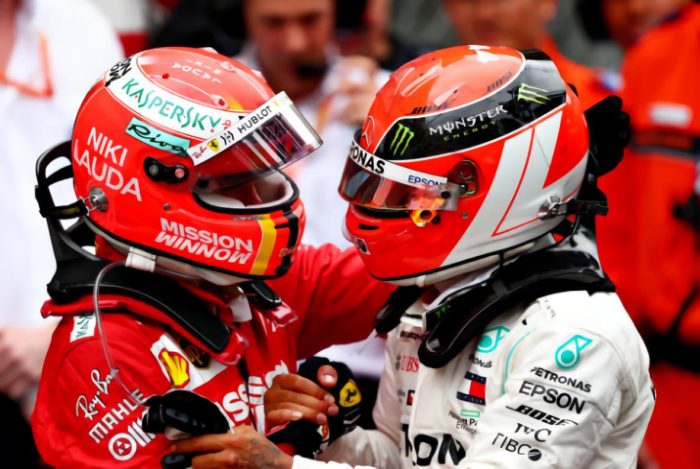
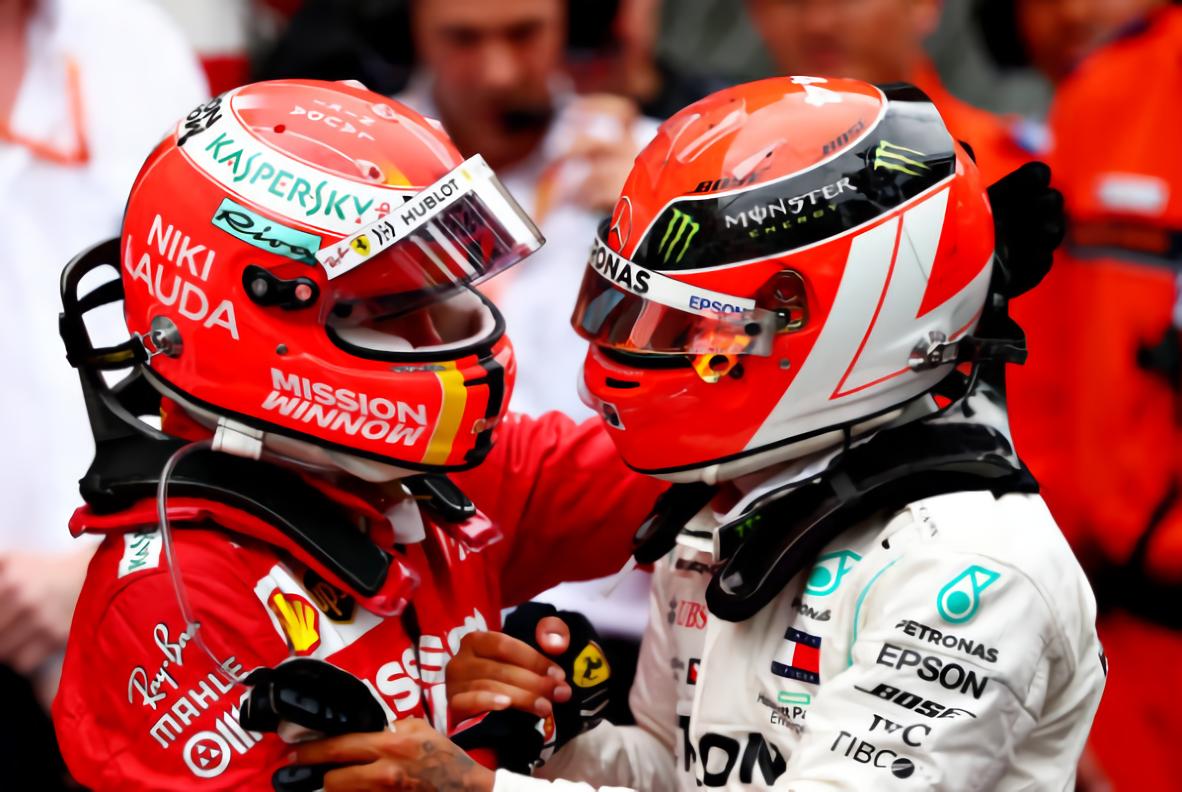
The run of Mercedes 1-2s finally came to an end at the 2019 Monaco Grand Prix, to be replaced by a Niki Lauda 1-2.

Lewis Hamilton took the victory in a McLaren-era Lauda helmet, followed (once Max Verstappen’s penalty had been applied) by the Ferrari-era Lauda helmet donned by Sebastian Vettel. It was a very fitting result for what was always going to be a poignant, somewhat muted Monaco Grand Prix weekend – a dampener put on all the glitz, glamour and indulgent festivities that the Monte Carlo race usually brings.

Whilst Monaco is often accused of being a procession, this was certainly no walk in the park for Hamilton. After an early safety car – brought out by Charles Leclerc’s gingerbread trail of bits of tyre and Ferrari floor – Mercedes placed their drivers on the medium tyre whilst Verstappen and Vettel went for the harder option. Verstappen and Valtteri Bottas then collided in the pit lane, leaving the former with a five second penalty and the latter needing to come in due to the damage. At this point, Mercedes changed Bottas to the harder tyre and Hamilton came to the realisation that he was facing the prospect of nursing his tyres for 67 laps with cars attacking him on better-suited rubber.

Toto Wolff later admitted that this was a rare strategic mistake from Mercedes, although their decision was justifiable at the time. They were wary of being jumped after the safety car if their competitors were on softer tyres, the hard tyre had proved tricky during practice and there was also the prospect of rain – sadly, for the spectacle, it never materialised beyond some light drizzle – with the medium the better tyre for damp conditions. It is always tricky to be the lead team in these situations as those following can react to your decisions.

Either way, Hamilton succeeded in fending off the increasingly aggressive Verstappen, who knew that second place would turn into fourth after the penalty if he could not pass, for a victory of perseverance and fighting against the odds. Everything that encapsulated Niki Lauda.

More Ferrari Woes

It was yet another tale of blunders from both team and drivers for Ferrari. They had looked well off the pace during the Thursday practice sessions but found some speed on Saturday morning with Leclerc topping the timesheets. Only for the sister car of Vettel to end up in the wall at Sainte Devote. The engineers did a good job to get it repaired in time for qualifying but that’s where things really started to unravel.

Vettel’s first attempt in Q1 left him in the drop zone. Leclerc also had a scrappy lap which was only 0.2 seconds quicker than his teammate’s but the team decided to try and save tyres by not sending him out, despite their driver’s repeated questioning of that decision. So the young Monegasque had to sit and watch from the garage as ‘LEC’ fell further and further down the timings screen, before being finally knocked into 16th, and out of qualifying, by Vettel of all people.

In the face of some trying times – particularly having victory cruelly snatched away in Bahrain – Leclerc has remained calm and said all the right things. But here, he was visibly furious. Monaco is his home race after all and he knows as well as anyone that passing around the Principality is almost impossible. He decided to go with an all or nothing approach on Sunday. Sadly it was to be the latter as, after an excellent pass on Romain Grosjean at La Rascasse the lap previously, Nico Hülkenberg proved to be less accommodating and Leclerc clipped the barrier. This left him with with a puncture which resulted in terminal damage to the car as he returned to the pits far too fast, clearly having reached the end of his tether.

Meanwhile Vettel, after a scruffy remainder of the qualifying session where he touched the barriers twice, did at least bring home second place come race day. Bizarrely Ferrari’s best result of the year despite the weekend as a whole feeling very much a failure. There is still a long way to go before the systematic issues in Ferrari’s operations are ironed out.

Sainz Continues to Excel Under the Radar

I have, for a long time, felt that Carlos Sainz is criminally underrated.

This is a driver who generally matched Verstappen in their time together at Toro Rosso. The Dutchman scored more points and was more spectacular but Sainz beat him in their qualifying head-to-head before suffering poor luck on race days for the most part.

Whilst Verstappen was hurried up the Red Bull ladder, Sainz’s career stalled somewhat as he spent season after season with Toro Rosso. He finally got his move to Renault towards the end of 2017 but there was to be more bad luck on race days and a very in-form teammate in Nico Hülkenberg. The German scored more points and many seemingly wrote off the still very young Sainz, despite the fact that the Hulk is no slouch, was fully settled in the team and, apparently, Sainz never particularly got on with the Renault’s handling.

Image credit: AFP

But this year, he has a clean slate. He has taken the seat of his boyhood hero, Fernando Alonso, at McLaren and is now finding his feet. After some misfortune and a poor decision to try and squeeze Verstappen that cost him an excellent result in Bahrain, Sainz has really started to perform, culminating in an excellent drive to sixth in Monaco. It also included what Sainz described as “the best move of my career” as he opportunistically carved round the outside of both Toro Rossos at Massenet on Lap 1.

Up against a highly-rated rookie in Lando Norris, Sainz seems to be relishing the role of team leader and it will be interesting to see whether both he and McLaren can continue their progress towards the front of the grid. Maybe we’ll see him back fighting regularly with Verstappen soon enough.

One Very Important Moment Swept Under the Rug

Not broadcast by FOM, a marshal was centimetres from being injured, or even killed, on Sunday.

The marshals at Monaco are generally accepted as being some of the best in the world. In the most constricted surroundings on the calendar, they have always dealt with incidents impressively quickly and efficiently. But it must be remembered that they are volunteers following orders. And when those orders result in a situation like this, Sergio Pérez doing well to keep his head and narrowly avoid two marshals crossing his path, the situation must be examined.

The Monaco Grand Prix in 60 Seconds

Answering the Burning Questions

Surely Mercedes can’t claim another 1-2?! It looked like it was heading that way after qualifying but they’ll have to settle for a lowly 1-3 this time.

Can Max Verstappen keep it out of the wall this year? He can.

Something of a Monaco expert, and on a track with less engine-dependence, can Daniel Ricciardo spring a surprise? An excellent performance in qualifying but poor strategy stifled his race somewhat.

Will Charles Leclerc’s home knowledge see him outclass his teammate? He had seemed the faster driver through practice but Ferrari’s error left him in a different race. A race that, as it transpired, did not last long.

It’s currently due to rain at some point over the weekend…could we have a classic Monaco race rather than a procession? It wasn’t a classic but it was at least a tense procession. Maybe rain next year?..

Walking away from a big team

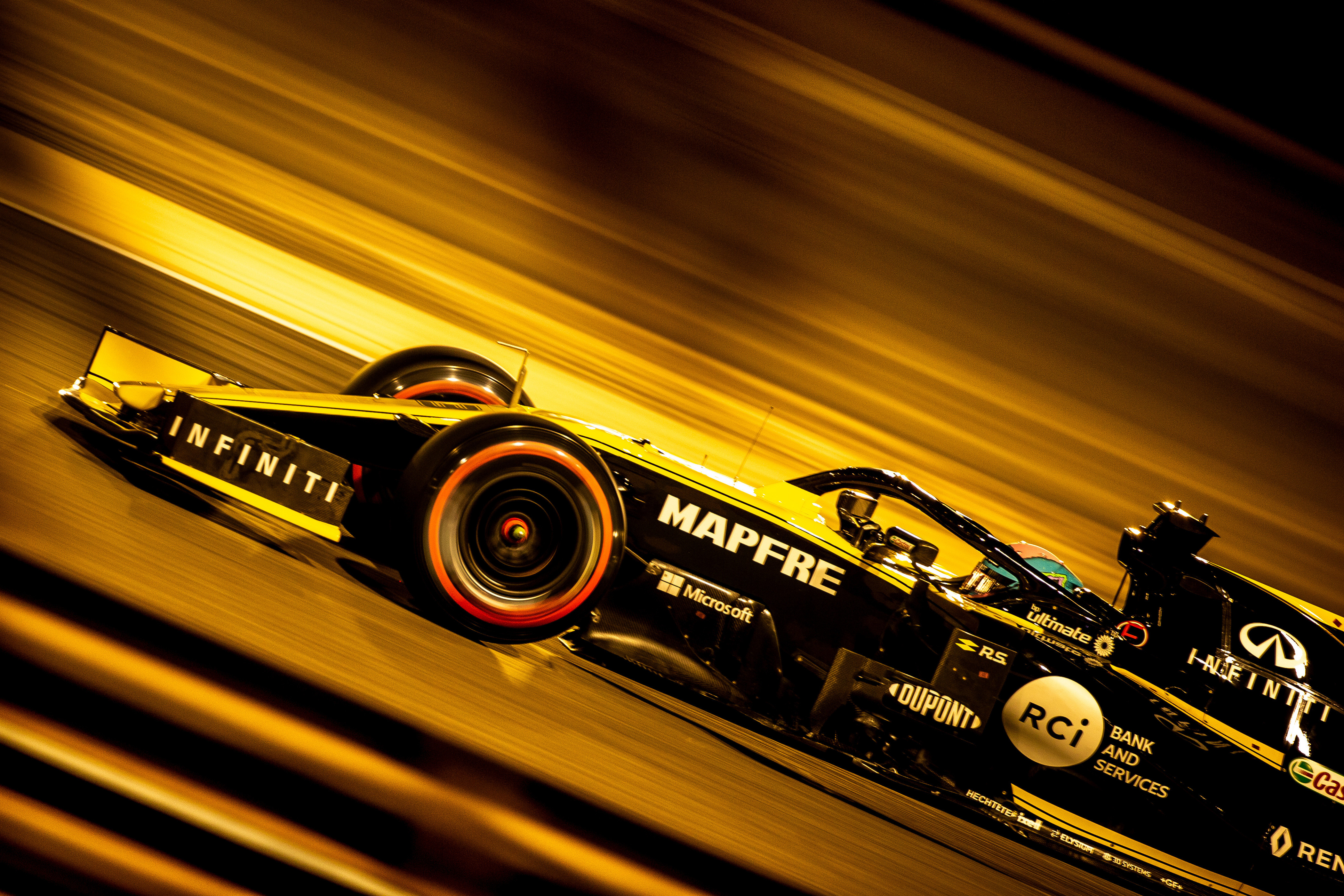
Daniel Ricciardo driving a Renault in 2019.
Image credit: XPB/James Moy Photography

In honour of Daniel Ricciardo‘s first points for Renault, this is a piece on the history of established, successful drivers leaving established, successful teams and how it worked out for them.

I’m only discussing drivers who left of their own accord – or at least as best we can tell without knowing all the ins and outs – so moves such as Damon Hill’s from Williams to Arrows in 1997 as world champion won’t be included. The 50s had a far more fluid driver-team dynamic; for example, Juan Manuel Fangio regularly changing teams depending on which he thought had the best car at that time. So let’s begin in the 60s.

Results are mixed.

Jack Brabham | 1962 | Cooper > Brabham

Jack Brabham won back-to-back championships with Cooper in 1959 and 1960 but during the second of those seasons was already becoming convinced that he could produce a better car himself, particularly once having helped design the T63 that took him to the championship. After a poor showing from Cooper in 1961, Brabham left to start the team this bore his name.

The first few years were not successful. His team suffered poor reliability, not helped by Brabham’s reluctance to spend money, and in 1965 he was beginning to consider retirement. He handed his car over to several other drivers and the lead-driver role to Dan Gurney. During that season, Gurney took the team’s first win but then announced he was leaving to start a team of his own and so Brabham decided to continue.

It was a good decision. Largely thanks to an inspired decision regarding the new engine regulations, 1966 saw Brabham win his third world championship. And in doing so, became the only man to win the world championship in a car that carried his own name. A record that still stands and likely will for a long time.

Success? Definitely.

Emerson Fittipaldi | 1976 | McLaren > Copersucar

Titles in 1972 with Lotus and 1974 with McLaren saw Emerson Fittipaldi become the youngest double world champion in the history of the sport. A record that lasted more than two decades until Michael Schumacher‘s second title in 1995. Fittipaldi finished the 1975 season as runner-up to the Ferrari of Niki Lauda before shocking the F1 world by announcing he was leaving McLaren for Copersucar – a team funded by a Brazilian sugar marketing company and run by his brother, Wilson.

13th place on his debut set the tone for the venture, however. The Brazilian never won again and managed only two podiums in the remainder of his career, staying at the team until retiring at the end of 1980. He moved into management of the team but it folded in 1982.

Meanwhile, James Hunt won the 1976 world title in the seat Fittipaldi had vacated…

Success? Definitely not.

Niki Lauda | 1978 | Ferrari > Brabham

Niki Lauda’s relationship with Ferrari never really recovered from his decision to withdraw from the crucial Japanese Grand Prix of 1976. Having recently returned from his horrific crash at the Nürburgring and in appalling weather conditions, Lauda said “my life is worth more than a title”.

The following year, despite Lauda comfortably winning the championship, tensions continued to grow. The title was won due to consistency rather than outright pace and Lauda disliked his new teammate, Carlos Reutemann. He said he felt let down by Ferrari for them putting extra pressure on him and announced his decision to quit.

He moved to a Brabham team that had struggled for most of the 1970s and sadly for the Austrian not much was to change during his two years there, with unreliability a major issue. That was except for one race and one infamous car – the Brabham BT46B. A radical design that became known as the ‘Fan Car’. It won its first and only race but was never used again; other teams vigorously protested its legality and team owner Bernie Ecclestone did not want any legal complications whilst he worked on his acquisition of the sport’s commercial rights.

At the end of 1979, Lauda retired, stating he had “no more desire to drive around in circles”. He would return in 1982 with McLaren, however, and win the world championship in 1984.

Success? Not at Brabham but the decision was understandable and he got his third title in the end.

James Hunt | 1979 | McLaren > Wolf

Things went steadily downhill for James Hunt at McLaren after winning the 1976 World Championship. His title defence derailed early in the season due to problems with the new car and, whilst that season ended reasonably well, 1978 was a disaster. Lotus had developed very effective ‘ground effect’ aerodynamics and McLaren were slow to respond. The car was eventually revised midway through the season but it did not work. This, along with the death of his close friend Ronnie Peterson, crushed Hunt’s motivation.

Despite a poor 1978, Hunt was still very much in demand. He turned down an offer from Ferrari, due to their complicated political environment, electing instead to move to Walter Wolf Racing. A team which had won its very first race and powered Jody Scheckter to second in the world championship in its first season. However, the team’s ground effect car was uncompetitive and unreliable.

Hunt retired from six of the first seven races and, after the Monaco Grand Prix, announced his immediate retirement from the sport. He could only watch on as Scheckter won the championship in the Ferrari seat he had turned down.

Comebacks almost transpired. First as a replacement for the injured Alain Prost in 1980 but Hunt broke his leg whilst skiing. Then in 1982 he was offered a drive at Brabham by Bernie Ecclestone but turned it down. And even in 1990, at least somewhat due to financial troubles, Hunt considered a comeback with Williams – testing a modern car but running several seconds off the pace.

Success? No. But leaving McLaren was less the issue than turning down Ferrari.

Nelson Piquet | 1988 | Williams > Lotus

Despite winning the title in 1987 at Williams, Nelson Piquet became obsessed with his feeling that he was not being given the undisputed number one driver status he claims was promised to him by the team. Even going as far as saying they actually favoured Nigel Mansell. And so he left for Lotus, having been promised the status he craved there.

Honda, who paid most of his salary, were unhappy with Williams and moved their engines along with the Brazilian. McLaren, also with Honda power, then dominated the next two seasons. Lotus were stagnating and Piquet himself also wasn’t performing. It could be that he was never the same driver after a bad concussion suffered in a crash the previous year, but he significantly harmed his reputation and resorted to attacking his rivals via petty comments in the media.

He later moved to Benetton and won three races in two seasons but never again challenged for the championship.

Success? No and dragged his former team down with him too.

Michael Schumacher | 1996 | Benetton > Ferrari

You could argue that moving to Ferrari is never going to be that much of a risk, certainly compared to some others on this list. But Michael Schumacher left Benetton as the constructors’ champions, having won back-to-back titles himself with them, for a Ferrari team that hadn’t won a drivers’ title since 1979 and had only won two races in the past five seasons.

But Schumacher had grown tired of the way Benetton was run and wanted both an increased salary and a new project.

He got both and we all know how the next decade with the Scuderia played out. After a few years of near misses (or distinctly not missing Jacques Villeneuve’s Williams and subsequently being disqualified from the 1997 season), Schumacher dominated the early 2000s, winning every title available between 2000 and 2004.

Fernando Alonso then arrived and dethroned him with the seven-time champion retiring at the end of 2006. A brief return to the sport with Mercedes in 2010 produced just one podium but Schumacher will always be remembered as the dominant force in Ferrari red.

Success? The success story.

Jacques Villeneuve | 1999 | Williams > BAR

After winning both championships in 1997, Williams had a strange title defence, both in terms of livery – in red for the first time – and performance, without a single win. They had been hampered by the underpowered Mecachrome engine and Villeneuve decided to join the newly formed BAR team for 1999. That decision was also certainly swayed by his friend and personal manager, Craig Pollock, who partly owned the team.

They had lofty ambitions and made boastful claims of winning the championship in their debut year. Claims that ultimately became embarrassing when they failed even to score a point, Villeneuve setting an unwanted record of failing to finish the first 11 races of the season.

During the four seasons that followed, BAR improved somewhat but never enough to take a win. Pollock was sacked in 2002 and, after being outpaced by a young Jenson Button in 2003, Villeneuve left the team. Without a drive, he was forced into a sabbatical before returning for three races with Renault at the end of the year but was off the pace.

He eventually retired from F1 during the 2006 season, whilst racing for BMW Sauber, having effectively been replaced by Robert Kubica after refusing to be part of a potential ‘shoot-out’ with the Pole.

Success? Not at all. A career that nose-dived.

Lewis Hamilton | 2013 | McLaren > Mercedes

When Lewis Hamilton announced he was moving from McLaren to Mercedes for the 2013 season, there were not many that thought it was a wise decision. McLaren were serial winners and, whilst the last few seasons had seen them second or third best, with Red Bull dominant, Mercedes had generally been also-rans since returning to the sport in 2010. But Niki Lauda had convinced Hamilton that it was a wise decision. And boy, was he right.

There was a solid first season with a victory and fourth place in the championship. But then in 2014, having spent years preparing for the new regulations and hybrid engines, Mercedes produced a car that was in a different league to the rest and Hamilton himself found a new level of excellence.

How certain he, or Lauda, were of the Silver Arrows’ impending dominance is up for debate. But Hamilton’s place now amongst the greats is not. He has won four of the last five titles, narrowly losing out to teammate Nico Rosberg in 2016 after a season plagued with unreliability, and is closing in on Schumacher’s all-time records. Records that most thought would never be threatened.

Whether or not, he can pass those records, Hamilton undeniably made the correct career move. McLaren have not won a race since he left.

Success? If Schumacher is the success story then Hamilton is well on his way to replicating that story.

Fernando Alonso | 2015 | Ferrari > McLaren

Fernando Alonso could arguably be on this list on more than one occasion. At the end of 2007, he left McLaren, after the most dramatic and political of seasons, to return to Renault. Alonso won just two races in two seasons there, but his second spell with the French team had only ever been a stopgap on his journey to Ferrari.

He succeeded in joining the Scuderia in 2010 and came agonisingly close to titles in both his debut year and 2012. Poor strategy in the final race put paid to his hopes in 2010 and then, in 2012, Alonso drove arguably one of the best seasons in the history of the sport, regularly dragging an underperforming Ferrari to places it had no right to be but agonisingly lost out to Sebastian Vettel by three points, once again at the final race.

The Spaniard became disillusioned, doubting he would ever be provided with a truly title-winning machine, and made a decision that stunned the sport – to return to McLaren.

In 2008, Alonso ever rejoining McLaren would have seemed unthinkable. Indeed, it still did to most in 2014. But McLaren had linked up with Honda on their return to the sport and Alonso dreamed of emulating his hero, Ayrton Senna, and winning in a McLaren Honda.

Sadly, it was not to be. Honda struggled to catch up with the other engine manufacturers, stifled by massively complex technology and McLaren’s strict regime, and Alonso spent the remainder of his career once again dragging the car to places it had no right to be. But now that was the top ten, rather than the top of the podium.

Success? Alonso’s career decisions have almost become a running joke within the sport. The guy just couldn’t pick the right path. A story of what could have been.

Daniel Ricciardo | 2019 | Red Bull > Renault

Daniel Ricciardo worked his way through the Red Bull junior system, progressing to Toro Rosso in 2012 and then being promoted to the big boy seat in 2014, promptly putting the reigning four-time world champion, Vettel, in his place. Ricciardo beat him fair and square and, when Vettel left the team at the end of the season, he became the team leader.

He then spent the last four seasons picking up plucky wins against the odds and pulling off audacious overtakes from way too far back, or “licking the stamp and sending it” as he’d put it. But the ever-likeable Aussie came to feel that Red Bull were beginning to favour their new golden boy, Max Verstappen, and decided to throw the dice with a move to Renault.

Only time will tell how he will compare to the others on this list. It could be an inspired move like Hamilton or a failed experiment like Villeneuve. Renault certainly have the aim of breaking into the current top 3 in years to come and there are new regulations coming in 2021 that could change the playing field completely.

We will just have to wait and see which part of that field Renault end up in.

Success? TBC.