2022 British GP report | A race that deserved its own article

It’s rare that I manage to find the time to do a race report these days, but the British Grand Prix was one that very much deserved a report of its own.
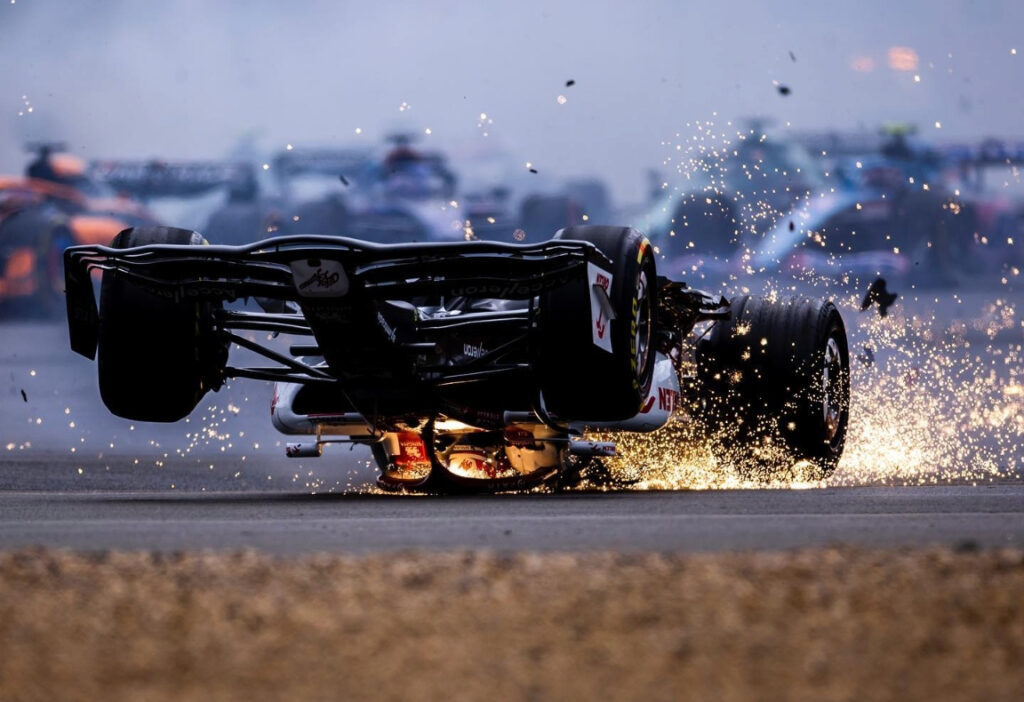
Image credit: vladimirrys

The suspicions of the paddock that Mercedes could find themselves closer to the sharp end on the smooth Silverstone surface looked to be confirmed through Friday, but Saturday saw the form book thrown out of the window as a bit of traditional English summer rain soaked the circuit.

Max Verstappen spent much of the session on top of the timesheets and seemed to have the most outright pace. However, he had numerous spins and off-track moments, including on his final lap, which allowed Carlos Sainz to grab his maiden pole position.

Charles Leclerc also had a moment on his final lap and Lewis Hamilton – who had been threatening to send his home crowd into raptures with an unlikely pole – was told to do a cool down lap at the wrong time and ended up down in fifth.

It was mostly blue skies come Sunday. But the festival atmosphere around Silverstone would suffer a blip immediately after the lights went out, as the crowd watched the Alfa Romeo of Zhou Guanyu fly into the barriers upside down before flipping over them and becoming wedged next to the armco.

Astonishingly – and thankfully – he was unharmed.
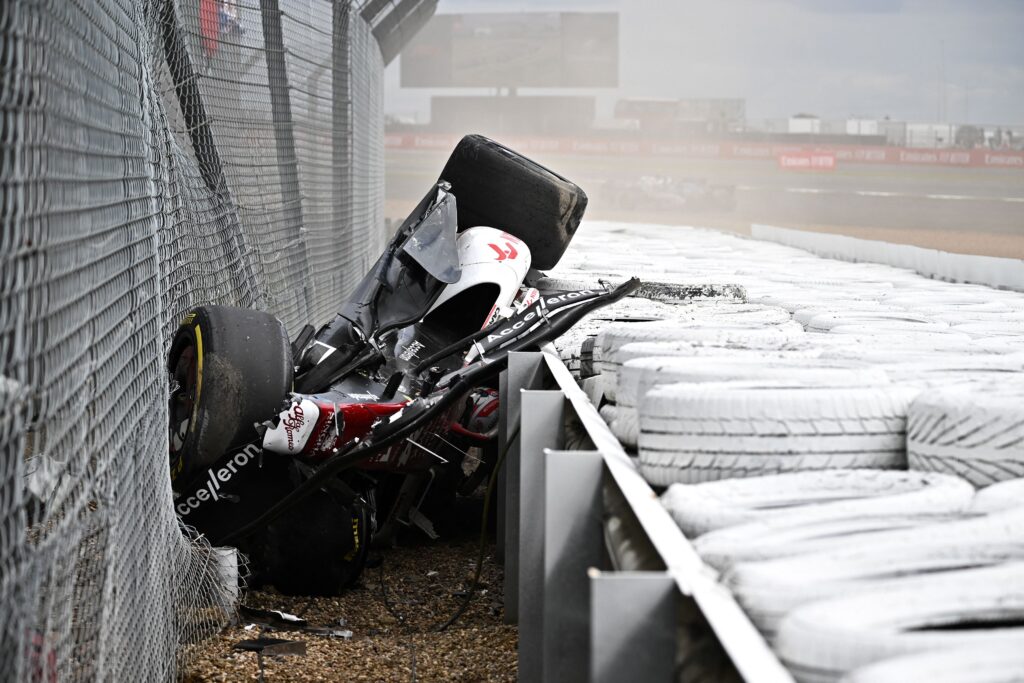
Image credit: AFP

The incident had produced a chain reaction that saw Zhou, George Russell and Alexander Albon all unable to take the restart an hour or so later, thus ending the top-five finishing run of the Brit.

When the lights went out for a second time, Sainz defended hard to keep his position ahead of Verstappen. Slightly further back, Leclerc made an optimistic lunge on Sergio Pérez which saw them both sustain wing damage.

The Mexican proved to have more of an issue and was forced to pit, allowing the other two Brits – Lando Norris and Hamilton – through.

Norris had jumped his more experienced compatriot on the first lap, but Hamilton soon found his way back past and set about hunting down the top three.

A mistake from Sainz through the infamous Maggots-Becketts-Chapel complex allowed Verstappen into the lead, but just two laps later, the Red Bull was losing speed and Verstappen pitted with what he suspected to be a puncture.

His suspicions would prove to be wrong, though, damage to his floor done by a stray piece of AlphaTauri bodywork meaning he was in for a long afternoon of damage limitation.

Despite his front wing damage, Leclerc closed in on his teammate and gave Ferrari a difficult decision to make. Hamilton was the fastest man on the track behind them and Leclerc wanted to be released.
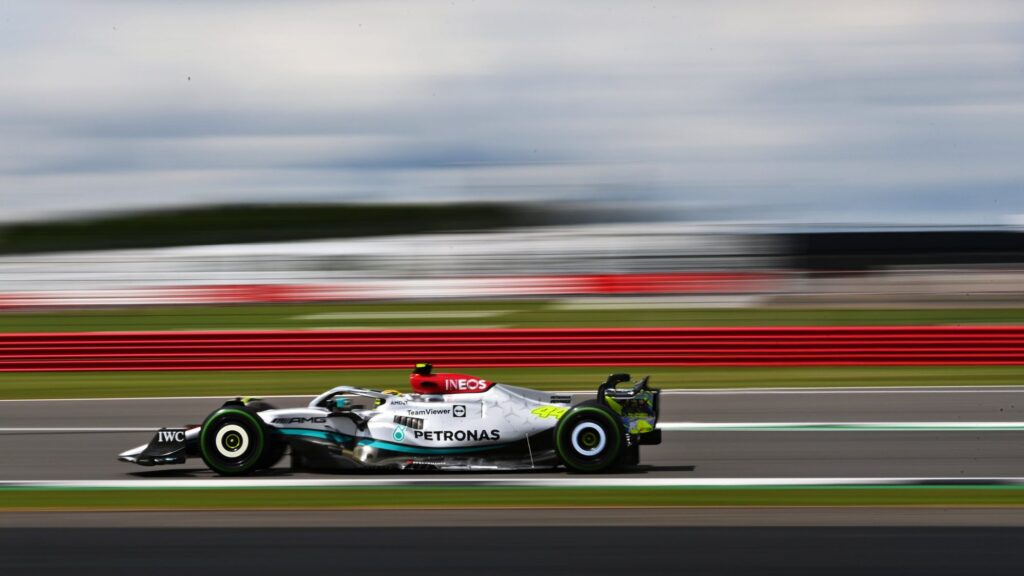
Image credit: Sutton Images

Ferrari chose to solve the situation by pitting Sainz slightly early. Leclerc’s pace did improve but Hamilton continued to close in and the second prancing horse was brought in soon after.

Hamilton remained out, continued to set impressive times whilst extending his stint and gave even the most pessimistic of his loyal fans a little hope of ending the joint-longest winless streak of his career.

Once again, the two red cars had met on the track, and this time, with Sainz unable to produced the requested lap times, he was asked to move aside by the team.

After pitting on lap 33, Hamilton began closing in with a considerable tyre advantage, but – yet again – a Safety Car was to be unkind to him.

It would be no kinder to the equally unfortunate Leclerc.

As Esteban Ocon ground to a halt on the former pit straight, Ferrari were given a decision to make once again.

They chose – somewhat astonishingly – to pit Sainz but leave Leclerc out. Hamilton followed suit, as did Pérez, who benefitted most from a free pit stop after having recovered to fourth.

The race got back underway with 10 laps remaining and Leclerc was left with an unenviable task of defending on worn, hard tyres against a string of fast cars equipped with brand new softs.

He survived barely a few corners before Sainz was past. Behind them, Pérez also passed Hamilton as the Mercedes took longer to heat up its tyres.

What followed was some of the best battling in years.
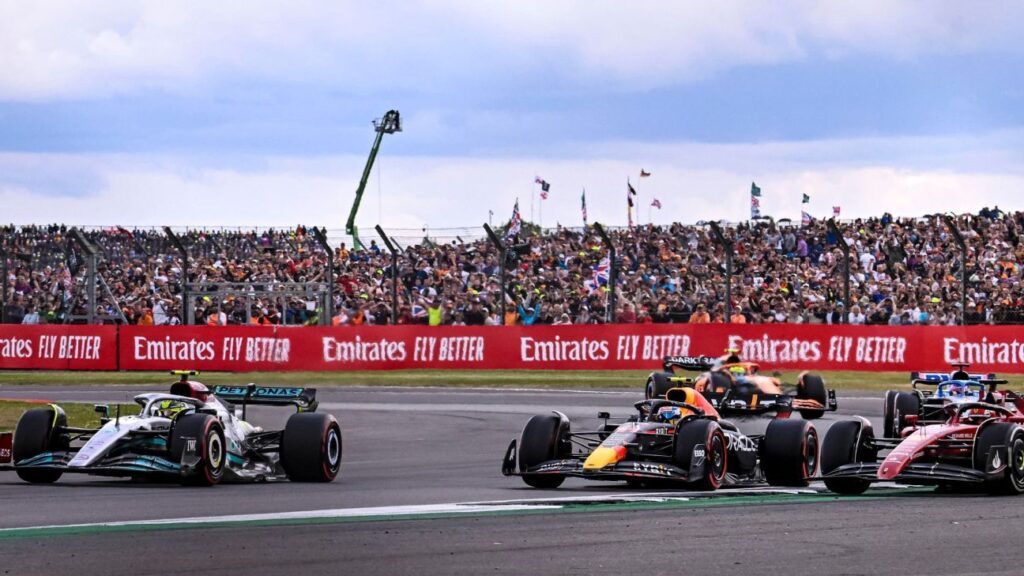
Image credit: EPA/MAXPPP

As Sainz scampered away into the distance, Leclerc defended for all he was worth.

He went through Stowe wheel-to-wheel with Pérez, the fight continued into the final chicane and then as they both ran wide – to quote an excitable David Croft – “through goes Hamilton!”

Pérez dived back in front of the Mercedes a couple of corners later, though, forcing Hamilton wide and also allowing Leclerc back through.

Hamilton tried around the outside of Luffield but had to get off the power and nearly allowed fifth-placed Fernando Alonso a chance to get involved.

Two laps later, car number 44 tried the same move at Luffield, this time getting ahead.

Leclerc wasn’t done, though, stayed in the slipstream and pulled off a quite astonishing move around the outside of Copse, despite his worn tyres.

Hamilton did ultimately claim the place later in the lap, but Leclerc would at least manage to hold onto fourth ahead of the chasing Alonso and Norris.

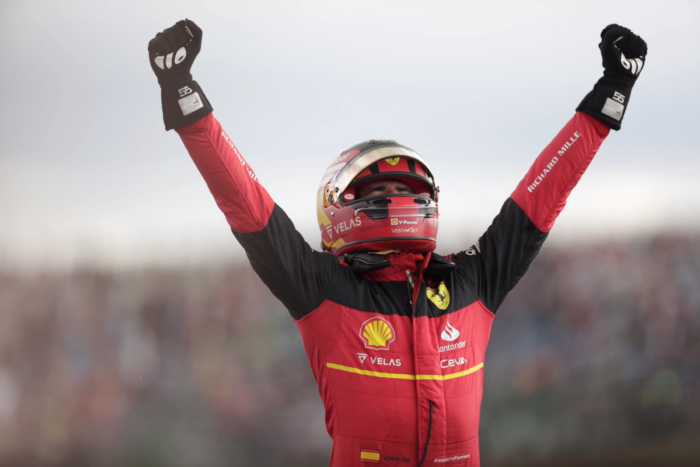
Out front, there were no such worries for his teammate. Sainz took the chequered flag to become the first driver to claim his maiden pole and win on the same weekend in over a decade.
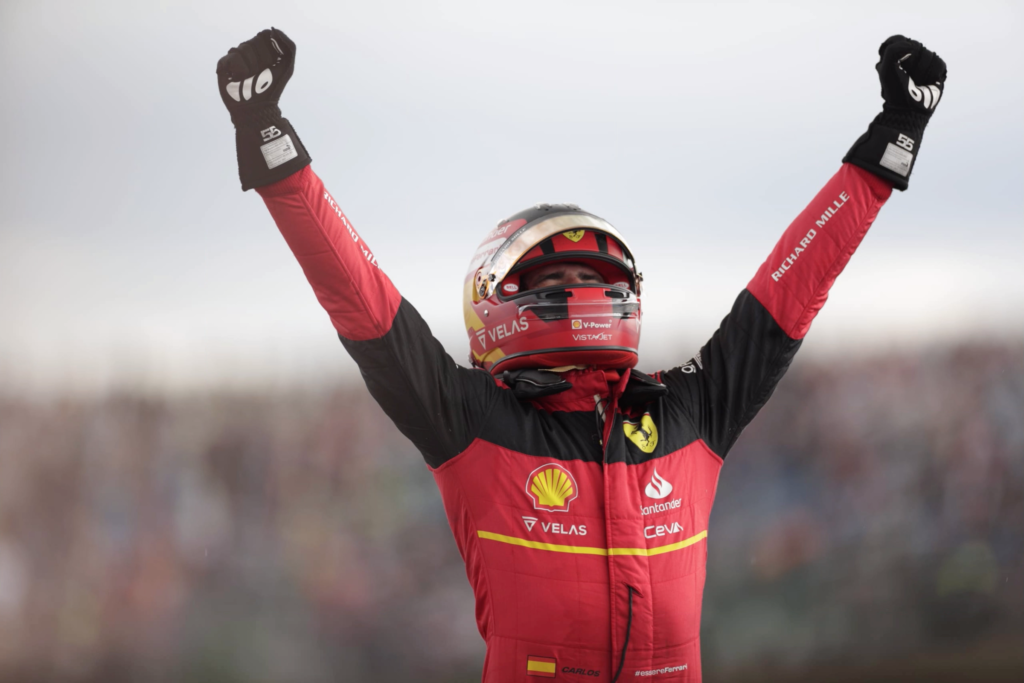
Image credit: Motorsport Images

The win came at the 150th attempt.

Pérez followed him home in second, perhaps fortunate to escape without a penalty for either forcing Hamilton off the road or cutting the chicane during his battle with Leclerc.

Hamilton may not have made it a record-breaking nine wins at one circuit, but he did break a similar record thanks to a 13th podium around Silverstone.

Leclerc’s fourth place saw him slightly close the gap to Verstappen in the standings, but it remains at 43 points, with the championship leader hanging onto seventh after some sturdy defence against Mick Schumacher in the final laps. Nonetheless, finally some points for the young German.

Civil war at Ferrari?

Reportedly, some of the Ferrari team members – seemingly those on Leclerc’s side of the garage – refused to join in the team celebrations for Sainz’s maiden victory.

Whilst this is never a good look for a team, their frustration is somewhat understandable after yet another tough weekend for their driver.

The swing in the championship battle – if there even still is one – has been astonishing.
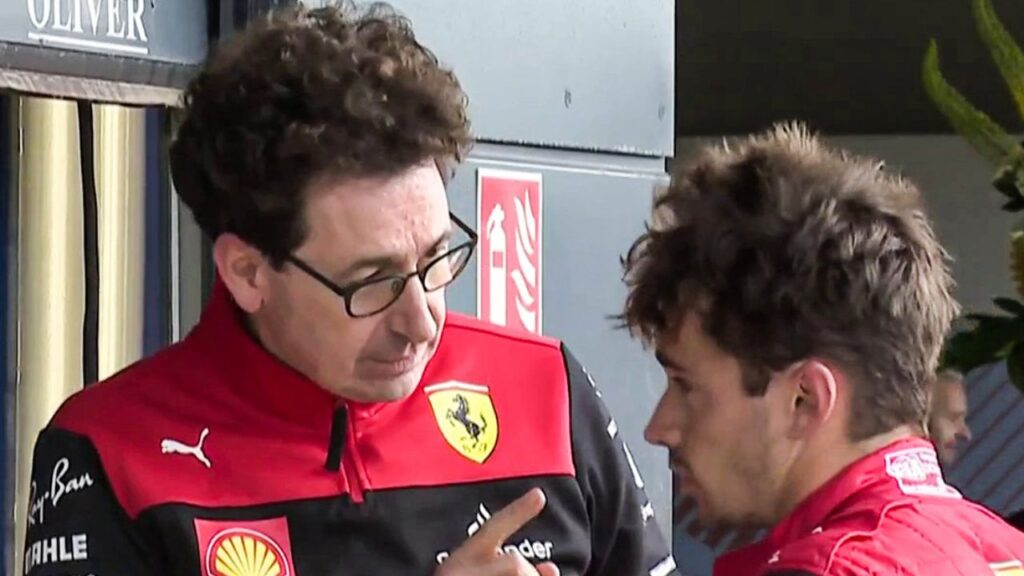
Image credit: Formula 1

Since his win in Australia, things have just not stopped going wrong for Leclerc.

He made his only mistake whilst chasing down the Red Bulls in Imola, a late spin demoting him from third to sixth. But since then, he has been blameless as his campaign has fallen apart.

An engine failure from a dominant lead in Spain. A horrible strategy dropping him from the lead to fourth at his home grand prix. Another engine failure from the lead in Baku which then forced him to start from the back in Canada after taking a new power unit. And now another strategy shocker that again turned first into fourth.

Mattia Binotto has dismissed accusations that they are bottling this championship despite having at least the joint-fastest car, saying “our objective is to be competitive, not to win the championship”.

That is simply not the attitude of a winner.

Ferrari should be fighting for both titles this year, plain and simple. And if they harbour any ambitions of doing so, they must turn around their operational issues rapidly.

Especially with a Technical Directive coming into effect from France that could hurt them – along with Red Bull – and Mercedes threatening to join the fight at the front. The Silver Arrows will remember well just how good their Italian opponents are at dropping the ball in a title fight from 2017 and 2018.

Answering the Burning Questions

Whose updates will make the biggest impact? Mercedes certainly appeared to have moved forward the most, but it could have just been the specifics of the track.

Can Ferrari and Charles Leclerc do something to reignite the title battle? Nearly…

Will Mercedes be more competitive on a track which should suit them? Very much so.
The Race in 60 Seconds

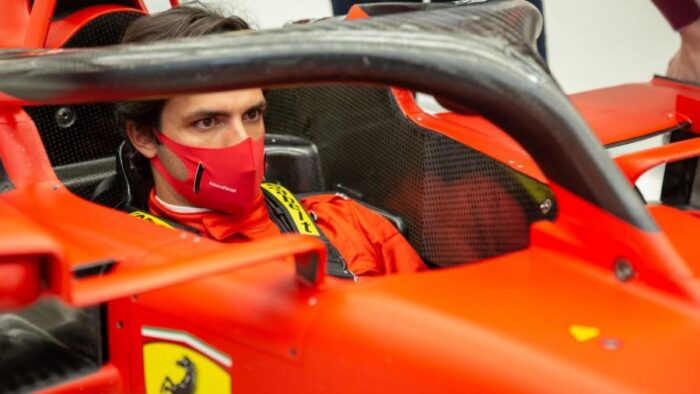
Taking your chance at Ferrari

How do you fill the shoes of a four-time world champion?

You would imagine that this thought has – fleetingly, at least – crossed the mind of Carlos Sainz ahead of his move to Ferrari this year. He will replace Sebastian Vettel who, whilst ultimately unsuccessful in his quest to bring a title back to Maranello, spearheaded the Italian marque’s endeavours from 2015 to 2020.

Many suspect the Spaniard will fulfil a role as the de facto number two to the Scuderia’s rising superstar, Charles Leclerc, but let’s not write him off so soon. It is worth remembering that Sainz largely matched Max Verstappen during their time as teammates at Toro Rosso and, after a somewhat uninspiring spell at Renault, has reminded the paddock of his considerable potential with two excellent seasons in the papaya orange of McLaren.

However, numerous Ferrari drivers have shown great potential, only for the expectation of the Tifosi – if not an entire nation – to weigh too heavily upon their shoulders.

So, can Sainz shine where many before him have only glimmered? He joins Ferrari after a few seasons at midfield teams who haven’t provided a serious chance at victory. How have those in a similar situation fared over the last few decades? Let’s investigate.

Jean Alesi

Tyrrell > Ferrari, 1991 | Races Before Move: 24 | Races for Ferrari: 81 | Wins: 1

Jean Alesi made quite an impact during his two seasons with Tyrrell, claiming two podiums in an underpowered car and famously battling with Ayrton Senna for the lead of the 1990 season-opener in Phoenix. His performances were impressive enough for Ferrari to take a chance on the young Frenchman.

Despite coping well with immediately having to compete with Alain Prost, Alesi would prove to be the perennial underachiever of F1 during the 90s – undeniably fast, but also an ill-fated combination of foolhardy and unlucky.

A Sicilian-born, passionate driver of the evocative number 27 Ferrari, Alesi was inevitably popular with the Tifosi but would ultimately manage just one win in 1995, before swapping seats with Michael Schumacher and moving to Benetton.

Eddie Irvine

Jordan > Ferrari, 1996 | Races Before Move: 32 | Races for Ferrari: 65 | Wins: 4

Eddie Irvine made an instant impression in F1 by scoring a point on his debut and then promptly being punched by Senna for having unlapped himself. Controversy continued to follow him, with two separate bans the following year and a subsequent threat of his Super Licence being revoked. He certainly showed flashes of speed in between the altercations, though, and Ferrari were suitably impressed to buy out his new contract with Jordan.

Irvine was initially unconvincing and, after a series of eight consecutive retirements, the Italian press was calling for him to be sacked. He steadily improved, however, and played a strong supporting role to Schumacher, before assuming the role of team leader in 1999 when the German broke his leg in a crash halfway through the season.

He would eventually miss out on the championship by two points but played a large part in Ferrari winning their first constructors’ title in 16 years. It would prove to be his final contribution before a largely unsuccessful move to Jaguar.

Rubens Barrichello

Stewart > Ferrari, 2000 | Races Before Move: 114 | Races for Ferrari: 104 | Wins: 9

Seen as a potential successor to Senna, Rubens Barrichello was already experienced in carrying the hopes of a nation by the time he joined Ferrari in 2000. He was, however, entering what was very much Schumacher’s team and that is something he would not be able to change over the subsequent six years.

The popular Brazilian would come to epitomise the ‘number two’ driver role – consistent, compliant and reliable but never quite fast enough to challenge the superstar on the other side of the garage. Team orders were, in fact, banned at the end of 2002 after the controversy of Ferrari forcing Barrichello to hand over a victory to his teammate in Austria.

With more freedom and a less commanding teammate, ‘Rubinho’ would likely have won far more than nine grands prix and could well have challenged for a title.

Felipe Massa

Sauber > Ferrari, 2006 | Races Before Move: 53 | Races for Ferrari: 139 | Wins: 11

Another popular Brazilian and one that would go on to become a Ferrari ‘number two’ also. Felipe Massa started out equal parts fast and error-prone with a hit-and-miss season at Sauber in 2002 but, after spending the following year as test driver for Ferrari, he rejoined his former team a more mature driver. He convincingly outpaced his former world champion teammate, Jacques Villeneuve, throughout the 2005 season and was signed to partner Schumacher at Ferrari for 2006.

Whilst still somewhat inconsistent, Massa was always fast and came about as close as you can to winning a world championship in 2008; only Lewis Hamilton’s infamous last corner “Is that Glock?” moment denying him the title.

A freak accident in 2009 left Massa briefly in a coma and, whilst he would recover in time for the following season, he was arguably never the same driver again. He spent his final four years with Ferrari in a support role to teammate Fernando Alonso and would never win another race.

Carlos Sainz

McLaren > Ferrari, 2021 | Races Before Move: 119 | Races For Ferrari: ? | Wins: ?

So, what does the future hold for Sainz in the red of the Scuderia?

Obviously, after such a calamitous season for Ferrari in 2020, the goalposts for a new recruit have been moved. The team will be rebuilding and that will likely help Sainz find his feet with expectations somewhat tempered for 2021 and a year to acclimatise without the instant pressure most of his predecessors have had to deal with.

Ferrari have historically held a policy of employing tried-and-tested drivers, but taking a chance on youth and potential last year, in Leclerc, proved very successful and 2021 will see the youngest Ferrari line-up in living memory. As we can see from these examples, joining Ferrari and dethroning a multiple world champion is no easy feat, but the young Monégasque managed it over the last two years. Now Sainz will have to attempt to dethrone him…

So, where were we?

Well, we were in Melbourne, about to start another Formula 1 season…and then the world changed.

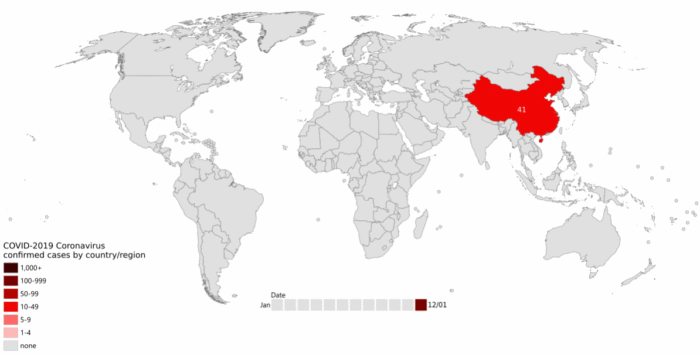
It has, in fact, changed beyond all recognition in the space of a few short months. Social distancing is the new normal – masks, gloves, two metre gaps, elbow bumps – and the Black Lives Matter campaign has swept around the globe after the death of George Floyd.

These have been truly unprecedented times, but, as curves have been flattened and lockdowns lifted, the world of sport is slowly, cautiously peering out from the rubble.

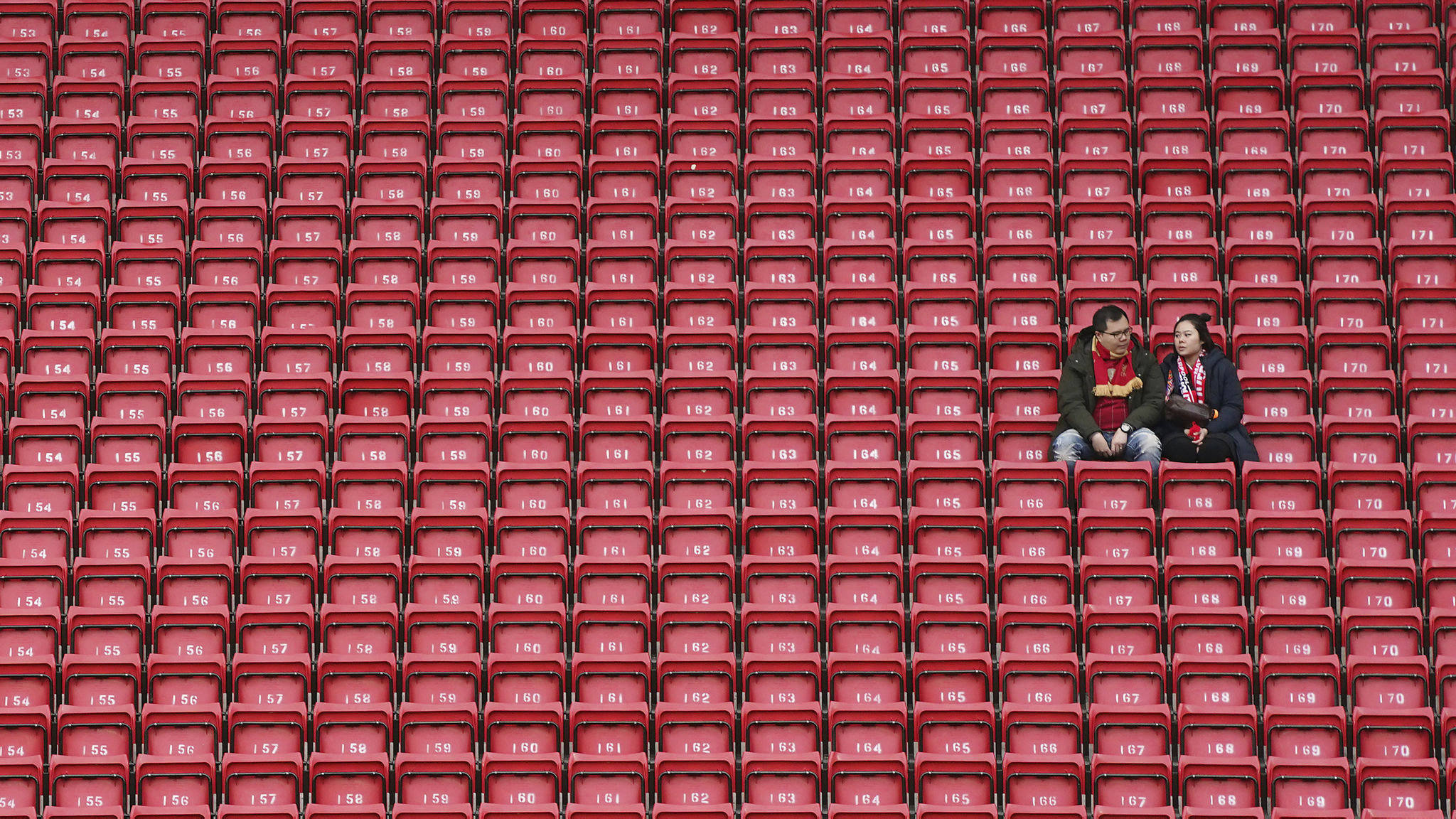
Empty stands in a COVID world.
Image credit: AP

With cases reducing in most countries and both testing kits and protective equipment now far more readily available, many sporting bodies have decided that, with the correct safety measures in place, it is safe to resume.

Premier League football has now restarted, with players and staff being tested twice a week, a maximum of 300 key people allowed inside the stadium and regular disinfection of equipment.

So, how will F1 look upon its return?

Formula 1’s ‘New Normal’

As sports go, the core elements of F1 are already fairly socially distanced; drivers are in their own cars, in the most advanced protective equipment and, if they get within two metres of their rivals, then they’ve probably crashed into one another…

This means that most of the changes will be aesthetic and/or behind the scenes.

The new regulations have been produced in conjunction with the WHO and feature all the measures with which we have become accustomed recently – two metre distancing wherever possible, PPE throughout and the expectation that “all attendees show responsible measures are being taken”.

There will be a daily questionnaire regarding potential symptoms to be completed by every member of the paddock, in addition to a contract tracing system, daily COVID briefings and an isolation hut on the premises.

What does it mean in terms of the show? Not a huge amount, really.

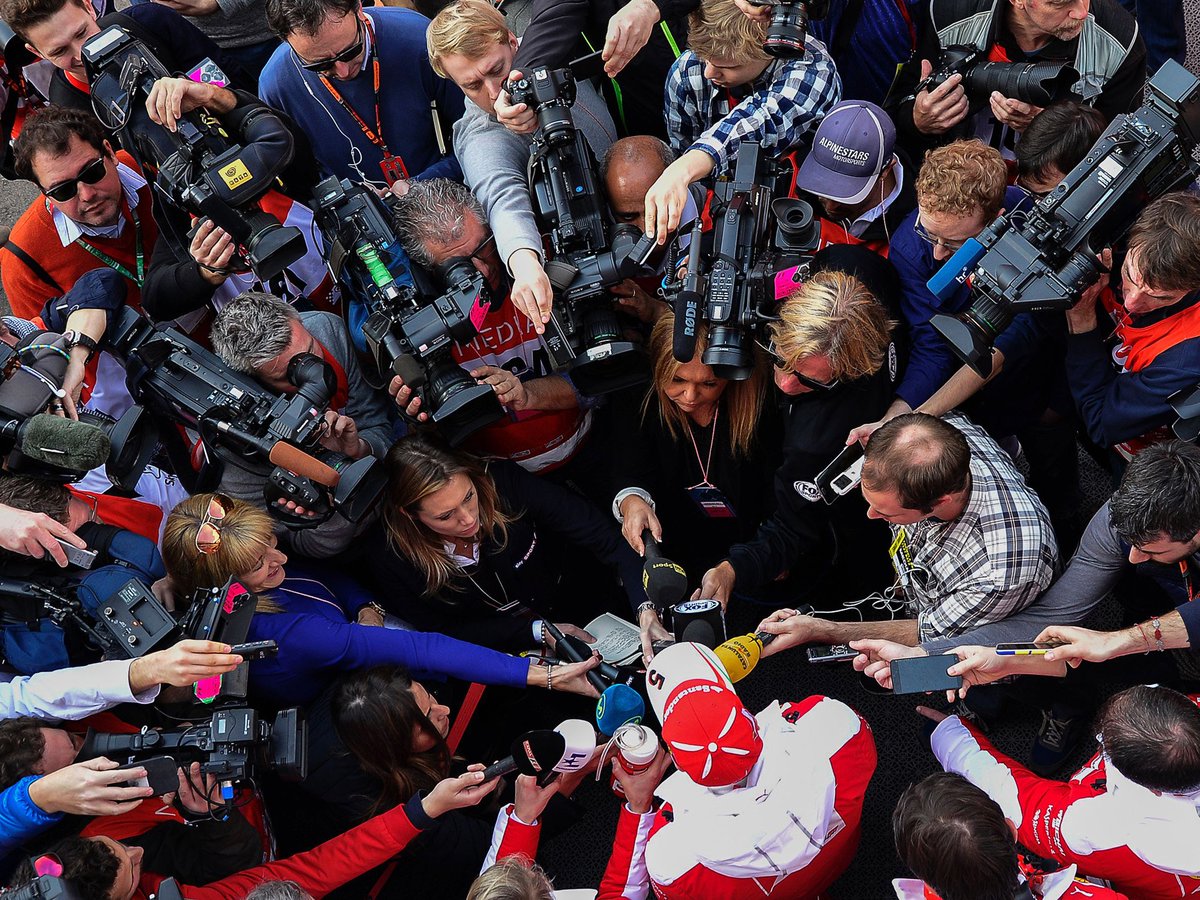
Media scrums will certainly not be seen at any point this year.
Image credit: Speedpix

The grid process is to be shortened significantly. Media scrums are obviously a thing of the past; the media’s entry will be limited to mostly video or ‘pool’ interviews – where all outlets’ questions will be asked together. The weighbridge will be disinfected after each car’s visit and the podium celebrations will be moved to the grid, in order to enable two metre spacings between the steps.

There has been no word on the champagne as yet; maybe they’ll spray disinfectant instead.

What Could the Calendar End up Looking Like This Year?

It seems astonishing, in hindsight, that the opening Grand Prix of the year very nearly went ahead. It may well have done, too, but for a member of the McLaren crew testing positive for the virus on the Thursday night.

In the aftermath, grands prix were gradually postponed, with Monaco being the first to fully cancel its 2020 event. The difficulty of assembling the infrastructure necessary for a street race made the event impossible, even with restrictions beginning to relax.

The same obviously applies to the street races in Singapore and Baku, who duly followed suit, and the Australian, Dutch, French and Japanese Grands Prix weren’t far behind, cancelling for a variety of reasons.

The requirement for a season to qualify as a World Championship is a minimum of eight races. The talk of a three continent requirement can be put to bed after Managing Director Ross Brawn confirmed that, in the exceptional circumstances of the COVID-19 crisis, this “recommendation” will not have to be met.

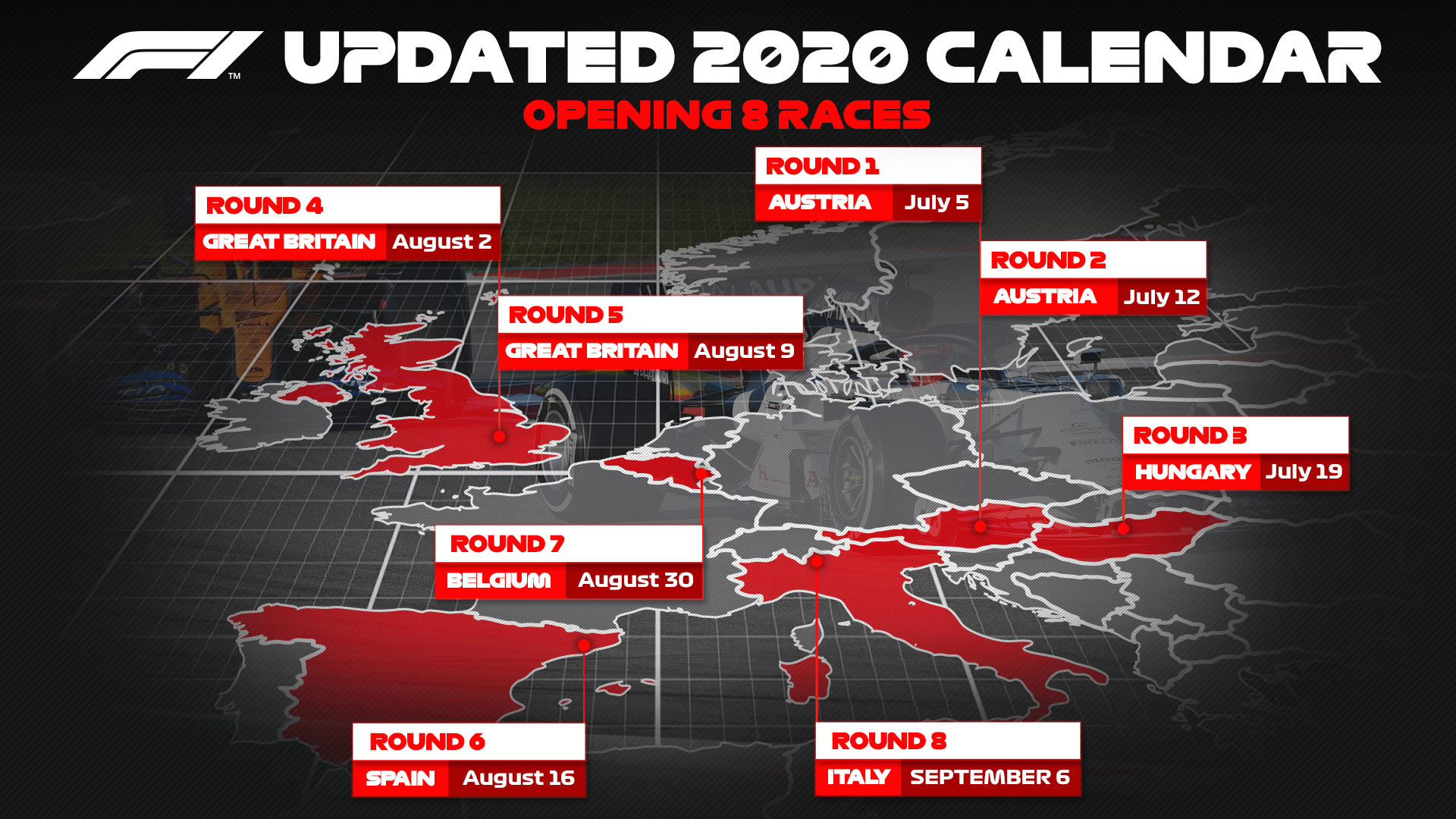
The FIA released a rescheduled calendar in early June, with the first eight races confirmed. They include – for the first time in F1’s history – a second race in both Austria and Great Britain; which have been named the Steiermark GP and the 70th Anniversary GP, respectively. The aim is to hold between 15 and 18 races overall, with the season potentially stretching into early 2021.

The latest calendar update.
Image credit: Formula 1

Beyond this, things remain largely up in the air. The races in Canada and Vietnam continue to be a possibility and there may even be another double-header in China, ironically. Bahrain and Abu Dhabi look fairly solid bets to host at least one race.

The United States is far from over its Coronavirus struggles, whilst Mexico and Brazil appear to be going in the wrong direction, so the prospect of races there seems problematic. However, with Liberty Media waiving race fees and, in fact, paying to rent the facilities, there are some old faces throwing their hats into the ring.

From the more recent past, Hockenheim is looking likely to host a race, having dropped off the calendar for 2020. But blasts from the past such as Imola have been mentioned; both Estoril and Algarve in Portugal (and even Mugello in Italy) are being considered.

It’s hard to say currently how many races we’ll end up with and where they’ll be, but let’s just be glad that we have a championship at all.

Since You’ve Been Gone

So, if you’ve been out of the F1 loop during lockdown, what have you missed? Here are the main headlines…

Silly Season Before the Season Even Began

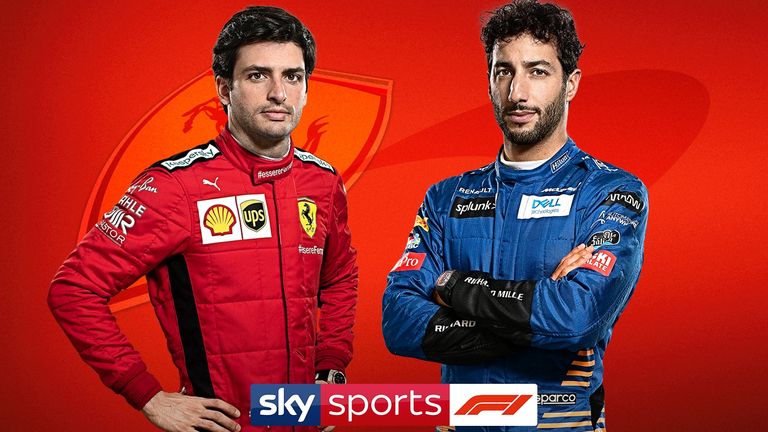
Carlos Sainz and Daniel Ricciardo in their new team overalls.
Image credit: Sky Sports F1

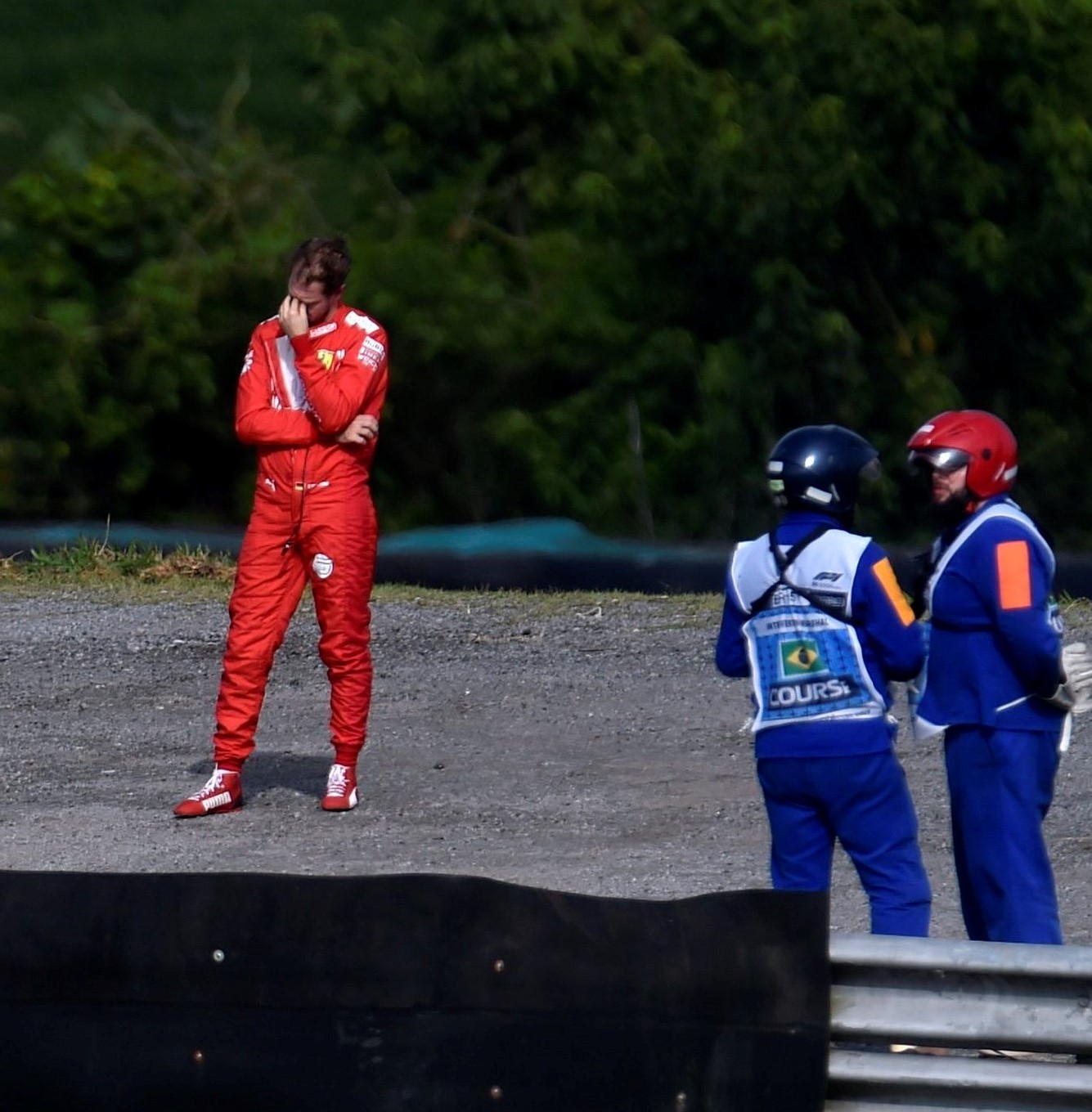
In the space of a couple of days, the F1 merry-go-round suddenly kicked into gear, sparked by Sebastian Vettel‘s announcement that he would be leaving Ferrari at the end of 2020. Within a few hours, Carlos Sainz was confirmed as his replacement and, not long after that, Daniel Ricciardo announced he was swapping the yellow of Renault for the papaya orange of McLaren in 2021.

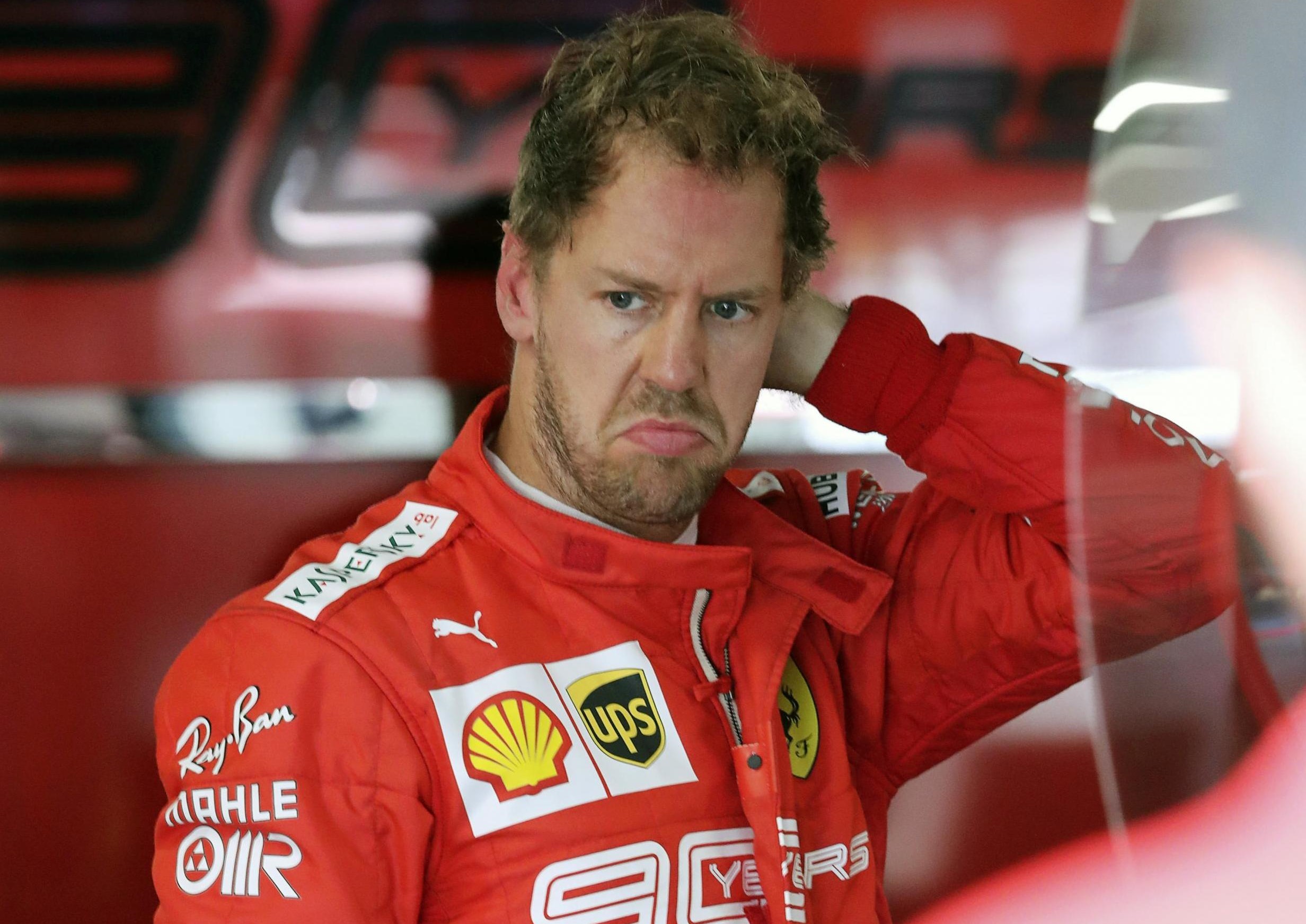
Vettel stated that “the team and I have realised that there is no longer a common desire to stay together beyond the end of this season”. Was he just burnt out after years of near misses and disappointment with the Scuderia? Or was it the team that have decided they want some fresh blood?

Either way, it can’t have been easy to give up on his dream of emulating his idol, Michael Schumacher, with a championship at Ferrari and his options for 2021 now look limited.

There were initial rumours of a Mercedes seat, but Toto Wolff has all but ruled that out, leaving his best chance at Renault. Will Vettel take a chance on what is currently a midfield team, with former teammate Ricciardo clearly having jumped ship? Or will he retire?

It would be a great shame for the sport to lose a four-time world champion, but you sense recently that his love for F1 has been dwindling a little.

An unhappy Sebastian Vettel.
Image credit: The Canadian Press

It is an incredible chance for Sainz, however. Many have seen him as a future de facto number two to Charles Leclerc, but let’s not write him off so soon. It is worth remembering that he largely matched Max Verstappen whilst the pair were at Toro Rosso and a stellar 2019 season refreshed memories of his considerable potential, after an uninspiring spell at Renault.

Ricciardo will be hoping that McLaren can continue their current upward trend and take advantage of the new regulations, which have now been delayed by a year to 2022. Unless he miraculously challenges for the title this year, it will have to be said that his Renault experiment was a failure.

It surely won’t wipe that perpetual smile off his face, though, and a pairing of the Australian and Lando Norris will certainly make 2021 an entertaining season for McLaren, in every sense.

Hamilton Leads the Fight

For once, that headline has nothing to do with Lewis Hamilton‘s dominance on the track.

The world champion has launched ‘The Hamilton Commission’ with the aim of increasing diversity within motorsport. “The time for platitudes and token gestures is over”, wrote Hamilton in a column for The Sunday Times. “Despite my success in the sport, the institutional barriers that have kept F1 highly exclusive persist.”

The 35-year-old has campaigned passionately during the enforced break, with a series of powerful statements on social media and participation in the peaceful BLM protest in Hyde Park.

And F1 has now followed his lead by launching the ‘We Race As One’ initiative, which has the aim to “impact long-lasting change, particularly regarding diversity and inclusion”. All cars will display a rainbow, comprising the colours of the 10 teams, throughout the 2020 season and the sport will also show support for key workers and families amid the fight against COVID-19.

As stated at the top of this article, the world has changed.

But maybe it was time for a change.

2019 Abu Dhabi GP report | Hamilton rounds out championship year with grand slam

That’s a wrap on F1 2019.
Image credit: Mercedes-AMG F1

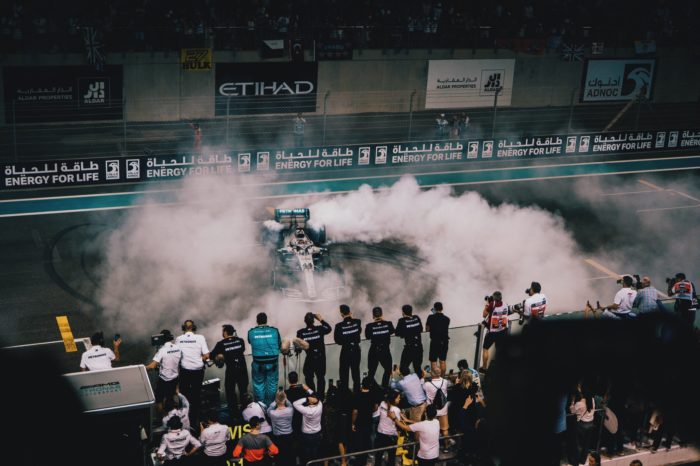
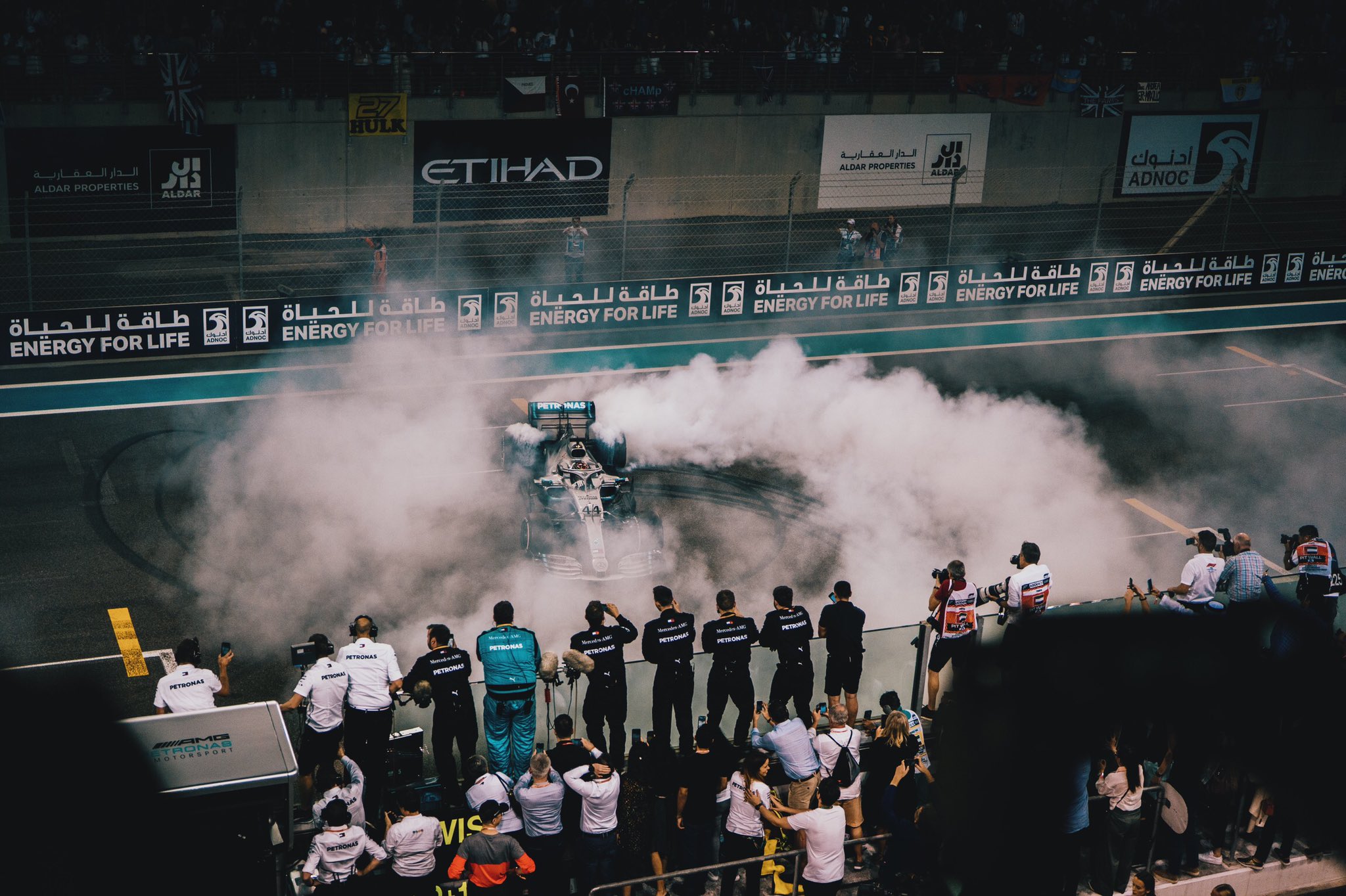
Lewis Hamilton finished the year at the 2019 Abu Dhabi Grand Prix in the fashion he has spent much of it – leading from the front. And in the most emphatic fashion so far this season, as he took his only ‘grand chelem’ – achieved by claiming pole, the win, the fastest lap and leading every lap – of the year.

That is the his sixth grand slam, moving him beyond Alberto Ascari and Michael Schumacher to outright second on the all-time list, two behind the late, great Jim Clark. Yet another record for Hamilton to set his sights on.

The race itself was sadly a fairly standard Abu Dhabi affair – a pretty dull race with the action limited mostly to Valtteri Bottas’s fight through the field from the back of the grid. The Finn’s job was also made slightly harder by the bizarre lack of DRS for 18 laps, apparently caused by a ‘data server crash’.

As Martin Brundle had feared may be the case, Hamilton ‘checked out’ at the front of the field, controlling his pace and keeping a comfortable lead throughout. He showed just how much pace he had to spare by setting the fastest lap of the race on reasonably old hard tyres when many behind had pitted for new, softer ones in the final few laps.

The fight for the other podium positions was slightly spicier. Charles Leclerc passed Max Verstappen on the first lap as the Red Bull seemed to initially struggle heating its tyres. But Verstappen ran 13 laps longer and comfortably passed the Ferrari, having rejoined just four seconds back on far fresher tyres, despite nursing a subtle engine issue throughout the race. Leclerc then switched to a two-stop strategy and just about managed to hold off the closing Bottas in the closing laps. Leclerc had spent the entire race aware that he could well be disqualified for a technical infringement from Ferrari before the race but, after a post-race investigation, the team were fined €50,000 and his third place stood.

It was another amateur-ish mistake from F1’s most experienced team – simply a case of the amount of fuel Ferrari had said was in Leclerc’s car being significantly different from the actual amount once it had been checked by the FIA. If they are to put together a real title challenge in 2020, Ferrari will have to iron out these basic operational failings…as well as the rather larger ones such as strategy and their drivers crashing into each other…

Sebastian Vettel at the 2019 Abu Dhabi Grand Prix.
Image credit: Foto Colombo Images

Sebastian Vettel came home a fairly underwhelming fifth, followed by the other Red Bull of Alexander Albon, the Anglo-Thai finishing a disappointing 52.5 seconds behind his teammate. Whilst, overall, Albon has done a solid job in what has undeniably been a big ask of a rookie driver, that is similar to the gaps we were seeing between Verstappen and Pierre Gasly before his demotion. With a proper preparation for next year, Albon will surely have better foundations to build on for 2020 but he will have to be consistently and markedly closer to the superstar on the other side of the garage to cement his place in both the team and the sport for the future.

Sergio Pérez claimed ‘best of the rest’ thanks to some trademark tyre conservation and a good strategy, nicking seventh from Lando Norris on the last lap with what he described as “one of the best moves in my career”.

Sainz Leaves it Late to Snatch Sixth

Another move on the last lap – this time with a McLaren being the overtaker rather than the overtaken – brought Carlos Sainz the single point he required to seal sixth in the Drivers’ Championship, with the Spaniard clearly ecstatic with the manner in which he claimed it.

Carlos Sainz at the Abu Dhabi Grand Prix.
Image credit: Sutton

Sainz absolutely deserves that sixth place. Whilst it has obviously been made possible by two drivers getting half a season each in the second Red Bull, the level of consistency achieved by the Spaniard has been excellent and he nearly broke the 100-point barrier despite a fair share of bad luck. He lost a haul of points in Bahrain through a coming together with Verstappen and more via a botched pit-stop in Italy.

Surely Red Bull are looking somewhat longingly at Sainz now as they struggle to find a driver worthy of their second seat. Verstappen and Sainz were very evenly matched as teammates in their rookie years and it seems that, in the last 12 months certainly, Sainz has pushed onto another level and is relishing his role as team leader at McLaren.

Tension between their respective fathers supposedly played a part in Sainz not being considered for the Red Bull drive when Daniel Ricciardo dropped the bomb that he was leaving for Renault last year. But you have to wonder, with a Verstappen-Sainz pairing, would Red Bull have been able to truly challenge Ferrari for seconds in the Constructors’ Championship this year?

Verstappen Claims the Other ‘Best of the Rest’

Whilst, at times, Ferrari and Red Bull have looked very fast – the Ferrari particularly in qualifying and the Red Bull particularly at altitude – over the course of the season, the Mercedes team has been somewhat in a class of one.

With his second place in Abu Dhabi – and a helping hand from the Ferrari clash last weekend – Verstappen claimed third in the championship and what is effectively ‘best of the rest’ beyond the Silver Arrows. It is another deserved unofficial crown, as Verstappen has surely stood out, alongside Hamilton, as the star of the field this year.

Image credit: Red Bull

Where, in past seasons, he had shown unquestionable raw speed but flashes of immaturity and rashness, this year has been nearly devoid of those flies in the ointment. There were perhaps a couple of overambitious moves but that comes with the territory when you are a bold driver like Verstappen.

If Red Bull can actually start a season competitively for once next year, and Verstappen can keep his head once faced with a real title battle, 2020 could even be a case of him going for ‘best of the best’.

But the final word must go to Hamilton.

Having been challenged more consistently by the other teams since the summer break, the world champion’s superlative performance at the Yas Marina Circuit was a pointed reminder to the prentenders to his throne that he is still very much the king.

The Abu Dhabi Grand Prix in 60 Seconds

Answering the Burning Questions

Who can go into the winter break on a high? Certainly Hamilton. But Verstappen and Leclerc will be pretty content too.

How will relations be between the two Ferrari drivers and within the team? There was a hint of tension with Leclerc missing his final qualifying lap and seeming to blame Vettel but really it was the team’s fault. That was followed by another silly error from the team on race day… Will any heads roll over the winter break?

Who will claim third in the Drivers’ Championship? Verstappen, pretty comfortably in the end.

Can Hülkenberg get a podium in possibly his last ever race?? Of course not. A token Driver of the Day award though!

2019 Brazilian GP report | Verstappen thrills in Brazil and Gasly claims second as the Ferraris collide

A fairly average race for 50 laps…and then absolute bedlam.
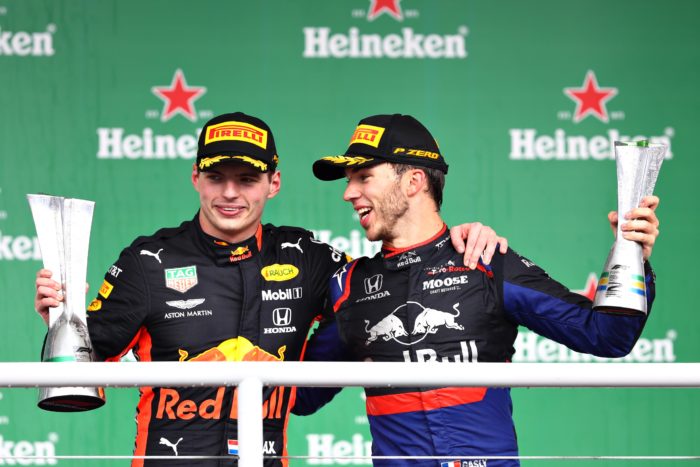
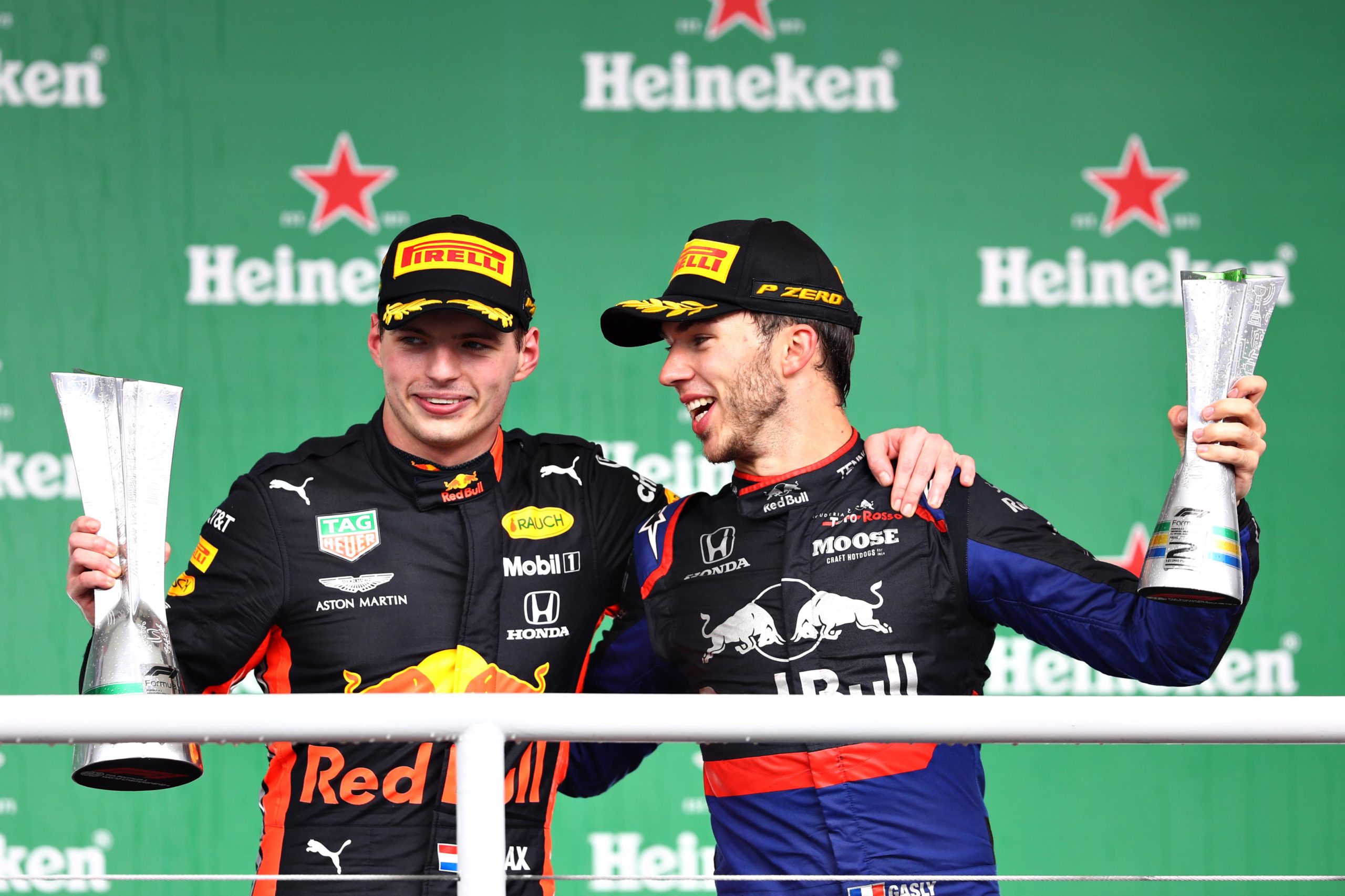
Max Verstappen and Pierre Gasly on the Brazilian Grand Prix podium.
Image credit: Getty Images

Max Verstappen took a commanding victory at the 2019 Brazilian Grand Prix as all around him – or certainly most – were losing their heads.

Verstappen led away from pole with Lewis Hamilton passing Sebastian Vettel for second place around the outside of the first corner. From there, it looked likely to be a tale of whether the young Dutchman could keep the newly-crowned world champion at bay. Mercedes had shown strong pace during race simulations in the practice sessions and, whilst never quite getting close enough for an overtaking attempt, Hamilton remained within touching distance throughout the first phase of the Grand Prix.

Mercedes triggered the undercut on lap 20 by pitting Hamilton and committing to a two-stop strategy. Red Bull responded a lap later but, via the combination of an unhelpful Williams pit release and a strong out lap from Hamilton, Verstappen emerged behind the Mercedes driver.

That would not remain the case for long, however. Hamilton had completely depleted his battery on his flying out lap and so was slow on the start/finish straight; Verstappen took the opportunity to fly past and regain his net lead.

The two drivers matched each other as they worked their way through backmarkers until, after another 20 or so laps, Mercedes attempted another undercut. This time with less success. Hamilton appeared happier on the medium tyres than he had been on the soft, though, and was closing the gap. But everything was about to be flipped on its head.

Whilst trying to find a way past Charles Leclerc for fourth, Valtteri Bottas’s Mercedes engine overheated and the Finn ground to a halt – the first mechanical retirement for Mercedes this year – which, despite some good parking, brought out the safety car. Mercedes told Hamilton to do the opposite to Verstappen; the Red Bull driver came in and so Hamilton stayed out, but almost immediately began to question the decision to leave him vulnerable on older, harder tyres.

His fears were quickly proven to be well-founded as, despite Hamilton’s best efforts to catch him out at the restart, Verstappen flew by once more before the first corner. Alexander Albon also made a great move to jump past Vettel, before starting to pressure Hamilton, with the Ferraris close behind. But not for long.

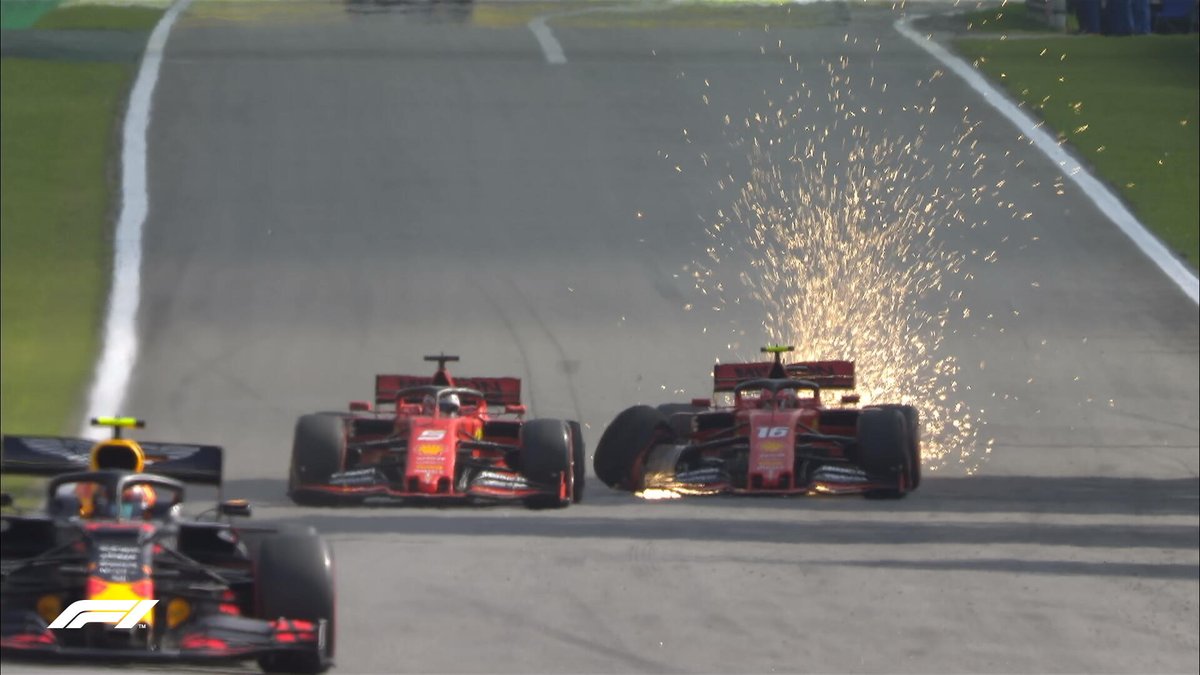
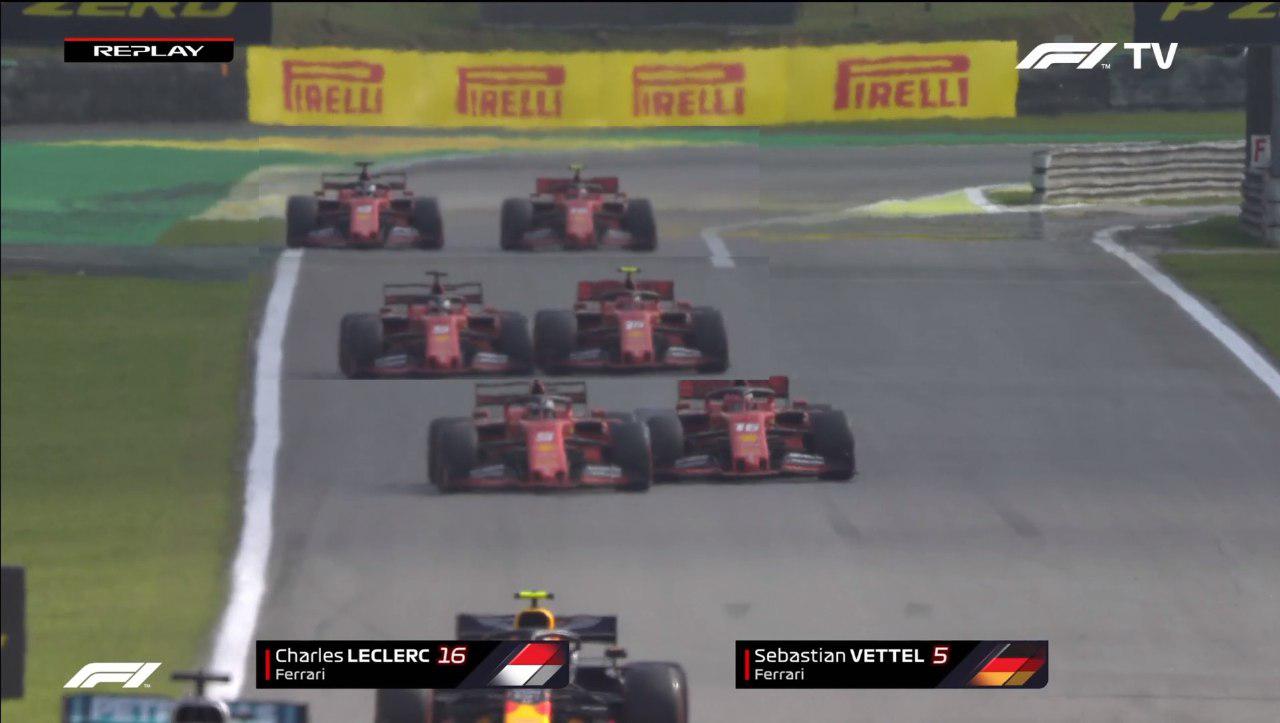
With five laps remaining, Leclerc dived down the inside of his teammate at the first corner but Vettel stayed close behind and pulled alongside on the following straight. As he passed, he drifted left, Leclerc did not move fast enough, there was slight tyre-to-tyre contact and Ferraris race quite literally fell apart.

The Ferraris collide at the Brazilian Grand Prix.
Image credit: Formula 1

Leclerc’s front left suspension was broken and Vettel was also parked up with the damage caused by a rear right puncture within a lap. As is tradition, both drivers blamed each other. (More on that later.)

This brought about another safety car. This time Mercedes gambled and brought Hamilton in, dropping him to fourth and leaving a Honda 1-2-3, as things stood, in the form of Verstappen, Albon and Pierre Gasly’s Toro Rosso. Lance Stroll had also retired after hitting debris from the Ferrari theatrics and it looked as though the race may finish behind the safety car.

It was restarted, however, with an effective two-lap sprint race to the chequered flag. Hamilton, on his fresh, soft tyres, dispatched Gasly at the first corner and was immediately onto the gearbox of Albon. Was the gamble about to pay off for Mercedes?

No. It was, in fact, about to end in tears, as Hamilton made an ambitious dive into the Bico de Pato corner. Albon certainly left the door open but, when he took the normal racing line and effectively closed it, Hamilton was too committed and made contact with the Red Bull, leaving it pointing in the wrong direction as the field sailed past. Agony for Albon, apologies from Hamilton post-race, but euphoria at Toro Rosso as Gasly moved into second position.

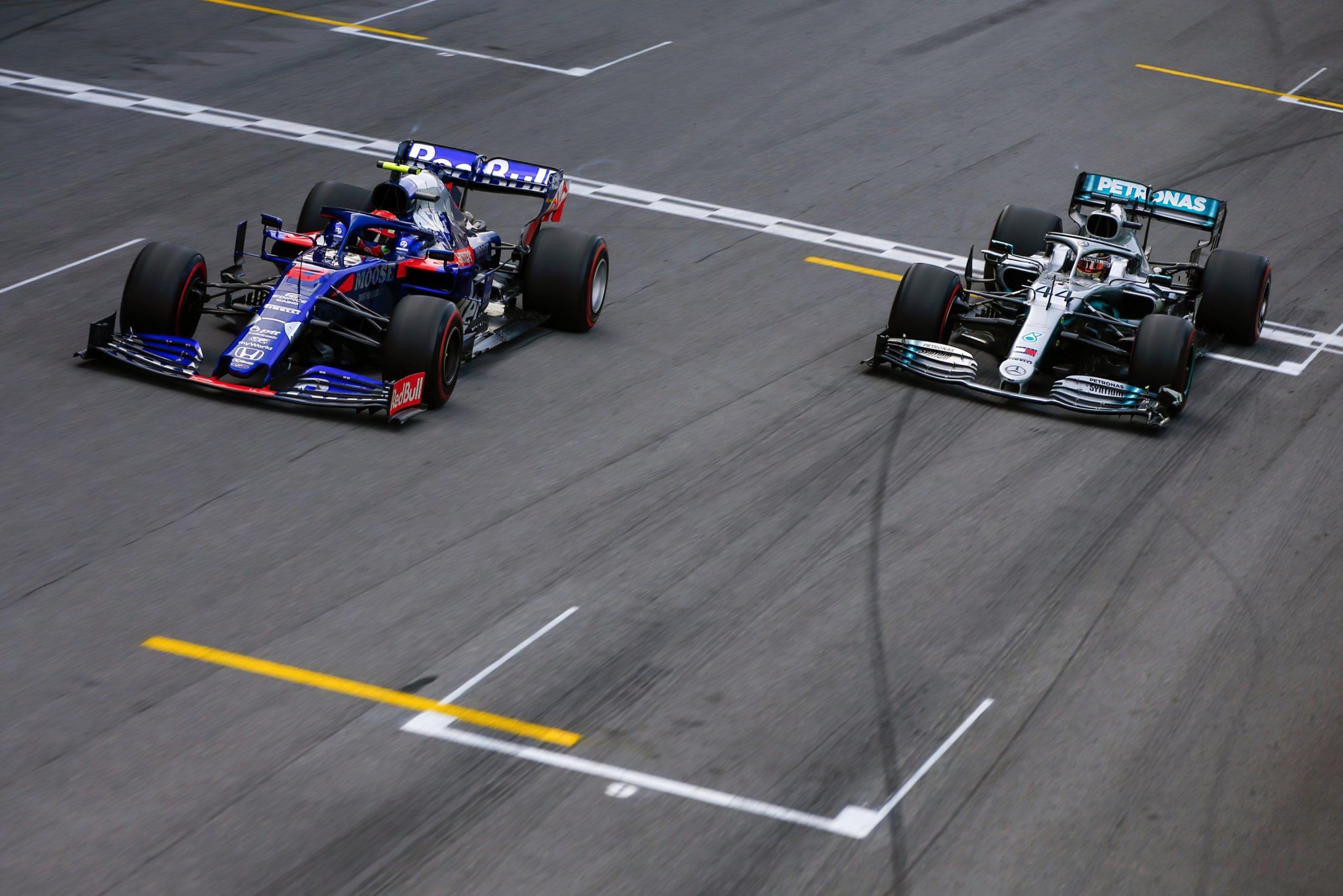
A lap later, coming out of the last corner, Hamilton got a run on the Frenchman and pulled alongside to produce a drag race to the line. But, in a show of just how far Honda have come this year, the Toro Rosso won that drag race and Gasly took a stirring first podium in F1, after an incredibly trying year. Cue an emotional release and a Senna-in-91-esque radio message.

Image credit: Motorsport Images

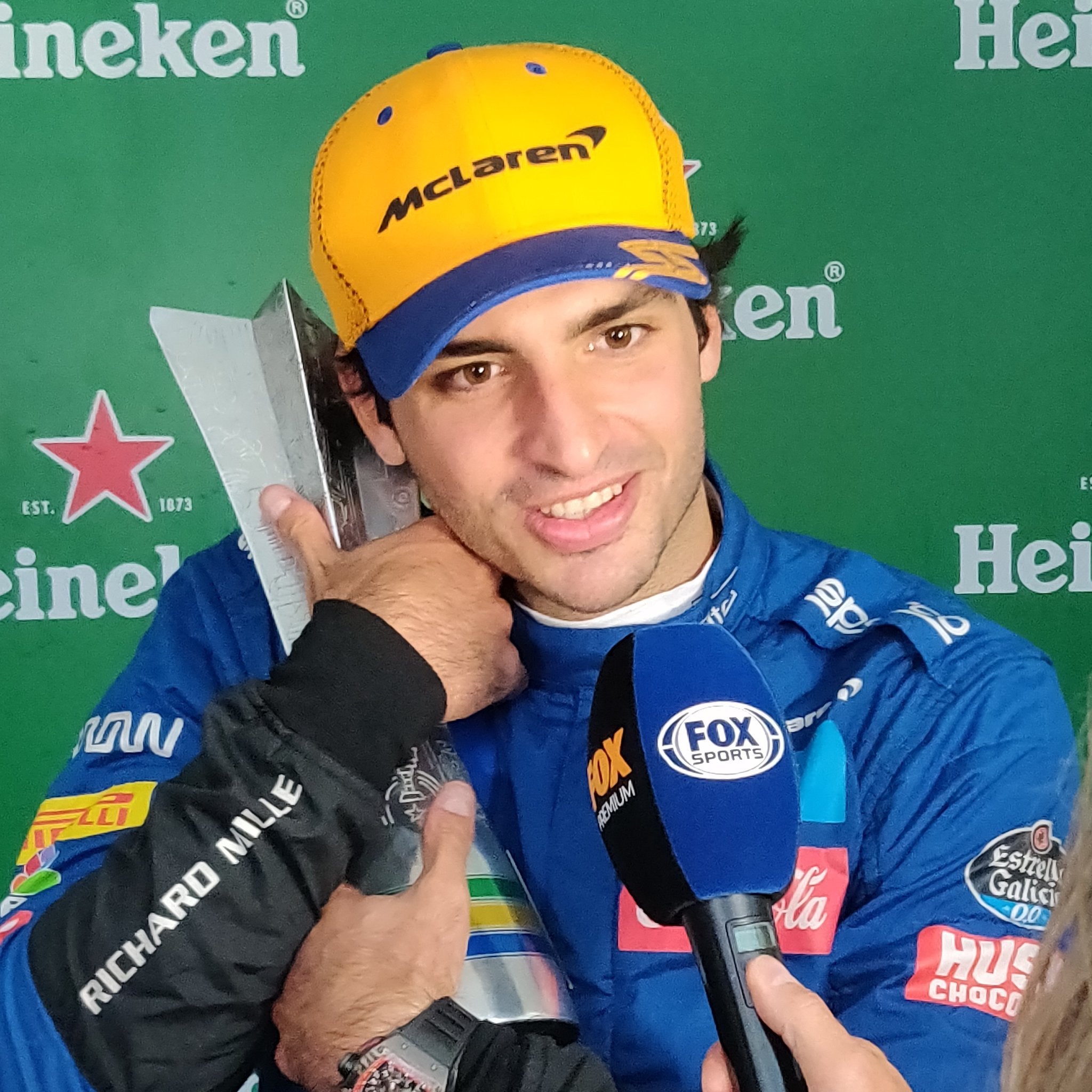
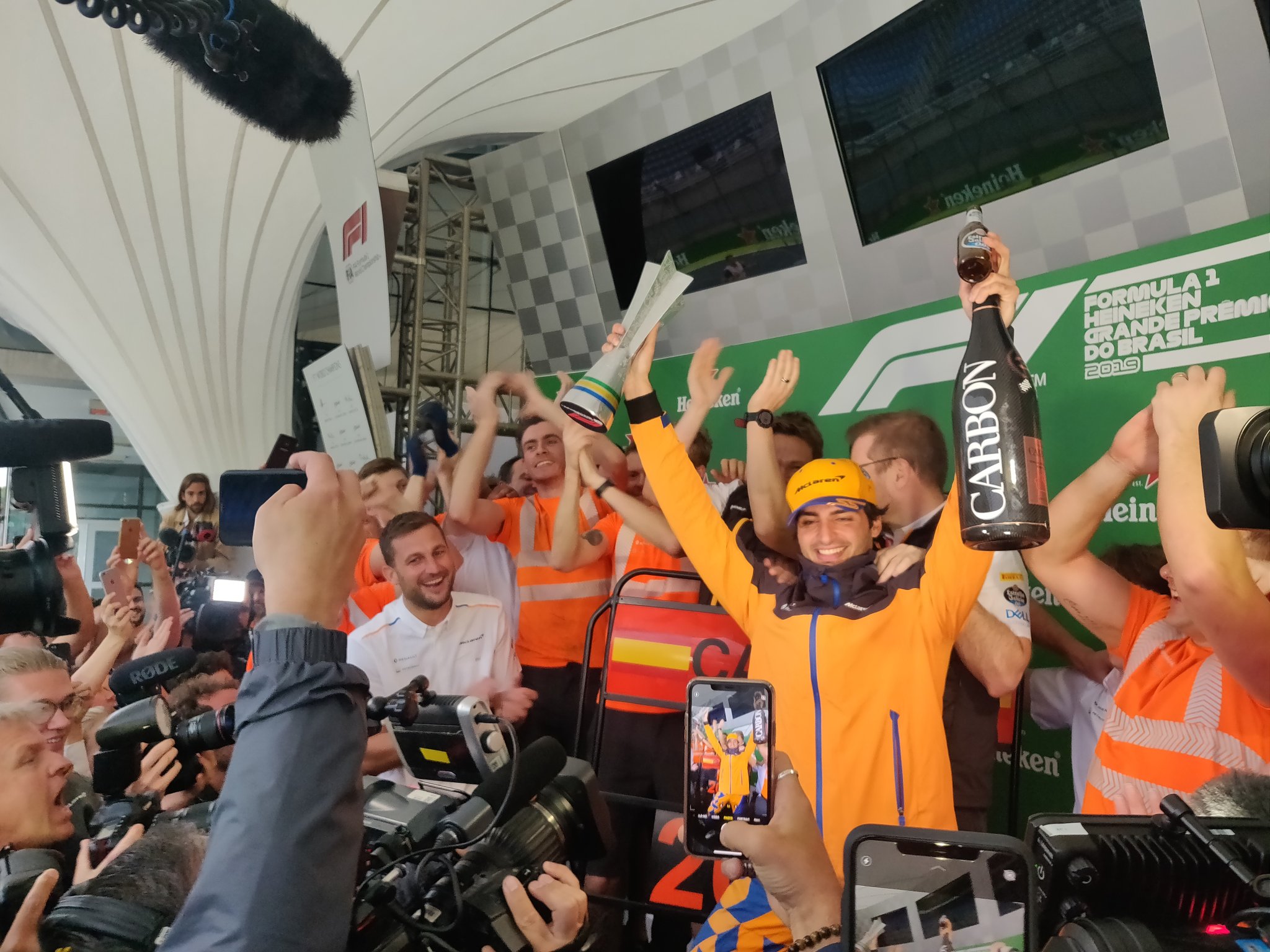
Once Hamilton had been given a five second penalty, we were left with a bizarre top five of Verstappen, Gasly, Carlos Sainz and the Alfa Romeos of Kimi Räikkönen and Antonio Giovinazzi. It was also a debut podium for Sainz and, although he was not part of the initial ceremony, he was later allowed up to the podium to celebrate with his team.

Again, there were some questionable strategy decisions from Mercedes. Bottas was confusingly pitted just 14 laps into a stint on the hard tyres as the team drastically bailed out of a one-stop. And whilst the undercuts for Hamilton were fairly well executed, the decision not to pit him under the first safety car left him a sitting duck and, but for the Ferrari incident, Hamilton could easily have found himself behind all four cars that had been following at that point. This was supposed to be a race for Mercedes to be set free from the constraints of playing it safe with the championship in mind but it came across more like rash, ill-considered decisions with a whiff of desperation at points. Especially in contrast to the excellence of the Red Bull strategies, pit stops and drive by Verstappen.

But hey, it could have been worse. They could be…

Ferrari…

After two years of near misses and now a season that promised so much but has massively under-delivered, the Tifosi fans are pretty numb to pain at the moment.

But this one will have hurt.

Tensions that have been in danger of boiling over for some time now, finally did so. And with disastrous consequences. The two drivers conspired to crash into each other whilst on a straight and, just like that, Ferrari’s season surely hit its nadir. But who was primarily to blame, if anyone?

Image credit: Formula 1

The stewards have ruled ‘no further action necessary’ but, for me, the blame must lie closer to Vettel’s door than that of Leclerc. It was a slightly rude divebomb – particularly on a teammate – by Leclerc into the first corner, but a fair and successful one. Maybe that stung Vettel – with Hamilton and Albon having also robbed him at the same corner earlier in the race – as there was no need for him to come across his teammate in the way that he did as he came back past. He had the overspeed to be ahead by the corner anyway.

Watching the onboards, you can see how little time Leclerc had to react. It was all a bit Turkey 2010 with Webber. Vettel has been under such pressure this season and has seen his number one status within the team come under serious threat; was this an attempt to show dominance? We can’t be sure.

Between the many spins and the incidents like this – remember that, just two races ago, Vettel squeezed Hamilton onto the grass at the start and was saved by the latter bailing out – the four-time world champion sometimes seems to lack a bit of spacial awareness in the car. He may have a bit of soul-searching to do before next season.

Image credit: Getty Images

It will be interesting to see how Ferrari handle the fallout from this. They have one race left to patch things up or it could be a very frosty winter…

Two Very Wholesome Podiums

The podium finishes for both Gasly and Sainz will be hugely popular throughout the paddock.

Gasly has had such a tough year. Obviously, struggling badly in the Red Bull and seemingly losing all confidence before being demoted during the summer break. But then particularly, during his first race back at Toro Rosso, losing his close, lifelong friend Anthoine Hubert to that tragic, fatal accident in Spa.

That makes his redemption arc in the second half of the season all the more impressive. He has generally had the better of new teammate Daniil Kvyat, despite having to readapt to the Toro Rosso, and has just kept getting stronger. He was ‘best of the rest’ for the majority of the weekend in Brazil and fully capitalised on the chance he was given. It also leaves him with the record for France’s youngest ever podium.

Carlos Sainz with his trophy at the Brazilian Grand Prix.
Image credit: EFE

Sainz, meanwhile, deserves it for the sheer quality of his performances this year. The Spaniard was starting to look like he may have contracted the Nico Hülkenberg podium curse with so many fourth and fifth place finishes in a generally impressive career.

But he has broken that duck and, judging by the consistently high level he has been (smoothly) operating at this year, it would not be a surprise to see him pick up many more trophies.

The Brazilian Grand Prix in 60 Seconds

Answering the Burning Questions

With the title wrapped up, can we still get an exciting race? Just a bit, yeah.

Will we get any more clues as to the effect the power unit clarifications have had on Ferrari? There is still talk from Mercedes and Red Bull that they are seeing a reduction but the Ferrari straight-line speed appeared closer to what we’re used to here. And the altitude made it hard to come to a definite conclusion.

How will Albon perform now that his seat for next year is confirmed? He still has work to do when it comes to qualifying pace but he looked at home mixing it with the big names during the race.

Who of Leclerc, Verstappen and Vettel will leave the weekend leading the battle for third in the championship? Verstappen, by a surprisingly comfortable 11 points.

Surely we’re overdue another crazy, wet race? Interlagos quite often delivers them… Well it wasn’t wet but it was certainly crazy.

2019 Monaco GP report | Hamilton takes emotional victory

Niki would be proud.
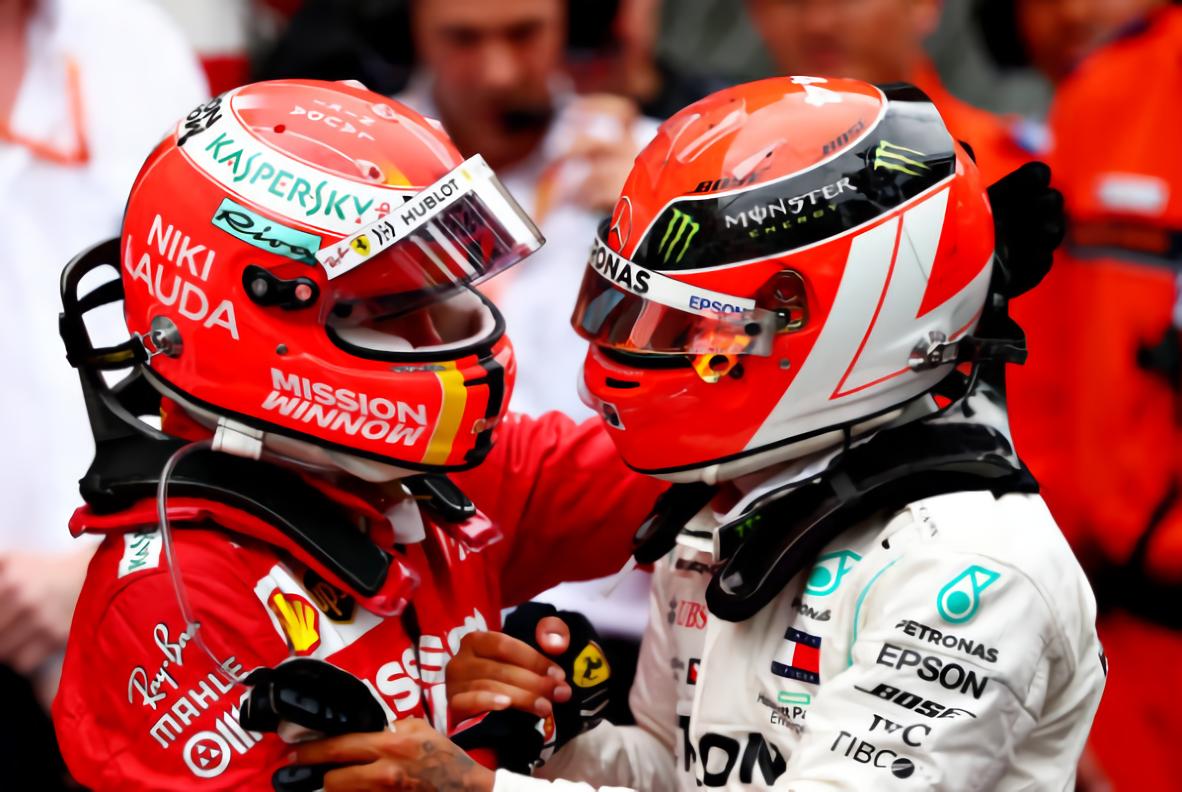
Lewis Hamilton and Sebastian Vettel at the 2019 Monaco Grand Prix.
Image credit: Getty Images

The run of Mercedes 1-2s finally came to an end at the 2019 Monaco Grand Prix, to be replaced by a Niki Lauda 1-2.

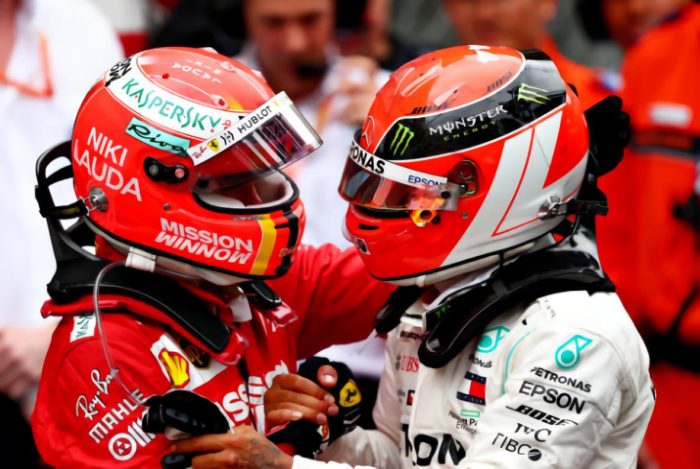
Lewis Hamilton took the victory in a McLaren-era Lauda helmet, followed (once Max Verstappen’s penalty had been applied) by the Ferrari-era Lauda helmet donned by Sebastian Vettel. It was a very fitting result for what was always going to be a poignant, somewhat muted Monaco Grand Prix weekend – a dampener put on all the glitz, glamour and indulgent festivities that the Monte Carlo race usually brings.

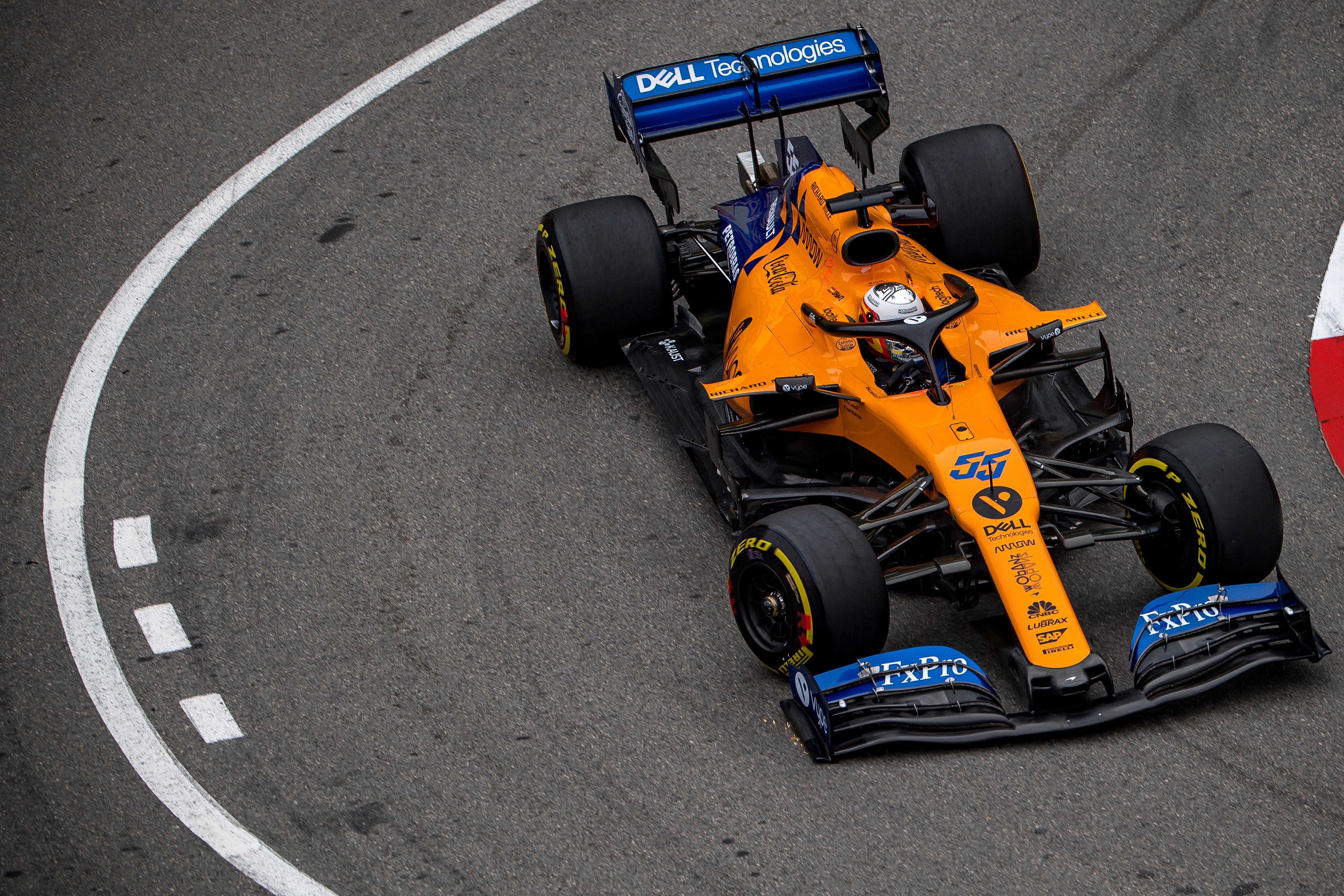
Whilst Monaco is often accused of being a procession, this was certainly no walk in the park for Hamilton. After an early safety car – brought out by Charles Leclerc’s gingerbread trail of bits of tyre and Ferrari floor – Mercedes placed their drivers on the medium tyre whilst Verstappen and Vettel went for the harder option. Verstappen and Valtteri Bottas then collided in the pit lane, leaving the former with a five second penalty and the latter needing to come in due to the damage. At this point, Mercedes changed Bottas to the harder tyre and Hamilton came to the realisation that he was facing the prospect of nursing his tyres for 67 laps with cars attacking him on better-suited rubber.

Toto Wolff later admitted that this was a rare strategic mistake from Mercedes, although their decision was justifiable at the time. They were wary of being jumped after the safety car if their competitors were on softer tyres, the hard tyre had proved tricky during practice and there was also the prospect of rain – sadly, for the spectacle, it never materialised beyond some light drizzle – with the medium the better tyre for damp conditions. It is always tricky to be the lead team in these situations as those following can react to your decisions.

Either way, Hamilton succeeded in fending off the increasingly aggressive Verstappen, who knew that second place would turn into fourth after the penalty if he could not pass, for a victory of perseverance and fighting against the odds. Everything that encapsulated Niki Lauda.

More Ferrari Woes

It was yet another tale of blunders from both team and drivers for Ferrari. They had looked well off the pace during the Thursday practice sessions but found some speed on Saturday morning with Leclerc topping the timesheets. Only for the sister car of Vettel to end up in the wall at Sainte Devote. The engineers did a good job to get it repaired in time for qualifying but that’s where things really started to unravel.

Vettel’s first attempt in Q1 left him in the drop zone. Leclerc also had a scrappy lap which was only 0.2 seconds quicker than his teammate’s but the team decided to try and save tyres by not sending him out, despite their driver’s repeated questioning of that decision. So the young Monegasque had to sit and watch from the garage as ‘LEC’ fell further and further down the timings screen, before being finally knocked into 16th, and out of qualifying, by Vettel of all people.

In the face of some trying times – particularly having victory cruelly snatched away in Bahrain – Leclerc has remained calm and said all the right things. But here, he was visibly furious. Monaco is his home race after all and he knows as well as anyone that passing around the Principality is almost impossible. He decided to go with an all or nothing approach on Sunday. Sadly it was to be the latter as, after an excellent pass on Romain Grosjean at La Rascasse the lap previously, Nico Hülkenberg proved to be less accommodating and Leclerc clipped the barrier. This left him with with a puncture which resulted in terminal damage to the car as he returned to the pits far too fast, clearly having reached the end of his tether.

Meanwhile Vettel, after a scruffy remainder of the qualifying session where he touched the barriers twice, did at least bring home second place come race day. Bizarrely Ferrari’s best result of the year despite the weekend as a whole feeling very much a failure. There is still a long way to go before the systematic issues in Ferrari’s operations are ironed out.

Sainz Continues to Excel Under the Radar

I have, for a long time, felt that Carlos Sainz is criminally underrated.

This is a driver who generally matched Verstappen in their time together at Toro Rosso. The Dutchman scored more points and was more spectacular but Sainz beat him in their qualifying head-to-head before suffering poor luck on race days for the most part.

Whilst Verstappen was hurried up the Red Bull ladder, Sainz’s career stalled somewhat as he spent season after season with Toro Rosso. He finally got his move to Renault towards the end of 2017 but there was to be more bad luck on race days and a very in-form teammate in Nico Hülkenberg. The German scored more points and many seemingly wrote off the still very young Sainz, despite the fact that the Hulk is no slouch, was fully settled in the team and, apparently, Sainz never particularly got on with the Renault’s handling.

Image credit: AFP

But this year, he has a clean slate. He has taken the seat of his boyhood hero, Fernando Alonso, at McLaren and is now finding his feet. After some misfortune and a poor decision to try and squeeze Verstappen that cost him an excellent result in Bahrain, Sainz has really started to perform, culminating in an excellent drive to sixth in Monaco. It also included what Sainz described as “the best move of my career” as he opportunistically carved round the outside of both Toro Rossos at Massenet on Lap 1.

Up against a highly-rated rookie in Lando Norris, Sainz seems to be relishing the role of team leader and it will be interesting to see whether both he and McLaren can continue their progress towards the front of the grid. Maybe we’ll see him back fighting regularly with Verstappen soon enough.

One Very Important Moment Swept Under the Rug

Not broadcast by FOM, a marshal was centimetres from being injured, or even killed, on Sunday.

The marshals at Monaco are generally accepted as being some of the best in the world. In the most constricted surroundings on the calendar, they have always dealt with incidents impressively quickly and efficiently. But it must be remembered that they are volunteers following orders. And when those orders result in a situation like this, Sergio Pérez doing well to keep his head and narrowly avoid two marshals crossing his path, the situation must be examined.

The Monaco Grand Prix in 60 Seconds

Answering the Burning Questions

Surely Mercedes can’t claim another 1-2?! It looked like it was heading that way after qualifying but they’ll have to settle for a lowly 1-3 this time.

Can Max Verstappen keep it out of the wall this year? He can.

Something of a Monaco expert, and on a track with less engine-dependence, can Daniel Ricciardo spring a surprise? An excellent performance in qualifying but poor strategy stifled his race somewhat.

Will Charles Leclerc’s home knowledge see him outclass his teammate? He had seemed the faster driver through practice but Ferrari’s error left him in a different race. A race that, as it transpired, did not last long.

It’s currently due to rain at some point over the weekend…could we have a classic Monaco race rather than a procession? It wasn’t a classic but it was at least a tense procession. Maybe rain next year?..