Six in a row for Red Bull

Apologies again for the lack of activity – work has been crazy, but a highlight being my namecheck from Crofty on Sky F1…

Anyway, I’m back for another multiple-races-into-one report!

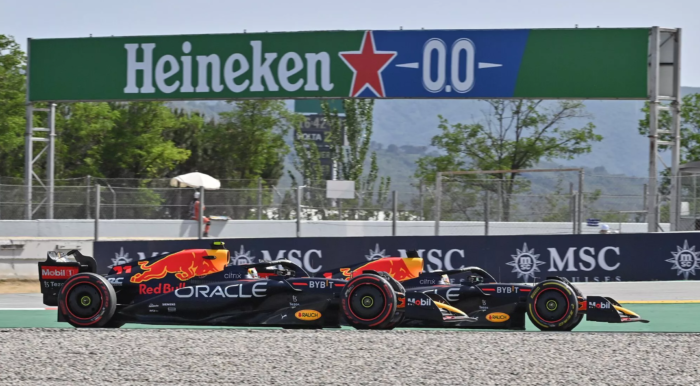
Last time it was three for the price of one. This time it’s six! And they’ve all been Red Bull wins…

The tide begins to turn in Imola

Really testing my memory here but let’s take a crack at a summary of the Emilia Romagna Grand Prix.

Having taken his first pole of the year, Max Verstappen got off the line poorly in the first Sprint Race of the year and was jumped by Charles Leclerc. He would make amends, though, reclaiming the lead on the penultimate lap.

Meanwhile, the title rivals’ respective teammates – Sergio Pérez and Carlos Sainz – fought their way through the field to third and fourth respectively, having started seventh and 10th after a chaotic, wet qualifying session which also saw the Mercedes caught out by a red flag and eliminated in Q2.

Image credit: Getty Images

The rain returned on Sunday and this time it was Leclerc with the poor getaway, dropping behind Pérez and Lando Norris.

All of Sainz’s hard work during the Sprint was undone immediately as he was punted out at the first corner by an understeering Daniel Ricciardo.

Leclerc reclaimed third from Norris but was never quite able to pass either Red Bull and then made his first mistake of the season as he desperately tried to catch Pérez.

A bad day for the onlooking Tifosi got worse as Leclerc spun at the Variante Alta chicane.

He recovered to sixth – and the fastest lap – after a pit stop for a broken front wing but saw his title lead shrink as the Red Bulls picked up their first 1-2 since the 2016 Malaysian Grand Prix, with Norris taking McLaren‘s only podium of the year so far.

Further back, George Russell made a great recovery drive to fourth, but teammate Lewis Hamilton was less fortunate on the opening lap and found himself stuck in a DRS train for the next 90 minutes.

Welcome to Miami

Will Smith references perhaps became a little less palatable thanks to a certain slap a month or so earlier, but the above was somewhat inevitable as F1 headed to Florida for the inaugural Miami Grand Prix.

In a race that appeared to want to be America’s version of Monaco, celebrities came from far and wide for a look at some F1 cars and a dip – or perhaps not – in the infamous fake marina.

Image credit: Reuters

On track, Ferrari locked out the front row for the first time in over two years but Verstappen would have them split by the first corner.

And eight laps later, he would have the lead.

The next hour or so was largely dull until a somewhat bizarre clash between Norris and Pierre Gasly brought out the Safety Car.

Leclerc gave it his all in the closing laps but Verstappen had enough to hold onto the lead, with Sainz also holding off Pérez for the final spot on the podium.

After a poor performance in qualifying, Russell got lucky with the timing of the Safety Car – not for the first time this season – allowing him to continue his run of top-five finishes, whilst Mick Schumacher threw away a chance of his first points with a clumsy lunge on hero and mentor Sebastian Vettel.

The Pain in Spain Falls Mainly on Leclerc

Having waited over five years for their last 1-2, Red Bull wouldn’t even have to wait five weeks for their next one.

Image credit: Motorsport Images

This time, though, it was not on merit.

Leclerc picked up another pole and proceeded to sail away at the front as Sainz and Verstappen behind him each took a trip into the gravel at Turn Four thanks to a couple of rogue gusts of wind.

That dropped the Dutchman behind Russell and Pérez. Whilst his teammate was predictably easy to pass, the Mercedes would prove far trickier – Verstappen spending almost half the race staring at the INEOS-branded rear wing as the DRS flap on his own rear wing developed a fault.

Their battle became one for the lead when Leclerc suffered an engine failure, his despairing calls over the radio reminiscent of those at Sakhir in 2019.

Red Bull decided to mix things up with a three-stop strategy for Verstappen and it paid off.

However, that was in some part due to the team asking Pérez to let him through, the displeased Mexican saying “that’s very unfair, but okay”.

Russell would take a second podium of the season, whilst his teammate provided arguably the performance of the day.

Hit by Kevin Magnussen on the opening lap, Hamilton had fallen to the very back of the pack but produced a stellar drive through the field to fourth, before a late engine issue saw him fall back behind Sainz.

Toto Wolff said he believed a 104th win would have been possible for the seven-time world champion without the early incident. Signs of life from the Silver Arrows?

The Leclerc Monaco Curse Strikes Again

Image credit: Getty Images

F1 returned to the setting of its favourite real marina in late May, with Leclerc surely standing the best chance to end his run of horrible luck on home soil.

And things looked even better once he’d secured the all-important pole position around the streets of Principality.

In terms of admin and organisation, it was a pretty shocking weekend for the under-pressure event.

A downpour and a local power cut saw a delay to the start of the race that was equal parts embarrassing and confusing, whilst the TV direction was once again poor at the only race on the calendar that insists upon having its own local director.

By the time the race finally got going, most of the rain had disappeared and Leclerc appeared comfortable out front.

Then came the Ferrari strategy blunder, though.

An erroneous stop for intermediate tyres put Leclerc in trouble; a belated call to stay out sealed his fate.

The end result was a top-four order of Pérez, Sainz, Verstappen and then Leclerc.

A nasty-looking crash that ripped Schumacher’s car in two brought out a red flag – as well as adding further pressure to the young German – and gave the leading cars a choice to make.

The Red Bulls chose the medium tyre for the final 45 laps of the race whilst the Ferraris went with the hard.

Ultimately it proved to be a moot point as passing was shown to be impossible once again on the tight streets, even when Pérez’s tyres were well past their best.

Image credit: Getty Images.

So, a third career win for the popular Mexican and one that almost brought him to tears on the podium.

A Definitive Swing in the Title Battle?

A fortnight later and the F1 circus headed to its often-far-more-chaotic street race in Azerbaijan.

It was yet another pole for Leclerc – his sixth in eight races – after a stunning final Q3 lap, but once again things would unravel on race day.

He was passed into the first corner by Pérez, but had been holding Verstappen at bay when teammate Sainz trundled into an escape road with a hydraulic issue.

The Spaniard’s painful 2022 season continues, but his misfortune did allow his team to take a strategy risk and bring Leclerc in for a cheap pit stop under the ensuing Virtual Safety Car.

Despite Verstappen having been tucked up behind his title rival, it was Pérez whose tyres were struggling and he was soon caught by his teammate.

The team informed the Mexican that there should be “no fighting” and car number one sailed past on the start-finish straight.

The race appeared to be heating up nicely with Leclerc retaking the lead on his alternate strategy as the Red Bulls pitted, but the weekend was about to get yet more painful for the Scuderia.

The cameras cut to a plume of smoke emerging from the back of the remaining prancing horse of Leclerc, who pulled into the pits to retire.

Image credit: Formula 1

From there it was a comfortable run to the chequered flag for Verstappen, with Pérez and Russell equally at ease in second and third.

If there was one thing that the weekend wasn’t for many of the drivers, however, it was comfortable.

The new regulations’ bouncing and porpoising issues hit new heights – both metaphorically and literally – with Hamilton barely able to get out of his car at the end of the race due to severe back pain.

F1 Finally Returns to Canada

After three years away, the sport finally made its return to the popular setting of Montreal, and the Circuit Gilles Villeneuve showed F1 what it had been missing.

Another eventful wet qualifying session saw Verstappen secure pole, with Fernando Alonso on the front row for the first time in over a decade and Leclerc starting at the back with an engine penalty.

It was Pérez suffering an early mechanical failure this time and bringing out a Virtual Safety Car under which Verstappen and Hamilton pitted.

Once things had shaken out it was a clear front three of last year’s title rivals either side of Sainz.

With 20 laps remaining, Yuki Tsunoda embarrassingly slid straight into the barriers at the pit exit, bringing out a first full Safety Car of the race.

On fresher tyres, Sainz hounded Verstappen to the end but the Red Bull’s superior traction meant he was always able to stay just out of reach in the DRS zones.

Image credit: Getty Images.

So close, yet so far once again for the Spaniard, who now has 11 podiums without a victory and is closing in on Nick Heidfeld’s unwanted record.

No such problems for Verstappen, though, who further extended his championship lead despite Leclerc recovering to fifth.

After two painful weekends – in every sense – on street circuits, Hamilton and Mercedes showed signs that they might be able to challenge on upcoming smoother tracks, whilst Mr-Saturday-turned-Mr-Consistency Russell continued his impressive record of finishing in the top five at every race.

F1 fans feared that Red Bull’s early-season mechanical woes would ruin the title battle as Leclerc dominated.

With a sixth consecutive race win for the Austrian team and now a 49-point margin to Leclerc in the championship, it appears that it may, in fact, be the other way round.
2019 Canadian GP report | Hamilton wins…but that’s not the headline

A good race; a greater controversy.
Lewis Hamilton and Sebastian Vettel on the podium at the 2019 Canadian Grand Prix.
Image credit: Motorsport Images

Let’s get the basics out of the way. Lewis Hamilton claimed victory at the 2019 Canadian Grand Prix and Mercedes continued their clean sweep of wins.

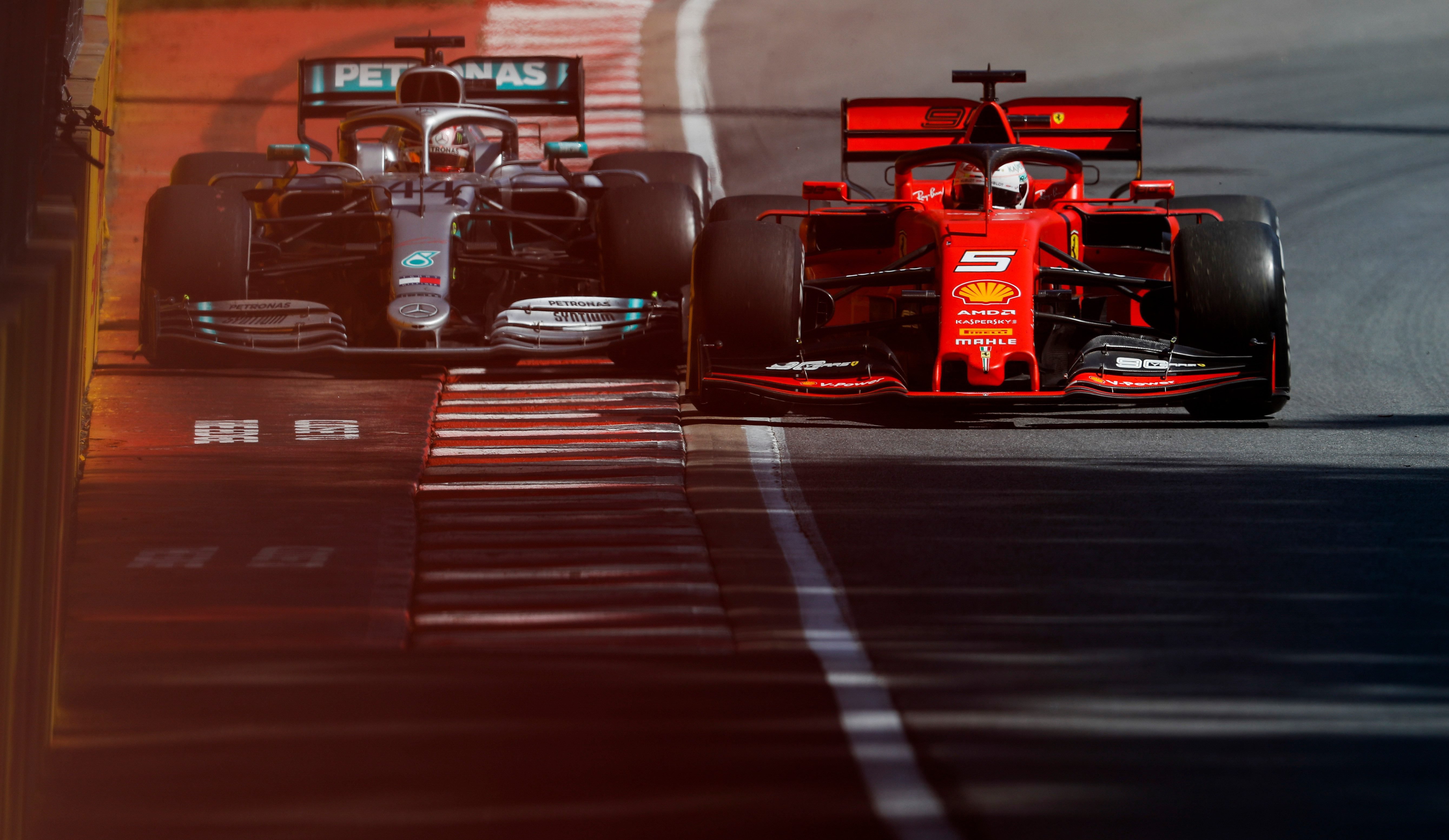
However, it was in very controversial circumstances after Sebastian Vettel was given a five-second penalty for obstructing Hamilton as the German rejoined the circuit having ended up on the grass at Turns 3 and 4. More on that later. (In fact, most of the post will be about it as it’s all anyone is going to be talking about.) But firstly, let’s quickly address the rest of the race. (Feel free to scroll down if you’re only interested in the controversy…)

The front two were near enough in a race of their own throughout with Vettel’s teammate, Charles Leclerc, never quite in the fight and Hamilton’s teammate, Valtteri Bottas, a distant fourth. Leclerc will be pleased at least to bounce back from his eventful – for all the wrong reasons – home race two weeks ago with a solid podium but he still needs to work on his qualifying performances. Despite often looking the faster Ferrari through the practice sessions, he has made mistakes when it really counts and left himself with a lot to do on Sunday. Bottas unfortunately reverted to Bottas 1.0 and was never really on Hamilton’s pace all weekend. A very scruffy Q3, where he was lucky to escape the barriers after a spin, saw him start 6th. He then lost a position at the start, spent numerous laps stuck behind slower cars and is now 29 points behind his teammate in the standings.

Daniel Ricciardo continues to look more and more at home in the Renault, demonstrating his late-braking talents – which he had seemed to be struggling to dial in to his new car at the start of the year – to keep Bottas behind him for far longer than he had any right to. The Honey Badger ended the race a commendable 6th and was followed home by the sister Renault of Nico Hülkenberg to complete an excellent weekend for the French team on a track at which they had not expected to be all that successful.

Max Verstappen recovered well to 5th after unfortunate timing with a red flag in Q2 left him starting 9th on the grid, whilst teammate Pierre Gasly’s struggles continued as he went in the opposite direction, from 5th to 8th. Lance Stroll had an excellent home race, progressing from 17th on the grid to finish 9th, claiming two well-deserved points to silence some of his critics, at least for a while. And finally a quick mention also for the unfortunate Lando Norris, whose rear suspension seemingly melted thanks to severely overheating brakes – something I have never seen before in the sport – which put paid to a very promising race for the youngster. His car unusually left stranded at the side of the pit exit – because it was not in a dangerous position – evoked memories of the 90s where broken cars would be scattered around the track, abandoned. And of course he used his retirement to produce yet another meme.

What We’re All Here to Talk About

Now then. Where to begin…

What Happened

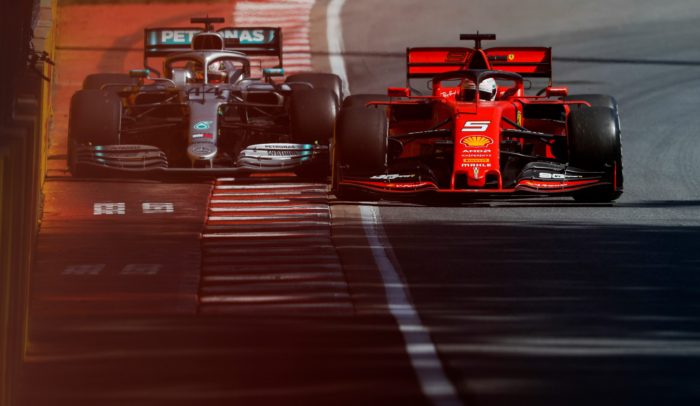
In arguably the battle of the year so far, Hamilton had been right on the tail of his long-term rival for some time. After the pit stops, he quickly closed a five-second gap and then began pressuring Vettel in what was shaping up to be a thrilling fight to the end of the race. We had already had nine laps of this when Vettel made a mistake under pressure – certainly not his first – and overcooked his entry into Turn 3, catching a snap of oversteer but in the process having to take to the grass.

Lewis Hamilton and Sebastian Vettel during the defining moment of the 2019 Canadian Grand Prix.
Image credit: LAT Images

This is where the controversy occurs. Vettel rejoined the track very close to Hamilton, who tried to go around the outside but then backed out as he was squeezed towards the wall. Hamilton came on the radio to say that Vettel had rejoined the track dangerously – understandably so when you see the incident from his on-board camera – and after a few minutes of investigation, the stewards handed Vettel a five-second time penalty. With that, the race effectively died. Whilst Hamilton states he continued to try and pass for the remaining laps, and to his credit he certainly didn’t just sit three or four seconds back and coast home, there was no real need for him to take any risks.

Vettel spent the remainder of the race understandably fuming and then, in bizarre scenes, parked his car as far as he could from the designated spot in parc fermé and stormed off to Ferrari hospitality, before being fetched by an official and his media adviser. He then returned for the podium via the Mercedes garage and a brief stop to switch the number boards, placing the ‘number one’ in front of the space where his car would have been and the ‘number two’ in front of Hamilton’s car. Credit where credit’s due: that is a baller move.

Now. For 95% of people, at least judging by social media, this appears to be a slam dunk and not up for debate; it was totally the incorrect decision and a huge injustice for the Ferrari driver. But as I see it – and I have looked into this in massive depth over the last 24 hours – it’s a closer call than that. There are many aspects to examine in little over a second of action and then many different ways to interpret the minutiae. Every point has a caveat and I could easily follow most of the following sentences with a ‘but’ or a ‘however’…and in fact I do a fair few times. Let’s start with the fundamentals: the rules.

The Rules

Here are two pertinent regulations.

The first: “Should a car leave the track the driver may rejoin, this may only be done when it is safe to do so and without gaining any lasting advantage.” Removing this from the bigger picture, putting it plainly in black and white, Vettel did return to the track in an unsafe manner and he did gain a lasting advantage in that if he’d rejoined more slowly and safely, Hamilton would have passed him. Only he didn’t really have the opportunity to do so. He was simply trying to recover control of the car the entire time he was on the grass and in the split second which followed on the track. The first time he checks his mirrors is around the point at which Hamilton had to bail out. Having said that, it’s down to his mistake that he is in that position so why should Hamilton be the one to suffer? (See what I mean about the caveats?..) As Hamilton put it, “I was just driving the normal line so I shouldn’t have been in the position of being close to crashing. It was his responsibility to avoid that, but it ended up being mine. So because of that I lost a chance of passing”.

The second: “Manoeuvres liable to hinder other drivers, such as deliberate crowding of a car beyond the edge of the track or any other abnormal change of direction, are strictly prohibited.” Similarly, whilst Vettel was not in control and thus the ‘deliberate’ aspect can be ignored, Hamilton was certainly hindered. But, by definition, a manoeuvre is ‘a movement requiring skill’, so surely not being in control means this can’t be classed as one. Either way, it has now come to light that a large part of the stewards’ decision came from Vettel’s movements after regaining control. Their data shows that, after checking his mirror, he opened the steering to move towards the edge of the track. Certainly a manoeuvre this time but up for debate whether, by that point, it was impeding Hamilton.

It all boils down to what each fan or member of the F1 paddock wants from the rules. They are a necessary evil. Remember how angry everyone was when Verstappen came on the scene and repeatedly exploited loopholes to defend dangerously? There have to be lines somewhere and, once those lines are drawn, surely they have to be enforced. The gravity of the situation shouldn’t be a factor. If this had happened between Sergio Pérez and Antonio Giovinazzi for 12th place, there is less at stake, and people obviously wouldn’t feel as passionately, but does that mean that the situation should be ruled differently?

Precedent

The bigger picture here is the consistency of rulings. Whilst most fans immediately stated that they are inconsistent, an almost identical incident between Verstappen and, ironically, then-Ferrari-driver Kimi Räikkönen at last year’s Japanese Grand Prix also brought about a five-second penalty. At the time, most seemed to go with the opinion of harsh but fair, and Ferrari obviously thought so. Vettel himself said “Look at Kimi. [Verstappen]’s off the track and he comes back and if Kimi just drives on they’d collide. But it’s not always right that the other guy has to move.” Sound familiar? The late, great Charlie Whiting described it as “a fairly straightforward one for the stewards”.

Here comes another caveat though. There was also a pretty similar incident between Ricciardo and Hamilton at Monaco in 2016 which was not penalised. This one was also for the lead of the race so had the same gravitas as Vettel and Hamilton’s incident. Did that factor in to the decision? Only the stewards will know. At the time, some certainly thought he was lucky to get away with it.

Just one more point to add to this already perplexing and convoluted mire I’ve created. Hypothetically, if Hamilton had kept his foot in and they had both ended up in the wall, what penalty, if any, would fans have expected to be dished out?

An Attempt at a Conclusion

So this is the crux of the matter. Did Vettel rejoin the track in an unsafe manner and cause Hamilton to take avoiding action? Yes. Did he have any control of that once off the track? No. Was it his fault he was off the track and thus out of control? Yes. This could go on and on, further down the rabbit hole.

We as fans have to accept that the stewards have far more information than us to base their decisions on and that they are more experienced than 99% of us. But it would be far easier to do so if there were a consistent panel of respected figures who were accountable and then came out and explained exactly how and why they came to their decisions. Surely that’s not too hard for the senior leaders to put together. The fact that the crowd ends up booing Hamilton – surely an innocent party in this whole debacle – in the absence of anywhere else to direct their anger, is a real shame.

It is hard to come to a definitive conclusion. I remain somewhat on the fence. I am fully for hard racing but I also understand that there have to be rules and, with the rules that we have currently, I can see why they came to the decision that they did. In this instance, they have applied the letter of the law rather than spirit of the law. The bigger question is whether the rules need to be amended. Generally this year the stewards have been more lenient and the public and pundits have seemed happy with it.

I guess it depends whether Liberty Media want the headlines to come from the racing or the controversy. As, if we can be certain about one thing in all this, it is that more lenient stewarding would have resulted in a far better end to the race.

Well, that and the days of ‘Ferrari International Assistance’ being long gone.

Answering the Burning Questions

(I guess I should still answer these…)

Will the track really favour Ferrari as predicted? We’ve heard that a few times this year.. Yes, for once the top two teams were evenly matched.

How much of an improvement will the Mercedes engine upgrade provide? Not a significant one seemingly. Also, one of them blew up…

Will the Wall of Champions claim any new victims? Kevin Magnussen had a brush with it but properly crashed on the other side of the track. And isn’t a champion anyway.

Can Bottas continue to get on top in qualifying or will Monaco prove a turning point? It’s looking more like the latter.

Will Leclerc bounce back from his less-than-ideal home Grand Prix? It was certainly an improvement, if not a great weekend.

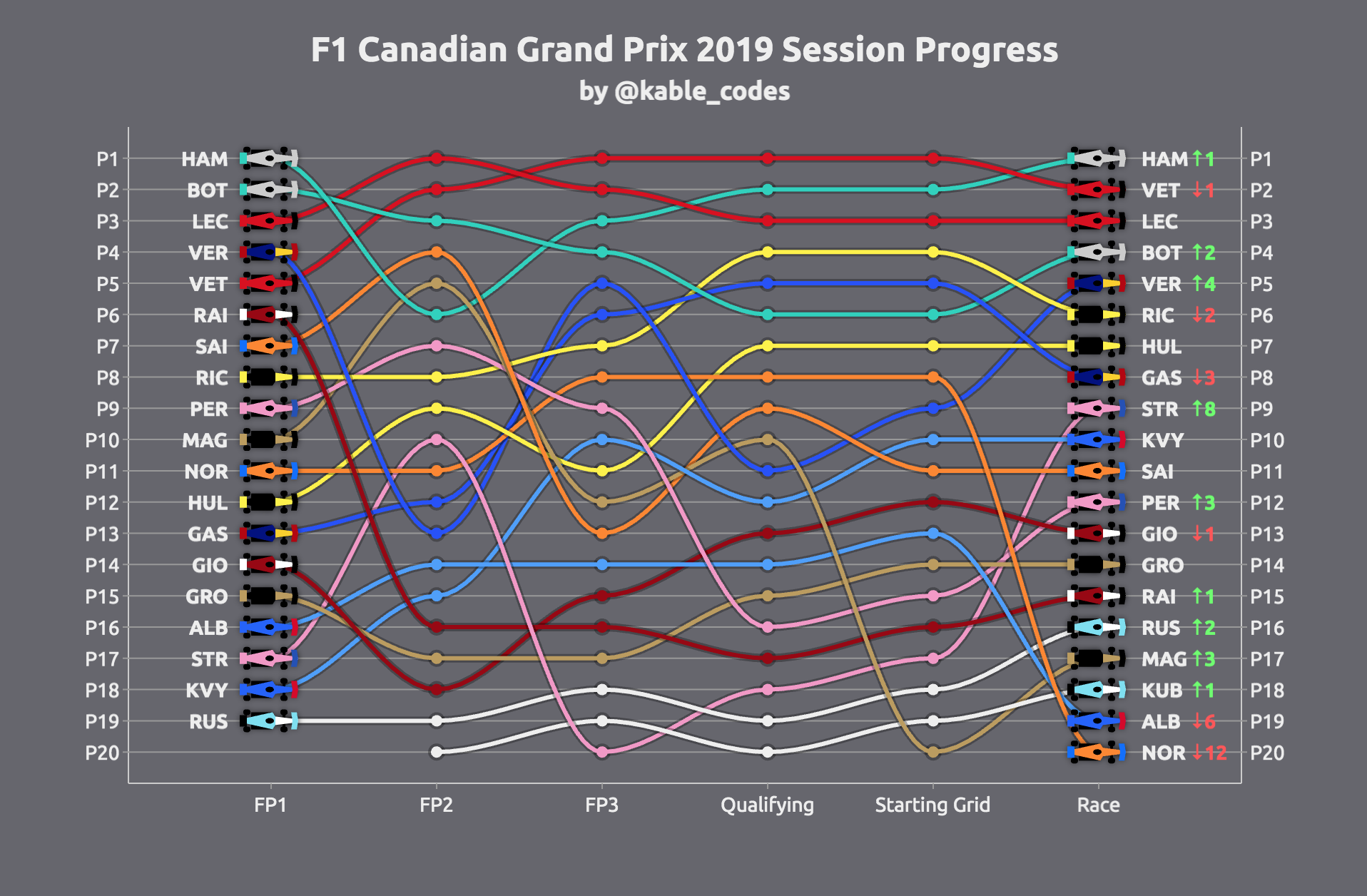
Session Progression

2019 Canadian GP preview

The Burning Questions

Will the track really favour Ferrari as predicted? We’ve heard that a few times this year..

How much of an improvement will the Mercedes engine upgrade provide?

Will the Wall of Champions claim any new victims?

Can Bottas continue to get on top in qualifying or will Monaco prove a turning point?

Will Leclerc bounce back from his less-than-ideal home Grand Prix?

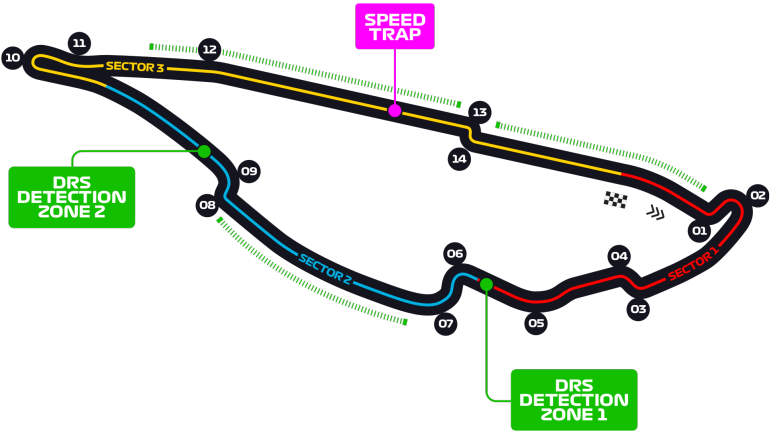
The Track

The Stats

Track Length: 4.361 km

Laps: 70

Race Distance: 305.27 km

First Grand Prix: 1978 (Montreal) | 1967 (Canadian GP)

Race Lap Record: Rubens Barrichello | Ferrari | 2004 | 1:13.622

Outright Lap Record: Sebastian Vettel | Ferrari | 2018 | 1:10.764

Most Driver Wins: Michael Schumacher | 1994, 1997, 1998, 2000, 2002, 2003, 2004

Most Constructor Wins: McLaren | 1988, 1990, 1992, 1999, 2005, 2007, 2010, 2011, 2012

The Photos

The Predictions

Podium

Pole Position

Fastest Lap

Driver of the Day