A messy situation has come to a close with Naomi Osaka’s announcement that she has withdrawn from the French Open.
Could the organisers have handled it better? Could Osaka have handled it better? Could the media have handled it better? The answer to all those questions is almost certainly yes. But this entire episode is just a microcosm of the modern state of journalism and raises questions about the stress put on athletes in our unquenchable thirst for more and more content.
The Japanese world number 2 announced in the build-up to the Roland Garros tournament that she would not be participating in any press conferences in order to protect her mental health. All forms of media were immediately awash with widely varying opinions – some supportive, others sadly predictably vitriolic.
Whilst public awareness of mental health has undoubtedly increased considerably over the last decade or so, there is still a long way to go to tame the stigma surrounding it; particularly amongst the older generations.
On a personal note, I have seen the effects of mental health up close. I lost a friend to bipolar disorder and then, upon losing my father in 2018, watched as my mother refused to let herself truly grieve and snapped at simply the utterance of the phrase ‘mental health’.
This still appears to be some people’s immediate response. ‘Mental health’, in the eyes of a portion of the public, is reserved solely for ‘crazy people’.
“Men don’t cry”, they hark. “Maintain that British stiff upper lip.”
This is a notion particularly apparent in sport. It is perhaps linked to the inherent physicality; each discipline’s modern-day gladiators, battling it out in the appropriate arena, doing their best not to show any signs of weakness.
But we no longer live in a gladiatorial age. There is not an emperor watching from above, ready to deliver the competitors’ fate via a thumbs up or thumbs down. We live in an age of millions of self-appointed emperors, ready to deliver their thumbs down emojis and far, far worse over social media.
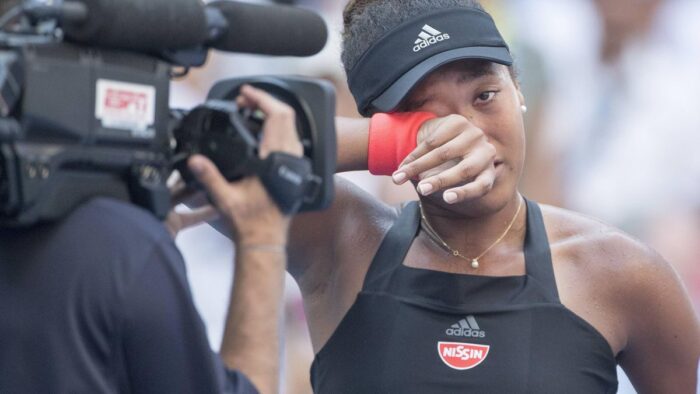
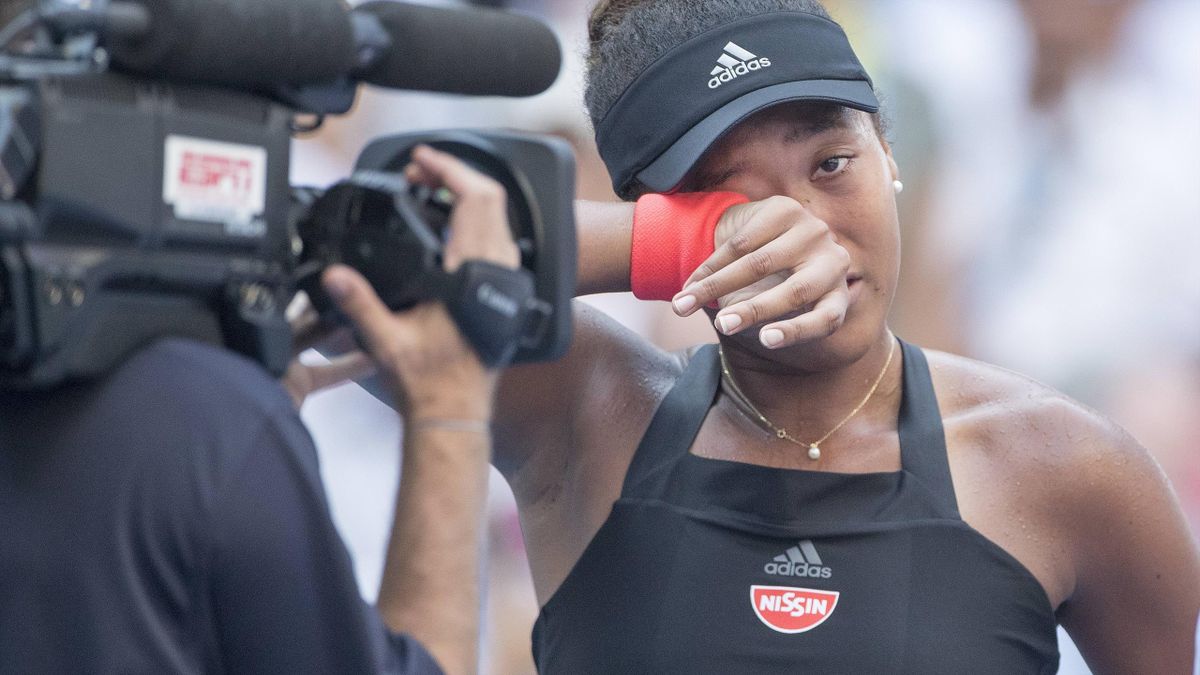
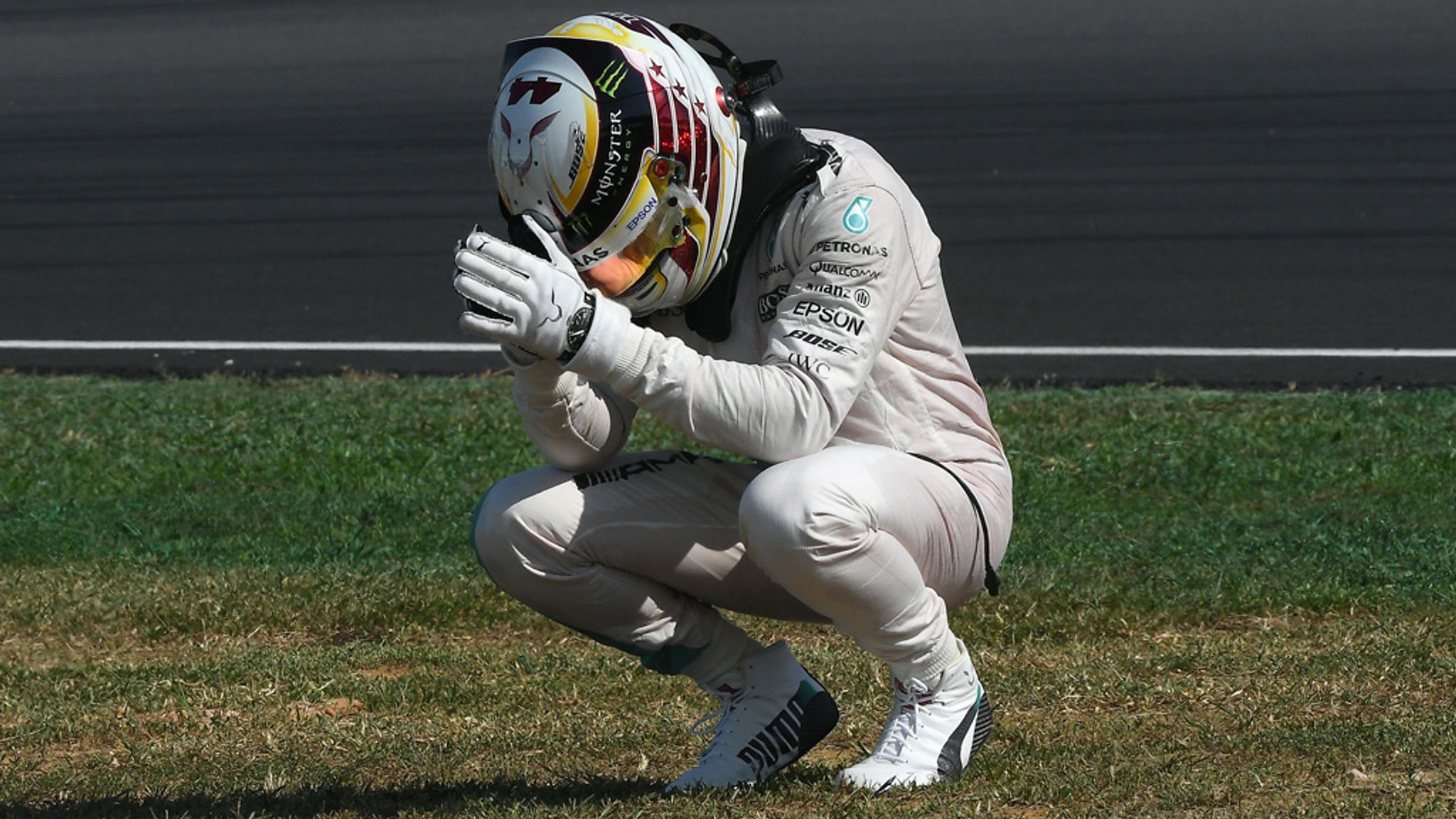
So, it should come as absolutely no surprise that Osaka – amongst many others who no doubt suffer in silence – endures bouts of depression. Even if you swear off social media and/or delegate management of your social platforms to a hired team, abuse is unavoidable. Below is the reception Osaka received in person as the winner of the US Open in 2018.
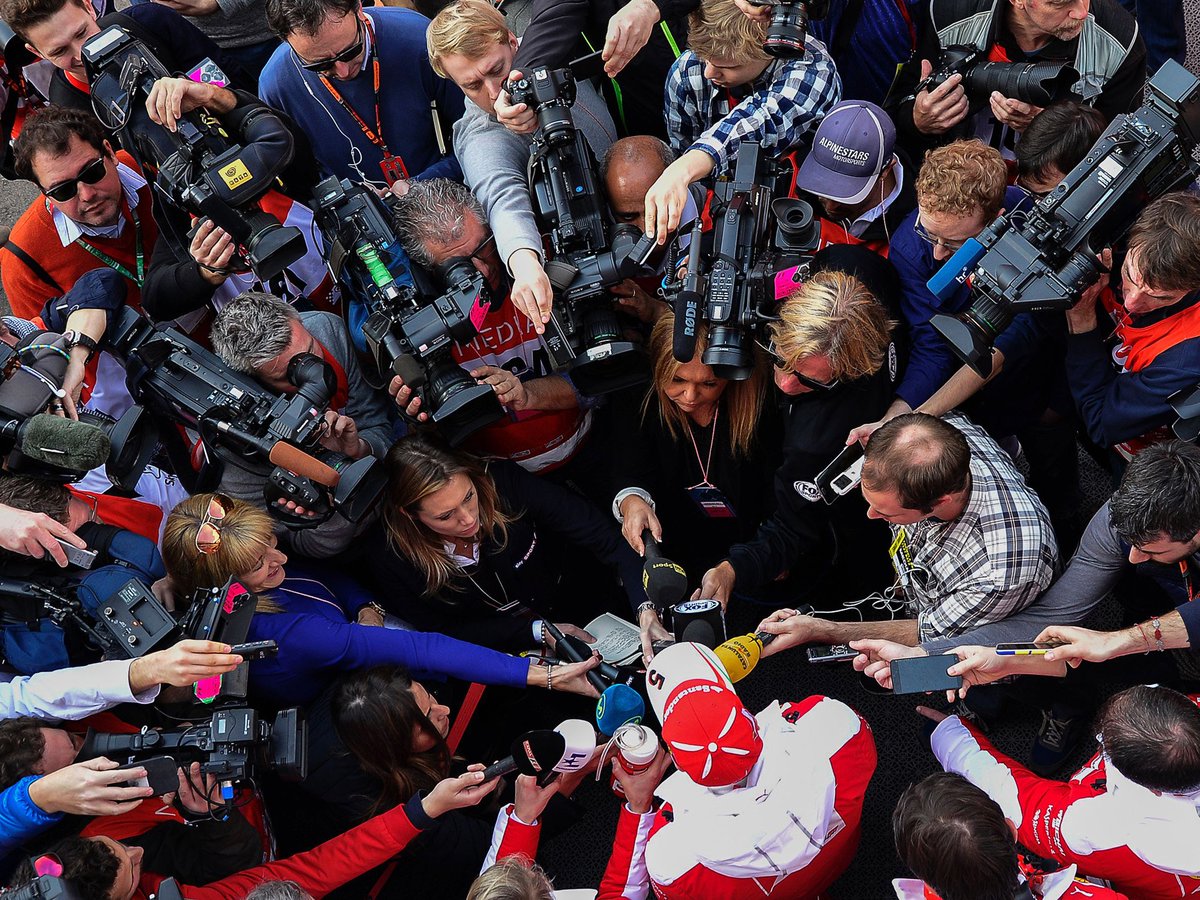
And once you’ve survived the mental onslaught of performing under the most intense spotlight in a daunting amphitheatre, you are sat down – with adrenaline still coursing through your veins – in front of the headline-hungry press.
This is the crux of the issue. We now live in a world where elements of the media have grown slowly redundant. In a time of smartphones, with all the world’s information seconds away via one Google search, newspapers are no longer essential in letting the world know the score, and how that score came to be. So, they are forced into predatory tactics, desperate for a quote that can be twisted to form a suitably clickbait-y headline and get those oh-so-precious page views.
But that’s not what journalism should be. There are other ways in which to refine the modus operandi; to adjust to the modern world in a manner befitting what was once a profession aimed to enlighten, rather than muddy the waters.
It is possible to produce an article without a reliance on quotes from competitors. I have done so here.
It is possible to provide meaningful insight and technical knowledge in one’s own words to produce an article worthy of the reader’s time. Rather than relying on a momentarily lapse from the athlete’s carefully rehearsed public relations spiel.
Yes, perhaps Osaka and her team could have handled this situation better. Maybe by going to the organisers directly rather than making the announcement on Twitter. But it would be no surprise to learn that she has done exactly that in the past, only to have her protestations fall on deaf ears.
The 23-year-old has made a real statement in Paris. She has effectively called the organisers’ bluff, after being threatened with expulsion from the tournament in the wake of her absence at Monday’s press conference. Osaka is likely far from the only young tennis player to feel this way and, if others follow suit, there won’t be a tournament to report on at all.
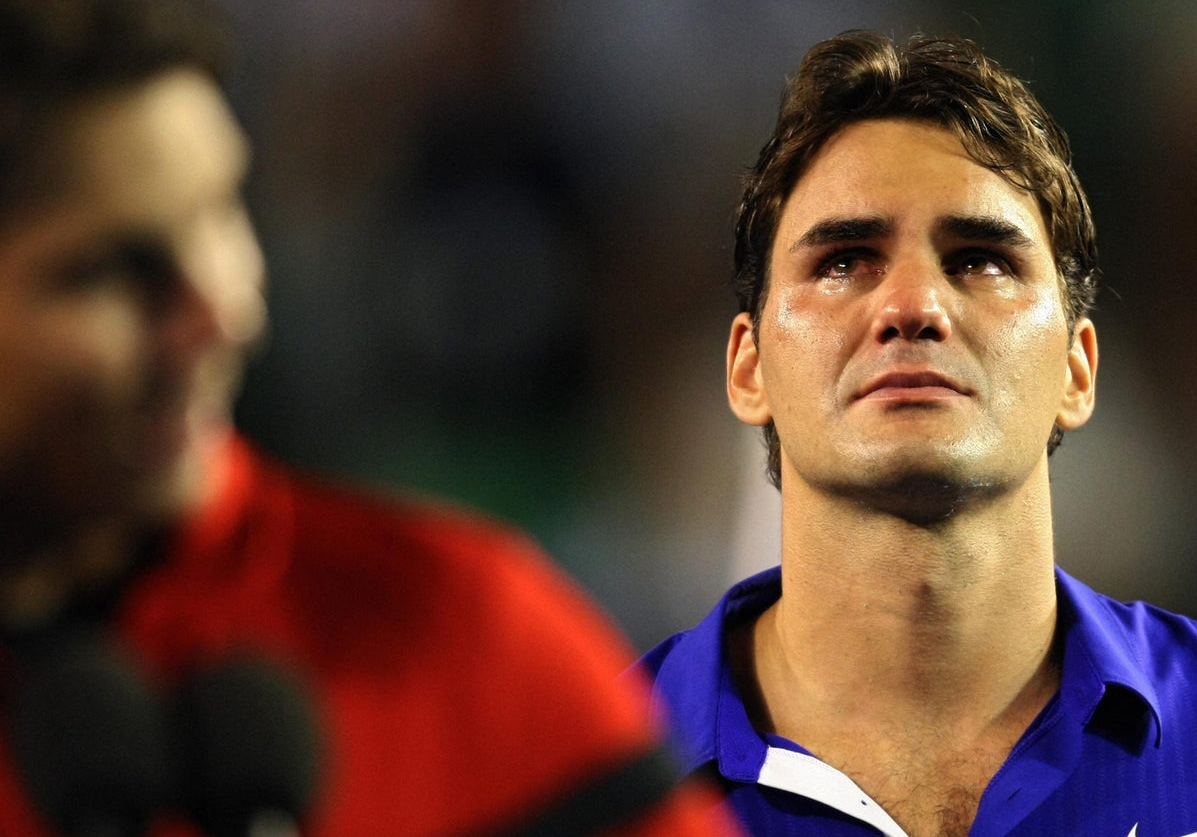
Raw emotion is a part of what makes sport so great, but watching the drama unfold should be enough. Immediately shoving a microphone in the loser’s face should not be deemed a necessity. And a tennis player forcing journalists to be a little creative with their writing should not be punishable by expulsion.
Ecstasy for Verstappen, agony for Leclerc, frustration for Hamilton.
Image credit: Getty Images
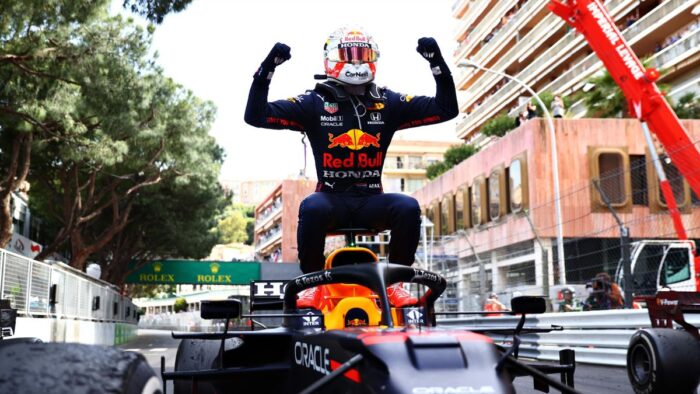
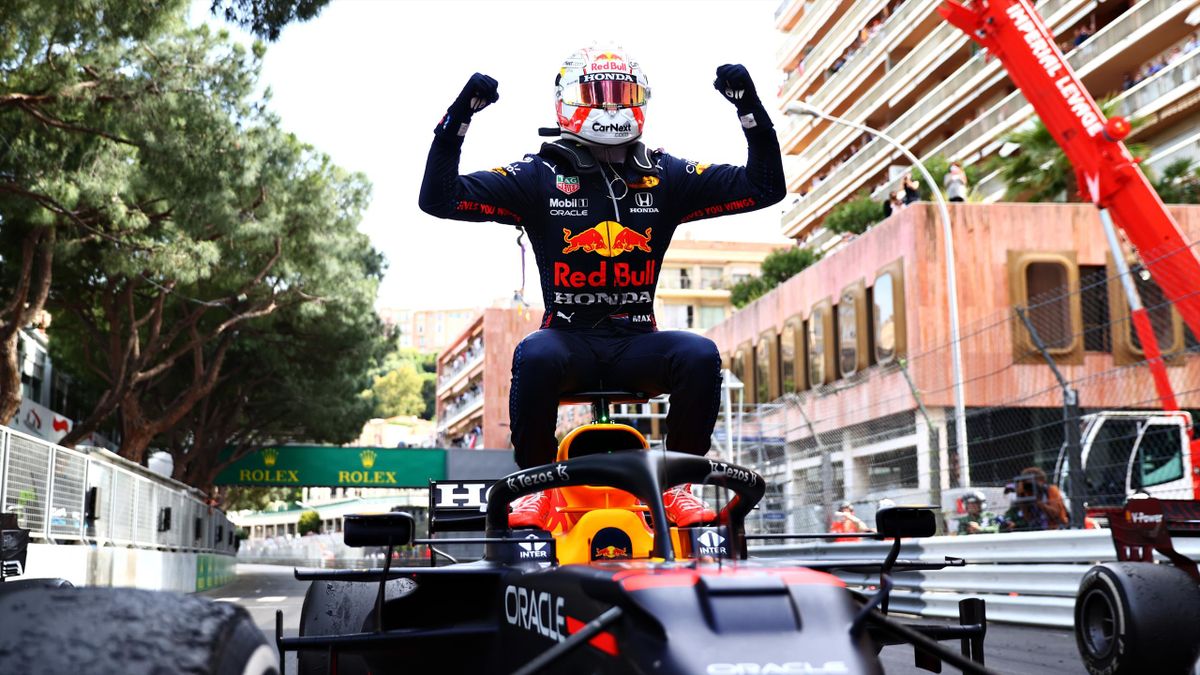
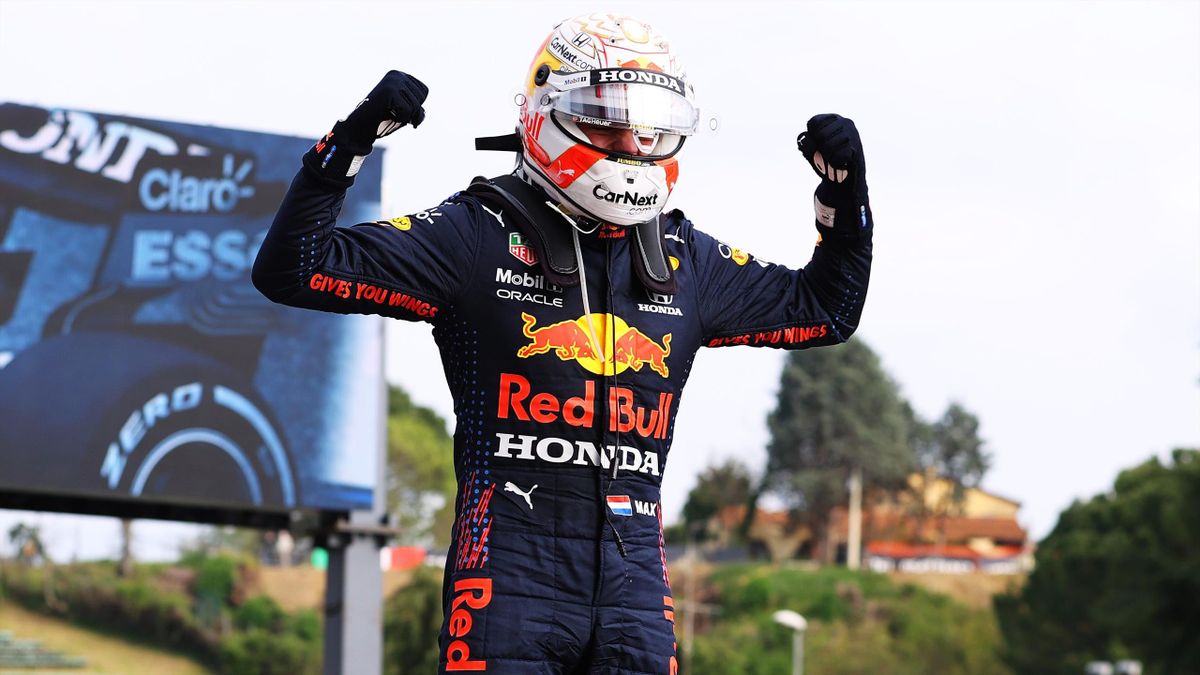
Max Verstappen took his first win at the Monaco Grand Prix as all his main challengers gradually fell by the wayside.
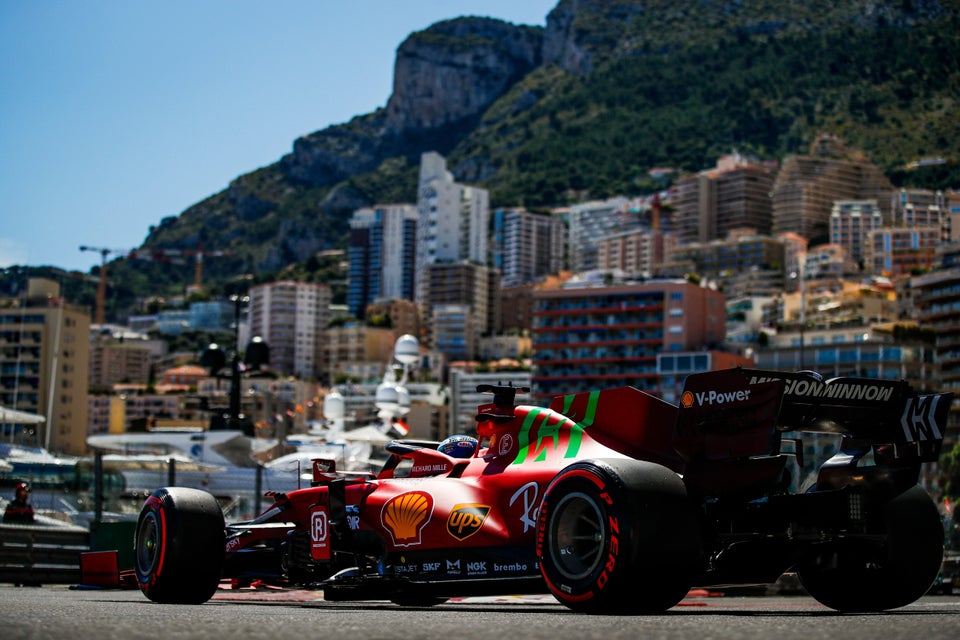
It appeared that Charles Leclerc had broken his Monaco curse when his gearbox was deemed safe to start the race after he had crashed in qualifying on his way to claiming pole position. But the curse returned with a vengeance on his installation lap and the Monegasque was cruelly consigned to watch his home race from the garage by a terminal driveshaft issue.
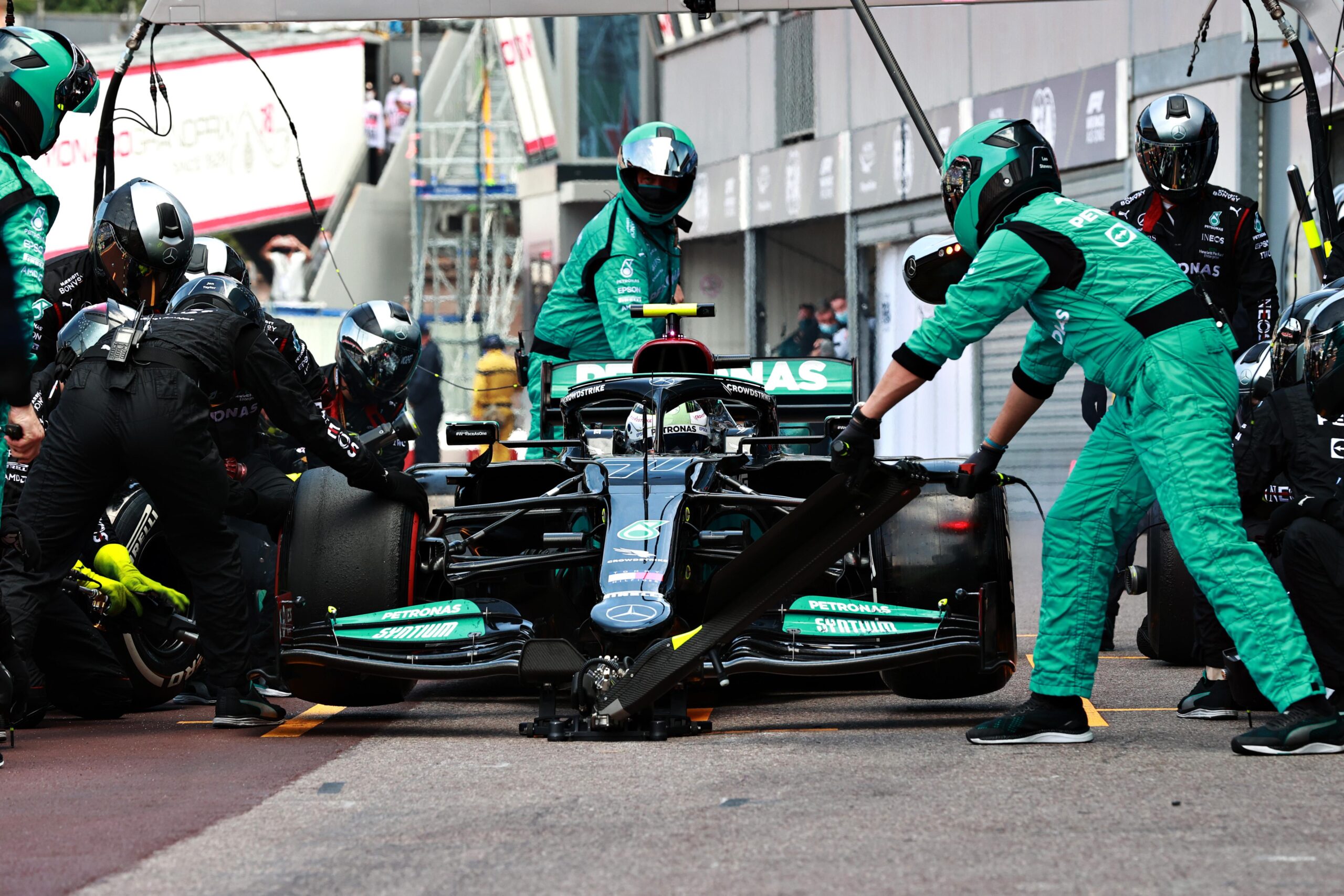
That left Verstappen effectively on pole and, once he had survived Valtteri Bottas‘s attack into the first corner, the race was his to lose. Bottas shadowed him for the first few laps as all the drivers managed their pace to conserve tyre life but, as they moved closer to the first stops, the Mercedes started to fall away from the Red Bull and into the clutches of Carlos Sainz in third place.
Out front, Verstappen was having no such dramas and serenely sailed to the chequered flag, keeping a comfortable gap to the chasing Sainz throughout. The Spaniard provided some consolation for Ferrari after Leclerc’s heartbreak with a strong second place, but was a little disappointed as he felt that he could have challenged for pole and victory without the Q3 red flag caused by his teammate’s crash.
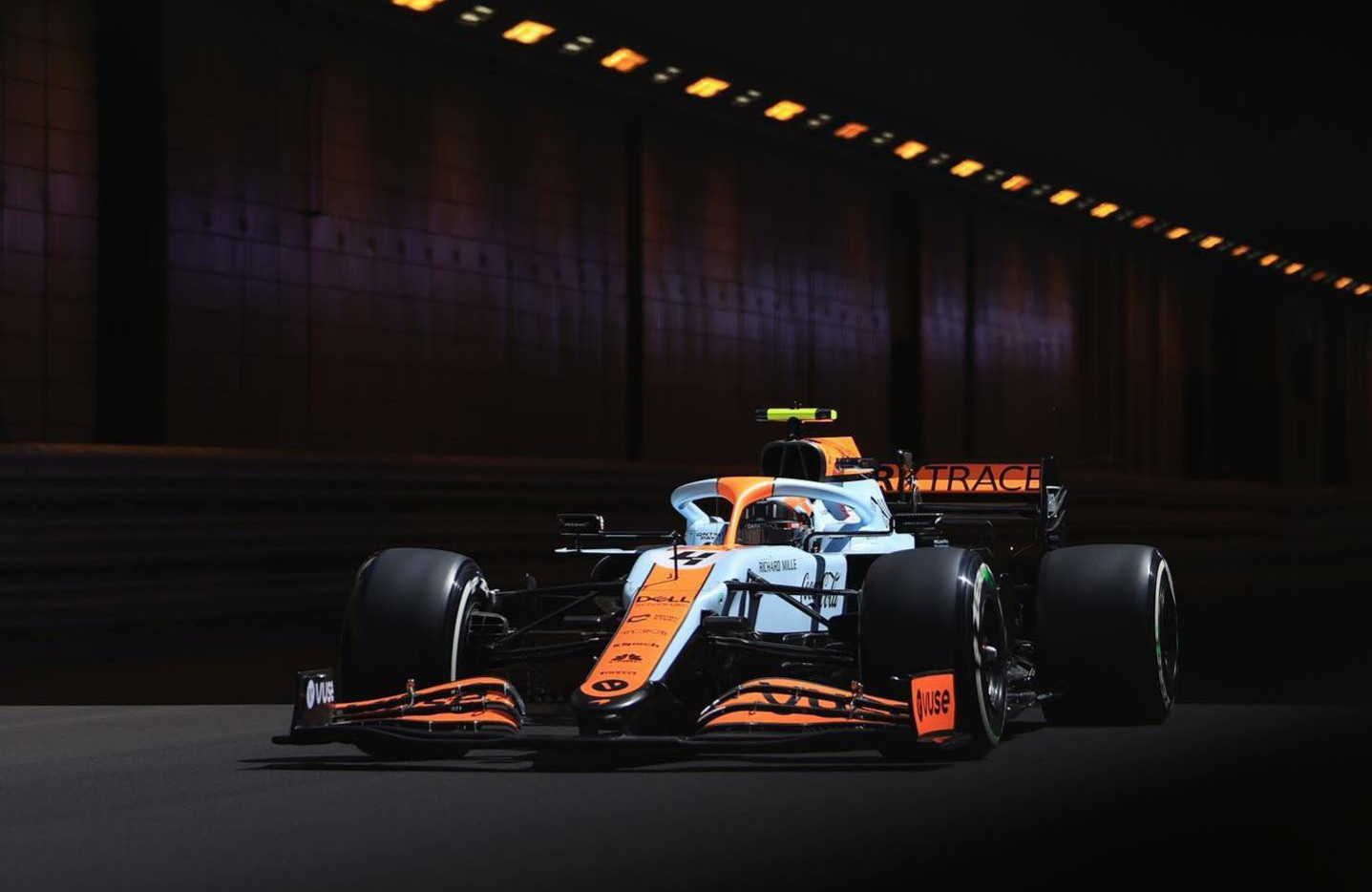
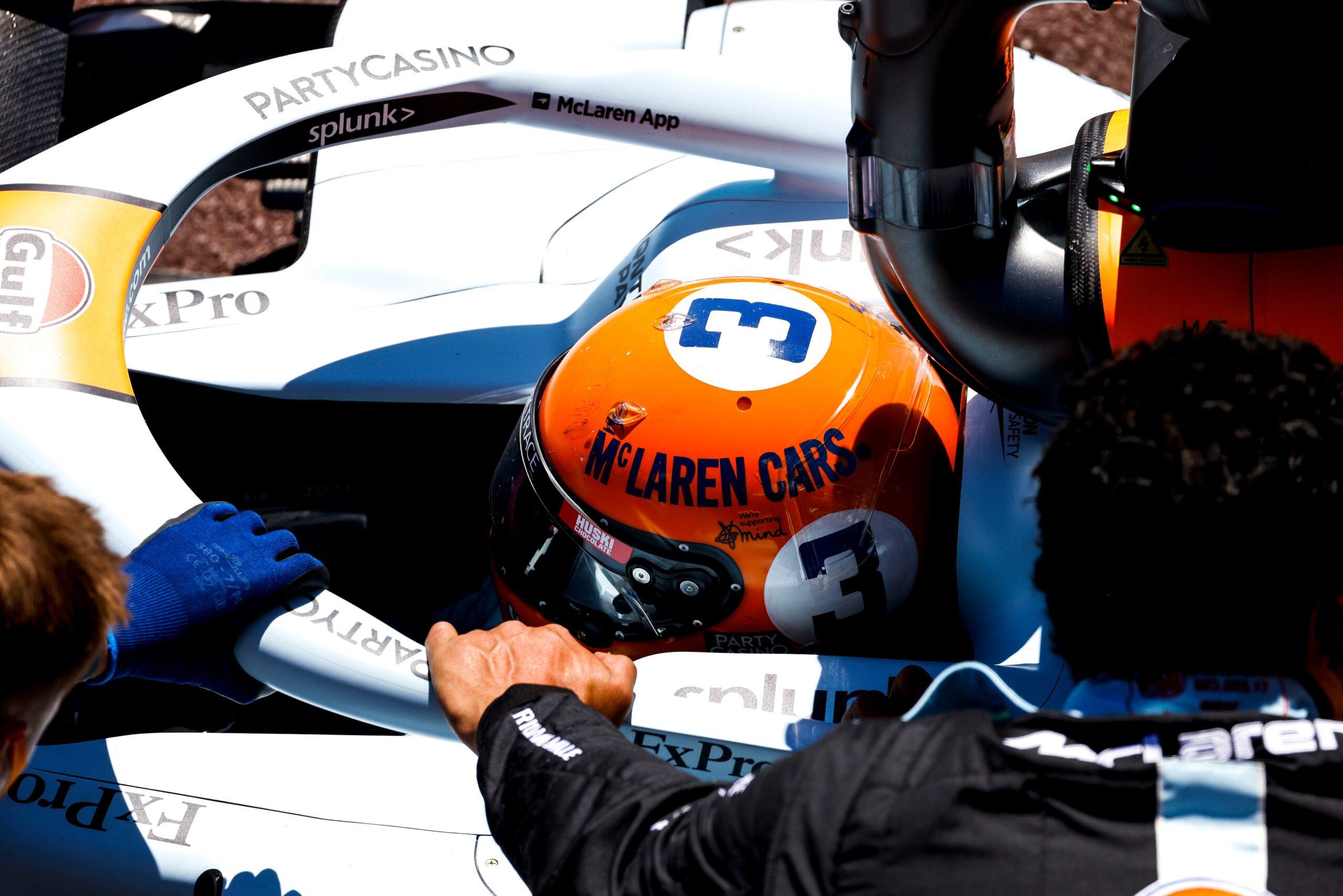
Lando Norris completed another excellent weekend – sporting the beautiful, one-off Gulf livery – and held off a late charge from Pérez to claim his second podium of the season and move up to third in the standings.
Image credit: Kym Illman
Vettel, Gasly and Hamilton predictably stayed in that order for the remainder of the race, Hamilton successfully pitting late on to claim the bonus point for fastest lap. Behind him, Lance Stroll made an alternative strategy work, starting on the hard tyres and moving up from 13th on the grid to finish eighth. Esteban Ocon finished a further half a minute down the road in ninth and Alfa Romeo‘s Antonio Giovinazzi claimed the final point – his first of the season.
It was a weekend not lacking in drama but the racing on Sunday was a typically mundane affair. And the Monegasque director – Monaco is the only race to use its own broadcast director – cut away from the one bit of wheel-to-wheel action that we did get… None of that will bother Verstappen and Red Bull, however, who have taken the lead in both championships. The momentum in the title battle switches once again.
Now, how will a very different street circuit – Baku in two weeks’ time – suit the cars?
Where Did That Ferrari Pace Come From?!
The Ferraris often flatter to deceive with their Friday pace, but this time they remained at the top of the timing charts throughout the weekend. So, how did that happen? Did they bring a major upgrade?
Image credit: DPPI
Well, I’m afraid to say – to any members of the Tifosi currently throwing their red caps in the air and declaring an imminent title charge – that is likely to be a one-off.
Ferrari have often gone well around the streets of the Principality – Vettel came home second in the previous two Monaco Grands Prix and 2017 saw a Ferrari 1-2. Their traditional short wheelbase makes the car nimble through the tight turns and, this year, the Monaco layout masked their still considerable deficiency when it comes to straight-line speed.
Even so, the drivers were surprised by their competitiveness.
“It is quite a big surprise,” Leclerc said. “Surely we were very competitive in Sector 3 in Barcelona, but again it’s a very different track and we were maybe expecting Red Bull and Mercedes to have something more for here, but apparently they didn’t and we were just very competitive from the start. So it was good, but until quali we didn’t believe we could fight for pole, so it’s a surprise.”
Whilst this likely isn’t the appearance of an unlikely championship contender, Ferrari can be very pleased with their progress since last year’s hugely disappointing campaign. Even the confines of Monaco wouldn’t have saved the SF1000. They can expect to compete at or near the front again in Hungary and Singapore – if that race happens – and now appear to be in a private battle with McLaren for third in the title. A feel good story for the two former giants of F1.
Vettel Finds Form, Ricciardo Loses It Again
Image credit: DPA Picture Alliance
It has been well documented that the drivers who switched teams for 2021 have been struggling to adapt due to the lack of testing. But Vettel appears to have finally made a breakthrough in the Aston Martin. He was far closer to Lance Stroll in Portugal and Spain than he had been at the first two grands prix of the year, and in Monaco he showed his experience, comfortably outperforming the Canadian in every session.
An impressive eighth in qualifying was turned into an even better fifth on Sunday, thanks to smart strategy and some guts during that wheel-to-wheel battle with Gasly. Vettel earned a well-deserved ‘Driver of the Day’ and will now look to build on this for the coming races.
Daniel Ricciardo, however, went in the opposite direction. After a much-improved performance in Spain saw him take a solid sixth place and finish ahead of teammate Norris for the first time, the wheels came off at what is his most successful circuit. The Aussie won here in 2018, after being robbed of victory in 2016, so moving aside to be lapped by Norris on Sunday will have been a bitter pill to swallow.
Image credit: Motorsport Images
Most worrying of all, he is at a loss to explain his lack of speed. “All weekend, even crossing the line a lot of laps I felt good, I was like that’s a good lap. And I think at one point I was 1.2s slower than say what Lando had just done, so no answers at the moment.”
He will need to find some answers quickly, or he risks having his reputation questioned in the manner Vettel’s was when Ricciardo joined Red Bull in 2014 and consistently outperformed him.
The Monaco Grand Prix in 60 Seconds
Answering the Burning Questions
Will Mercedes or Red Bull be on top around the twists of the Circuit de Monaco? Red Bull, if not Ferrari!
Can Max Verstappen make up for the many laps he spent stuck behind Lewis Hamilton in 2019? He can, in some style.
Will any teams surprise with their performance at this unique track? See above…
Who will have the best unique helmet design? The Williams drivers’ designs in honour of the team’s 750th race were nice, as were the McLaren Gulf specials, but I’m going for Bottas’s cartoon design.
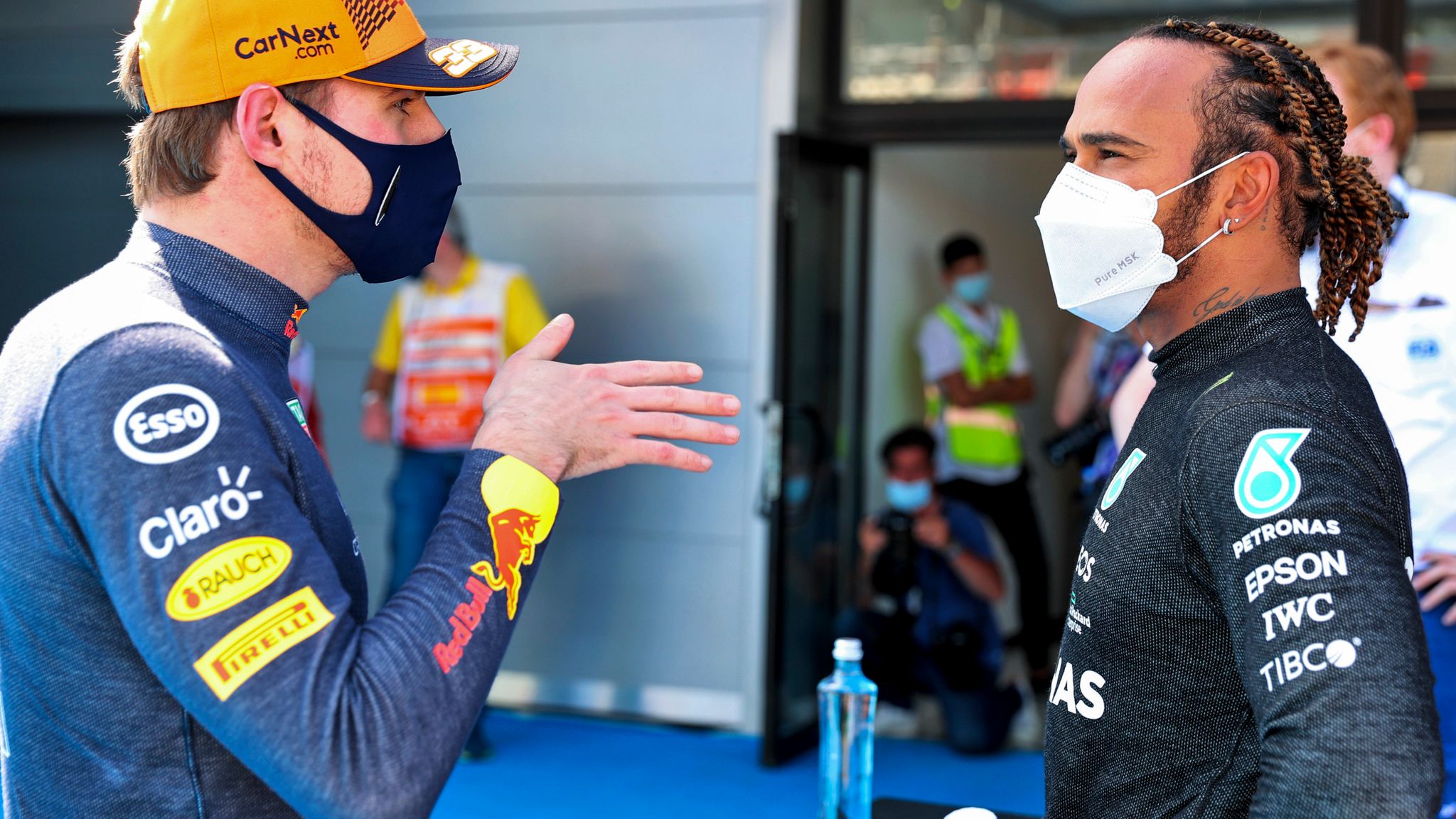
Lewis Hamilton | “I think I have done well to avoid all the incidents. But we have 19 more [races] and we could connect. He feels he perhaps has a lot to prove. I’m not in the same boat.”
Max Verstappen | “I have nothing to prove and avoiding contact goes both ways. So we have done well. We race hard, we avoided the contact both sides. Let’s hope we can keep doing that and keep racing hard against each other.”
Zak Brown | “I’m delighted with the extension of our agreement with Lando for 2022 and beyond. He’s been instrumental in our return of form here at McLaren and we’re proud of the growth he’s shown since he first started with us back in 2017.”
Sebastian Vettel | “No advice! Obviously I didn’t succeed, Lewis beat me, so it’s better not to give [Verstappen] any advice! I guess he wants to succeed. It’s a long year, there are a lot of races so, I don’t know, it doesn’t work like this. I’m not giving him any advice.”
The Thursday Form
Practice 2 Top 5
1 | Charles Leclerc | 1:11.684 | 30 Laps
2 | Carlos Sainz | 1:11.796 | 32 Laps
3 | Lewis Hamilton | 1:12.074 | 28 Laps
4 | Max Verstappen | 1:12.081 | 27 Laps
5 | Valtteri Bottas | 1:12.107 | 32 Laps
Practice 1 Top 5
1 | Sergio Pérez | 1:12.487 | 36 Laps
2 | Carlos Sainz | 1:12.606 | 32 Laps
3 | Max Verstappen | 1:12.648 | 39 Laps
4 | Pierre Gasly | 1:12.929 | 37 Laps
5 | Lewis Hamilton | 1:12.995 | 34 Laps
Red Bull and Mercedes continue their battle, but it was Ferrari who provided the headlines on Thursday.
There were mixed fortunes in the Scuderia garage in the morning session. Carlos Sainz consistently produced purple sectors throughout the session and ended up second, but Charles Leclerc’s Monaco curse appeared to be continuing as he suffered a gearbox issue which saw his morning running over after just four laps.
The afternoon was good news for all in red, though, as the drivers finished with a surprising 1-2. Leclerc showed no ill effects from missing the earlier session and topped the times, an impressive four tenths clear of Lewis Hamilton and Max Verstappen.
Whether they can stay at the front come qualifying – after Monaco’s traditional rest day on Friday – is another matter, but they appear to be a genuine threat to the title rivals.
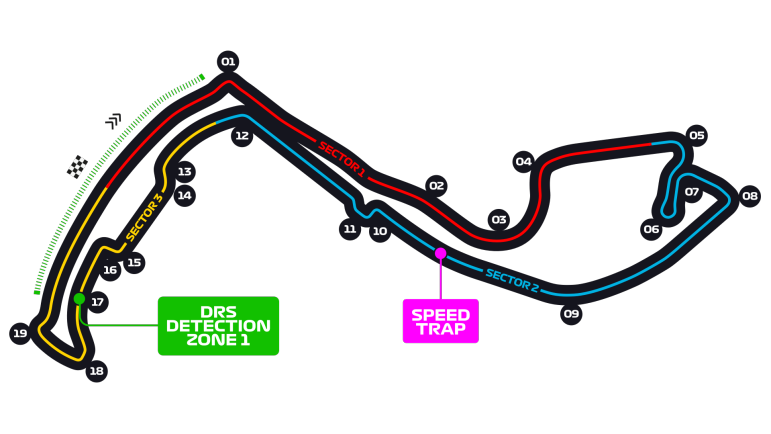
“Driving around this track is like riding a bike around a living room”, said Nelson Piquet. COVID-19 meant that the world’s most advanced ‘bikes’ were unable to traverse the world’s most expensive ‘living room’ last year, but this week finally sees the return of the Monaco Grand Prix.
The 2021 season has thus far served up four highly entertaining battles between seven-time world champion Lewis Hamilton and the heir to this throne, Max Verstappen. Whilst races at Monaco can often be a somewhat mundane affair – more rush hour than Rush – when they are good, they tend to be very good.
Here are the best of the 77 grands prix to this point. Let’s hope that number 78 will be able to compete with them.
1965
Image credit: Stuart Heydinger
Graham Hill completed a hat-trick of victories in Monte Carlo and cemented his position as ‘Mr. Monaco’ after a stunning comeback drive in 1965.
After having secured pole position and then opened up a comfortable lead, Hill spun whilst trying to overtake backmarker Bob Anderson on lap 25 and found himself down an escape road. At a time when reverse gear wasn’t available in F1 cars, the Briton was forced to climb out and push his car back onto the track.
Over the following 40 laps, Hill steadily but surely clawed back the 30-second deficit to the leaders and then picked them off one by one. He withstood a late charge from reigning champion John Surtees to take the chequered flag and earn the third of his five victories in Monaco.
1970
Image credit: Corbis
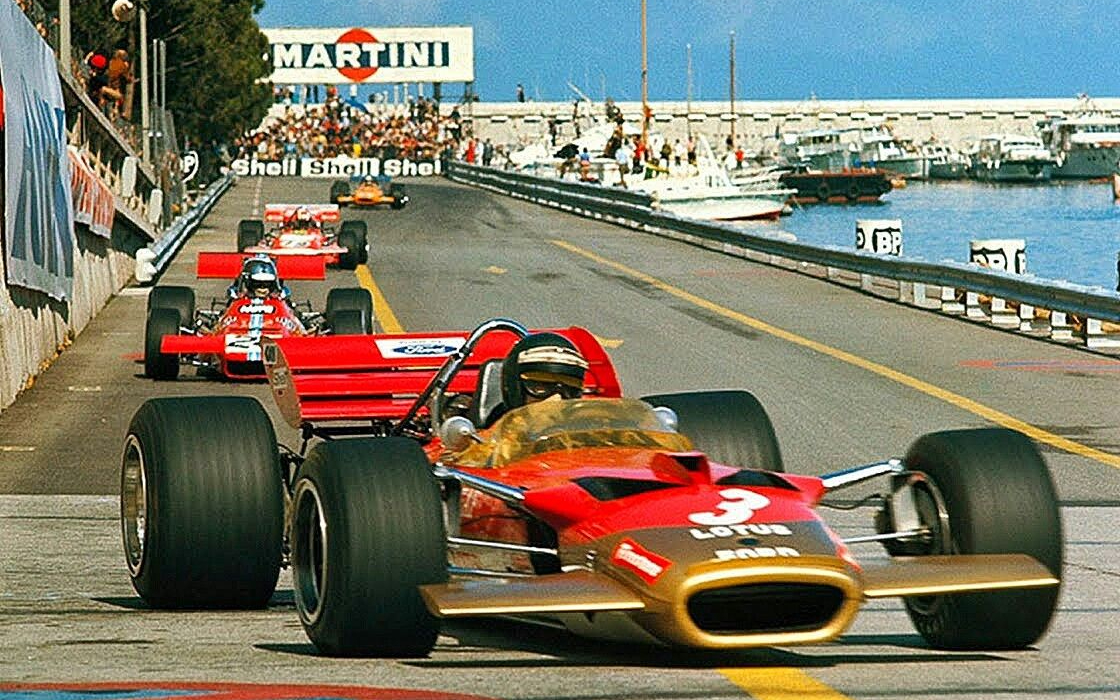
Jochen Rindt and Colin Chapman had many a disagreement regarding the safety of the Lotus cars and, after a huge accident in Spain, Rindt refused to use the latest Lotus 72 at the 1970 Monaco Grand Prix.
Despite that, the Austrian made steady progress through the field from eighth on the grid – aided by numerous retirements in front of him – and found himself in second place with 19 laps remaining. Jack Brabham’s appeared to have a comfortable 15-second lead but it gradually decreased and, after being held up twice by backmarkers, it was down to four seconds on the penultimate lap.
Rindt blitzed the lap record and was suddenly within touching distance. Under pressure at the final hairpin, Brabham went off-line to lap Piers Courage and slithered off into the barrier, leaving Rindt to inherit his sole Monaco triumph and the last ever victory for the famous Lotus 49.
1982
Image credit: LAT
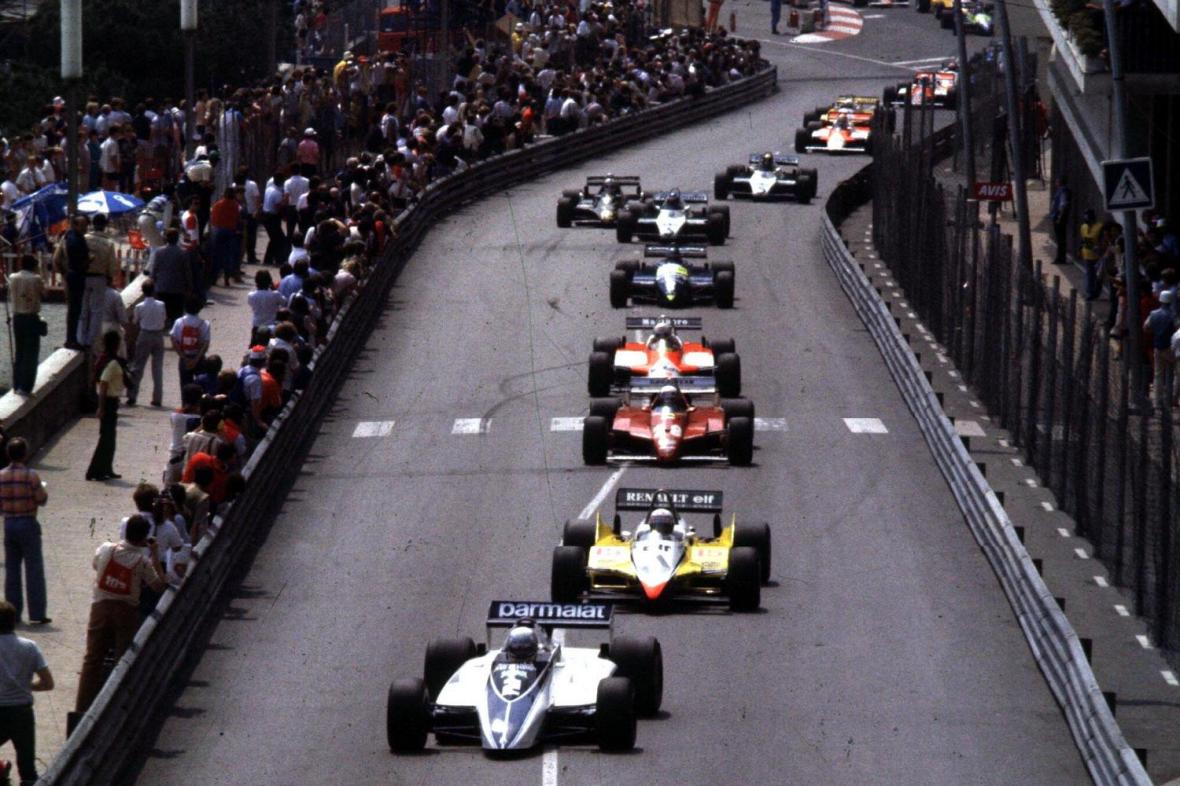
The 1982 Monaco Grand Prix was a race which, it appeared, nobody wanted to win.
Alain Prost appeared favourite after his pole-sitting teammate, René Arnoux, had spun on lap 15. But with three laps remaining and rain starting to fall, Prost himself spun out and handed the lead to Riccardo Patrese, only for the Italian to spin as well during the following lap. That left Didier Pironi in the lead, but his car ran out of fuel on the final lap. Andrea de Cesaris would have inherited the lead but had also run out of fuel and Derek Daly – the next man down the road – had just retired with a gearbox failure.
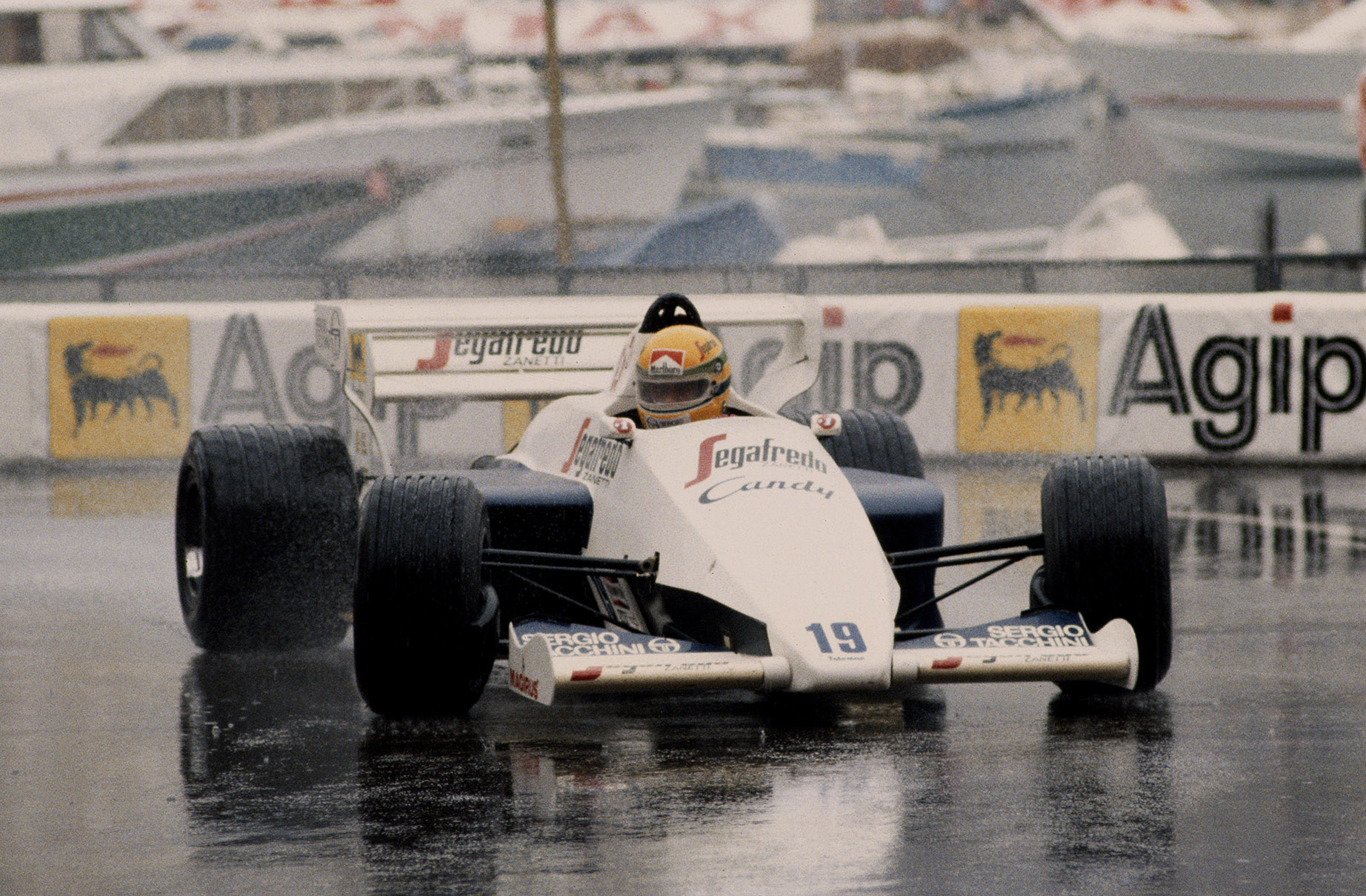
Two years later, another wet race saw Ayrton Senna announce himself as a superstar in the making.
At the request of Niki Lauda, Bernie Ecclestone used his power to have the tunnel flooded, as oil from prior use had “turned it into a fifth gear skid pad” when the cars came racing in carrying the spray from their tyres. Pole-sitter Prost was passed on lap nine by Nigel Mansell, to lead a grand prix for the first time, but the Briton crashed six laps later after sliding on a painted white line.
Prost reassumed the lead and, on lap 29, began waving to the stewards to signal the race should be stopped, with Senna – who had started the race 13th in an uncompetitive Toleman – closing in rapidly. The red flag was duly shown at the end of lap 32. Senna passed Prost’s slowing McLaren before the finish line but, as per the rules, the positions were counted from the last lap completed by every driver and Prost retained the victory. Nonetheless, Senna had emphatically displayed the wet weather skills that would become infamous over the next decade.
1992
Image credit: LAT Images
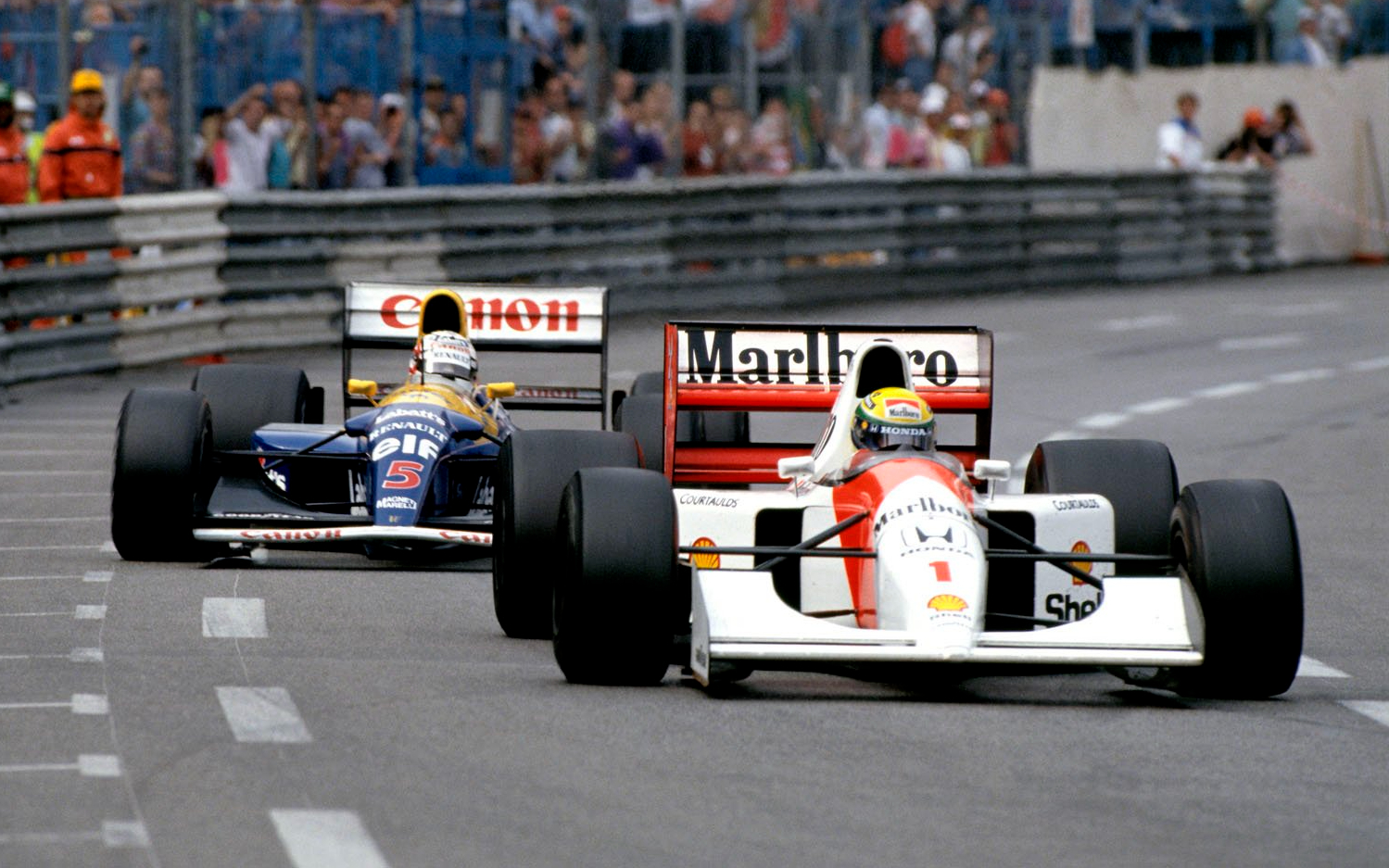
1992 saw another Senna Monaco masterclass; this time, though, in defensive driving.
That season’s Williams was one of the most dominant in the history of the sport, Mansell taking the championship at a canter and winning a then-record 9 of 16 races. In Monaco, however, a late puncture in a race he had been dominating saw him emerge from the pits seven seconds behind Senna’s McLaren.
That gap had disappeared in just a lap and a half. Senna was still sporting the same tyres on which he had started the race, but was not about to let his rival through in a hurry. Mansell darted left and right for the remaining five laps but to no avail as the Brazilian positioned his car perfectly and remained utterly resolute. The Master of Monaco was not to be denied that day and took his fourth consecutive victory in the Principality.
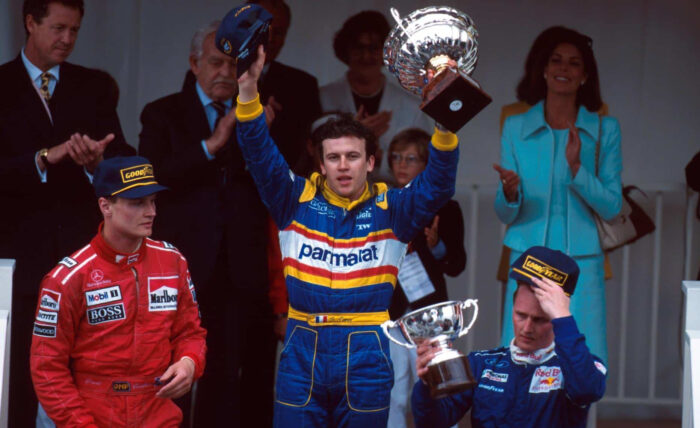
1996
A pre-race downpour in 1996 saw a fraught start during which five drivers – including Michael Schumacher – retired from the race on the first lap. Another four had gone before lap 10.
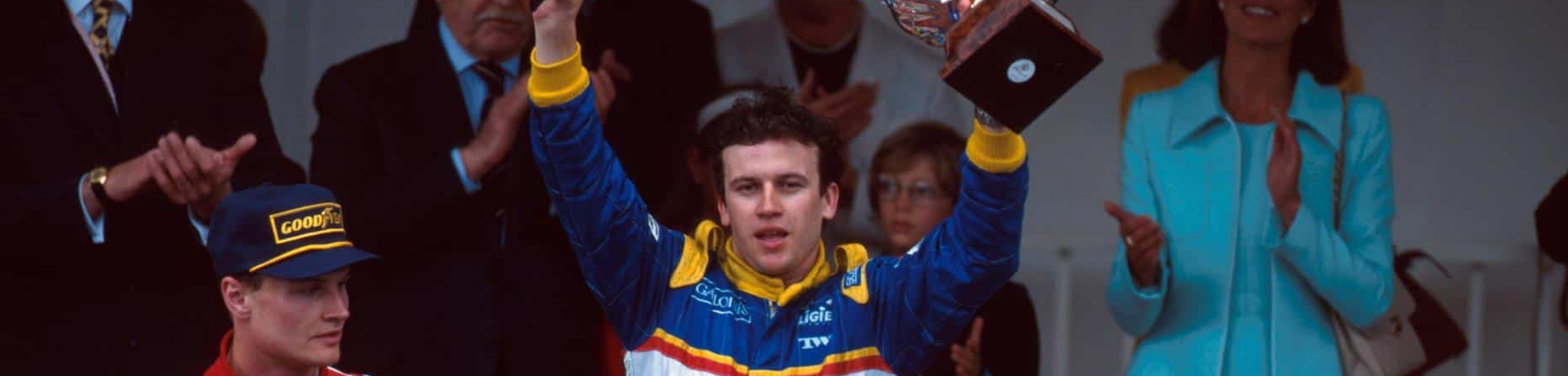
Amid the chaos, a certain Olivier Panis had moved up from 14th on the grid to run eighth at the halfway point. With the rain clouds having moved on, the Frenchman instructed his Ligier team to monitor the first driver pitting for slicks and report on their progress. That would prove to be Damon Hill, whose instant speed convinced Panis to pit on the following lap.
Others weren’t as quick to respond and Panis moved up to fourth. He quickly dispatched Eddie Irvine – into the wall, to be specific – and, when Hill and Jean Alesi suffered mechanical failures up ahead, found himself in the lead. A lack of fuel threatened the Frenchman’s maiden victory, but he clung on from the chasing David Coulthard and was the first of just three drivers to reach the chequered flag. It would prove to be his only win. But, if you’re only going to get one, it’s not a bad one to have.
2008
Image credit: EFE
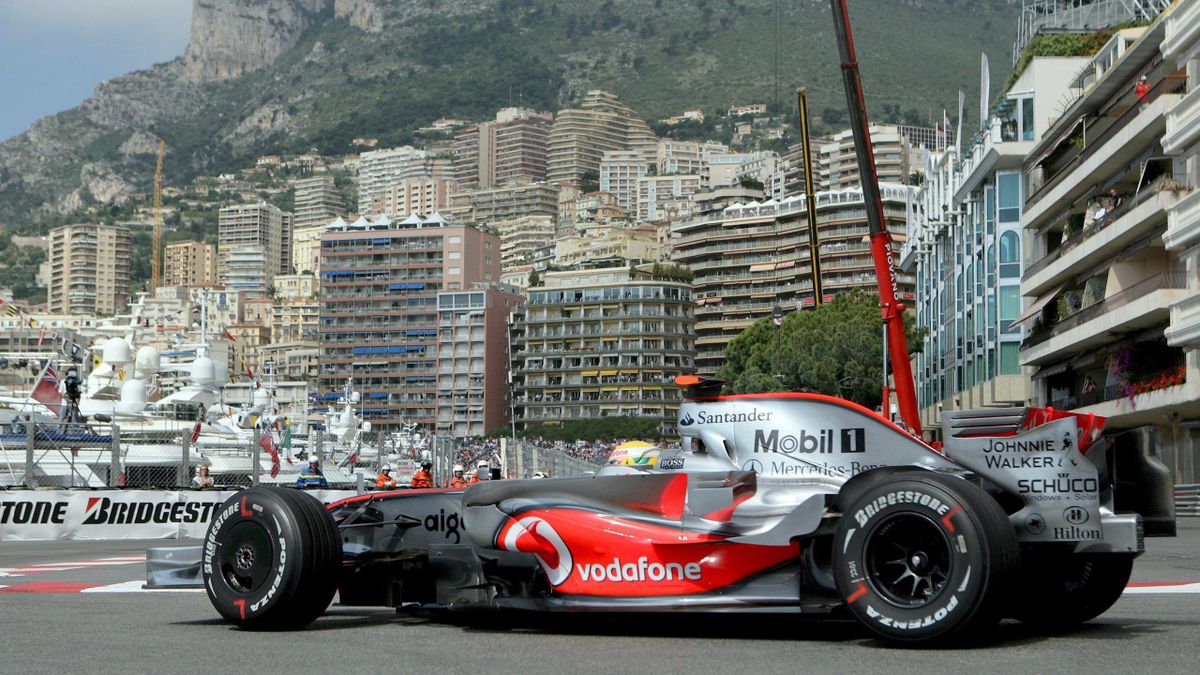
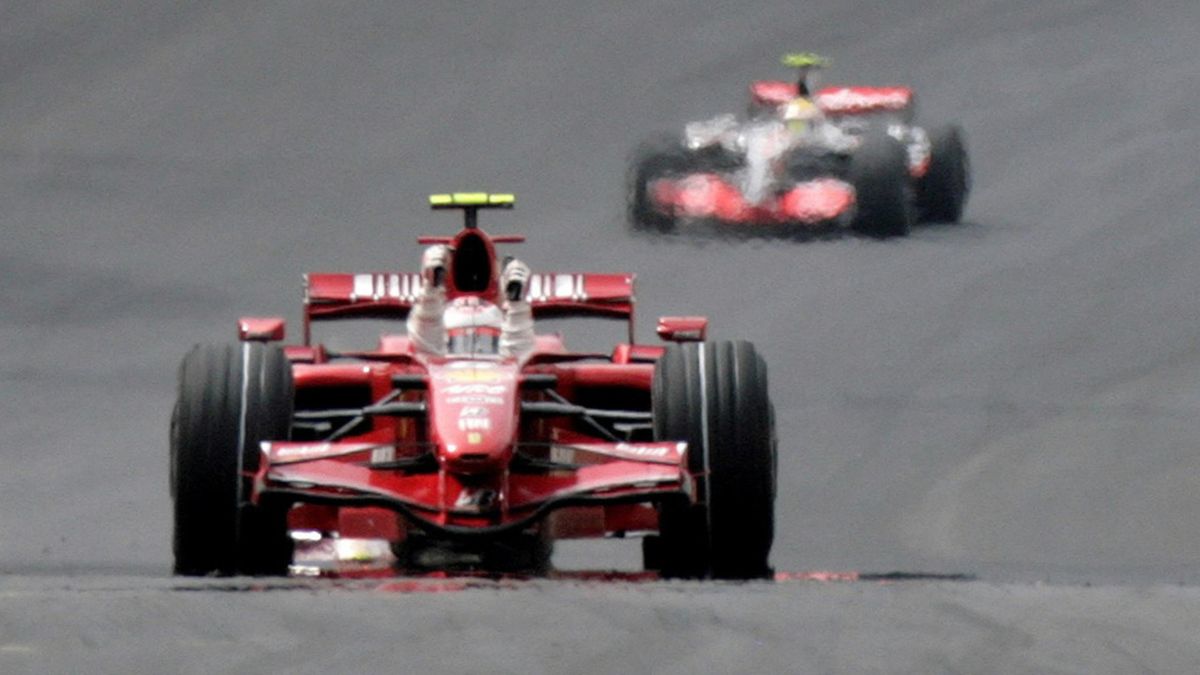
Small mistakes have huge consequences in the tight confines of the Circuit de Monaco. Those consequences are almost always bad but, in 2008, a small mistake ultimately led to a victory for Lewis Hamilton.
Once again, rain played a major part in an eventful Monaco Grand Prix. Hamilton had passed Kimi Räikkönen for second place on the opening lap, but on lap 6, with the conditions worsening, he fractionally misjudged his exit from Tabac and tapped his right-rear wheel against the barrier, popping the tyre off the rim. That led Hamilton and his team to take a risk, fitting intermediate tyres and fuelling for a long second stint.
It proved to be inspired. The rain ceased, a dry line emerged, and Hamilton took the lead. When the time came for his next stop, conditions had reached the point for a transition to slicks and Hamilton maintained his lead to the chequered flag, despite a late safety car. Behind him, Adrian Sutil had been running in an unlikely, career-best fourth place, only to be taken out of the race by Räikkönen with just eight laps to go.
2016
Image credit: The Telegraph
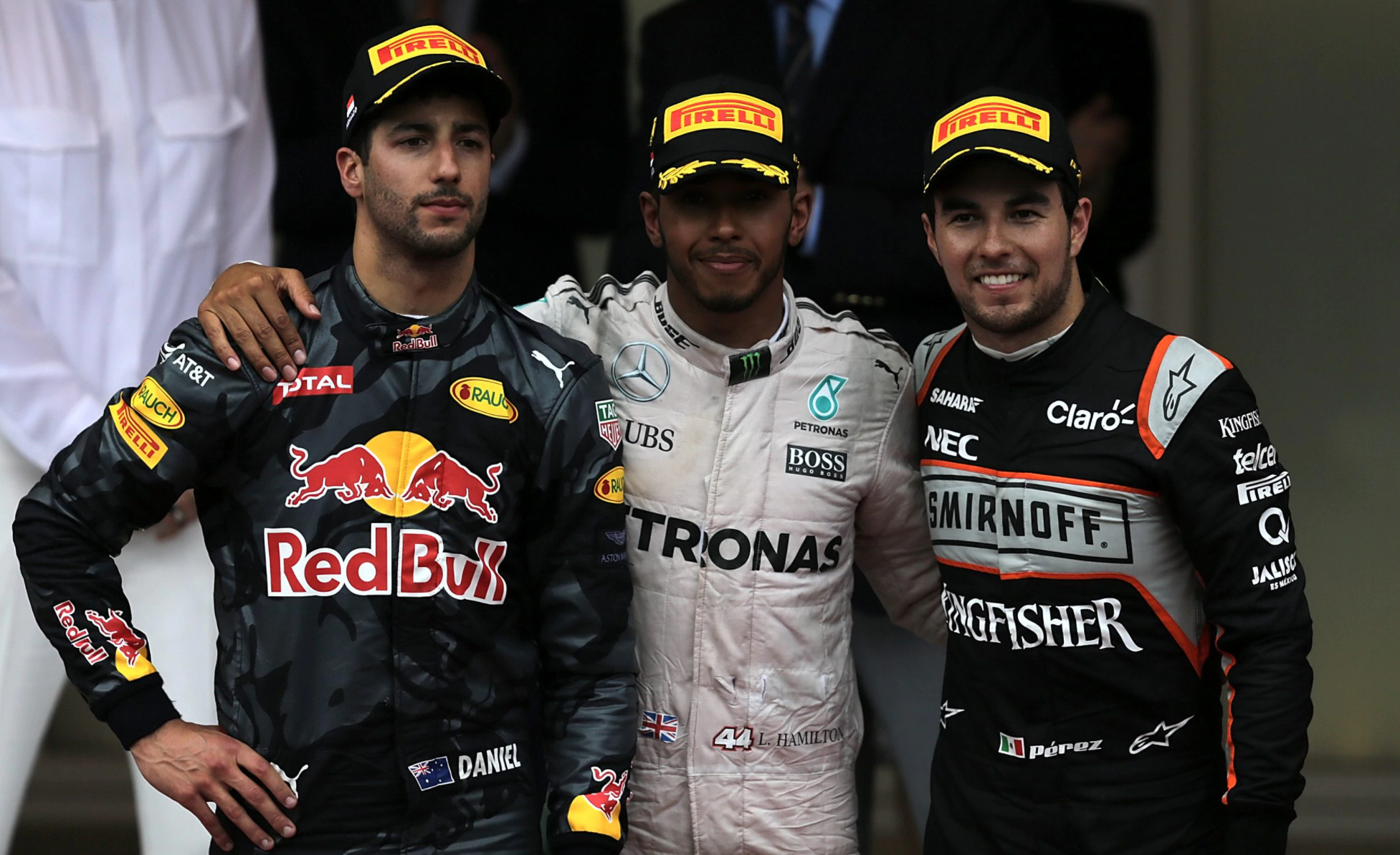
2016 saw another wet race and another Hamilton win, but in very different circumstances.
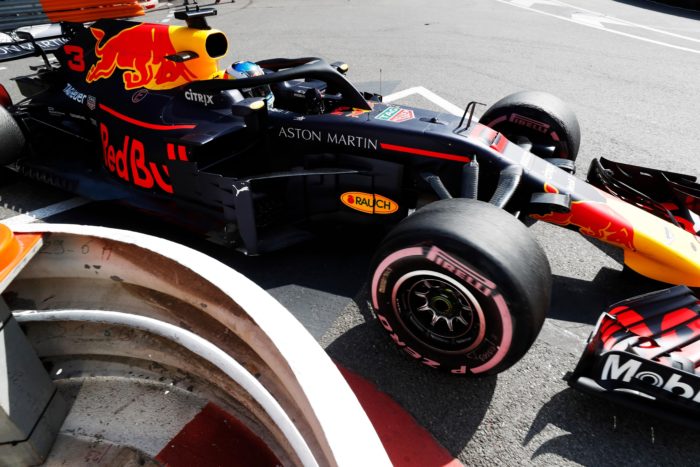
Daniel Ricciardo led away from pole, followed by the Mercedes pair of Nico Rosberg and Hamilton. The two Silver Arrows were on best behaviour – after their infamous crash in Spain two weeks beforehand – and, after struggling with the conditions in the early laps, Rosberg obeyed a team order to allow his teammate through.
Out front, Ricciardo had built a comfortable lead but, when the time came for his change to slicks, the Red Bullpit crew weren’t ready. Mechanics fumbled for the right tyres and Hamilton agonisingly swept by when Ricciardo eventually reached the end of the pit lane. Over the course of the remaining 45 laps, Hamilton produced a defensive display akin to Senna in 1992 as a frustrated Honey Badger bit at his heels.
It felt like redemption for Hamilton who had suffered a similar fate 12 months earlier when an erroneous call to pit lost him a certain victory. And Ricciardo himself would right the wrongs in 2018, claiming an impressive win after an engine issue left him down on power and defending for his life for most of the race.
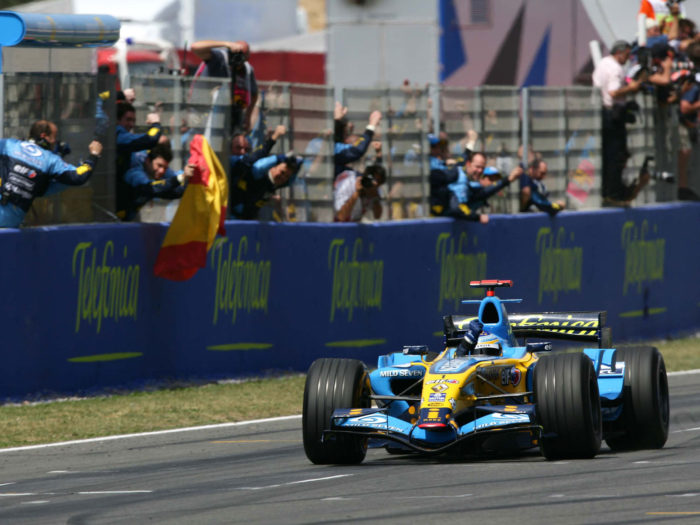
What had been threatening to become a trademark soporific Spanish Grand Prix was reignited by a Mercedes strategy gamble, which paid off in the form of a fifth consecutive victory for Lewis Hamilton at the Circuit de Barcelona-Catalunya.
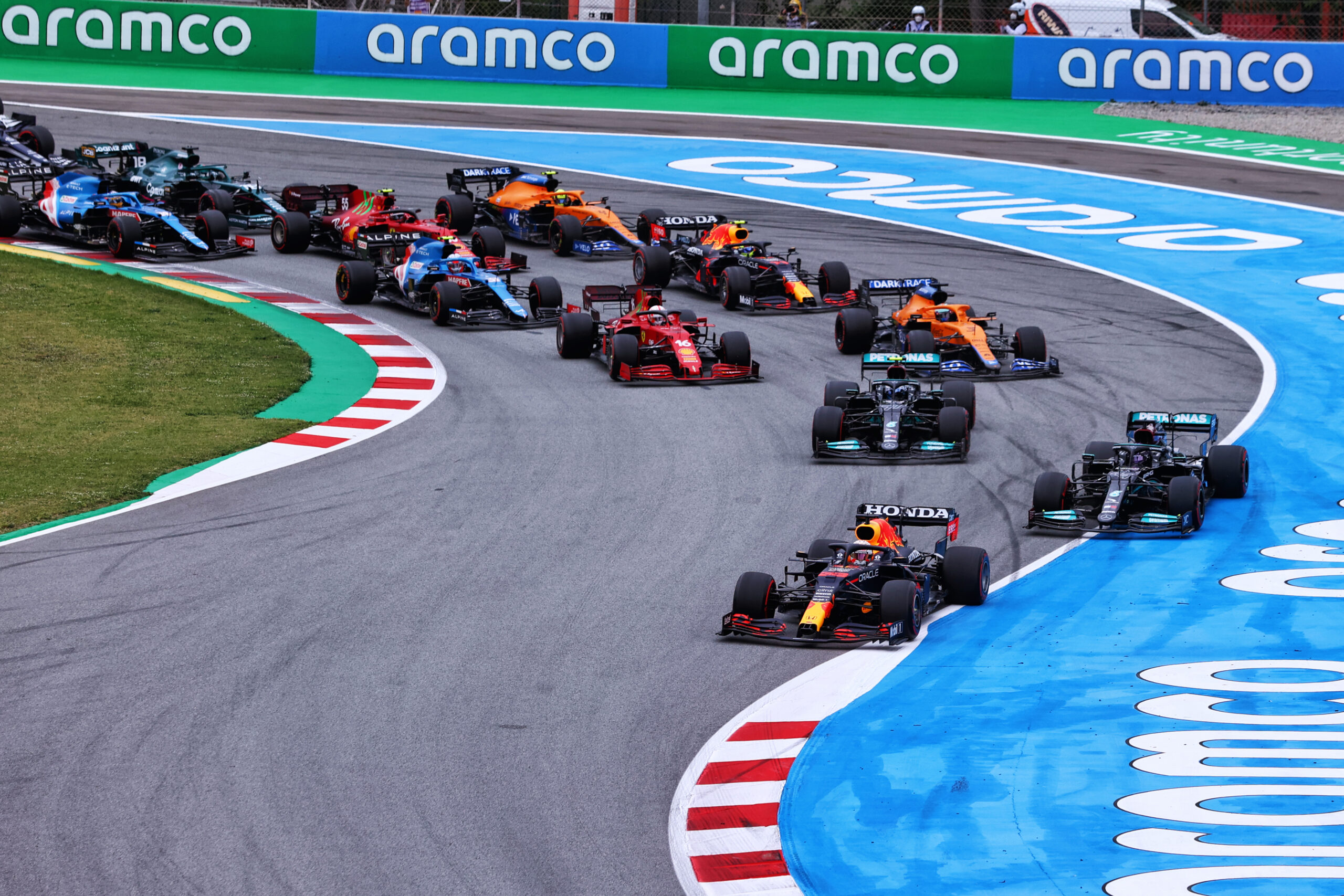
Saturday saw Hamilton claim his 100th pole position in Formula 1 – a simply mind-boggling achievement – and many assumed he would move one step closer to a century of wins on Sunday. But that assumption was immediately brought into question thanks to a bullish move into the first corner by Max Verstappen.
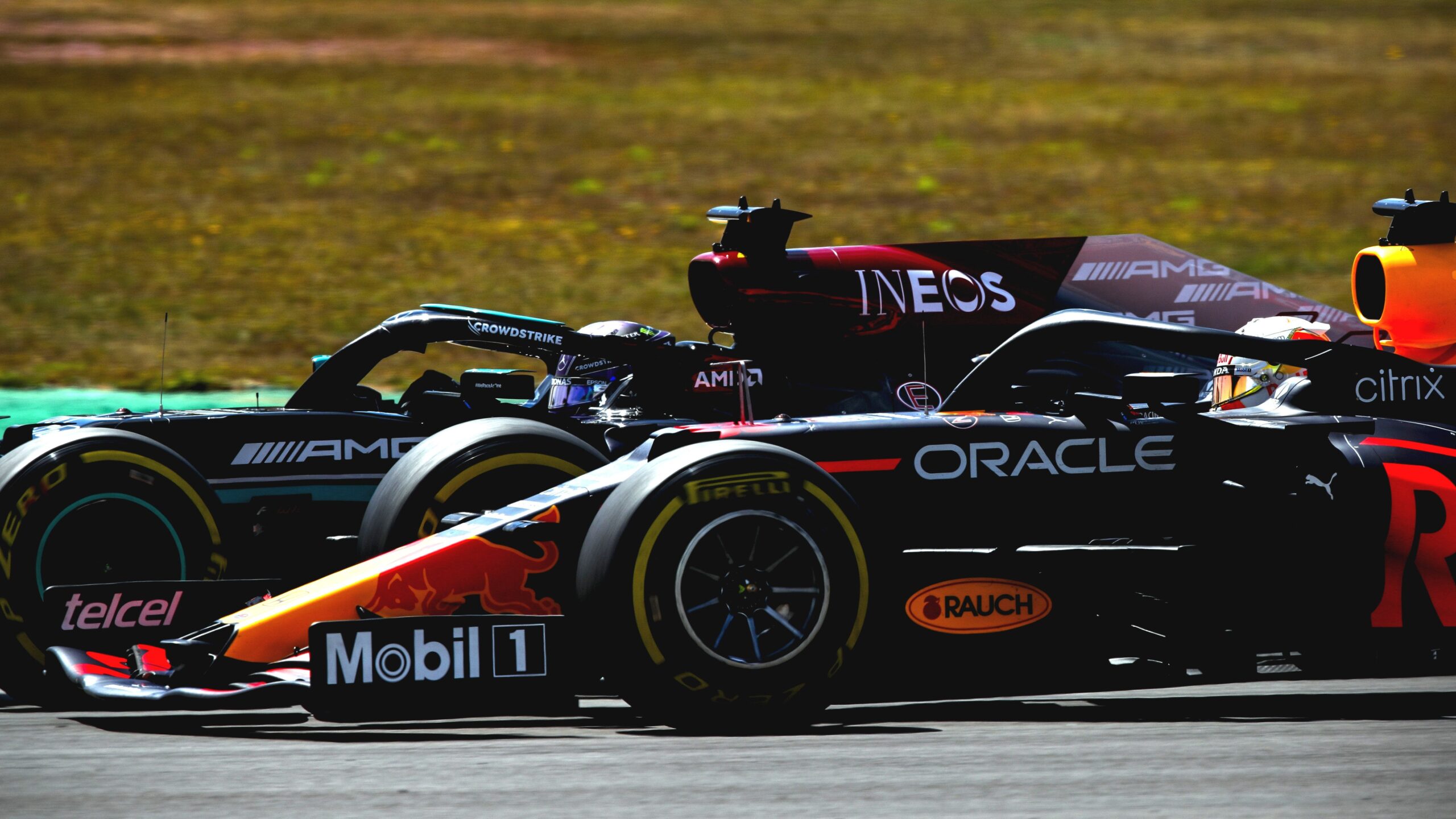
The two title rivals got away fairly evenly – the Dutchman aided by an unusual level of rubber on the normally dirty side of the track – and, with the Red Bull in his blind spot, Hamilton felt unable to move over and claim the inside line. Verstappen is not a driver that requires more than one invitation. He braked very late and, not for the first time this season, got his elbows out at the first corner, leaving Hamilton nowhere to go on the outside.
Verstappen and Hamilton streaked away at the front, the Mercedes driver hounding his rival but never getting quite close enough to threaten a pass. With Sergio Pérez too close behind for Mercedes to attempt an undercut, it was Verstappen who pitted first.
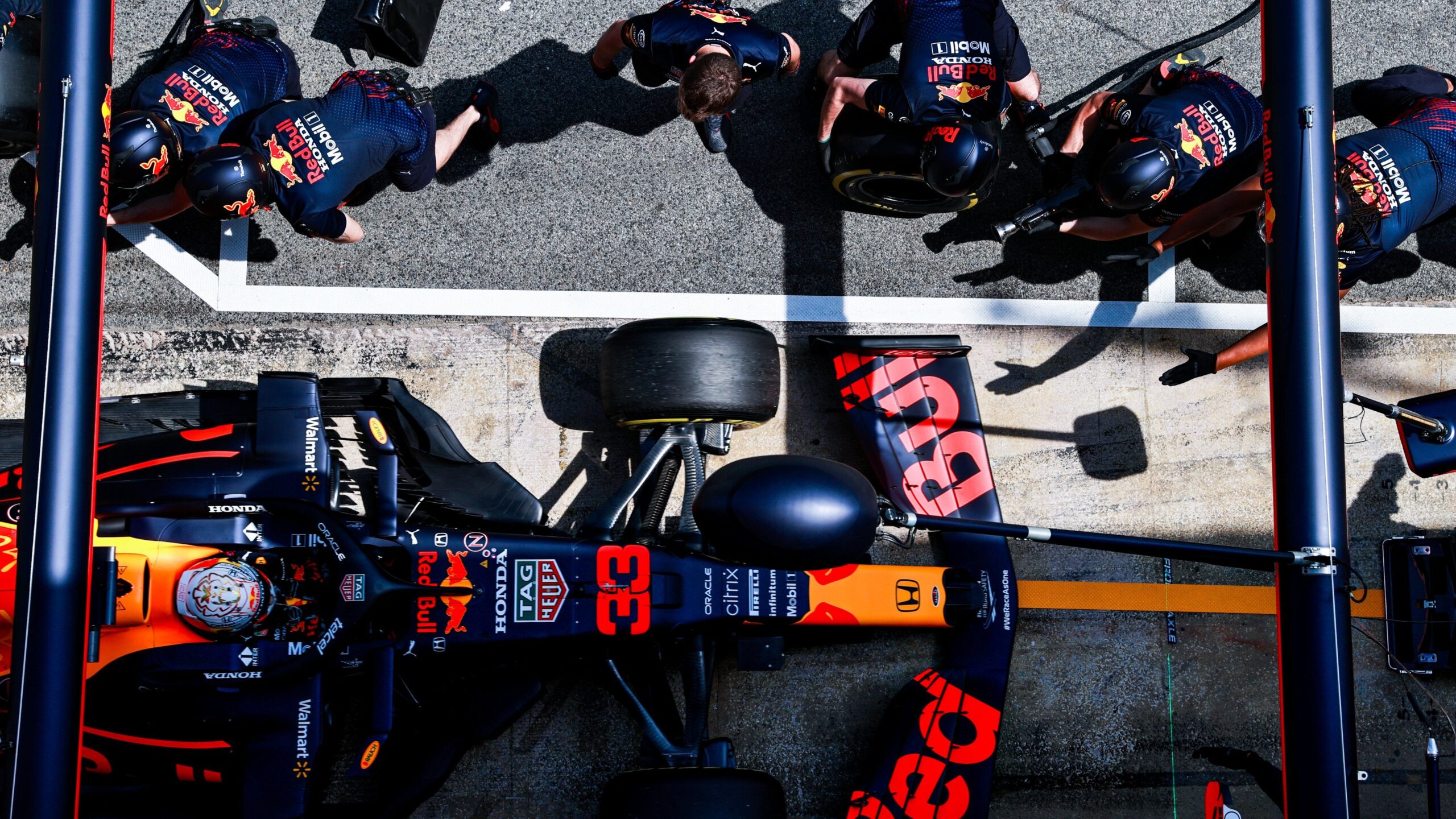
It was unscheduled – Verstappen sensing Hamilton was about to pass him on the straight – and resulted in an uncharacteristically slow Red Bull pit stop. That offered Mercedes an opportunity, but they declined – they had a different plan in mind…
Hamilton extended his stint a further four laps, rejoining a little over five seconds behind Verstappen. But, with the Mercedes clearly well-suited to the medium tyre, Hamilton was once more closely inspecting his rival’s rear wing within a few laps.
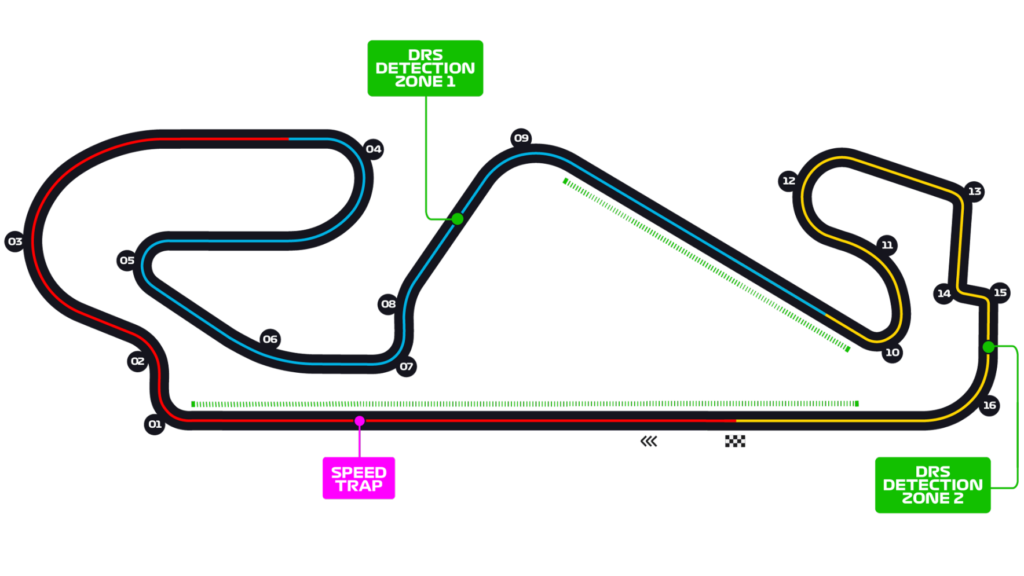
As ever, the Circuit de Barcelona-Catalunya provided little in the way of passing opportunities, though – especially since the recent reprofiling of Turn 10 – and it appeared likely that we would watch Hamilton follow on the brink of the DRS window for the next 45 minutes.
But this is when Mercedes produced their surprise.
Hamilton darted into the pits on lap 42 to fit another set of medium tyres. This had been in Mercedes’ thoughts throughout the weekend and they were the only team to have kept two fresh sets of the medium compound for the race. So, it was to be a repeat of the 2019 Hungarian Grand Prix, as Hamilton set about closing down a gap of more than 20 seconds in just over 20 laps.
The Red Bull computers predicted that Hamilton would catch their driver on the last lap, but that would prove to be an optimistic forecast as Hamilton took nearly two seconds per lap out of the gap. Despite not getting much help from his teammate – more on that later – the Briton was on the back of Verstappen by lap 59.
The Red Bull weaved along the start-finish straight, desperately trying to break the tow he was providing, but the pass was an inevitability, Verstappen later describing himself as a “sitting duck”. Hamilton used the extra grip from his much younger tyres to brake later and comfortably claimed the lead as they entered Turn 1.
Image credit: XPB/PA
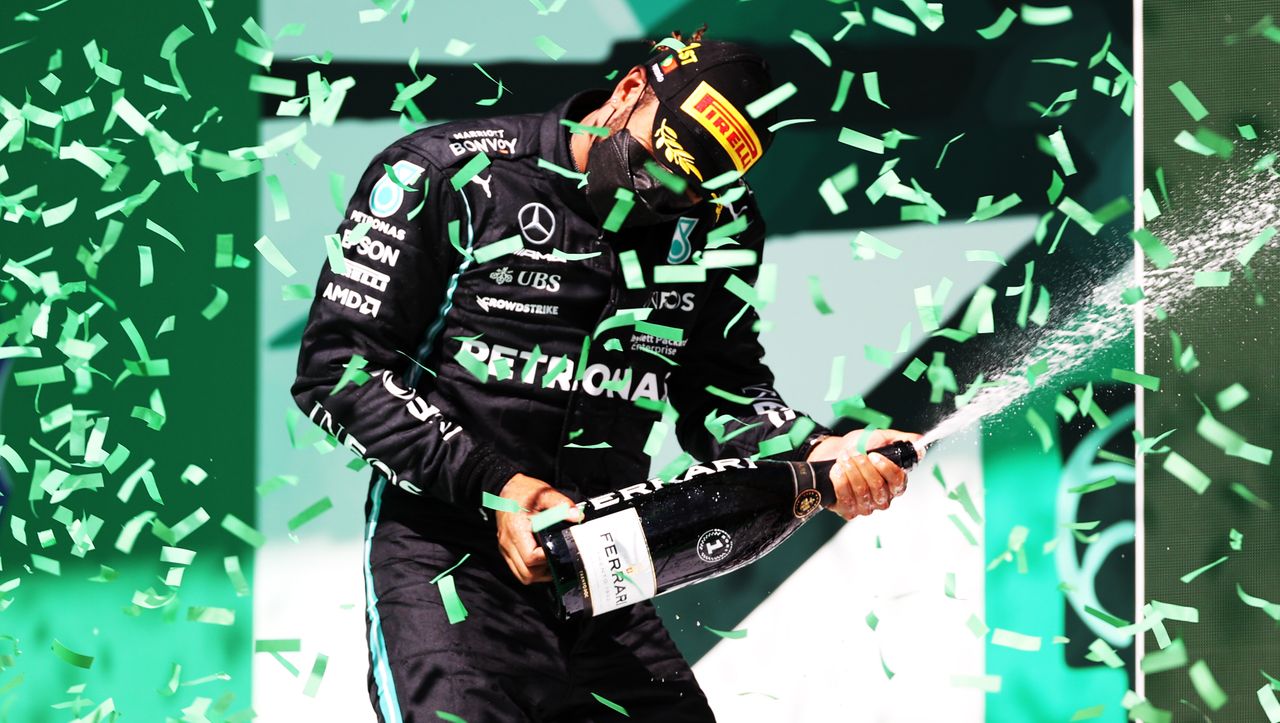
Behind them, Bottas had pitted in an attempt to claim the fastest lap, but in doing so allowed Verstappen to do the same. There was to be no repeat of his mistake in Portugal this time and the Dutchman took the extra point with ease. It was Hamilton who took the chequered flag, however, and extended his lead in the championship to 14 points.
Is the Mercedes Now the Fastest Car?
It has only been six weeks since Verstappen took pole by four tenths in Bahrain and the F1 status quo appeared to have been turned on its head. And yet now, without us really noticing, Hamilton has equalled his best ever start to a season. Three wins and one second place were also his results during the first four races of 2015 – a season that would prove to be one of his most dominant – so are we kidding ourselves that there is such an exciting title battle?
In a word, no.
But for some small yet costly mistakes – and some luck on Hamilton’s part – Verstappen would be the one leading the championship. Bahrain was his race to lose, but he did. Hamilton was very fortunate to recover to second in Imola, and the complexion of the race in Portugal would likely have been different had Verstappen not lost pole position due to a track limits violation. These are the minute differences that can swing a championship one direction or another, and Mercedes are very experienced in ensuring that they swing their way.
Image credit: Honda Racing
However, in terms of pure speed, the Red Bull looks a genuine match for them this year. Spain has always been a Mercedes circuit – that’s five wins in a row for Hamilton – but Red Bull were right there with them, three hundredths of a second behind in qualifying and leading for 90% of the race.
Monaco in two weeks time will be a very different challenge. The Mercedes car has looked strong in slow corners – of which Monaco, obviously, has many – but it also has a very long wheelbase and Red Bull have performed well through the streets of the Principality in recent years. The circuit provides such a unique test of a Formula 1 car that there’s no way of knowing who will do well until the cars are being driven in anger, millimetres from those infamous walls.
Hamilton may have the edge right now, but this title battle remains very much in the balance.
The Best of the Rest
Leclerc had another excellent weekend. He qualified in fourth for the third time in four attempts this year and the predictable combination of Ham-Ver-Bot is almost now extendable to Ham-Ver-Bot-Lec.
Image credit: Getty Images
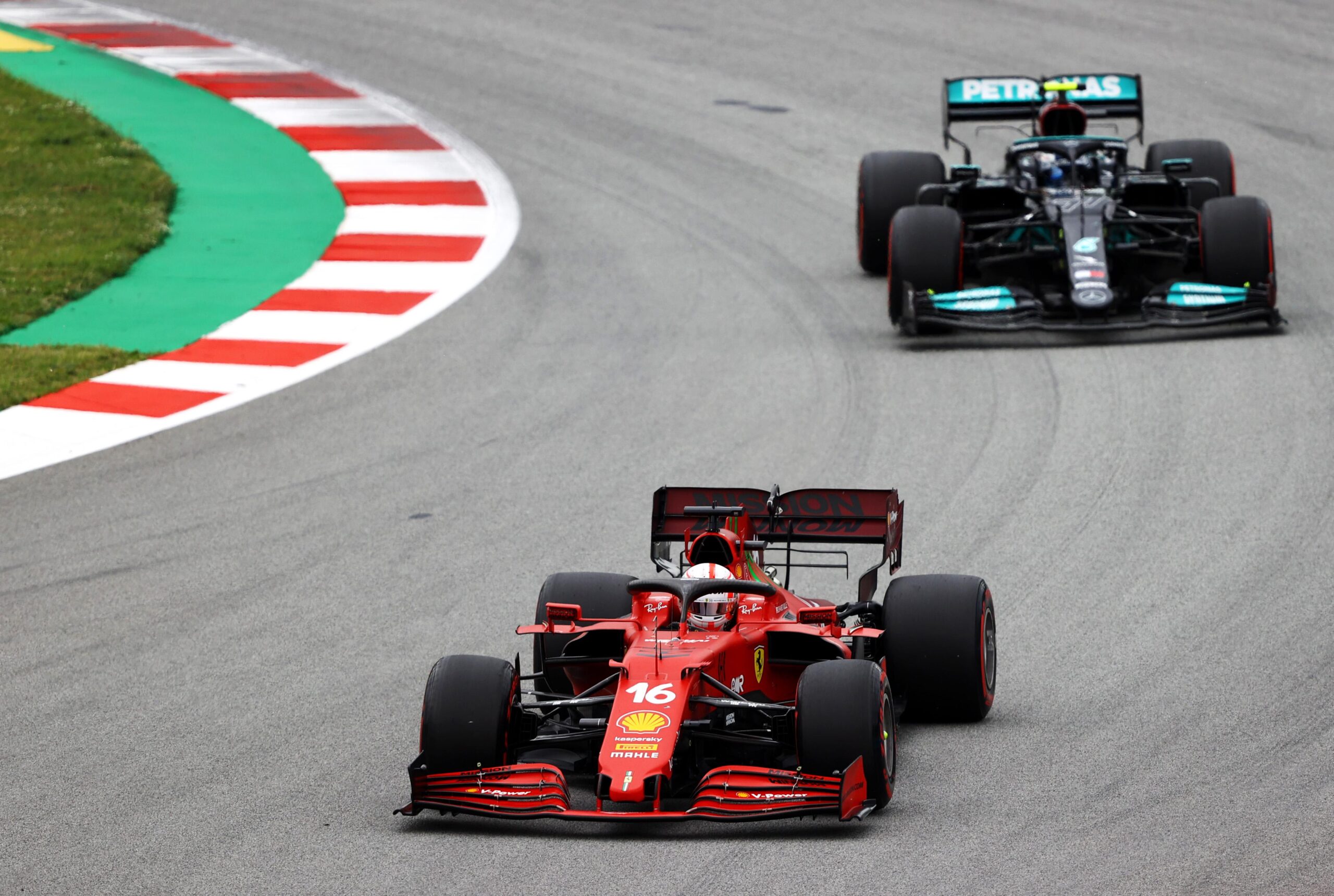
After his excellent early pass, he kept the far superior Mercedes of Bottas behind for the first stint and eventually finished a comfortable 10 seconds ahead of Pérez to move to just one point behind Lando Norris in the standings.
Norris himself was a little anonymous this weekend on his way to eighth and, for the first time in 2021, was legitimately beaten by teammate Daniel Ricciardo. The Honey Badger’s trademark smile was very much back on his face as he finished a solid sixth, holding off Carlos Sainz in the final laps.
Alpine initially appeared to have picked up where they left off in Portugal with Esteban Ocon qualifying an excellent fifth but, on Sunday, their strategy was lacking and their pace disappeared. Ocon clung onto a points finish in ninth, but Fernando Alonso tumbled back through the field in the dying laps and eventually finished behind a Williams in 17th. There is still work to do for the French team.
Pierre Gasly recovered from a clumsy five-second penalty, for parking his AlphaTauri beyond his allocated spot on the grid, to earn the final point for 10th. But it was the rookie on the other side of the garage who made the headlines on Saturday. One of his infamous, expletive-ridden radio messages was followed up by an interview where he questioned whether he had the same car as his teammate. Undoubtedly, Team Principal Franz Tost will have had some very stern words with the youngster, who it appears has some growing up to do.
The Bottas ‘Block’
Image credit: XPB Images
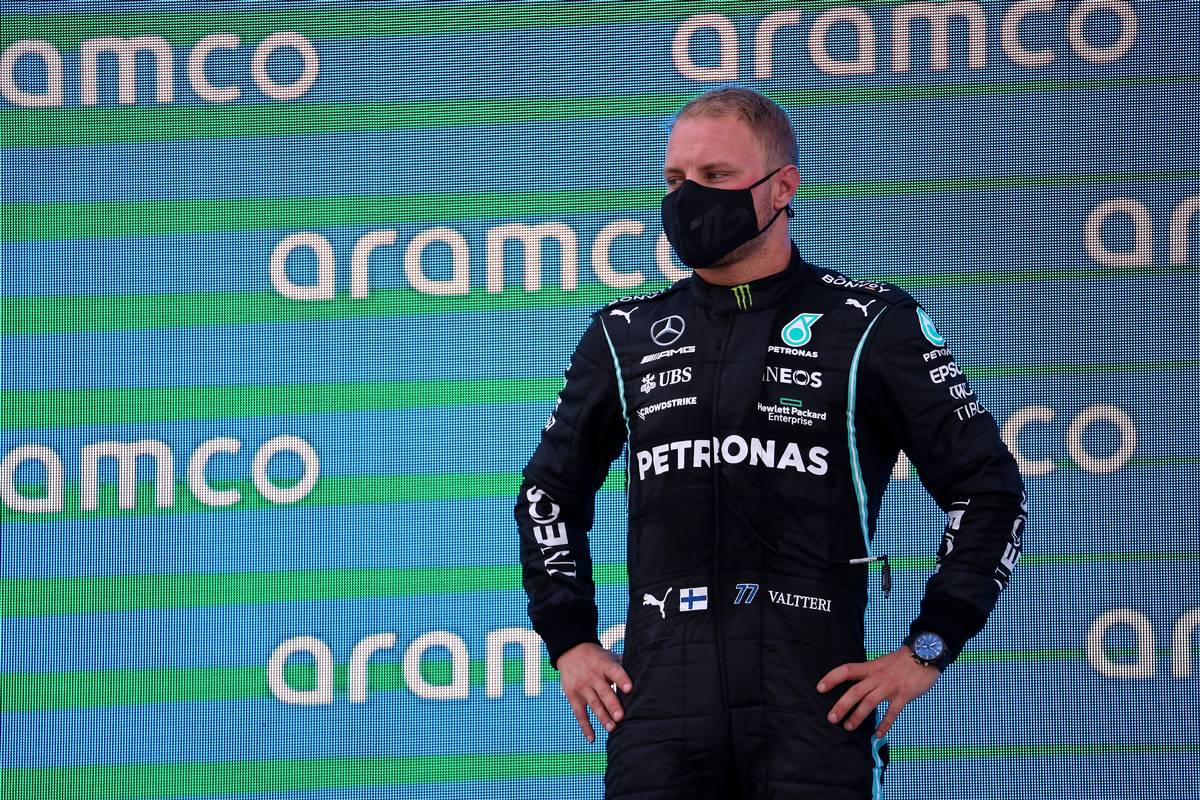
As previously mentioned, Hamilton’s pursuit of Verstappen late in the race was made a little harder by his teammate. As the World Champion approached, Bottas was told by his engineer, “Don’t hold Lewis up”. But he did just that. Hamilton followed closely for the best part of a lap – losing at least a second to Verstappen – before somewhat having to force a pass into Turn 10.
“I definitely could have let him by earlier,” Bottas said after the race. “But I was doing my own race. I’m not here to let people by, I’m here to race.” He said at the start of this season that he would be more selfish and single-minded; it would appear he is following up on that promise.
Does his mindset reveal anything about Mercedes’ plans for next year? Is this a man who knows his time is up and, thus, is now going to do everything in his power to take the title in what would likely be his last ever chance? That is just conjecture for the moment. But, whether he likes it or not, Bottas has held onto his seat at Mercedes by being the ideal driver for their second seat. One that is fast enough to keep Hamilton on his toes and help with strategic battles during the race, but one that is also compliant when required.
If he ceases to be that driver, his chances of remaining with the team beyond 2021 look slim at best.
The Spanish Grand Prix in 60 Seconds
Answering the Burning Questions
Can Verstappen strike back in the title battle? Not quite, despite a valiant effort.
How will the teams fare without having had their usual pre-season testing at Barcelona? There was no noticeable difference and just the one retirement.
Can Alpine continue their good form from Portugal? On Saturday, yes. On Sunday, not so much.
Will the Aston Martin updates bring them back towards the front of the midfield? Nope, they still have quite a bit of work to do.
Most Driver Wins: Michael Schumacher | 1995, 1996, 2001, 2002, 2003, 2004
Most Constructor Wins: Ferrari | 1996, 2001, 2002, 2003, 2004, 2007, 2008, 2013
The Weather
The Quotes
Lewis Hamilton | “We have a good package but it has weak areas which we are working on. You’re seeing the closest battle you’ve seen for some time. Max is performing exceptionally well. He has a championship-winning car and team without a doubt who can really pull off the job this year if we don’t do our job.”
Max Verstappen | “I always try to get the best possible results out of it. I went twice outside of the track limits where it cost me basically a pole and a fastest lap but it’s also because I don’t settle for second or third. It is exciting and I am looking forward to every single battle.”
Valtteri Bottas | “There are still 20 races to go which is a huge amount of points and I am definitely not giving up on the goal this year. I believe the hard work will pay off and keep believing and I know the results will come and pay off.”
Kimi Räikkönen | “The worst thing was my son saying ‘you always tell me to look forward’ when he drives go-karts… He gave me a bit of that!”
The Friday Form
Practice 2 Top 5
1 | Lewis Hamilton | 1:18.170 | 32 Laps
2 | Valtteri Bottas | 1:18.309 | 31 Laps
3 | Charles Leclerc | 1:18.335 | 28 Laps
4 | Esteban Ocon | 1:18.466 | 29 Laps
5 | Fernando Alonso | 1:18.518 | 30 Laps
Practice 1 Top 5
1 | Valtteri Bottas | 1:18.504 | 25 Laps
2 | Max Verstappen | 1:18.537 | 19 Laps
3 | Lewis Hamilton | 1:18.627 | 22 Laps
4 | Lando Norris | 1:18.944 | 24 Laps
5 | Charles Leclerc | 1:18.996 | 25 Laps
Mercedes surprisingly appear to be slightly ahead of their title rivals over at Red Bull so far in Barcelona. Most had expected the Circuit de Barcelona-Catalunya – with it’s long, sweeping corners – to suit the Red Bull but it was the German marque who topped both practice sessions.
Max Verstappen made a mistake on his flying lap in Practice 2 so his fastest time came on the medium tyre earlier in the session, but he was around a tenth of a second behind Hamilton at that point. Continuing the trend of 2021, it would appear to very nip and tuck between the two leading teams and will all come down to who is holding more back and who can nail that crucial Q3 lap tomorrow.
Behind them, the Alpines look to have picked up where they left off in Portugal and there was also promising pace for the Ferraris and AlphaTauris, who saw Pierre Gasly and Yuki Tsunoda finish Practice 2 in sixth and seventh.
The World Champion had missed out on pole number 100 by just 0.007 seconds on Saturday and fell back to third early in the race on Sunday. An uncharacteristic mistake from Kimi Räikkönen, as he bizarrely drove into the back of his Alfa Romeo teammate on the start-finish straight, brought about an early safety car. Hamilton was caught out when he “literally just for a split second” checked his mirror to see where Verstappen was and “in that split second, that’s when Valtteri went”. With the jump on Hamilton, Verstappen passed him into the first corner and set about pressuring the leading Mercedes.
The Red Bull was clearly faster in the tighter, middle section of the track but lacked the straight-line speed to make a pass on the straight, even with DRS. And when Verstappen suffered a moment of oversteer coming through the penultimate corner, Hamilton was able to retake the place, bravely diving to the inside as the Dutchman defended. Verstappen tried to come back at the second corner but Hamilton was able to repay the favour he received in Imola, taking the racing line and running his rival out of road.
Image credit: LAT Images
Hamilton closed in on his teammate and, as they started lap 20, pulled off another daring overtake, sweeping around the outside of Bottas into Turn One. From there, the Briton never looked under threat. Behind him, Bottas continued to hold off Verstappen as he had earlier in the race, until Red Bull pulled the trigger and attempted an undercut with a pit stop on lap 35.
A slightly tardy stop for Bottas one lap later put him under pressure from the onrushing Verstappen. As the Finn slithered about on his cold tyres, and then got a bit sideways coming out of Turn Three, Verstappen was able to get alongside him on the straight and take the position.
Bottas was homing back in on second place later in the race, but a sensor issue caused him to lose power briefly and he failed to close the gap again. Sergio Pérez, in the second Red Bull, had done his trademark tyre-whispering job and eventually pitted for soft tyres with 15 laps remaining. The Mexican is yet to claim his first podium for Red Bull but a solid fourth at the chequered flag is his best result yet and what the Red Bull management brought him in to achieve.
Behind the leading teams, in ‘Formula 1.5’, Lando Norris continued his excellent form with a fine drive to fifth, including an opportunistic move around the outside of Esteban Ocon on the opening lap. Charles Leclerc came home in sixth, ahead of the Alpine pair of Ocon and Fernando Alonso. Daniel Ricciardo recovered well to ninth, after a disappointing qualifying had left him 16th on the grid, and Pierre Gasly completed the points finishers.
Verstappen and Bottas both went for the fastest lap late on. The Red Bull man completed the faster tour but lost the ensuing bonus point when his lap time was deleted for a track limits infringement. Further frustration for Verstappen after track limits had also denied him pole on Saturday. Christian Horner was content overall, though, saying that they were happy with second as they “knew this would be a track that favours Mercedes”.
This grand prix may not have had the thrills and spills of the first two races, but there were some great overtakes and the battle remains tight between the two protagonists at the top. They will continue their fight a bit further along the Mediterranean coast in Barcelona in just a few days time – the first of many double-headers this season.
Image credit: Daimler AG
Progress at Alpine
It was a good weekend over in the blue corner of Alpine. The French team had so far struggled to get on top of their 2021 car and – after fighting for third in the championship last year – had slid back towards the back of the midfield.
There were updates in Imola which showed promise but perhaps required some more mileage to fully understand. Additional updates were brought to Portugal and, from the outset, they were visibly faster. The two drivers finished Friday afternoon’s practice session in fifth and sixth and Ocon maintained that form on Saturday.
Whilst Alonso never looked comfortable after a spin early on in qualifying, his younger teammate was flying. He finished Q1 and Q2 in fourth place and ultimately claimed sixth on the grid, just three thousandths of a second behind Leclerc.
And Sunday showed that their race pace was a match for their short runs. Alonso made amends for his scrappy qualifying with a thrilling comeback from 13th on the grid to eighth, finishing just a second behind his teammate who, after losing an exciting early battle with Norris, had produced a mature drive worthy of his six points. “The car feels much better and much more alive and really competitive”, said Alonso. “It has been a big step forward for us.”
The Portuguese Grand Prix in 60 Seconds
Answering the Burning Questions
Who will take the next round in the Hamilton-Verstappen battle? It was round 3 to Hamilton, but certainly not a knock-out blow.
Or will we get a third different winner in three races? Nope. Bottas started well, but faded away as the race went on.
Can Lando Norris continue his excellent form at the start of this season? He can and remains third in the drivers’ standings.
Will we get some cold-track chaos like we did at last year’s race? The sunny weather made things more manageable but the wind kept the drivers on their toes.
George Russell | “The incident is one thing, my actions afterwards were another, and in my opinion they weren’t good enough. I do want to be a role model, I do want to lead by example, and my actions post-crash were not that.”
Max Verstappen | “It was of course great to win, after missing out in Bahrain it felt very satisfying to win the race in Imola. There were definitely a few things that we wanted to learn from the Bahrain race, which we did, and we could bring home the win.”
Fernando Alonso | “It’s going to be difficult here, for sure. It’s another new circuit. Most of the grid, they raced here five months ago, so that’s something that I will need to get up to speed with quickly in the free practice.”
Nicholas Latifi | ” Obviously it’s really disappointing for me, two years my home race has been cancelled. But I do believe it was the right decision for the health and safety of the Canadian people and the travelling Formula 1 personnel.”
A lucky break involving a fortunately timed red flag at Imola led to many claims on social media that Lewis Hamilton is the luckiest driver ever to have raced.
So, how lucky is he exactly? Let’s investigate.
The Good
The Briton has certainly caught a lucky break from time to time.
Imola has been especially kind to him over the last 12 months. In addition to the red flag which rescued him this year, he received a helping hand at the 2020 race from a well-timed Virtual Safety Car. Hamilton was able to pit during the VSC period, allowing him to gain a net 10 seconds and steal the lead from teammate Valtteri Bottas.
A similar situation benefitted him at Silverstone and Sochi in 2019, both races ending with that familiar combination of the British and German national anthems.
Earlier that year, the controversial decision to penalise Sebastian Vettel at the Canadian Grand Prix propelled Hamilton to the top step of the podium, even if he wasn’t parked next to the number 1 board… And more problems for the Scuderia – this time a mechanical failure for Charles Leclerc – helped him clinch what had appeared an unlikely victory in Bahrain.
Obviously, over the years, there are many other times when retirements to others have seen him claim victory. Bottas was unlucky at the 2018 Azerbaijan Grand Prix, suffering a tyre blow-out with just three laps remaining. Mechanical failures put an end to battles between Hamilton and arch rival Nico Rosberg in Russia in 2015 and Britain in 2014.
The relentless consistency of the Hamilton-Mercedes partnership means that he is often there to capitalise when others falter, for whatever reason.
The Bad
Earlier in his career, Hamilton was not the polished article we see scooping up championship after championship today. He had a reputation for doing things the hard way, either from self-inflicted obstacles or external factors conspiring against him.
Even in 2014, Bleacher Report described him as “a three- or four-time world champion trapped in the career of a one-title wonder, with luck – more often than not – at the root of his failure to scoop more accolades.”
Image credit: Getty Images
And whilst that was the year in which he finally scooped that elusive second title, Lady Luck still made him work for it. The number 44 Mercedes retired with an engine problem just two laps into the season-opening Australian Grand Prix, immediately leaving him with a 25-point deficit to teammate Rosberg.
He won the next four races to claw back the gap and take the lead, only to lose it again in Monaco where, if we are to believe the German, it was purely bad luck to blame for his notorious trip down the escape road…
Further mechanical failures in Canada, Germany and Hungary – along with a race-ending puncture courtesy of Rosberg in Belgium – ultimately weren’t enough to deny him the championship, but they certainly didn’t make it easy.
And, if his second title was dramatic, it was nothing on his first. Of course, he infamously passed Timo Glock at the very final corner to regain that crucial fifth place, but a sudden deluge with five laps remaining when Hamilton had been in a comfortable position for the title certainly couldn’t be described as lucky.
After three seasons without a championship – and a particularly trying campaign in 2011 – Hamilton vowed to return stronger than ever in 2012. He followed through on that promise – seven pole positions over the course of the year demonstrating the speed that was clearly there – but forces beyond his control would derail his title bid at an alarming rate.
Image credit: Sky Sports F1
There were mechanical failures from the lead in Singapore and Abu Dhabi, and further issues in China, Germany, Japan and Korea. McLaren also suffered a series of catastrophic pit stops, which ruined Hamilton’s races in Bahrain, Monaco and Valencia.
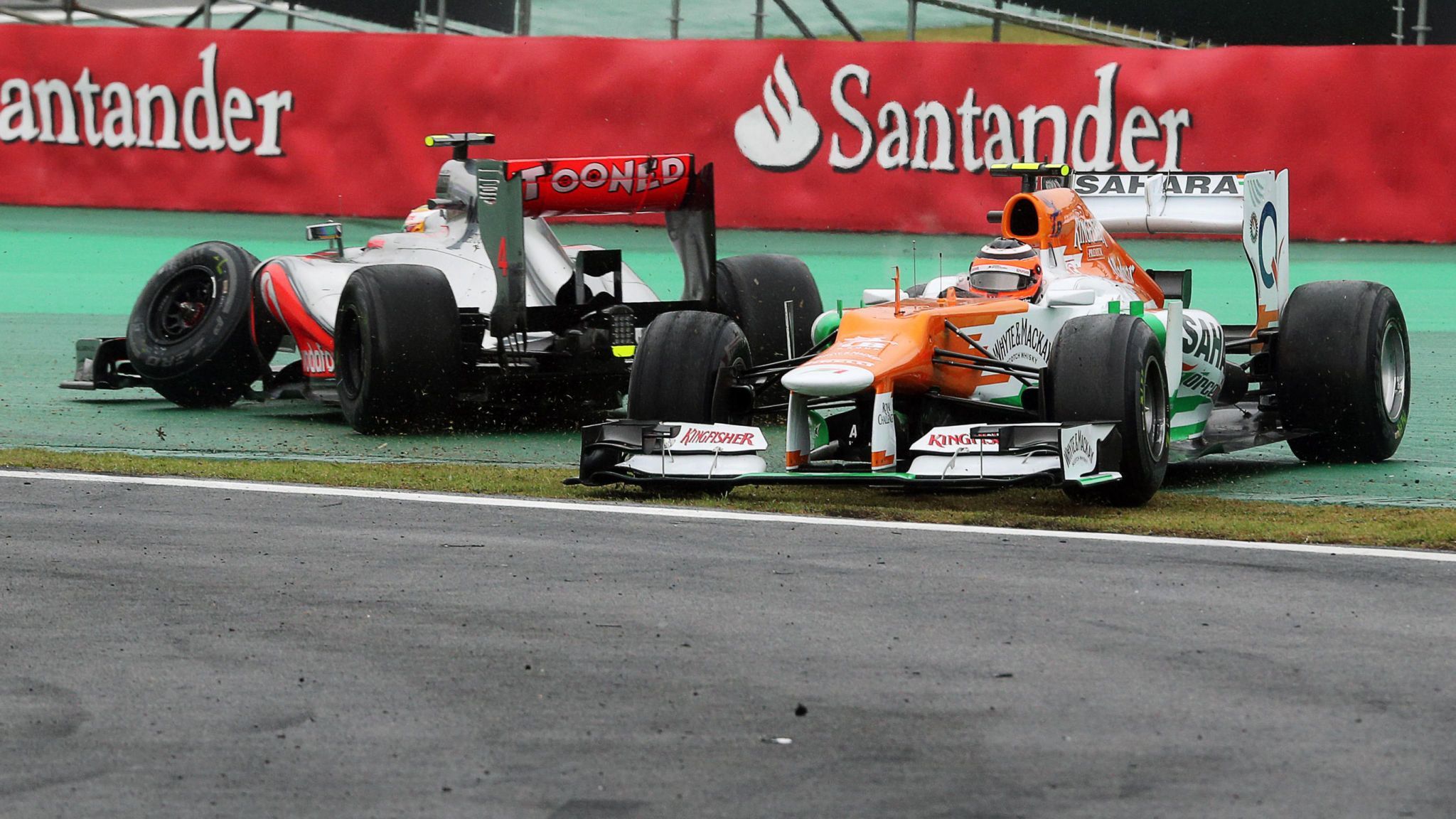
Nico Hülkenberg took him out of the race whilst battling for the lead in Brazil. Romain Grosjean and Pastor Maldonado caused two further retirements. And a fuel irregularity saw him demoted from pole to the back of the grid in Spain – but did give us a shock victory for a certain Venezuelan.
The Ugly
Hamilton has experienced two especially damaging pieces of misfortune that are the difference between him being a seven- and nine-time world champion.
First, in his rookie season, fate conspired to erase a 17-point advantage in the space of two races. The incident that saw him stuck in a Chinese gravel trap boils down to an error; arguably more so at the hands of the team, who left him out driving on tyres which were worn down to the canvas, but an error nonetheless. He was blameless, though, as his title aspirations crumbled in Brazil.
Despite that mishap in China, a young Hamilton still held an advantage of four points over teammate Fernando Alonso and seven points over Kimi Räikkönen. On lap 8, however, he suffered a gearbox problem and watched most of the field overtake him as he crawled up towards Ferradura. After about 30 seconds, he managed to reset his car’s computer and get going again but had fallen to 18th.
His recovery to an eventual seventh was not enough and he had somehow missed the chance to become the first-ever driver to secure the title in his rookie season.
Image credit: Eurosport
Nine years later, he was to be cruelly denied again.
The 2016 season was a tale of incredible consistency by Rosberg and horrendous reliability for Hamilton. Early in the season, two engine failures during qualifying – and being taken out at the first corner by future teammate Bottas – left Hamilton with a deficit to claw back, but by the summer break he had done just that.
However, those failed engines also meant he had to start from the back of the grid at the next race in Belgium. After that, and a hydraulics fault in Singapore, he had lost the lead once again, but was looking good for a crucial win in Malaysia when we heard that fabled radio call of “Oh no, no” as Hamilton’s hopes went up in flames.
From there, Rosberg didn’t put a foot wrong and did all that was required of him to cling on to the title by five points, despite Hamilton’s best efforts to make life as hard as possible for him at the finale.
Image credit: Sky Sports F1
So, How Lucky is He?
There is, of course, the old adage that you make your own luck. Many times in recent years we have seen Hamilton avoiding unnecessary risk and taking as little out of the car as possible, clearly more interested in the long game and focused on the championship. That perspective has come with experience – the younger Hamilton fought tooth and nail for every position and it often got him into trouble.
Hamilton can appear especially lucky because he is in the spotlight and, thus, every break that goes his way is highlighted. Many fans are desperate for any result other than a Hamilton win after such a period of dominance, so when he lucks into a win or escapes a bad result, it can seem as though it’s just another case of ‘lucky old Lewis’.
But then occasions like Monza in 2020 – where Hamilton was unlucky with the timing of a safety car and being erroneously called into the pits lost him a certain win – are somewhat forgotten because Pierre Gasly‘s fairy-tale victory is (rightly) the main focus.
Ironically, it was Hamilton’s year of appalling luck in 2012 that led him to take the leap to Mercedes. So, considering the unparalleled success he has achieved as a result of that move, could it be argued that the bad luck was, in fact, good luck?
Fortune is a fickle mistress and one which is very hard to define.
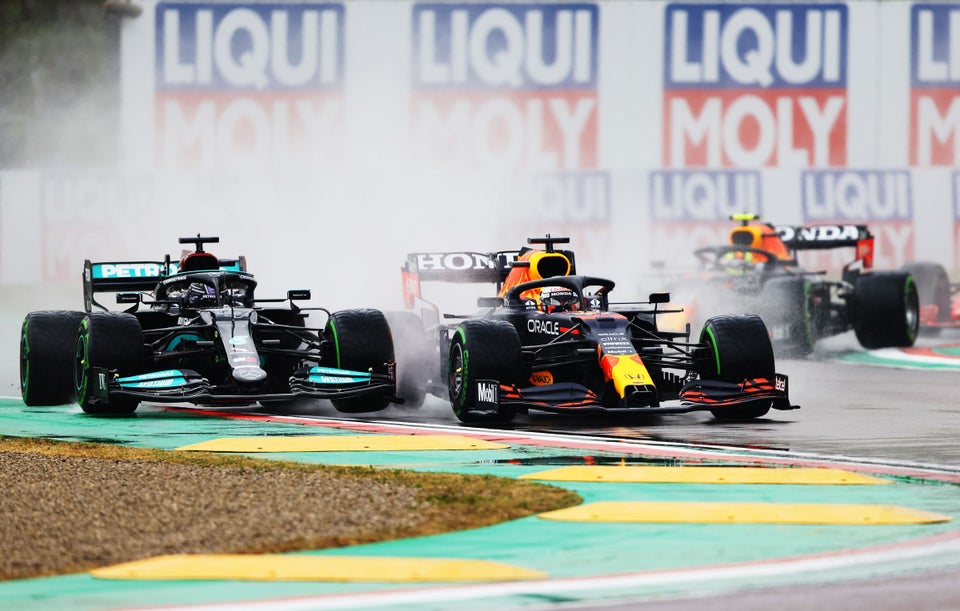
When the lights did go out, it was Verstappen who made a flying start from third on the grid. He had the racing line into the first corner and was able to run his main rival, Lewis Hamilton, out of road and claim the lead. Hamilton bounced over the raised kerbs and damaged his front wing but held onto second. Further round the first lap, Nicholas Latifi spun his Williams and then, upon rejoining, put himself into the wall after leaving Nikita Mazepin nowhere to go on the run down towards the Variante Alta.
That produced a safety car and (you’d expect) a moment of calm… But no, Mick Schumacher overcooked it whilst warming his tyres and pitched himself into the wall at the pit exit. The German rookie was able to recover but would have to drive round minus a front wing for a couple of laps as the pit lane was closed, ironically, to clear the debris from his crash. Sergio Pérez then ran wide into the gravel and earned himself a penalty by passing two cars to reclaim his position under safety car conditions.
Image credit: Formula 1
Verstappen controlled the restart well and the leading pair dropped the rest of the pack. Leclerc – running in an impressive third – was already 15 seconds behind when Verstappen pitted on lap 28. Hamilton responded a lap later but a slow stop ruined any chances of him jumping the Dutchman and he rejoined a few seconds behind.
The World Champion appeared to be more comfortable on the dry tyres, though, and was closing the gap as the two drivers worked their way through the backmarkers. However, on lap 31, Mercedes‘ race imploded.
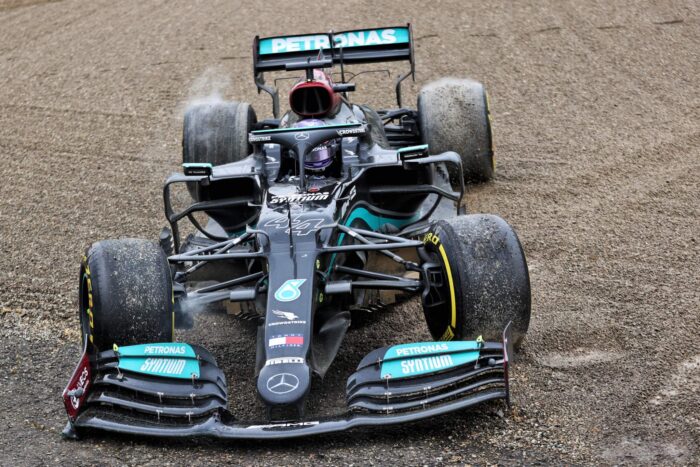
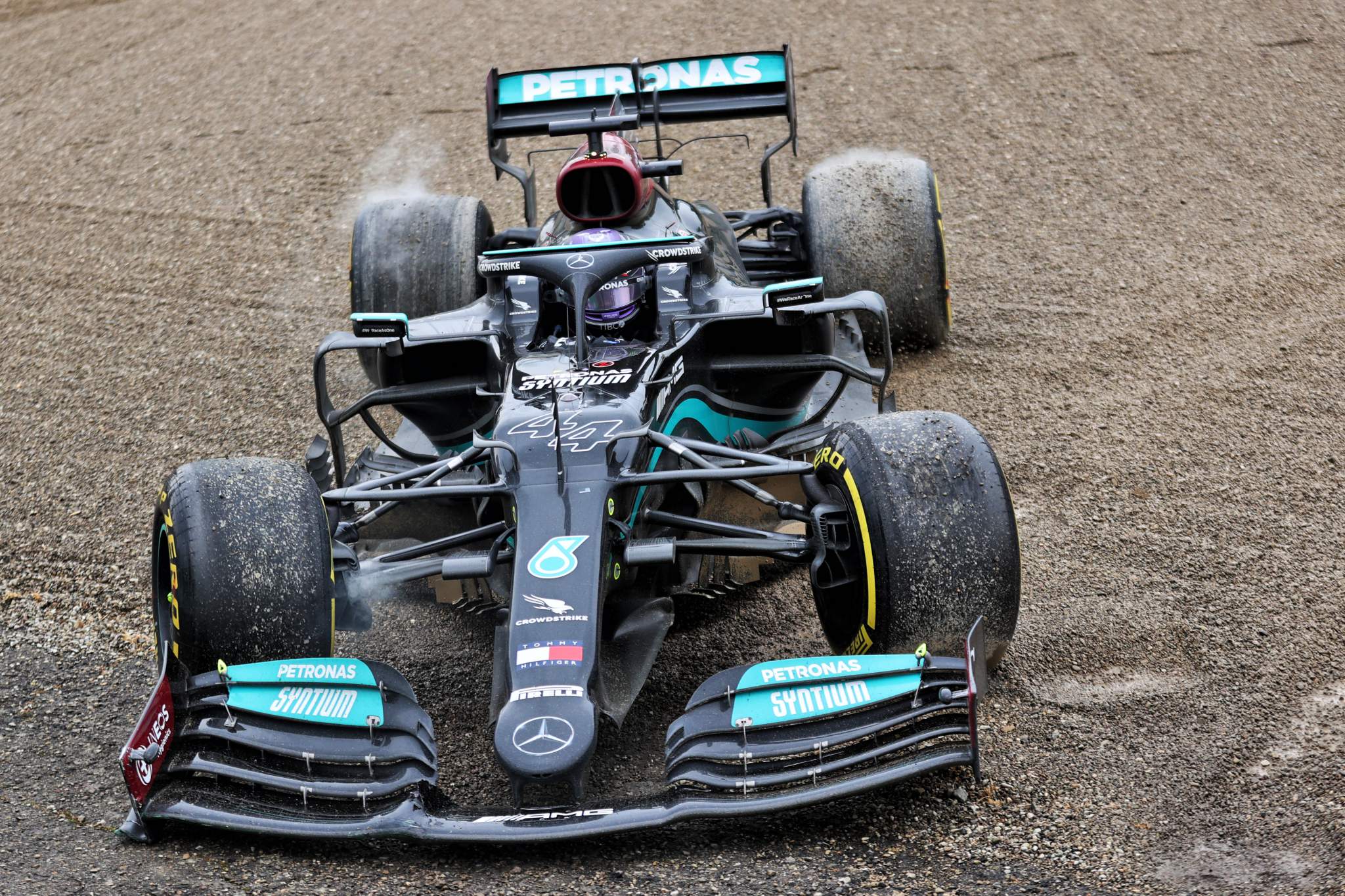
George Russell slowed to allow his fellow countryman past as they approached the Tosa hairpin, but stayed on the racing line. Force to overtake on the wet part of the track, Hamilton slithered off into the gravel and ultimately the wall, as the appalling turning circle of a modern Formula 1 car was laid bare. After some trouble, he engaged reverse gear and excruciatingly back-pedalled over the gravel and onto the track, but with a damaged front wing. And things were about to go from bad to worse in the Mercedes camp.
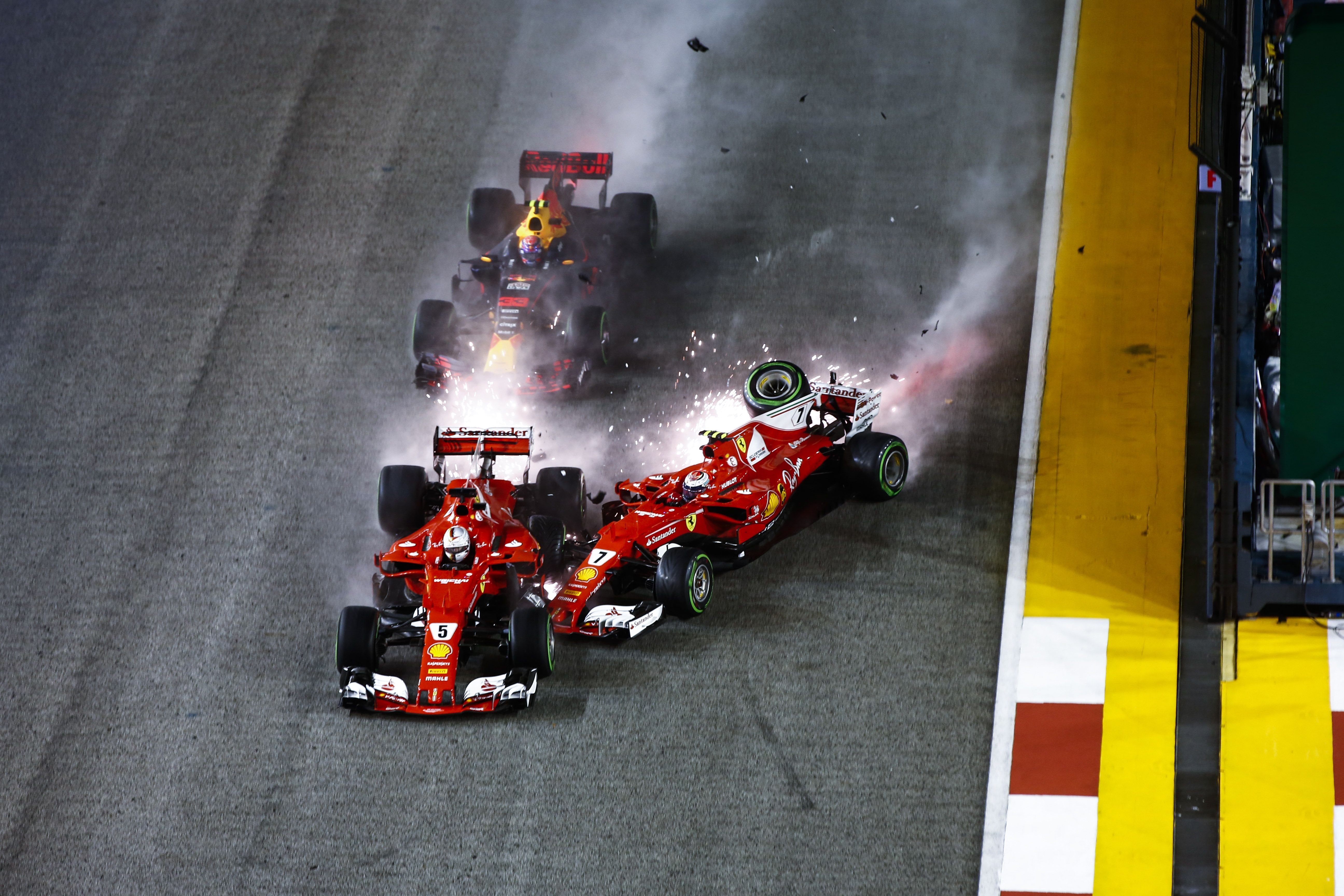
As Hamilton limped back to the pits, the other Mercedes driver and the Mercedes protégé came together in a massive way. After a poor qualifying had seen Bottas start from eighth, his struggles had continued come the race and he unbelievably found himself defending against a Williams. At full speed on the start-finish straight, Russell pulled alongside the Mercedes but put a wheel on the grass and immediately speared across into the Finn, both drivers going straight on and smashing into the barriers. With debris all over the track, the race was red-flagged.
After a brief stoppage, the drivers rejoined the track for a rolling restart. Ironically, the Mercedes disaster had actually aided Hamilton, who found himself in ninth, no longer a lap down, and with a repaired car. Verstappen then got lucky himself as he lost the car whilst backing the pack up for the restart, but was just about able to save the situation and Leclerc politely remained behind.
When he did successfully get the race back underway, the McLaren gamble to fit soft tyres saw Lando Norris pass Leclerc for second and briefly put pressure on the leader. Yuki Tsunoda passed Hamilton into the first corner but immediately spun and a lap later Pérez also found himself pointing the wrong direction in the gravel. A tale of hero to zero for the Mexican who had been the first teammate to outqualify Verstappen since Daniel Ricciardo left the team.
Two drivers may have removed themselves as obstacles, but Hamilton still had a lot of work to do if he was to recover to the podium. But recover he did. Slowly but surely, he got to within a second of each of the cars in front and executed a move into Tamburello. Norris put up an excellent fight on what were now very worn soft tyres, but eventually ceded his position with three laps remaining. He would hold off the chasing Ferraris for third, though, and claimed a very well-earned podium – the second of his career.
Ricciardo took sixth but – after earlier having to move aside for his teammate – admitted he still has a lot of work to do as he tries to acclimatise to his new, papaya machine. Late penalties for Lance Stroll and Kimi Räikkönen saw Pierre Gasly promoted to seventh and Alonso claim his first point since returning to the sport, despite never looking especially comfortable in the car.
Image credit: Getty Images
Out front, it had all been plain sailing for Verstappen since his minor blunder at the restart and he had built up a comfortable 20-second lead. Hamilton snatched the fastest lap late on, which keeps him one point ahead in the drivers’ standings, but the title fight is very much on.
A Damaging Day for Bottas and Russell
Now that the field has closed up so dramatically on the Silver Arrows, when Bottas has one of his off-days in qualifying, it is far more brutally exposed. He was a little under half a second shy of his teammate’s pole time and whilst, in the past, that would often still have seen him on the front row, in Imola it left him in an embarrassing eighth place.
And yet, Sunday was arguably worse. Surprisingly, considering his heritage and love of rallying, driving in the wet does not appear to be a strong suit for the Finn – just look at his performance in Turkey last year… He fell back a further two places at the start and then spent 28 laps stuck behind the Aston Martin of Stroll. That is what put him into a situation where he could be crashed into by an arguably overexcited Russell.
If you are expecting that to reflect well on Russell’s chances of replacing him next year, however, you’d be wrong. Whilst qualifying saw another performance worthy of his ‘Mr. Saturday’ moniker and the incident with Bottas itself could have been excusable, it was his reaction during the aftermath that left a bitter taste in the mouth.
Image credit: Getty Images
First, Russell stormed up to the smoking wreckage that contained Bottas, lambasted him for “trying to kill them both” and gave him a smack on the helmet for good measure. As Bottas emerged visibly winded from his car and was then being examined at the medical centre, Russell was already Tweeting his criticisms and claiming that Bottas would have defended differently if it were another driver.
Whilst his initial, heat-of-the-moment reaction was understandable, he really should have thoroughly examined the footage before going to see the media as it seems pretty clear to most that it was somewhere between a racing incident and Russell’s fault. Mercedes Team Principal Toto Wolff described it as 60:40 in terms of blame and was left fairly unimpressed.
This comes not long after the young Briton crashed behind the safety car whilst also chasing points at Imola last year. There is no denying that he has talent – and he obviously cannot have any blame attributed to him for what happened in Bahrain last year – but, if he is not careful, he could gain himself a reputation for choking when opportunities come his way. And throwing his toys out of the pram in the process.
The Emilia Romagna Grand Prix in 60 Seconds
Answering the Burning Questions
With a very different location to the last race, will Red Bull still have the fastest car? It was hard to say. It looks like Mercedes have certainly at least closed the gap.
Can Max Verstappen make amends for his near miss last time out? Very much so!
Will any of the teams have brought significant upgrades for the first European race after a three-week gap? Ferrari’s new floor appears to have given them a performance boost.
How will the midfield shape up? Can Alpine or Aston Martin improve on their disappointing performances in the desert? A little but the midfield order appeared pretty similar.
Will we see some challenging conditions with cold temperatures and a fair chance of rain? We will!