2019 German GP report | Verstappen wins utterly chaotic race

What a difference a year makes…
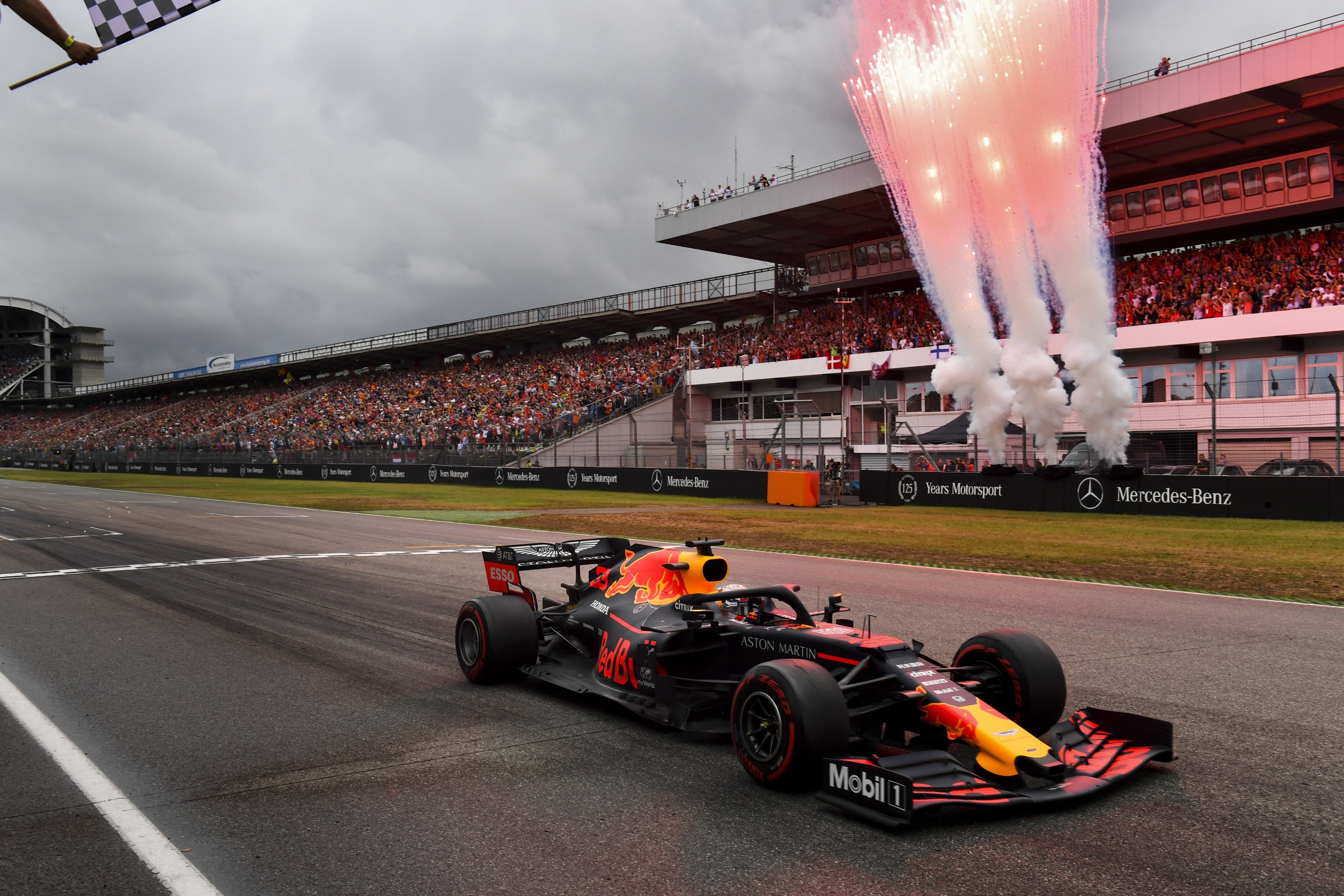
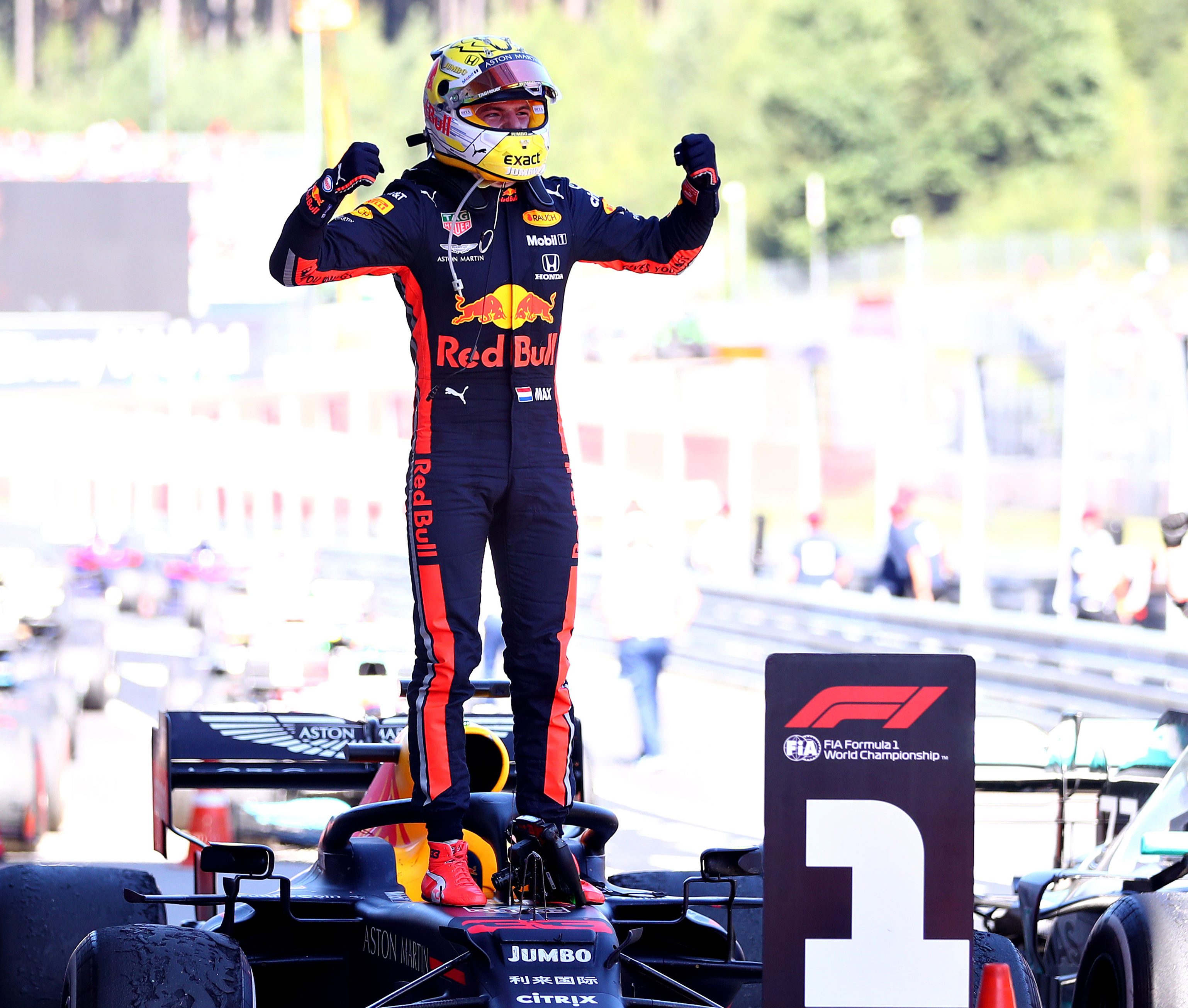
Max Verstappen wins the German Grand Prix.
Image credit: LAT Images

Max Verstappen came home to take a popular victory at the 2019 German Grand Prix after an incredibly eventful race which was dominated by ever-changing weather conditions. The race started under a safety car but, after it came in, we experienced the first post-safety-car standing start. And from there, the madness never really stopped.

Strap yourself in: this might be a long write-up.

Lewis Hamilton led away from pole but Verstappen, alongside him on the front row, suffered severely with wheelspin and dropped back behind Valtteri Bottas and the Alfa Romeo of Kimi Räikkönen. There was normally a car in a run-off area during the next few laps as the drivers struggled with cold tyres and a slippery track. Räikkönen held on to his impressive 3rd place for a couple of laps but was passed by Verstappen just before Sergio Pérez became the first casualty of the race, spinning his very jittery Racing Point and being collected by the wall. That brought out the first safety car of the day and the first wave of pit stop panic. Most cars came in for intermediate tyres and, in the pandemonium, Ferrari were punished with a fine for an unsafe release having sent Charles Leclerc out directly into Romain Grosjean’s path.

The rain stopped and the track began to dry up, but teams suspected more was on the way and were instructing their drivers to try and take care of their tyres. Daniel Ricciardo experienced an all-too-familiar Renault engine blow-up on Lap 15 and Leclerc used the ensuing Virtual Safety Car for a cheap pit stop. Suddenly he was the fastest car on track by two seconds a lap and rapidly closing in on the front three. A bit more rain had begun to fall but Kevin Magnussen and then Sebastian Vettel – who had started the race from the back of the grid – took the gamble of pitting for dry tyres; after initially sliding around, they began to set fastest sectors and those in front decided to follow suit.

Red Bull fitted the mediums to Verstappen, which take longer to heat up than the soft tyres. The Dutchman span – but survived with a neat 360 – and berrated his team over the radio for not giving him the softs. Another Renault engine blow-up – this time for the luckless Lando Norris – brought out another VSC on Lap 28. The race was about to turn on its head.

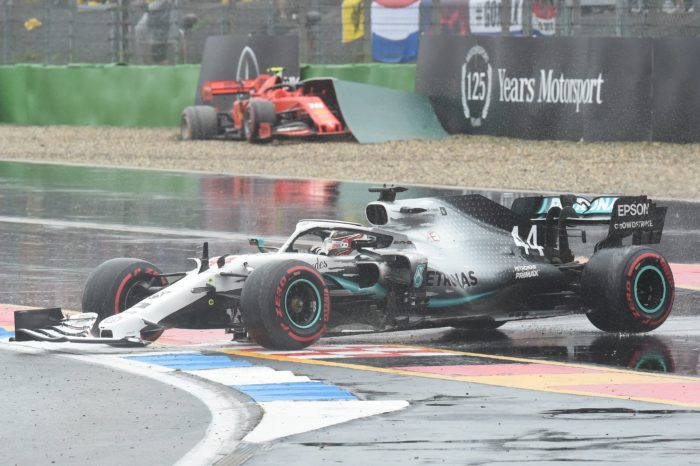
Leclerc benefitted again, pitting for soft tyres and leapfrogging Bottas for 2nd place. Hamilton, who had been controlling the race superbly from the front up to this point, then also pitted for softs. This top two would not last long however as Leclerc ran wide on to the slippery drag strip on the outside of the final corner and aquaplaned into the barriers and out of the race. Moments later, with a safety car already called, Hamilton suffered a near carbon copy of the incident but just about managed to keep the car moving, having bounced off the barriers. He had lost his front wing though and would need to pit.
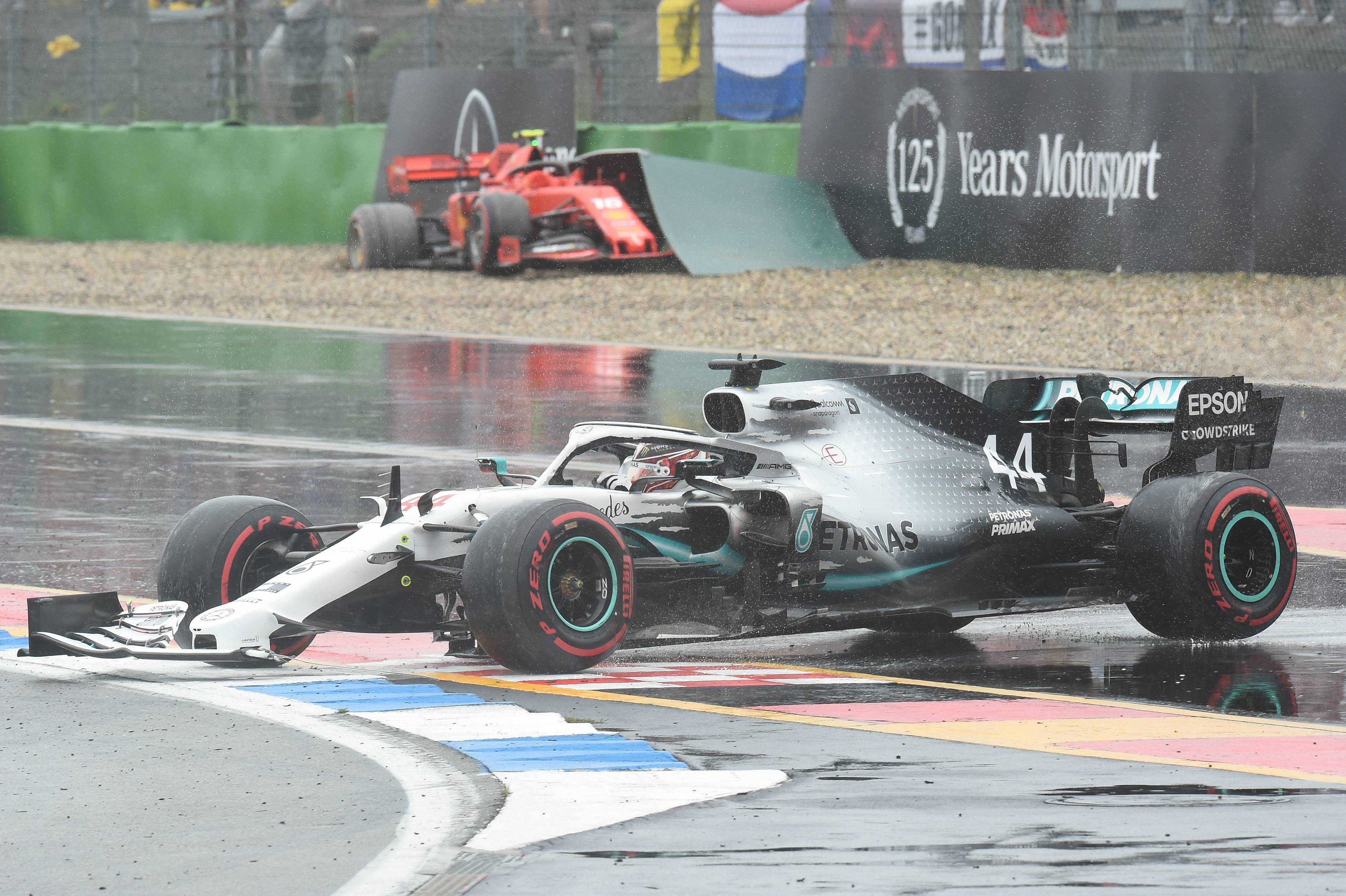
Image credit: AFP

This meant, firstly, he had to go the wrong side of the bollard at pit entry – which would earn him a five second penalty – and, secondly, that his engineers were not ready. Thus ensued a fairly comedic 50-second pit stop with engineers bumping into each other as they tried to replace the nose and changed their mind on which tyres to fit. Hamilton did eventually re-join in 5th; some blushes spared by the gap he had held and the safety car. In the meantime, most had now changed back to inters and the new top 5 was Verstappen, Nico Hülkenberg, Bottas, Alexander Albon, Hamilton.

The Mercedes cars worked their way back into the top 3 within a few laps and then, with that elusive podium in sight, agonisingly, Hülkenberg recreated the Leclerc/Hamilton incidents but with the Leclerc result of bogging down in the gravel and retiring. This brought out yet another safety car. Verstappen and Vettel pitted but the Mercedes did not. Just three laps after the restart, all the drivers came in for dry tyres and Racing Point’s gamble to fit them to Lance Stroll’s car during the safety car period meant that he was suddenly, unbelievably leading the race.

It didn’t take long for Verstappen to retake the lead of the race but we were left with a provisional podium of Verstappen, Stroll and the Toro Rosso of Daniil Kvyat. Then another uncharacteristic error from Hamilton saw him spin at turn 1 on Lap 54, whilst chasing down. The championship-leader narrowly kept it out of the barriers but was forced to pit for new tyres and rejoined in last place. And then, just when Mercedes thought things couldn’t get any worse, Bottas – whilst chasing Stroll for 3rd – recreated Hamilton’s spin from a couple of laps prior but couldn’t keep it out of the barriers. He hit the wall, about as hard as Toto Wolff’s hand hit his desk, and was out of the race too. The safety car made its fifth appearance.

It returned to the pits on Lap 59, leaving a five-lap sprint race to the end. The race still had time for one more retirement as Pierre Gasly drove into the back of Albon whilst battling for 6th; a poorly-timed mistake from the under-fire Frenchman, with excellent performances from both the Toro Rosso drivers that are eyeing up his seat. Verstappen finished the job and sealed an almost flawless victory – his second of the season. Meanwhile Vettel, who had been steadily working his way through the field at various points of the race, sent the home fans wild by passing Stroll and then Kvyat for an unlikely 2nd place.

Behind Verstappen and Vettel, Kvyat took the final place on the podium – Toro Rosso’s second ever podium. Stroll held on to 4th, Sainz – who had at one point spun out and had to put it in reverse – claimed 5th, and Albon 6th. After the race, the two Alfa Romeos – who had finished 7th and 8th on the road – were given 30 second time penalties for driver aid infringements. This promoted the Haas drivers of Romain Grosjean and Kevin Magnussen, who had conspired to crash into each other once again during the final laps, along with Hamilton to 9th and Robert Kubica to 10th. In a season where he has perenially been running in last place, the least likely of points scorers to cap the least likely of races.

And breathe.

Redemption in Red

Image credit: Ferrari

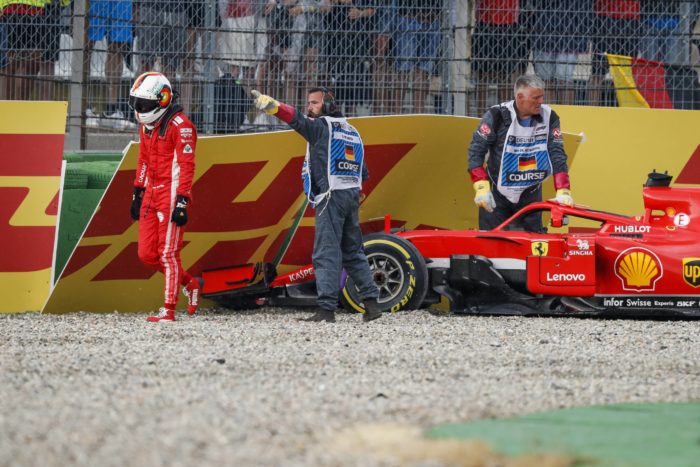
A year on from his title-swinging, gut-wrenching crash in the rain at Hockenheim, Sebastian Vettel produced an inspired fight through the field to finish 2nd, having started the race at the very back of the grid.

It was not only a tale of the difference a year can make for Vettel, but also the difference 24 hours can make. For the second time in three races, he experienced a technical issue in qualifying as his Ferrari developed a turbo problem and he was unable to set a competitive time. Last place on the grid with rain forecast for Sunday always felt like a chance for redemption and that’s exactly how it played out.

Vettel, who was born just half an hour’s drive down the road from Hockenheim, got straight down to business. He was up to 10th by Lap 5; 7th by Lap 8. For the most part of the race he was then generally running in the low end of the top 10 – changing surprisingly little despite the madness going on around him. But he came alive towards the end of the race, using the straight line speed of the Ferrari and some tactical nous to pass cars before and after the final safety car period and collecting a well-deserved 2nd place.

It is a much-needed result for himself and his team. And particularly fitting that it occurred on the effective anniversary of his lowest point, in Germany last year. For a team that has been much-criticised for their strategic calls in recent years, Ferrari barely put a foot wrong in such a manic race and made up numerous positions for both cars with opportunistic pit stops.

Will this prove to be a turning point for team and driver? Time will tell. But it’s certainly a step in the right direction.

A Miserable Anniversary for Mercedes

For a team that had won nine of the first 10 races this season, one would imagine that this was just another weekend. But no, this one really mattered to the dominant force of recent F1 history that is Mercedes-Benz: it was one of their two home Grands Prix; they were celebrating (complete with special livery and fancy dress) the 125th anniversary of motorsport and their 200th Grand Prix; this was the one race they had given access to the Netflix crew of Drive to Survive. So for things to have gone this way will have especially hurt them.

In fairness, there were few truly major errors; it was mostly a domino effect from a few small ones. They dominated the first half of the race. Particularly so Hamilton, despite still suffering from illness, but that ended with the first switch to dry tyres. In hindsight, it was a bad call. Hamilton had a very comfortable lead and was saying that he didn’t think the switch was the right call – it was still raining after all. Could they have waited for a lap or two to see how things were progressing? Yes, but of course that is easy to say now. Either way, the call was made, Hamilton ran wide and then brought about an embarrassing pit stop as he was forced to pit immediately whilst the team had been waiting for Bottas with different tyres. The whole episode made the fancy dress element of their celebrations seem suddenly very clownish.

A few laps later, they were back running 2nd and 3rd but this is where the wheels were really about to fall off – literally in the case of Bottas. Again, in hindsight, they probably should have pitted Hamilton under the safety car and were overly wary of the five-second time penalty dropping him too far back when the drying track was about to make that issue far worse. But the drivers were about to outdo the strategists in terms of their mistakes with synchronised spins at Turn 1.

Hamilton rescued his but Bottas did not and his was far more costly. Hamilton does not present his competitors with an opportunity to claw back that many points in the title race very often. And for it to happen just as the Mercedes hierarchy is about to decide on their driver line-up for 2020 and beyond is particularly unfortunate. You have to wonder if Bottas will mentally recover from this setback.

It seemed Toto Wolff had decided after the race that they would not be making such a song and dance about any celebration in the future: “It shows that you shouldn’t fool around with stuff – you should concentrate on the job, we are not superstitious, but we should focus on the job at hand.”

The German Grand Prix in 90 Seconds (It needed the Extra 30)

Answering the Burning Questions

Will the run of great races continue? Oh yeah. And then some.

Can Bottas can do anything to claw back some of Hamilton’s championship lead? He had the opportunity but fluffed his lines.

Will Leclerc and Verstappen have another epic battle? Not this time. Verstappen battled with Bottas, Leclerc battled with the slippery drag strip.

Can Gasly continue the progress he made at Silverstone? No. He crashed badly during practice and drove into the back of the sister car of Albon.

There are a few updates this weekend. Whose will have the biggest impact? Hard to tell in the rain but judging by earlier in the weekend, Racing Point seemed to have made a big jump.

Could we actually have a wet race?? We could and did. And it was great.
2019 German GP preview

The Burning Questions

Will the run of great races continue?

Can Bottas can do anything to claw back some of Hamilton’s championship lead?

Will Leclerc and Verstappen have another epic battle?

Can Gasly continue the progress he made at Silverstone?

There are a few updates this weekend. Whose will have the biggest impact?

Could we actually have a wet race??

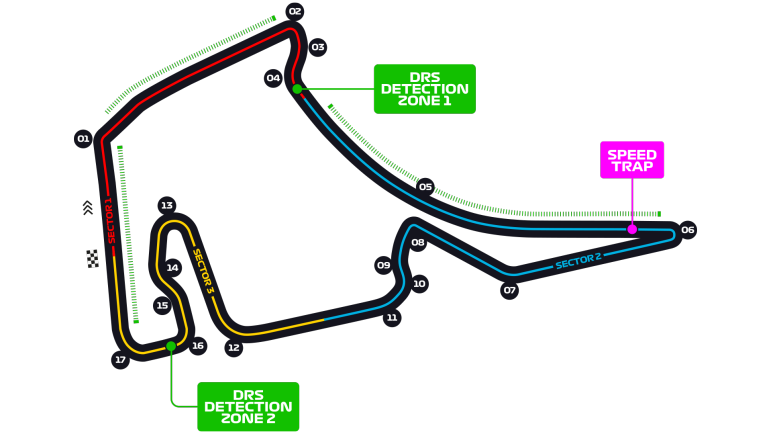
The Track

The Stats

Track Length: 4.574 km

Laps: 67

Race Distance: 306.458 km

First Grand Prix: 1970 (Hockenheimring) | 1951 (German GP)

Race Lap Record: Kimi Räikkönen | McLaren | 2004 | 1:13.780

Outright Lap Record: Sebastian Vettel | Ferrari | 2018 | 1:11.212

Most Driver Wins: Michael Schumacher | 1995, 2002, 2004, 2006

Most Constructor Wins: Ferrari | 1977, 1982, 1983, 1994, 1999, 2000, 2002, 2004, 2006, 2010, 2012

The Photos

The Predictions

Podium

Pole Position

Fastest Lap

Driver of the Day

2019 British GP report | Hamilton wins for record sixth time

History for Hamilton, fun for the fans.
Image credit: Getty Images

With some help from a fortunately timed safety car, Lewis Hamilton took a record-breaking victory at the 2019 British Grand Prix.

Having been pipped to pole position by his teammate Valtteri Bottas on Saturday, Hamilton came out of the blocks quickly and looked thoroughly determined to make amends. After a few laps getting increasingly close to the Finn’s gearbox, Hamilton made his move with a clever cut-back through Brooklands and looked to have the job done. But Bottas had other ideas. With the passionate home crowd still roaring, he pulled back alongside Hamilton and regained the lead into Copse Corner.

That was to prove the championship-leader’s best opportunity as he spent the rest of the first stint generally between 0.5 and 0.8 seconds behind. But when Bottas pitted on lap 16, Hamilton and his team saw an opportunity to mix up their strategy. He stayed out as long as he could, knowing that Bottas would need to stop again, with the aim of a one-stop race and the hope for a safety car. The latter duly obliged. By that point however, Hamilton had already put himself into a commanding position.

Even without a safety car, he was about to pit and rejoin a couple of seconds behind his teammate. Hamilton could then have sat behind Bottas, waiting for him to pit again and he showed just how much extra pace he had when he set the fastest lap on the last lap of the race, despite being on 30-lap-old hard tyres.

Bottas was actually fortunate to retain his 2nd place as those behind him had also pitted under the safety car and he was the only driver in the top six that needed to pit again. As it was, some antics from those following made his job far easier.

The Action Behind the Mercedes

Charles Leclerc and Max Verstappen picked up where they left off in Austria and this time the young Ferrari driver was going to make sure he gave as good as he got. He defended magnificently – at times towards the boundaries of acceptability, but always within them – lap after lap, in a battle that will likely be remembered for a long time to come and continues what is shaping into a fantastic rivalry. However, for all his excellent work, the Red Bull team produced a quicker pit stop which edged Verstappen out in front. Leclerc was not done though and immediately seized on a mistake by the Dutchman to regain his position. They then continued their fight until the safety car, where a delayed stop for Lelerc left him down in 6th.
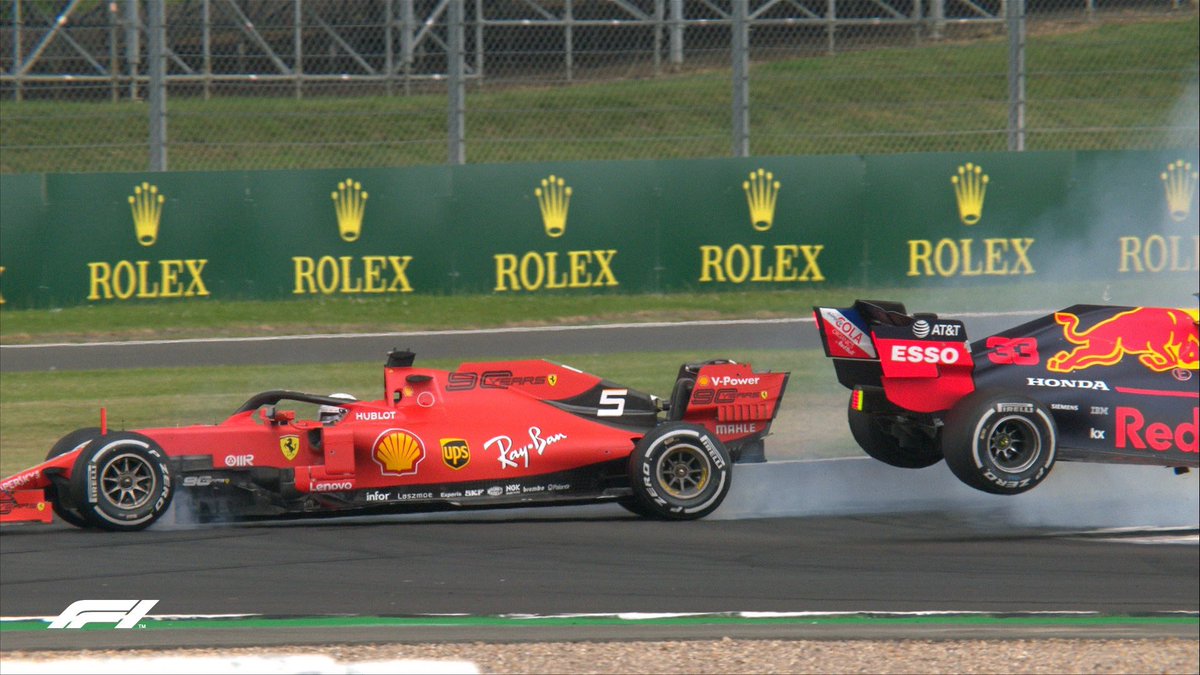
Sebastian Vettel benefitted the most from the safety car and found himself up in 3rd on a weekend where he had been consistently off the pace. Verstappen, having been let past his team mate Pierre Gasly, began to close the gap on Vettel and on Lap 37 he made a move around the outside of Stowe. He was ahead but had ran slightly wide which allowed the German to close back up as they approached the chicane at the end of Vale. Vettel aimed for a small gap that was barely there and, once Verstappen had fully closed it off, was over-committed and had nowhere to go but into the back of the Red Bull. In desperation, he locked up and slammed into Verstappen’s gearbox, sending him flying sideways over the chicane.

Sebastian Vettel and Max Verstappen collide at the British Grand Prix.
Image credit: Formula 1

Verstappen impressively kept the car moving through the gravel and would recover to 5th, whilst Vettel had damaged his Ferrari more significantly and, once a ten-second penalty had been added on, would finish dead last.

It is another high profile mistake from the four-time world champion and will increase the pressure on him even further as we approach the German Grand Prix – the scene of his infamous crash last year that caused a swing in the championship he would never recover from and marked the beginning of this series of mistakes that has now run the length of an entire season. His young teammate has seemingly rectified his qualifying issues – having said he had changed his approach after the Canadian Grand Prix – and is now looking thoroughly the stronger Ferrari driver. Indeed, despite the issues with strategy and slow pit stops that were out of his control, he recovered to finish 3rd after the drama had unfolded ahead of him, and described it as “the race I enjoyed most in my F1 career”.

More Drama Throughout the Field

The action was not limited to the front six cars. Lando Norris continued his excellent form to run as best of the rest early on in the race, having passed the Renault of Daniel Ricciardo and then held him off impressively. However, it was his teammate, Carlos Sainz, who was the biggest benefactor of the safety car in the midfield, with it promoting him to 7th place, having started 13th. The Spaniard then did well to hold off an eager-to-divebomb Ricciardo for the final few laps and inherited 6th after the Vettel-Verstappen incident. The safety car sadly had the opposite affect on Norris who was left in the same situation as Bottas – but without a Mercedes to recover the lost time of a second stop – and ended 11th.

Haas had another weekend to forget. Amid ongoing dramas with their joke of a title sponsor, Rich Energy – seriously, they formulate tweets that read like a Donald Trump parody account – their two drivers crashed into each other on the first lap and were then soon forced to retire. What looked a promising season, when they qualified in 6th and 7th at the season-opener, has turned into a nightmare. They are now on average the second slowest car, particularly on Sundays as they continue to struggle with the tyres, and Romain Grosjean is surely wearing his team’s patience paper-thin with his current run of errors – even managing to spin into the wall at the pit exit during Practice 1.

A Few Extra Shout-Outs

The sheer amount of action in the race has left little room for much more analysis, so just a few quick words for those who deserve them.

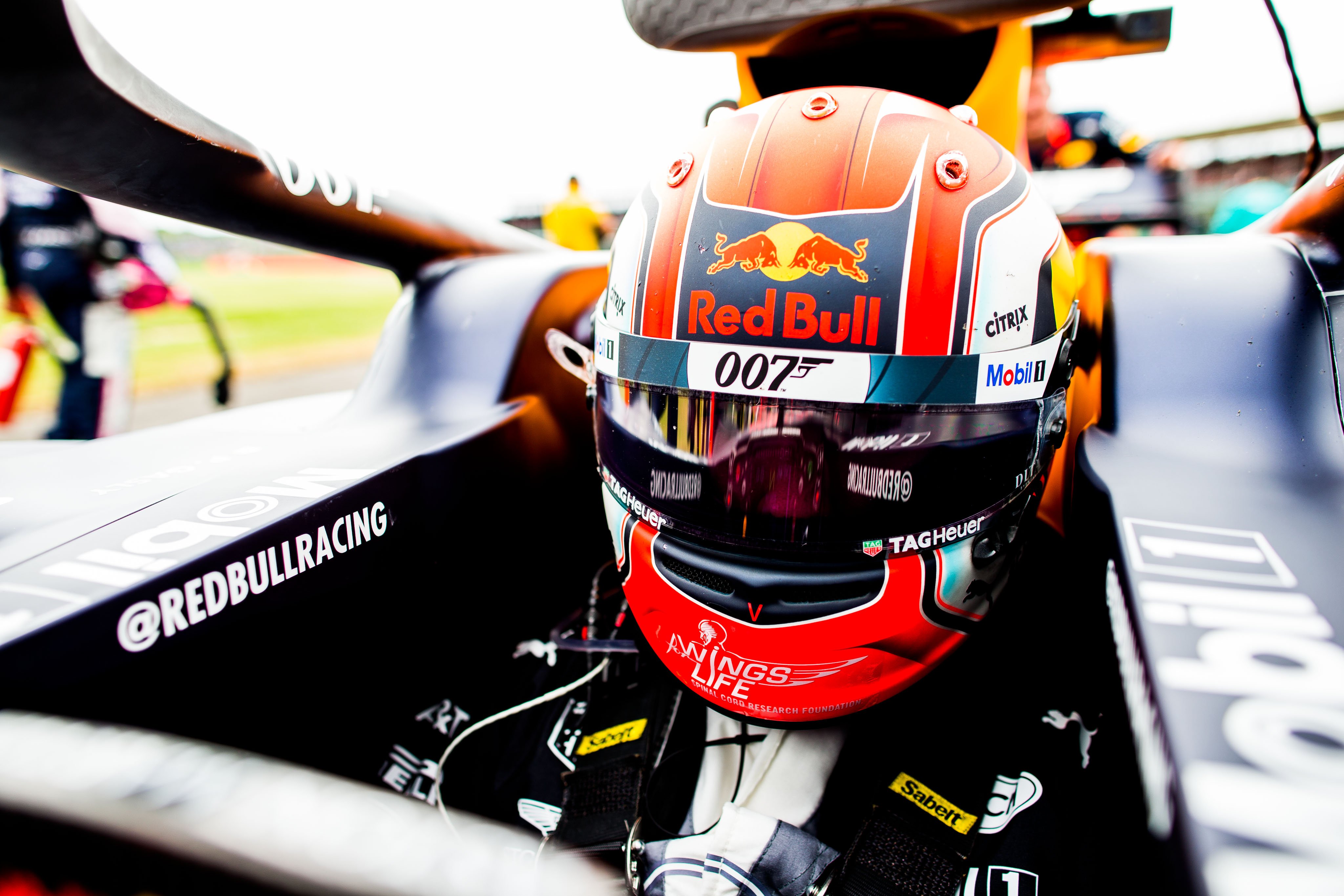
Pierre Gasly had a long-overdue but nonetheless much-improved weekend. With the aim of helping him find some form, the Red Bull bosses decided he would be given Verstappen’s setup, with just the ability to tweak a few aspects to his liking. It seems to have worked wonders as he was the faster Red Bull through the practice sessions, came much closer to matching his teammate in qualifying and then finished a season-best 4th, having been in amongst the action of the top 6 throughout the race. He now needs to keep this up to reduce the rumours around his seat as silly season heats up.

Image credit: Red Bull Racing

Daniil Kvyat, having been somewhat put in his place on Saturday by teammate Alexander Albon, slowly but surely made his way up from 17th on the grid to finish an impressive 8th. Albon though was unfortunate on Sunday and further enhanced his reputation through the weekend on a track where he took the victory in F2 last year.

Speaking of last year’s F2, the 2018 champion, George Russell, continued his clean sweep over Robert Kubica on Saturday and then converted that to a best-ever finishing position of 14th in the race. Williams are slowly closing the gap on the midfield and it is Russell who is generally passing any cars that drop near him.

Although Hamilton’s 26 points were the only ones gained by British drivers at the British Grand Prix, Norris, Russell and Albon are all showing that British motorsport – or Thai-British motorsport in Albon’s case – has a very bright future.

Answering the Burning Questions

Can Red Bull and/or Ferrari take momentum from their performance in Austria and challenge Mercedes again? Ferrari looked closer earlier on but come race day it was Red Bull who may have challenged, had Verstappen been able to pass Leclerc. Mercedes were most likely in a class of one again though.

Will there be another controversial stewarding decision to make? The Vettel penalty was pretty much a slam dunk and the fact nothing between Leclerc and Verstappen was even investigated is pleasingly consistent.

Will McLaren continue to cement their place at the front of the midfield? Yes. Norris was unfortunate whilst Sainz was fortunate. Renault were certainly closer but it’s McLaren who came out with the most points.

Is Gasly capable of a decent result that would alleviate at least some pressure? Yes!

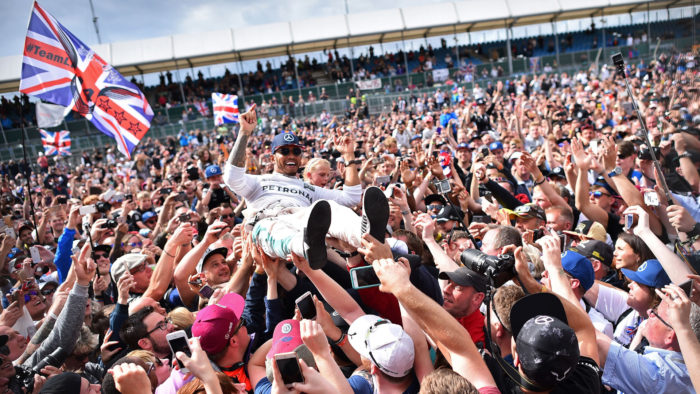
Can Hamilton make amends for last year’s British GP disappointment and send the home crowd wild? And if so, will he crowdsurf again? Yes and yes.

The British Grand Prix in 60 Seconds

2019 British GP preview

The Burning Questions

Can Red Bull and/or Ferrari take momentum from their performance in Austria and challenge Mercedes again?

Will there be another controversial stewarding decision to make?

Will McLaren continue to cement their place at the front of the midfield?

Is Gasly capable of a decent result that would alleviate at least some pressure?

Can Hamilton make amends for last year’s British GP disappointment and send the home crowd wild? And if so, will he crowdsurf again?

The Track

The Stats

Track Length: 5.891 km

Laps: 52

Race Distance: 306.198 km

First Grand Prix: 1950

Race Lap Record: Lewis Hamilton | Mercedes | 2017 | 1:30.621

Outright Lap Record: Lewis Hamilton | Mercedes | 2018 | 1:25.892

Most Driver Wins: Alain Prost/Lewis Hamilton | 1983, 1985, 1989, 1990, 1993/2008, 2014, 2015, 2016, 2017

Most Constructor Wins: Ferrari/McLaren | 1951, 1954, 1956, 1958, 1990, 1998, 2002, 2003, 2004, 2007, 2011, 2018/1973, 1975, 1977, 1981, 1985, 1988, 1989, 1999, 2000, 2001, 2005, 2008

The Photos

The Predictions

Podium

Pole Position

Fastest Lap

Driver of the Day

2019 Austrian GP report | Verstappen takes dramatic victory

An end to the Mercedes domination…and what a way to end it.
Max Verstappen wins the 2019 Austrian Grand Prix.
Image credit: Getty Images

Many criticised the sport in the wake of an uneventful race in France but, just seven days later, Formula 1 reminded the world of the drama it can produce with an action-packed 2019 Austrian Grand Prix, a last-gasp pass for the win and obviously some controversy to boot.

The youngest ever front row promised excitement into the first corner but, after Max Verstappen got away horribly, Charles Leclerc was left unchallenged and all the drama unfolded behind him with Lando Norris even momentarily passing Lewis Hamilton for 3rd. The following laps produced some good racing as Hamilton, Verstappen and Sebastian Vettel worked their way past the slower cars, before the usual top five started to break away from the pack and the race somewhat settled down.

Leclerc appeared comfortable at the front but was forced to pit slightly early to cover off Bottas – something that would prove decisive later on. Hamilton and Verstappen aimed to go long in their first stint but the Briton put paid to his chances by clipping one of the many unforgiving kerbs around the Spielberg track and damaging his front wing. The younger man in the Red Bull made no such mistake however and re-emerged in 4th with tyres 10 laps fresher than those ahead of him.

Verstappen then set about chasing Vettel, passing him with about 20 laps remaining and suddenly the masses of orange in the crowd realised there was the chance of an unlikely victory. Bottas proved easy to dispatch – the Mercedes had been short of power throughout as they struggled with cooling – and he was right on Leclerc’s tail with four laps to go. On Lap 68, Verstappen dived down the inside into Turn 3, allowing Leclerc a Ferrari’s width on the outside and they drag raced along the back straight with Leclerc coming out on top. One lap later, Verstappen made the same move but this time did not leave the room, taking the lead and then the victory – the first for a Honda engine since Jenson Button in 2006.

“Hard Racing” or “Not the Way You Overtake

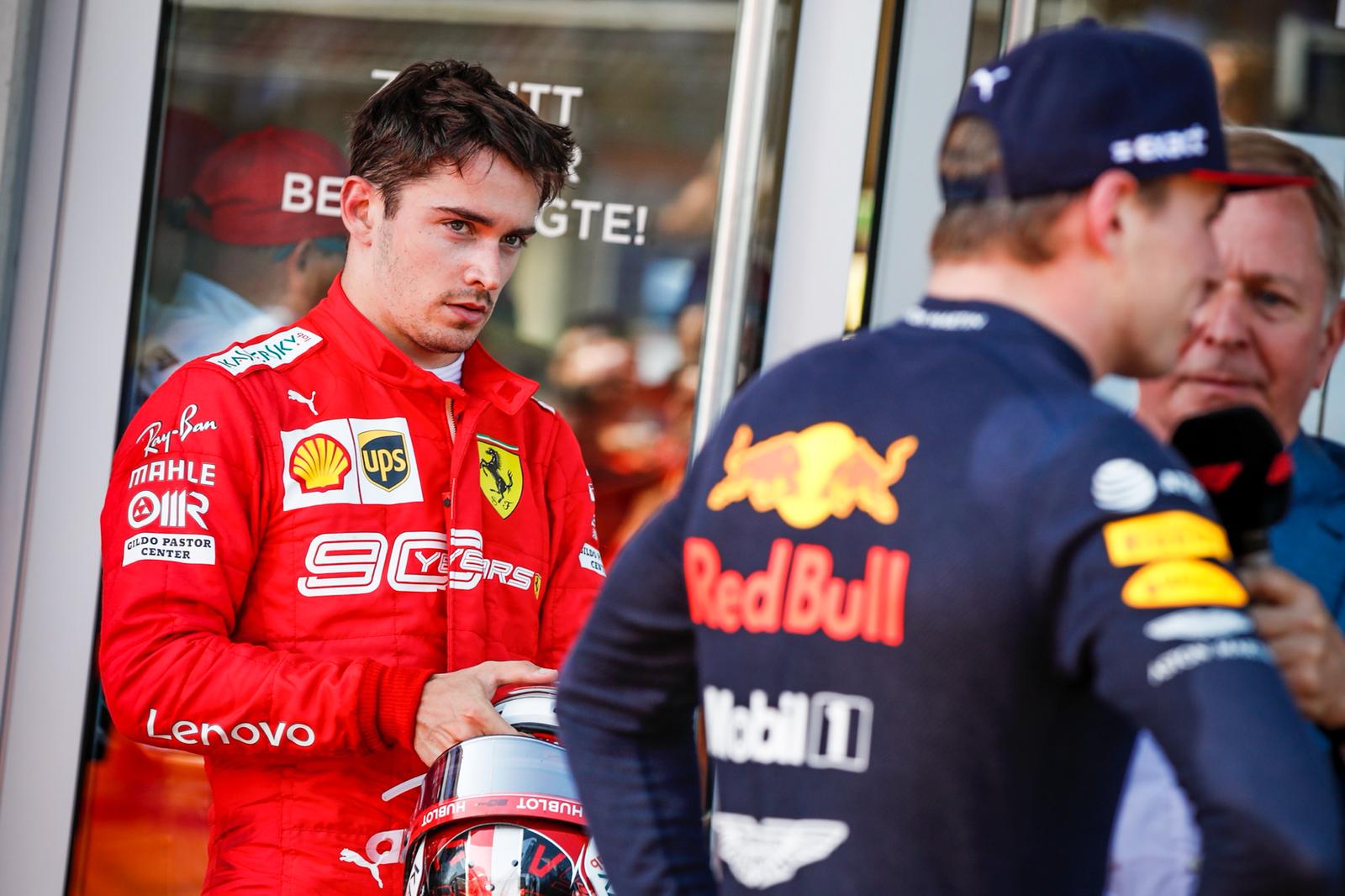
As you would expect, Verstappen and Leclerc had very different views on the overtake. They both immediately came on the radio; Verstappen claiming Leclerc had turned in on him and Leclerc asking “what the hell is that?”

Image credit: DPPI

The stewards decided to investigate, with the result only being confirmed as a Verstappen victory three hours after he had taken the chequered flag. And so the conversation of what the rules should be and how they should be enforced reared its ugly head once more.

It is very easy to see why Ferrari and their fans could feel aggrieved. There have been two fairly similar incidents in which they have somehow lost out on both occasions, despite being on opposite sides of the two. Vettel was penalised for not leaving Hamilton a car’s width in Canada and the obvious differences between there and here are that Verstappen was fully in control of his vehicle and that Leclerc was fully alongside his rival. Both of which you could reasonably expect to further cement a penalty.

Personally, whilst I’m glad the result stood – the sport didn’t need another overturned win fiasco and Leclerc deserves a better maiden victory than being told three hours after the fact – I can’t help feeling that Formula 1 has contradicted itself. After the Vettel penalty, there was a lot of talk of ‘the letter of the law’ and so on, but now it’s about ‘the way to interpret the rules’. I refer back to my post after the Canadian Grand Prix and my opinion that the stewards should be a consistent panel of respected figures who are accountable and explain exactly how and why they have come to their decisions. There is no point having thousands of regulations if they are not airtight and leave so many situations that are open to interpretation – that has been the case in the three most recent races and they all appear to have been dealt with differently. It is obviously far easier said than done but a reasonable number of more iron-clad rules and a stable stewarding presence is surely the answer.

Whatever your opinion on the incident though, it could well turn out to be an infamous moment that defines the beginning of an intense rivalry. One that could even dominate the sport for the next decade.

McLaren Prosper Whilst Mercedes Faulter

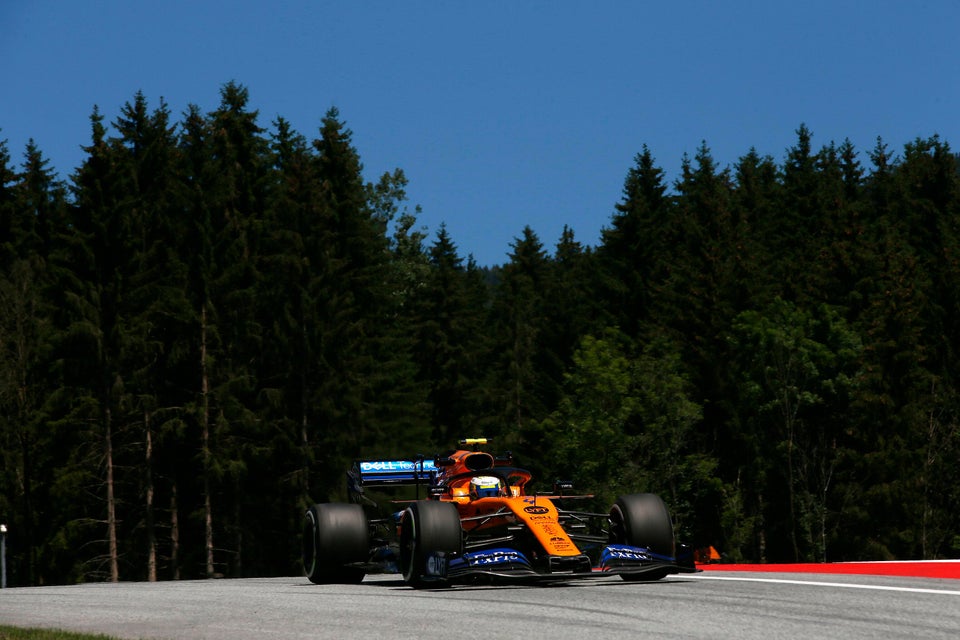
McLaren continued their good run of form and excellent progress this season with 6th and 8th place finishes. Both impressive drives in very different circumstances. Norris showed his star potential again by qualifying 5th and then mixing it with the front-runners for a few laps before settling into a very solid 6th and holding off the other Red Bull of Pierre Gasly – yet another disappointing performance from the under-pressure Frenchman. Meanwhile, Carlos Sainz fought admirably from the back of the grid to end up 8th.

Lando Norris at the 2019 Austrian Grand Prix.
Image credit: DPA

To have had two great races back-to-back on such different tracks as Paul Ricard and the Red Bull Ring shows how much progress McLaren have made and, for all his undeniable talent, there is a distinct freshness to the team since Fernando Alonso’s departure. They are enjoying the challenge of their revival without the pressure that Alonso puts on a team. There are no politics; it’s just racing. And they continue to punch above their weight, or at least their weight of recent years.

Mercedes, however, finally had an off-week.

It’s unlikely to prove a huge turning point, as the unique combination of high temperatures and altitute, twinned with a very short track, meant they had cooling issues throughout the weekend. Their engines were not at full power and they were even having to do a considerable amount of ‘lift and coast’ during the race, where the drivers lift off the throttle up to 400m before the corner.

But certainly it bodes well for some more competitive races whilst temperatures are likely to be higher in the summer.

The Austrian Grand Prix in 60 Seconds

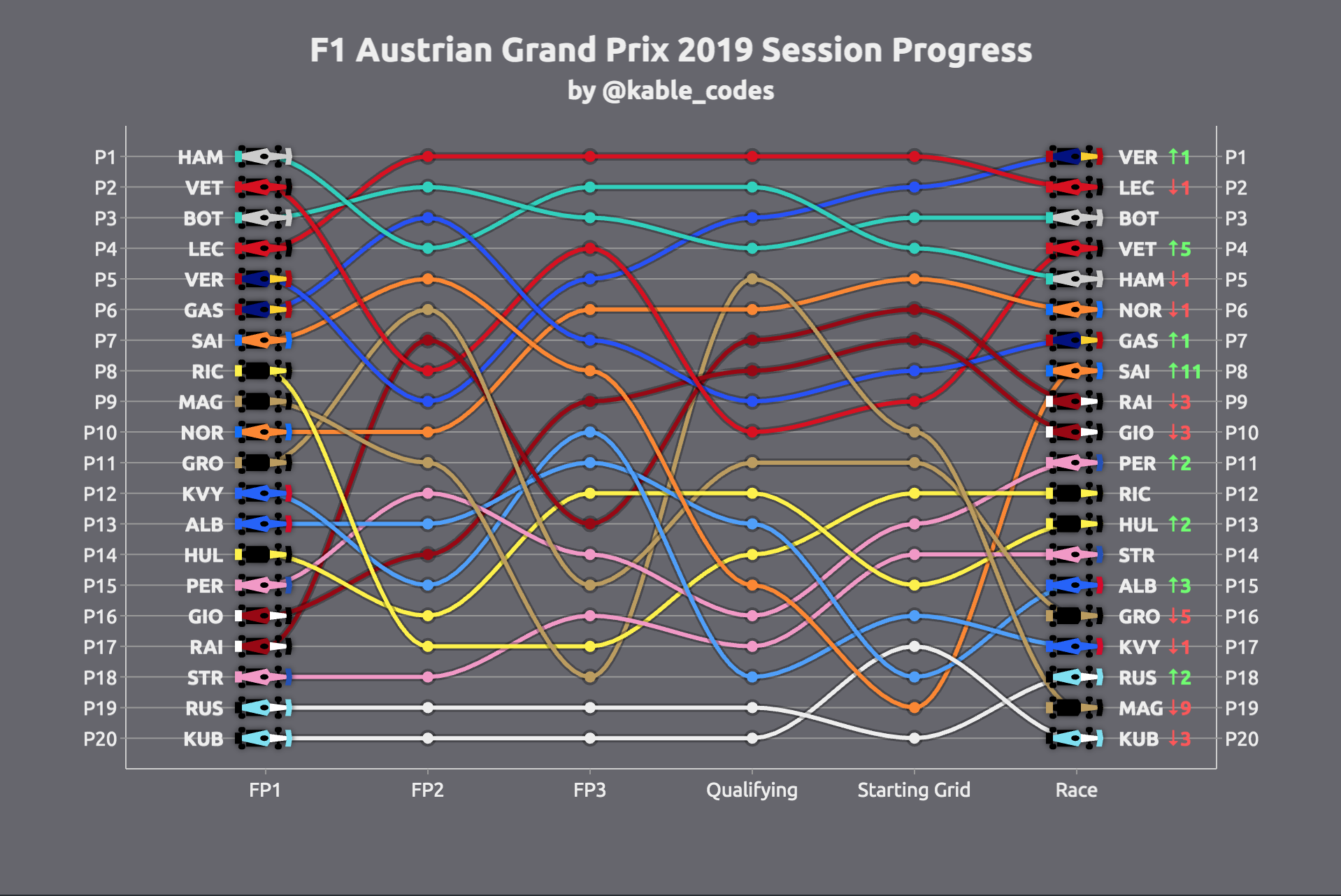
Session Progression